Research Article · Volume 10, Issue 12, 10 November 2022 · Open Access
Effect of Enzymes Supplementation to Low Energy and Protein Corn Soybean Meal Diets on Broiler Performance and Quality of Carcass and Meat
· · · ·
Affiliations & Notes ⌄
1Department of Poultry Nutrition, Animal Production Research Institute, Agriculture Research Center, Nadi El-Said Street, Dokki, Giza, Egypt. *Correspondence | Hemat A Abdel Magied, Department of Poultry Nutrition, Animal Production Research Institute, Agriculture Research Center, Nadi El-Said Street, Dokki, Giza, Egypt
The effect of supplemented pectinase (PE) and protease (CIBENZA® DP100) (P) individually or mixture (PEP) and either on low crude protein (CP) and low metabolizable energy (ME) were studied on growth performance, carcass characteristics and meat quality of Arbor Acres broiler chickens. Two experiments were conducted in current study; experiments 1 (EXP1) evaluated the effects of PE and/or P supplementation to standard corn-soybean broiler diet (STD). while experiment 2 (EXP2) examined the PEP supplemented to different levels of low CP (low 10 or 15 %) and low ME diets (lower 100 or 150 kcal/kg) than control (L10%-100, L10%-150, L15%-100, L15%-150). The obtained results were: the EXP1 showed that significant improvement in feed conversion ratio (FCR) for chicken in P treatment by 8.38 and 5.75 % in compared to control and PE, respectively. Also, chicken in PEP treatment significantly (P<0.05) increased dressing % by 7.89% and drum stick by 9.27% compared to control. All supplementation had significant improvement in total protein (TP) level in broiler meat. PE and PEP enhance meat oxidative by decreased malondialdehyde (MDA) by 28.15 and 19.87 %, respectively and improve meat quality by decreased low density lipoprotein (LDL) by 7.69 and 4.73 %, respectively. The EXP2 observed chicks fed on low ME and low CP diet significantly decreased total body weight gain (BWG) with increased in total feed intake and FCR. Chicken treated by PEP had significant increased on final body weight, BWG and improved FCR for control and L10%-100. Chicks fed on PEP+L10%-100 and PEP+STD significantly gained the highest dressing followed by L10%-100. These results in general show positive effect of EXP1 witch improved FCR by supplemented P however PEP supplementation increased dressing % and drum stick %. Both supplementation enhanced meat TP and decreased meat MDA. The EXP2 witch used low CP and low ME with PEP supplementation enhance especially for L10%-100 and control. The chemical quality of produced meat as the concentrations of MDA and LDL were decreased and increased meat TP.
The high costs of ingredients for yellow corn and soybean meal, which are the traditional feed mainly used in poultry rations, is one of the toughest challenges facing the poultry industry in developing countries ; ; . So, the use of exogenous enzymes has become an excellent alternative and one of the most important mechanisms for feeding broilers to improve the performance of foods provided to animals. Also, it increase the efficiency of rations, improve feed digestion, reduces the effects of anti-nutritional and enhances productivity indicators .
The ability to reduce energy in adding feed enzymes has been investigated by many research , 2016 b; 2018). Also, protein is a very important and expensive component in broiler diets . Reducing dietary crude protein without deleterious effects on broiler performance is a great challenge for broiler nutritionists . Using these external enzymes individually or combined to feed the broiler, studies have stated that they have a role in improving the utilization of nutrient, and recording more consistent performance of the animal. , 2016 a and b;;. The effect of protease enzymes supplementation has been examined by many investigators on protein and amino acid utilization of broilers and showed improved digestion and its availability and 2014). The additional increase in energy utilization by some studies were recorded by adding protease to the broiler diets . Also, Selim et al. (2016a) using proteases with low protein in broilers diets recorded economical and environmental benefits. Which cleared in growth improvement, made broiler meat healthier (MDA decreased by 36%), and the cost of feeding/kilogram of weight of body decreased by 3.94 %.
Cowan et al. (1999) found that supplemented pectinase to broiler diet based on sorghum improved feed conversion ratio and final body weight. Applying low ME100 + PE in diets may help producers to obtain perfect weight for marketing with good carcass and meat quality .
Also, using mixture supplementation of enzymes xylanase and protease (XP) in low energy 100 kcal and low protein (10%) diet for broiler were studied by Allouche et al. (2015). They showed that enhanced in growth performance, carcass traits, meat quality and the highest saving of feeding cost/kg of body weight (9.1%) for treated groups in compared to control one. Selim et al. (2019) recorded that reducing in the cost of feeding and enhanced growth performance, carcass traits and meat quality by supplemented XP combination to low protein (10%) and low energy (100 kcal) broilers diet.
The aim of this study was to investigate the effect of enzymes proteases and pectinase or their combination supplementation to standard or low diet different in energy and protein levels on the production performance, carcass characteristics, and meat quality of broilers.
MATERIALS AND METHODS
Experimental design and diets
The experimental work was conducted during the period in Poultry Research Unit, Fayoum Research Station, Fayoum Governor, Egypt. This Research is belong to Animal Production Research Institute (APRI), Agriculture Research Center (ARC). Two experiments were carried out according to the guidelines of the ethical committee of Animal Production Research Institute.
Experiment 1: One hundred and sixty one, days old Arbor Acres unsexed broiler chicks were randomly allocated (one way design) in four treatments, four replicates per treatment and ten birds/replicate. The diets were supplementation of two enzymes pectinase (PE) 1000U/kg diet, protease (CIBENZA® DP100) P 300000 U/kg diet and their mixture PEP (pectinase1000U/kg diet+protease300 000 U/kg diet). Three standard experimental diets (Table 1) were used in the three stages of this study (1-10 d), growing (11-24 d) and finishing (25-40 d) periods as described in Table 2. The diet contained 3000 kcal/kg of metabolizable energy (ME) and 23% dietary crude protein (CP), 3100 kcal/kg of ME and 21% CP and 3200 kcal of ME/kg and 19% CP, STD contained whole strain requirement from the rest of macro and micro nutrients during starting, growing and finishing periods, respectively.
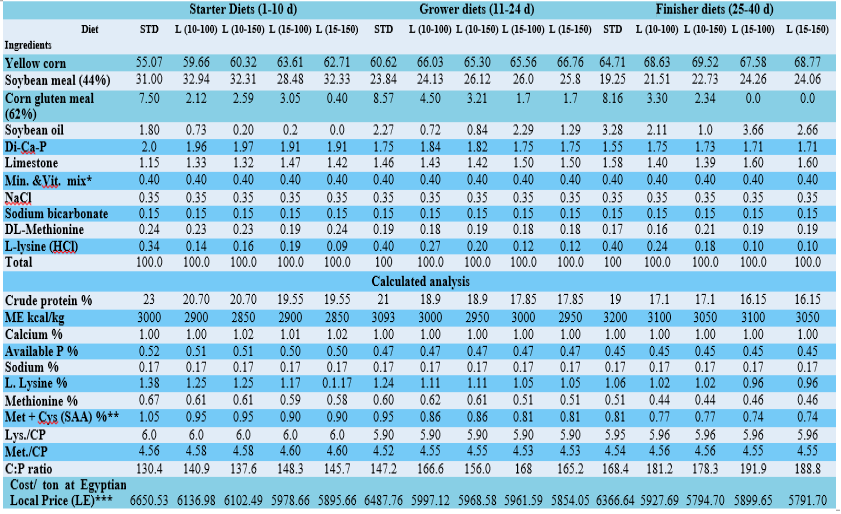
Experiment 2: Four hundred 1-d old unsexed Arbor Acres broiler chicks were divided into ten treatments (2x5 factorial design) with four replicates per treatment (10 birds per replicate). Two levels of PEP without and with (0 and PE 1000U /kg diet + P 300000 U/kg diet, respectively), and five levels of CP and ME were examined. A corn soybean meal-based control diet was formulated and used as a control diet strain recommendation (STD); four experimental diets were formulated to reduce energy and crude protein contents, 10% CP+100 kcal/kg ME lower than STD (L10-100); 10% CP+150 kcal/kg ME lower than STD (L10-150); 15% CP+100 kcal/kg ME lower than STD (L15-100); 15% CP+150 kcal/kg ME lower than STD (L15-150). Both of (L10-100); (L10-150); (L15-100) and (L15-150) diets were formulated to contain the same total lysine/CP and total SAA (methionine+cystine)/CP percentages of STD of certain feeding phase. Composition and calculated analysis of experimental diets are shown in Table 1.
The two experiments described in this study generally followed the same protocols. Birds were fed ad libitum during feeding phases which were starter (1-10 d of age), grower (11-24 d of age) and finisher (25-40 d of age). All chicks were housed on wire battery cages and received the same managerial conditions and veterinary program during the
Table 1: Composition and calculated values of experimental diets.
* Vitamins and minerals premix will provide each kg of diet with: Vit. A, 11000 IU; Vit. D3, 5000 IU; Vit. E, 50 mg; Vit K3, 3mg; Vit. B1, 2mg; Vit. B2 6mg; B6 3 mg; B12, 14 mcg; Nicotinicacid 60 mg; Folic acid 1.75 mg, Pantothenic acid 13mg; and Biotine 120 mcg ;Choline 600 mg; Copper 16mg; Iron 40mg; Manganese 120 mg; Zinc 100mg; Iodine 1.25mg; and Selenium 0.3 mg; ** SAA = Methionine + Cystine ; ***Cost of pectinase supplemented diets increased 21 LE/Ton feed of each trématent and cost of protease supplemented diets increased 70 LE/Ton feed of each formula ;. STD = Standard requirements.
experimental period (1-40 d of age). Parameters of growth performance including final body weight (FBW), body weight gain (BWG), feed intake (FI), and feed conversion ratio (FCR) were recorded and feeding cost was calculated during the experimental period.
Slaughter, carcass characteristics and meat quality
At the end of both experiment (40 days of age), four birds around the average live body weight of each treatment were slaughtered to record carcass characteristics. Carcass, abdominal fat, edible parts (liver, gizzard and heart) were weighted and calculated as % from live body weight. Also, weights of front quarter (FQ) which include breast quarter muscles and skin (without wing) and back quarter (BQ) which includes drumstick and thigh were recorded as percentage from carcass weight. While weights including of drumstick (DS) and thigh samples were recorded as percentage of back quarter. Skin weight of every part was recorded as percentage of its part. After that all breast, thigh and drumstick samples were weighed and kept for 24 h at 4°C to complete the physical measurements which are Drip loss for meat cuts and chemical measurement which are malondialdehyde (MDA), total protein, low density lipoprotein (LDL) and high-density lipoprotein (HDL) analysis of broiler meat .
Statistical analyses
In this study, two models were used for analyzing data obtained by statistically analyzed using SAS (2004).
In experiment 1:
Data of all experimental treatments were subjected to one way analysis of variance to detect the differences between all treatments as the following model:
Yij = μ+Ti+eij
Where: μ = overall mean of Yij, Ti = effect of treatment, i = (1,…,4),
eij = Experimental error
In experiment 2:
Data of two levels of pectinase + protease (without and with), with different levels of protein and energy were subjected to two way analysis of variance to detect the effects of pectinase + protease and levels of energy and protein as the following model:
Yijk= µ+Pi +Lj +(PL)ij + eijk.
Where: Yijk = Trait measured, µ = Overall mean,
Pi = enzymes supplementation (0 and PEP), i=1,2
Lj= CP and ME ratio (STD, L10+100, L10+150, L15+100 and L15+150), j= 1, 2, 3,4,5
(PL)ij = Interaction between PEP and levels of CP and ME, ij= 1,….,10
eijk = Experimental error
Duncan’s Multiple Range test (Duncan’s, 1955) was used for both experimental to `separate means when separation was relevant. Statistical significance was accepted at probability level of (P<0.05).
RESULTS AND DISSCUSION
Experiment One (EXP1)
Growth performance: The growth performance parameters of EXP.1 for broiler chicks fed on PE, P and their mixture PEP were recorded in Table 2. The present results revealed that, enzymes supplementation (PE, P or PEP) to broiler diets resulted in numerical improveme FBW, BWG and significantly improveme in FCR for supplementing P by 8.38 and 5.75 %compared with the control and PE supplementation treatments, respectively. Also, PE and PEP treatments improved feed conversion values (1.74 and 1.69) without significant effect in compared to control (1.79).
Carcass traits: Results of carcass traits in Table 3 showed that, adding enzymes to the diet had significant effect on the dressing, edible parts, breast weight and BQ % (thigh and DS). The mixture of pectinase and protease supplementation improved dressing by 7.89% and DS by 9.27 % compared to control group.
Meat quality: The recorded values of physical and chemical meat quality measurements were listed in Table 4. The addition of PEP mixture to broiler diet significantly (P<0.05) decreased pHu of thigh in compared to pectinase and control diets, respectively. The results of the study revealed enhance meat oxidative by decreased MDA by 28.15 and 19.87 % and improve meat quality by decreased LDL by 7.69 and 4.73 % of broiler meat for birds fed pectinase and PEP supplementation, respectively in compared to control group. Also, the additions of enzymes to broiler diet showed positive effect on TP concentration of broiler meat, the TP was increased significantly by 32.61 % with adding pectinase compared to the diet control.
About the effect of pectinase or protease supplementation on broiler performance the results in this study are consistent with the published by Selim et al., (2016a) who recorded that adding proteases to low-protein to broiler diet could enhance performance, carcass traits, lead to improve quality of meat and decrease cost of feeding of the low protein broiler diets (L10 or L15 % CP). Otherwise, Selim et al. (2016b) investigated that, adding pectinase enzyme to low diet energy 100 or 150 kcal/kg diet didn’t improve growth performance parameters, while the quality of carcass and meat were enhanced.
According to the results of this study, it could be concluded that both of pectinase and proteins enzyme supplementation to broiler diet based on corn-soybean meal, could improve feed conversion ratio and the quality of carcass and meat were enhanced. For these reasons, we think that we can add the mixture of PEP to low-energy and low protein diets to see if they can improve the growth performance and the quality of the meat as we decide in the next experiment.
Experiment Two (EXP2)
Growth performance: The results of broiler growth performance are presented in Table 5. Supplementation of PEP to broilers diets had significantly (P<0.05) increased on FBW and BWG; while improved FCR value from 2.04 to 1.94. The data of low dietary ME and low crud protein level effect revealed significantly decreased total BWG with increase in total feed intake and FCR. The best FCR (1.73) recorded by control group followed by L10% -100 group (1.85), while L15%-150group recorded the worst FCR value (2.26).
Among all treatments, regarding to decreasing dietary protein and ME reflect on bad performance parameters of broilers, this bad result increase with decreasing the dietary protein and ME. Results showed that, the worst FCR (2.29) recorded by chicks fed Basal+L15%-150; while the chicks fed PEP+STD group recorded the best FCR (1.68) followed by control group (1.78) and PEP+L10%-100 group (1.81). Also, these results showed that feed conversion ratio could be improved by adding PEP enzymes to control diets or L10%-100 diets, respectively without depression in final body weights. Better performance of broiler treated with PEP, control and PEP+L10%-100 than others treatments were noticed.
These results agree with Selim et al. (2015;2016 aand b; 2018) who recorded depression in growth performance when decreasing ME of broiler diets more than 100 kcal/kg or decreasing CP more than 10% from the requirement of broilers. Several studies ; and b) reported that improved FBW, feed intake and feed conversion ratio in broilers when supplemented protease to diet. The enhancement of CP and amino acid digestibility due to protease supplementation. Furthermore, enzymes will work synergistically (Wu et al., 2004) and exogenous enzymes can break down
Table 2: Effect of pectinase and protease or both enzymes supplementation on growth performance of broiler chicks.
Treatment
Final body weight
(g)
Feed intake
(g)
Body weight gain
(g)
Feed conversion ratio
Control
1888.00
3323.20
1861.67
1.79a
Pectinase
1916.67
3265.50
1876.67
1.74 a
Protease
1982.96
3174.70
1942.96
1.64 b
PEP
1934.17
3190.30
1894.17
1.69 ab
Mean of SE
±50.22
±98.65
±52.53
±0.30
Probability
N.S
N.S
N.S
0.04
a,b,...= Means in the same row with different superscripts, differ significantly (P<0.05); N.S = Not Significant (P>0.05).PEP = Pectinase +protease
Table 3: Effect of pectinase and protease or both enzymes supplementation on Carcass characteristics of broiler.
Treatment
Carcass
Front quarter (FQ)
Back quarter (BQ)
Dressing
(% from live weight)
Edible Parts
(% from carcass)
Abdominal fat
(% from carcass)
Breast weight
(% from carcass)
Skin
(% from Breast)
Total weight
(% from carcass)
Thigh
Drums stick (DS)
Weight
(% from BQ)
Skin
(% from Thigh)
weight
(% from carcass)
Skin
(% from DS)
Control
70.00b
5.63b
1.18
19.73 a
8.75
17.47
61.93 a
9.61 a
38.07 b
10.10
Pectinase
72.41 ab
6.61 a
1.41
19.75 a
6.39
17.18
63.05 a
6.48 c
36.95 b
7.53
Protease
70.11 b
6.60 a
1.35
16.53 b
8.92
18.28
61.07 a
8.52 ab
35.93 b
10.31
PEP
75.52 a
5.94 ab
1.39
19.35 a
6.25
17.32
58.40 b
7.56 bc
41.60 a
9.45
Mean of SE
±2.30
±0.26
±0.24
±0.46
±0.80
±0.36
±0.81
±0.55
±0.81
±0.95
Probability
0.009
0.007
N.S
0.003
N.S
N.S
0.02
0.02
0.02
N.S
a,b,...= Means in the same row with different superscripts, differ significantly (P<0.05); N.S = Not Significant (P>0.05). PEP = Pectinase +protease
Table 4: Effect of pectinase and protease or both enzymes supplementation on physical and chemical meat quality of broiler chicks.
Treatment
Physical measurements
Chemical measurements
Breast
Thigh
Drum Stick
Drip Loss
pH
Drip Loss
pH
Drip Loss
pH
MDA
(nmol/100g meat)
TP
(mg/100g meat)
LDL
(mg/100g meat)
HDL
(mg/100g meat)
Control
3.08
7.20
2.34
6.31 a
0.89
6.38
530.28 a
44.19 c
1327.86 a
697.54
Pectinase
4.13
7.70
3.20
6.34 a
1.33
6.41
380.99 c
58.60 a
1225.71b
678.33
Protease
3.58
7.76
3.10
6.15 ab
1.23
6.30
536.62 a
52.06 ab
1327.86 a
651.27
PEP
2.26
6.60
1.45
6.11 b
1.43
6.41
454.93 b
49.26 bc
1265.00 b
689.68
Mean of SE
±0.49
±0.36
±0.54
±0.06
±0.16
±0.06
±17.56
±2.10
±14.17
±24.42
Probability
N.S
N.S
N.S
0.05
N.S
N.S
0.0007
0.008
0.002
N.S
a,b,...= Means in the same row with different superscripts, differ significantly (P<0.05); N.S = Not Significant (P>0.05). PEP = Pectinase +protease
the non starch polysaccharides (NSPs) and releasing cell contents and overcoming the negative effects of supplementing legume grains ; .
However, Pucci et al. (2010) showed that supplemented EC mixture (amylase, cellulase and protease) to broilers diets based on corn and soybean meal significantly (P<0.05) improved FCR. Angel et al. (2011) reported that the assimilation of nutrients by the birds especially in the early stage of life improved by supplementation of endogenous enzyme production which in turn improves as a result of the addition of exogenous enzymes. The release of nutrients encapsulated by the cell wall caused by enzymes which disruption of the plant cell wall integrity .
Table 5: Effect of pectinase and protease enzymes supplementation on growth performance of broiler chicks.
Treatments
Final Body weight (g)
Feed intake (g)
Body weight gain (g)
Feed conversion ratio
Main effect Enzyme Supplementation
Basal
1769.47b
3503.76
1731.63 b
2.04 a
PEP
1828.67a
3446.87
1788.67 a
1.94 b
Mean of SE
±13.21
±38.16
±13.47
±0.03
Probability
0.004
N.S
0.005
0.02
Composition
STD
1930.81a
3272.29 c
1895.94 a
1.73 c
10% -100
1895.10 a
3434.25 bc
1855.10 a
1.85 c
10%-150
1802.38 b
3677.56 a
1762.38 b
2.09 b
15%-100
1805.87 b
3606.50 ab
1765.87 b
2.04 b
15%-150
1562.44 c
3427.29 bc
1522.44 c
2.26 a
Mean of SE
±20.23
±58.42
±20.61
±0.04
probability
<0.0001
0.0005
<0.0001
<0.0001
Treatments
Basal+STD
1916.00a
3347.40bc
1886.25a
1.78 de
PEP+STD
1945.63 a
3197.20 c
1905.63 a
1.68 e
Basal +10%-100
1887.78 abc
3501.80 ab
1847.78 abc
1.90 cd
PEP+10%-100
1902.43 ab
3366.70 bc
1862.43 ab
1.81 de
Basal +10%-150
1710.00 d
3556.30 ab
1670.00 d
2.13 ab
PEP+10%-150
1871.67 abc
3768.50 a
1831.67 abc
2.06 bc
Basal +15%-100
1796.50 c
3740.50 a
1756.50 cd
2.13 ab
PEP+15%-100
1818.37 bc
3427.80 bc
1778.37 bc
1.93 cd
Basal +15%-150
1522.22e
3386.00 bc
1482.22 e
2.29 a
PEP+15%-150
1602.67e
3469.30 bc
1562.67 e
2.23 ab
Mean of SE
±28.61
±82.62
±29.16
±0.06
probability
<0.0001
0.001
<0.0001
<0.0001
a,b,...= Means in the same row with different superscripts, differ significantly (P<0.05), STD = Standard requirements, PEP = Pectinase + Protease
Also, Ghazi et al. (2003) reported the same trend of FCR through enhancing digestibility of nitrogen and improving true ME with no effect of FI during the experiment . On the other hand, Selim et al. (2016b) observed that there was no increase in growth performance of the use pectinase (PE) supplementation in low energy diets for broiler.
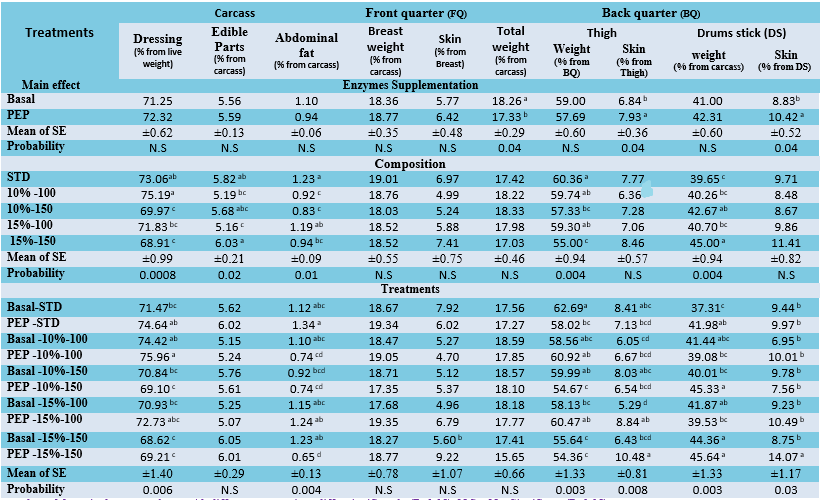
Carcass traits: The recorded values of carcass characteristics measurements (Table 6) presented that in the presence and absence of PEP to broiler diets or dietary basal diet had no significant difference in all parameters of carcass characteristics except total weight of BQ %, thigh skin and DS skin of broilers at 40 days of age. The addition of PEP to broilers diets decreased significantly total weight of BQ % and increased significantly Skin % of thigh and DS. However, reducing ME and CP affecting significantly on dressing , edible parts, abdominal fat, thigh and DS.
Generally, chicks fed on PEP+L10%-100 and PEP+STD significantly gained the highest dressing, followed by L10%-100. Regarding to abdominal fat % birds fed on PEP+L15%-150, PEP+10%-100, PEP +L10%-150 and L10%-150 recorded lower % compared to PEP-STD. There was significant increase of DS weight % from carcass due to feeding on PEP+L15%-150, L15%-150 and PEP+ L10%-150 compared to STD. On the other hand, the highest value of thigh % recorded by STD. These results are in match with Selim et al. (2016b) who observed that the quality of carcass was enhanced with pectinase (PE) supplementation in low -energy diets for broiler. While, Min et al. (2011) who obtained that when broiler were fed on diet supplemented with Rovabio Max (containing pectinase) at rate of 200g/tone and low energy diet (40 kcal/kg diet) didn’t differ significantly compared with control group in dressing and breast meat yield %.
Meat quality: The relationship between either PEP supplementation and ME and CP level on some physical and
Table 6: Effect of pectinase and protease on Carcass characteristics of broiler chicks.
a,b,...= Means in the same column with different superscripts, differ significantly (P<0.05); N.S = Not Significant (P>0.05). STD = Standard requirements, PEP =pectinase + protease
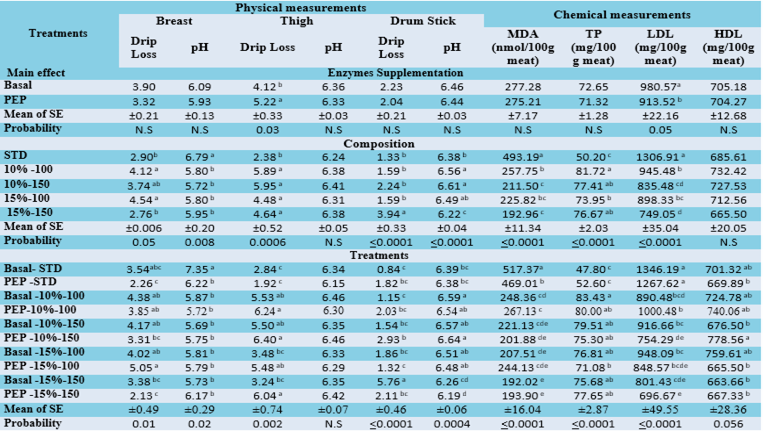
Table 7: Effect of pectinase and protease on physical and chemical meat quality of broiler chicks
a,b,...= Means in the same column with different superscripts, differ significantly (P<0.05); N.S = Not Significant (P>0.05). STD = Standard requirements PEP = Pectinase + protease
chemical parameters of broiler meat are presented in Table 7. Supplementation of PEP to broiler diets didn’t cause any significant change in determined values of drip loss and pHu of all examined broiler meat cuts except thigh drip loss; it was increased from 4.12 to 5.22.While reducing dietary crude protein and ME significantly reducing pHu of breast meat and significantly increasing pHu of DS except DS pHu of 15%-150 which was decreased significantly. Regarding to drip loss, it was significantly increased by reducing dietary crude protein and ME for all cuts except 15%-150 treatment decreased breast drip loss.
Among all treatments the drip loss and pHu of all cuts significantly affected except thigh pHu. Breast drip loss samples wear increased by using PEP+L15%-100 diets as compared with other values, while the addition of PEP for STD and L15%-150 recorded significantly the lowest breast drip loss value. Thigh drip loss values increased for PEP -L10%-150, PEP -10%-100 and PEP-L15%-150 significantly compared with STD and PEP values. Decreasing CP and ME L15%-150 increasing significantly DS drip loss compared with all treatments. Chicks fed on control diet showed significantly high breast pHu values compared with other diets. The lowest pHu value recorded by L10%+150 for breast cuts and PEP+L15%-150 for DS cuts.
According to pH and drip loss results, water holding capacity and possessing ability of breast meat might be increased ; . On the other side reducing dietary ME from STD level to E100 or E150 enhanced glycogen storage in breast meat whereas breast pH values decreased. Also increased values of processing yield . In previous study by Zakaria et al. (2010) reported that non significant impact on meat quality traits of broiler (pH, cooking loss and water holding capacity) when adding mixture enzymes containing pectinase. On the other hand, Selim et al. (2016b) observed that the quality of meat was enhanced with pectinase (PE) supplementation in low -energy diets for broiler.
The presented results of some chemical characteristics (Table 7) show that although supplementation of PEP enzymes to broiler diets did not cause any significant change of MDA, TP, or HDL of broiler meat samples, but decreased significantly LDL. The reduction of ME and CP level decreased significantly the concentrations of MDA and LDL of meat, L15%-150 recorded the lowest value by 60.88 % and 42.69 %, respectively compared to STD. Otherwise, the reduction of dietary crude protein and ME level significantly (P<0.05) increased TP in compared to STD; 10%-100 recorded the highest value by 62.79 % in compared to STD. The results among all treatments showed a significant decrease in MDA and LDL of broiler meat of birds compared to basal diet treatments or basal diet and PEP, respectively. On the other hand, all treatments significantly increased TP in broiler meat compared with the basal and PEP.
In general, the reduction in dietary crude protein and ME level improve broiler meat quality. The broiler fed 15%-150 and PEP-L15%-150 diet recorded decrease in the concentration of MDA in meat by 62.89 %and 62.52% compared to basal diet, while the broiler fed PEP+15%-150 recorded decrease in the concentration of LDL by 48.25 % compared to the basal diet. While, TP concentration increased in meat for broiler fed 10%-100 and PEP+10%-100, respectively. These results in general show positive effect of reducing CP and ME on the chemical quality of produced meat as the concentrations of MDA and LDL were decreased. The same trend was recorded previously by Rao et al. (2004) who reported that, the chicks feed on yellow maize with supplementing enzymes at 0.5 g/kg diet recorded reduction in LDL concentrations in serum, while protein concentration in the liver and breast muscle increases. Also, Lilly et al. (2011) studied the effect of diets with either excessive, high, low or deficient dietary amino acid density during the period from 28 to 42 day of age on meat quality. They reported that feeding deficient amino acid diet due to less protein and more fat in yielded thigh meat while feeding high and excessive amino acid yielded more susceptible to oxidation thigh meat.
acknowledgements
The author highly acknowledged all of the people that contributed directly or indirectly to the work presented here.
conflict of interest
The authors have declared no conflict of interest.
novelty statement
We found that the best supplementation was the mixture enzymes PEP to standard or lower 10% CP and 100 kcal ME broiler corn/soybean meal diets, which improved growth performance, dressing % and meat quality.
authors contribution
All authors participated in the production of this manuscript. original authors have read and agreed to the current version of the manuscript.
CONCLUSION
All supplementation individually or mixture for pectinase and protease to standard broiler diet or the mixture for low dietary ME and CP broiler diet improved growth performance, dressing % and meat quality and enhance oxidative stability of meat by decreased MDA. The best supplementation was the mixture enzymes PEP to standard or lower 10% CP and 100 kcal ME broiler corn/soybean meal diets.
Figures
Figure 1. Figure 2. Figure 3. Figure 4.
References
Abd El-Hack ME, Alagawany M, Farag MR, Dhama K (2015). Use of maize distiller’s dried grains with solubles (DDGS) in laying hen diets: trends and advances. Asian J. Anim. Vet. Adv., 10: 690-707. https://doi.org/10.3923/ajava.2015.690.707[CrossRef]
Alagawany M, Attia AI (2015). Effects of feeding sugar beet pulp and Avizyme supplementation on performance, egg quality, nutrient digestion and nitrogen balance of laying Japanese quail. Avian Biol. Res., 8: 79-88. https://doi.org/10.3184/175815515X14274754281188[CrossRef]
Ali A., Williams I.H., Martin G.B., S.Sipsas (2009). Proceedings of the Australian Poult.Sci. Symposium 20: 45.
Allouche L., Madani T., Hamouda A., Boucherit M.R., Taleb H., Samah O., Rahamani K., Touabati A (2015). Effect of addition of exogenous enzymes in hypocaloric diet in broiler chicken on performance, biochemical parameters and meat characteristics. Biotechnol. Anim. Husband. 31, 4 :551-565. https://doi.org/10.2298/BAH1504551A[CrossRef]
Angel C. R., W. Saylor, S. L. Vieira, N. Ward (2011). Effects of a monocomponent protease on performance and protein utilization in 7- to 22- day-old broiler chickens. Poult. Sci. 90: 2281–2286. https://doi.org/10.3382/ps.2011-01482[CrossRef]
Barbut S. (1993). Colour measurements for evaluating the pale soft exudative (PSE) occurrence in turkey meat. Food. Res. Int. 26: 39-43. https://doi.org/10.1016/0963-9969(93)90103-P[CrossRef]
Cowan W.D., Pettersson D.R., Ross G.M. (1999). Investigation into the effect of xylanases and pectinases on broilers performance in sorghum based diets with low levels of wheat. Proc. Aust. Poult. Sci. Symp., 11:112-115.
Cowieson A. J., Zaefarian F., Knap I., Ravindran V. (2017). Interactive effects of dietary protein concentration, a mono-component exogenous protease and ascorbic acid on broiler performance, nutritional status and gut health. Anim. Prod. Sci. 57:1058–1068. https://doi.org/10.1071/AN15740[CrossRef]
Duncan D. B. (1955). Multiple range and multiple F tests. Biometrics. 11: 1-42. https://doi.org/10.2307/3001478[CrossRef]
El-kholy K., S.M. Rakha, H. T. Tag El-din (2020). Physical performance of broiler chickens affected by dietary biological additives. J. World’s Poult. Res. 10(3):443-450. https://doi.org/10.36380/jwpr.2020.51[CrossRef]
Ghazi S, Rooke J.A., Galbraith H. (2003). “Improvement of the nutritive value of soybean meal by protease and a-galactosidase treatment in broiler cockerels and broiler chicks”. Brit. Poult. Sci. 44.3: 410-418. https://doi.org/10.1080/00071660310001598283[CrossRef]
Hooge D.M., PIERCE J.L., Mc BRIDE K.W., RIGOLIN P.J. (2010). Metaanalysis of broiler chicken trials using diets with or without allzyme SSF enzyme complex. Int. J. Poult. Sci., v.9, n.9, p.819-823. https://doi.org/10.3923/ijps.2010.819.823[CrossRef]
Jia W., Slominski B. A., Guenter W., Humphreys A., O. Jones (2008). The effect of Enzyme supplementation on Egg production parameters and Omega -3 Fatty Acid deposition in Laying Hens Fed Flaxsced and Canola Seed. Poult. Sci. 87: 2005-2014. https://doi.org/10.3382/ps.2007-00474[CrossRef]
Kamran Z., M. A. Mirza, A. U. Haq, S. Mahmood (2004). Effect of decreasing dietary protein levels with optimum amino acids profile on the performance of broilers. Pakistan Vet. J., 24: 165-168.
Lilly RA, Schilling MW, Silva JL, Martin JM, Corzo A. (2011). The effects of dietary amino acid density in broiler feed on carcass characteristics and meat quality. J. Appl. Poult. Res. 20:56-67. https://doi.org/10.3382/japr.2010-00222[CrossRef]
Mahmood T., Mirza M. A., Nawaz H., Shahid M. (2017a). Effect of different exogenous proteases on growth performance, nutrient digestibility, and carcass response in broiler chickens fed poultry by-product meal-based diets. Livest. Sci. 200:71–75. https://doi.org/10.1016/j.livsci.2017.04.009[CrossRef]
Mahmood T, Mirza M, Nawaz H (2017b). Effect of supplementing exogenous protease in low protein poultry by-product meal based diets on growth performance and nutrient digestibility in broilers. Anim. Feed Sci. Technol. 2017;228:23–31. https://doi.org/10.1016/j.anifeedsci.2017.01.012[CrossRef]
Min Y. N., Liu F. Z., Hancock A., Coto C., Lu C., Karimi A., Yan F., Waldroup P. W. (2011). Evaluation of Rovabio in normal and reduced-nutrient corn-soybean meal and Distillers Dried Grains with Solubles diets for broilers. Int. J. Poult. Sci., 10: 786-795. https://doi.org/10.3923/ijps.2011.786.795[CrossRef]
Olukosi O. A., L. A. Beeson, K. Englyst, L. F. Romero. (2015). Effects of exogenous proteases without or with carbohydrases on nutrient digestibility and disappearance of non-starch polysaccharides in broiler chickens. Poult. Sci. 94:2662–2669. https://doi.org/10.3382/ps/pev260[CrossRef]
Pucci L.E.A., Rodrigues P.B., Bertechini A.G., Nascimento G.A.J., Lima R.R., Silva L.R. (2010). Forma física, suplementação enzimática e nível nutricional de rações para frangos de corte na fase inicial: desempenho e digestibilidade dos nutrientes. Rev. Brasileira de Zootec., 39 (6): 1271-1279 https://doi.org/10.1590/S1516-35982010000600016.[CrossRef]
Rao S. V. R., Raju M. V. L. N., Shashibindu M. S., Murthy O. K. (2004). Effect of supplemental enzymes in diets containing yellow maize or pearl millet (Pennisetum typhoides) as the principal source of energy in broiler chicken. Anim. Nutr. Feed. Techn., 4(2):101-111.
Ravindran V. (2013). Feed enzymes: The science, practice, and metabolic realities. J. Appl. Poult. Res., 22 (3): 628-636. https://doi.org/10.3382/japr.2013-00739[CrossRef]
Romero L. F., C. M. Parsons, P. L. Utterback, P. W. Plumstead, and V. Ravindran. (2013). Comparative effects of dietary carbohydrases without or with protease on the ileal digestibility of energy and amino acids and AMEn in young broilers. Anim. Feed Sci. Technol. 181:35–44.
Romero L. F., J. S. Sands, S. E. Indrakumar, P. W. Plumstead, S. Dalsgaard, V. Ravindran. (2014). Contribution of protein, starch, and fat to the apparent ileal digestible energy of corn- and wheat-based broiler diets in response to exogenous xylanase and amylase without or with protease. Poult. Sci. 93:1–13. https://doi.org/10.1016/j.anifeedsci.2013.02.001[CrossRef]
SAS, “Statistical Analisys System” (2004). Users guide. Versão 9.1. Cary: Statistical Analisys System Institute, (2004).
Selim A. Nessrin, Abdel Magied A. Hemat, Habib H. Heba, Waly H. Amany, A.A. Fadl, S.M. Shalash (2019). Using Protease and Xylanase Enzymes as Single or Combined Supplementation to Corn-Soybean Meal Broiler Diets”. EC Vet. Sci. 4.8: 637-652.
Selim A. Nessrin, Amany H. Waly, Hemat A. Abdel Magied, Heba H. Habib, A.A. Fadl, S.M. Shalash. (2018). A study on synergism between two different supplemental carbohydrases enzymes to standard or low energy broiler diets. Egypt. Poult. Sci. Vol. (38) (IV): (1207-1228). https://doi.org/10.21608/epsj.2018.23269[CrossRef]
Selim A. Nessrin, Heba H. Habib, Hemat A. Abdel Magied, Amany H. Waly, A.A. Fadl, S.M. Shalash. (2016). Evaluation of using protease enzyme at different levels of protein in corn-soybean meal broiler diets. Egypt. Poult. Sci. (36) (I): 231-247. https://doi.org/10.21608/epsj.2016.33255[CrossRef]
Selim A. Nessrin, Abdel Magied A. Hemat, Habib H. Heba, Waly H. Amany, A.A. Fadl, S.M. Shalash (2016). Effect of pectinase enzyme supplementation and low energy corn-soybean meal diets on broiler performance and quality of carcass and meat. Egypt. Poult. Sci. (36) (I): (319-335) (2016). https://doi.org/10.21608/epsj.2016.33378[CrossRef]
Selim A. Nessrin, Waly H. Amany, Abdel Magied A. Hemat, Habib H. Heba, A.A. Fadl, S.M. Shalash (2015). Further benefits of xylanaseenzyme supplementation to low energy corn-soybean meal broiler diets. Egyptian J. Nutrit. Feeds., 18(3): 443-456. https://doi.org/10.21608/ejnf.2015.105838[CrossRef]
Wu Y.B., Ravindran V., Thomas D.G., Birtles M.J., W.H. Hendriks (2004). British Poult. Sci. 45: 76-84 https://doi.org/10.1080/00071660410001668897[CrossRef]
Zakaria H. A. H., Jalal M. A. R., Ishmais M. A. A. (2010). The influence of supplemental multi-enzyme feed additive on the performance, carcass characteristics and meat quality traits of broiler chickens. Int. J. Poult. Sci., 9:126- 133. https://doi.org/10.3923/ijps.2010.126.133[CrossRef]
Zhang H., Savage E. M. (2010). Comparisons of sensory descriptive flavor and texture profiles of cooked broiler breast fillets categorized by raw meat color lightness values. Poult. Sci. 89:1049–1055. https://doi.org/10.3382/ps.2009-00422[CrossRef]