Based on the data given by the National Institute of Oceanography (N I O), Visakhapatnam, that the marine environment especially of the coastal regions there are two
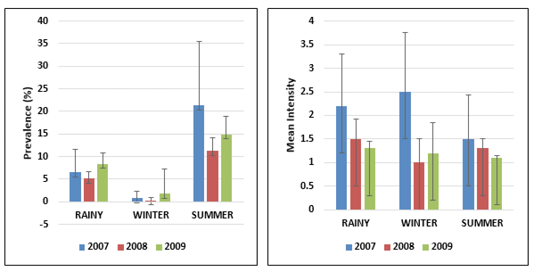
Figure 1: Error bars represent the standard deviation of the Prevalence and Mean Intensity of infection season wise from 2007-2009
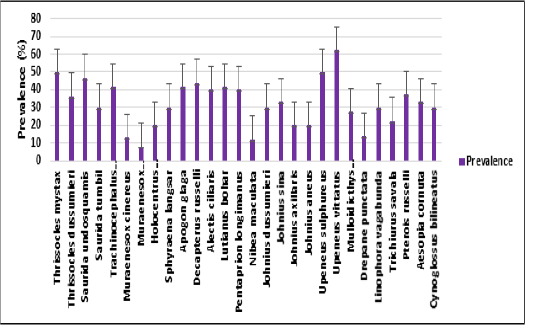
Figure 2: Error bars represent the standard deviation of the prevalence of infection in each fish species in a total period of 3 years 2007 to 2009
peaks of high temperatures in each year recorded from 2007 to 2009. The intensity of nematode infections was also recorded high in these peak periods. This is an indication that the high temperature of the coastal marine environment plays an important role for the intensity of nematode infection to the marine fish. On the basis of the recorded evidence the effect of temperature is directly proportional to the intensity of activity of a nematode parasite which influences the intensity of infection. This factor has been observed clearly in the marine environment where the intensity of nematode infection to the fish is higher during the periods of high temperature and less infection during the periods of low temperatures. Caspeta-Mandujano and Mejia-Mojica in 2004 reported that the nematode Rhabdochona canadensis infection in a fish Notropis boucardi was highest in prevalence and mean intensity in May and low in January. The present study holds true with the views of Genc et al. (2005) and Puinyabati et al. (2010) who suggested that the parasite infection showed seasonal variations with the highest prevalence in summer season. They also reported that the warm water conditions resulted in an unusually heavy infestation of nematodes.
In the year 2007, two peaks of high temperatures were recorded. The first peak of high temperatures 30.040C and 29.560C were recorded during the month of May and June respectively. In these two months the high intensity of nematode infection among the fish is recorded as 62.8% and 31.2% respectively (Figure 3). Thryssocles mystax and Upeneus sulphureus were among the infected fishes who were infected by the nematode parasite Contracaecum vittate. The second peak of high temperatures i.e 29.060C and 29.440C were recorded during the month of September and October respectively (Figure 3). In these two months the intensity of nematode infection in the fish is also high as 16.6% and 24.6% respectively. Mulloidicthys auriflamma and Alectis indica were infected by the nematode parasite Rhabdochona sp and Raphidascaris diadonis.
In the year 2008 the first peak of high temperatures 30.0C and 30.120C were recorded during the month of May and June respectively (Figure 3). In these two months the high intensity of nematode infection among the fish is recorded as 22.8% and 15.2% respectively. Saurida undosquamis and Johnius sina were among the infected fishes who got infected high by the nematode parasite Contracaecum sp and Contracaecum vittati. The second peak of high temperatures 28.990C and 28.090C were recorded during the month of September and October respectively (Figure 3). In these months the intensity of nematode infection in the fish is also high as 5.7% and 9% respectively. Pentaprion longimanus and Trachinocephalus myops were infected by the nematode parasite Contracaecum vittati and Contracaecum sp.
In the year 2009 the first peak of high temperatures 30.160C and 29.240C were recorded during the month of May and June respectively (Figure 3). In these two months the high intensity of nematode infection among the fish is recorded as 24.2% and 18% respectively. Among the infected fish Upeneus vittatus, Saurida tumbil and Trichiurus savala were infected high by the nematode parasite Contracaecum vittati, Indocucullanus arabiansae and Camallanus savala n.sp. The second peak of high temperatures 29.550C and 29.570C were recorded during the month of September and October respectively (Figure 3). In these months the intensity of nematode infection in the fish is also high as 11.7% and 14.2% respectively. Among the infected fish Sphyraena langsar, Thyrissocles dussumieri and Cynoglossus bilineatus were infected high by the nematode parasite Paranisakis and Contracaecum sp.
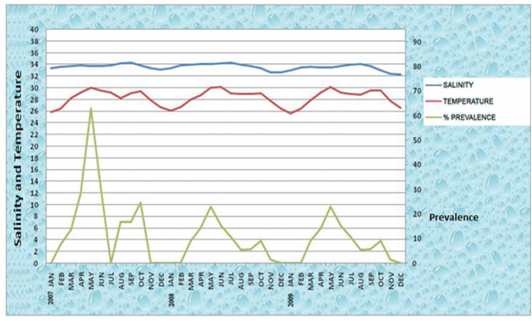
Figure 3: Comparison of Salinity, Temperature with Prevalence of infection in a total period of 3 years 2007-2009
The low temperatures were recorded as 25.842720C, 27.858140C and 26.720410C during the months of January, November and December respectively in the year 2007. The percentage of infection is nil in these three months. In other months less intensity of infection was observed (Figure 3).
The low temperatures were recorded as 26.111390C, 26.6950C and 26.409770C during the months of January, February and December respectively in the year 2008. The percentage of infection is nil in these three months. In other months less intensity of infection was observed (Figure 3).
The low temperatures were recorded as 25.636130C and 26.624840C during the months of January and December respectively in the year 2009. In these two months the percentage of infection is nil. In other months less intensity of infection was observed (Figure 3).