A large percentage of the feed ingredients consumed by a chicken is in a form that necessitates chemical and other reactions before it can be utilized by the bird. Digestion refers to those changes that occur in the alimentary canal to make it possible for the feed to be absorbed through the intestinal wall and enter the bloodstream (Coon, 2002).
Figure (1) and Table (3) show that protein digestibility occurred in the crop, gizzard, jejunum, ileum and the feces of the broiler chickens fed the experimental diets. Crops had little protein digestibility in treatments T2, T3, T4, T5, and T6. The values of digestibility were 3.92, 4.18, 3.94, 5.45 and 4.29 % respectively higher little pit than the control treatmentsT1, T7 and T8 (3.81, 3.54 and 3.38 % respectively. The reason for the improved protein digestion was due to the presence of Lactobacilli bacteria in the powdered yogurt, which settled in the compost of the crop and characterized by their effect in the ferment-
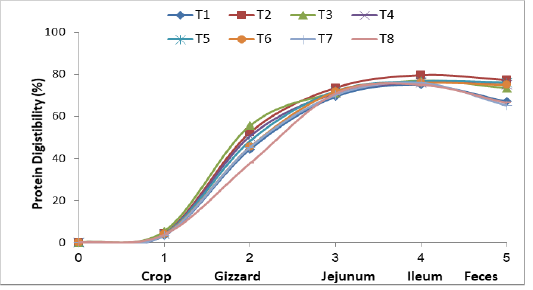
Figure 1: Effect of supplementing dried and processed yoghurt in broiler diets on protein digestibility in gastro-intestinal tract and feces
Table 3: Effect of supplementing dried and processed yoghurt in broiler diets on protein digestibility (%) of the gut contents and feces of broiler at 35 days of age
Notes: a, b,c Means in the same row with no common superscript are different significantly (p≤0.05), SEM: Standard Error of Means
ation processed, which dissolved a small percentage of amino acids of some proteins during storage (Green and Sainbury, 2001). The protein digestibility was significantly higher in the gizzard, treatments T2, T3, T4 and T5 were protein digestibility 52.35, 55.62, 50.59 and 48.34 % as compared with controls, T6, T7 and T8 (44.40, 45.50, 45.35 and 37.68 %) respectively. This elevation was due to the fact that the upper parts of the digestive system of the domestic birds, including the compass are characterized by a high acidity level, which encourages the colonization of certain bacteria like Lactobacilli and Enterococcus. Hilmi et al. (2007) indicated that Lactobacillus and Enterococcus were dominated in the upper part of intestine treatments in broiler chickens. The birds have proventriculus and gizzard for gastric digestion, the lining of the proventriculus contains papillae and multi-lobular gland, which secrete both acid in form hydrochloric acid and proleolytic enzymes in the form of pepsin (Kleyn, 2013). Pepsinogen under the influence of high acidity, the pepsinogen transform into active pepsin and works on the decomposition of proteins, the gizzard acts only as a mechanical organ, it is important for mixing ingested feed with water, saliva, hydrochloric acid and pepsin, also the time spent in the gizzard by the digesta allows for increased contact between the feed and gastric acid and pepsin therefore facilitating the further denaturation and digestion of proteins prior to release into the small intestine (Rynsburger, 2009). The same figure shows the high protein digestion in the jejunum of treatments T2, T3, T4, T5 and T6 at 73.62, 71.27, 71.03, 72.09 and 71.86 % respectively as compared to T1, T7 and T8, its reported 69.80, 70.18 and 70.89 respectively. This is due to enhancement of the efficiency of enzymes in the duodenum and small intestine, such as peptidase and proteinase from pancreas which stimulated by cholecystokinin (Amerah et al., 2009), for the sovereignty of beneficial bacteria (Flint and Garner, 2009). The higher digestion rate in the ileum of protein in treatments T2, T3, T4 and T5 with dried yoghurt supplemented. It was recorded 79.71, 77.05, 76.18 and 76.73 % compared with the control (75.08 %) and the treatments added to the imported probiotics T6, T7 and T8, which reached 75.94, 75.92 and 75.12 % respectively. The reason for improvement of the digestion of the protein to the acidity level in the gastrointestinal tract was due to it’s importance in influencing protease enzyme which showed the rise of lactic acid in the contents of small intestine. The decrease in pH showed at Table (4), stimulates and facilitates the enzyme’s activity as well as it’s active involvement in the decomposition of feed which prevents the growth of pathogenic and proved a greater changes for the sovereignty of beneficial bacteria (Flint and Garner, 2009; Recoules et al., 2017). Noy and Sklan (1995), also showed an improvement in the nitrogen digestion rate of 92 % in the ileum area. The overall digestibility in the feces showed that highly apparent digestion of the birds treatments T2, T3, T4, T5 and T6 fed on the yoghurt supplements and Labozyme, which was 77.38, 73.53, 75.16, 76.15 and 74.98 % respectively compared with control (67.08 %) and treatments T7 and T8 which supplemented with imported Biolac (65.20 %) and Interzyme (66.45%). The increase in the digestion of protein in general was due to the diversity of microorganisms in the probiotic of dried yoghurt (AL-KhalidiI, 2005). Omara, (2012) indicated that increased in the crude protein digestion when using screening milk and why as natural probiotics. The results of the study agreed with the Auda, (2017) when used of dried kefir milk loaded on feed materials, which resulted in a significant improvement in the digestion of protein in the bird dropping.
Table 4: Effect of supplementing dried and processed yoghurt in broiler diets on lactic acid ratio in the intestine liquid of broiler at 35 days of age
Notes: a, b,c Means in the same row with no common superscript are different significantly (p≤0.05), SEM: Standard Error of Means

