
Domestic farming has a great contribution in rural agriculture, livestock and dairy sectors of Pakistan. Their help ranges from the crop and livestock production to cottage industry. The women in rural societies of Pakistan deliver many farm duties especially in the Punjab province, anterior Sindh, KP, Gilgat-Baltistan and Baluchistan. In the hilly areas men and women of the rural community use the donkeys for daily practice work like fetching water, collection of firewood for domestic use and sale in the nearby local market to cope their daily needs. The present study was carried out in three different rural towns of Dera Ismail khan district of KP in the year 2016, where the house hold community members male and female keeping animals to cope their livelihood needs. By restoring proportionate sampling each group was comprised of 30 males 30 females. Animal’s owners were selected for the purpose of this study as the representative samples of the area by personal interviewing of respondents and observations regarding different pack animals i.e. camel, bull, horses/ mules and donkey. Score from female respondents by different pack animals i.e. camel, bull, horses/ mules and donkey receive were 33.67±2.55, 29±1.00, 29.52±2.52 and 58.67±2.082 respectively (% means ± Standard deviation), while from male respondents with the % means ± Standard deviation of 34.67±6.43, 35.00±1.00, 36.00±2.65, 44.33±4.041 respectively.
Research Article · Volume 35, Issue 1, 8 May 2020 · Open Access
Donkeys as an Alternate Domestic Pack-animal in the Arid Zone of Dera Ismail Khan, Pakistan
· · · · · · · · ·
Affiliations & Notes ⌄
- 1Faculty of Veterinary and Animal Sciences, Gomal University, D.I.Khan, Pakistan 2Department of Veterinary Pharmacology and Toxicology, College of Veterinary and Animal sciences, Pookode, Wayanad, Kerala, India 673576 3Faculty of Veterinary and Animal sciences, Lasbela University of Agriculture, Water and Marine Sciences (LUAWMS), Pakistan 4Departments of Livestock and Dairy Development KP, Pakistan , Corresponding author: Muhammad Inamullah Malik malikinamgu@gmail.com
Article Info ⌄
- Journal:
- Punjab University Journal of Zoology
- Published:
- 8 May 2020
From the article
- Percentage Means ± Standard deviation scores received by different pack animals i.e. camel, bull, horses/ mules and donkey were 33.67±2.55, 29±1.00, 29.52±2.52 and 58.67±2.082 respectively.
- There was no significant difference (p > 0.05) observed by two-way ANOVA among the % score achieved by different animals species by male respondents with the % means±Standard deviation of 34.67±6.43, 35.00 ±1.00, 36.00±2.65, 44.33±4.041 respectively (Figure 2).
- Taking these all issues into consideration there are many possibilities for the rural women to use the donkey as an alternate pack animal.
- Donkey as domestic helping animal received significantly higher score as compared with other animals from female and male respondents of the rural communities.
Selected from the article's own text.
Abstract
Introduction
The arid zone of Pakistan is experiencing low agricultural production due to insufficient water resources and farm power utilization. Lack of appropriate modern technological access are the main cause of agricultural deprivation . Poor seasonal rainfall distribution over the last decade has also not only effect Pakistan and Afghanistan in Asia but other countries of the world . In the rest of the world like African region it has also contributed to the widespread of poverty among the thousands of farming households ; .
The majority of farmers in the arid zone of Pakistan use the draft animals to carry their goods supply and also other different tasks. Horses, donkeys and camels are the major drought animals ; . These are used in the rainy areas and pastoral societies tends to be a male-dominated work environment . Work in farms are mostly done by men and assisted by women by helping in to the accessary activities or have secondary role in weeding, planting, harvesting and animal grazing activities . On the other hand, women also worked with drought animals in these areas ; . Along with other farming activities to carry their farm luggage to different places of work, female use and manage pack animals . However, women’s ease in accessing animals like camel, horse and bulls is generally limited due to their ways of management because women generally work with small ruminants and cattle in homes ; . All women are not so brave to work with camels and bulls and feel inconvenient carrying goods or riding these large pack animals because of expected aggression other causes like bulls often having long horns ; .
Donkeys are normally more acceptable as pack animals for women and women find them very friendly to carry different goods and riding by means of this innocent animal. While Ox and camel are costly in term of initial cost and daily maintenance ; . This research will describe the use of donkeys as alternate pack animal for women of the arid-agricultural based societies in D.I. Khan region of Pakistan with particular reference to their possible greater use by women in house hold farming system ; ; .
Materials and Methods
The present study was carried out in three different towns of Dera Ismail Khan district of KPK in the year 2015-2016 in the areas where the pack animals used by the women and men to carry their baggage’s farm belongings and house hold carriages. By restoring proportionate sampling each group was comprised of 30 males and 30 females. Pack-animals owners were selected for the purpose of study was the representative samples of the area by interviewing questionnaire administered to the respondents regarding different pack animals i.e. camel, bull, horses/ mules and donkey were recorded. Data was recorded in triplicate samples and analyzed by Graph Pad prism by column statistics determining their means with standard deviation followed by two-way ANOVA and Sidak’s multiple comparison tests and percentages were presented in bar graphs.
Results and Discussion
The % values of scores got in the results of interviews from male and female correspondents of the farmers’ family were analyzed by two-way ANOVA and presented in graphical format. Percentage Means ± Standard deviation scores received by different pack animals i.e. camel, bull, horses/ mules and donkey were 33.67±2.55, 29±1.00, 29.52±2.52 and 58.67±2.082 respectively. Overall highly significance (p < 0.01) difference was observed among the % score achieved by different animals’ species from female respondents (Figure 1).
There was no significant difference (p > 0.05) observed by two-way ANOVA among the % score achieved by different animals species by male respondents with the % means±Standard deviation of 34.67±6.43, 35.00 ±1.00, 36.00±2.65, 44.33±4.041 respectively (Figure 2).
Multiple comparisons
Multiple comparison was performed by applying Sidak’s multiple comparisons test to the data and comparison shows no significant difference (p > 0.05) among the scores of camels, Bull, Horse/mule species of pack animals between male and female respondents while overall significant (P<0.01) difference was observed among the % score achieved by the donkey from female and male correspondents of the interview (Figure 3).
Percentage Means±Standard deviation% scores received by different pack animals camel, bull, horses/ mules and donkey were 33.67±2.55, 29±1.00, 29.52±2.52 and 58.67±2.082 respectively. Overall highly significance (P< 0.01) difference was observed among the % score achieved by different animals species these results were in agreement with the studies who described that working equines, particularly donkeys, play a significant role in empowering the household farmers in many developing nations .
No significant difference (p >0.05) was observed by two-way ANOVA tests among the % score achieved by different animals species from male respondents with the % means ± Standard deviation of 34.67±6.43, 35.00±1.00, 36.00±2.65, 44.33±4.041 respectively. These results were in agreement with the studies who described that similarities and differences between pastoral resource utilization are present and the influence of heterogeneous environmental settings needs to be considered in resource utilization (Nusser and Holdschlag, 2012).
Multiple comparison was done by applying Sidak’s multiple comparisons test to the data and comparison shows no significant difference (p > 0.05) among the scores of camel, Bull, Horse/mule species of pack animals by male and female correspondents while overall high significance (P< 0.01) difference was observed among the % score achieved by the donkey from female and male respondents of the interview these results were in agreement with the studies who described that through a diachronic overview of the appearance of the characteristics shared by pastoral agricultural groups in Africa and Asia, it was clear that only this mode of livelihood have taken its present shape. This pattern is consistent with recent studies of other domestic animals in different regions of the world suggest that the women have major role in process of domestication of working animals ; .
Conclusions
Taking these all issues into consideration there are many possibilities for the rural women to use the donkey as an alternate pack animal. It is clear that there exists as so much safe and sound probable potential which if realized could advantage many peoples and families in the pastoral society of Pakistan. Donkey as domestic helping animal received significantly higher score as compared with other animals from female and male respondents of the rural communities. Donkey are the major drought animal in this arid zone and should be given special consideration to improve their management and health status. So that maximum benefits could be obtained in their proper use.
Acknowledgements
We are thankful to Livestock and Dairy Development Department and civil society of the Dera Ismail Khan Arid Zone for their coperation.
Conflict of interest
There is no conflict of interest.
Figures
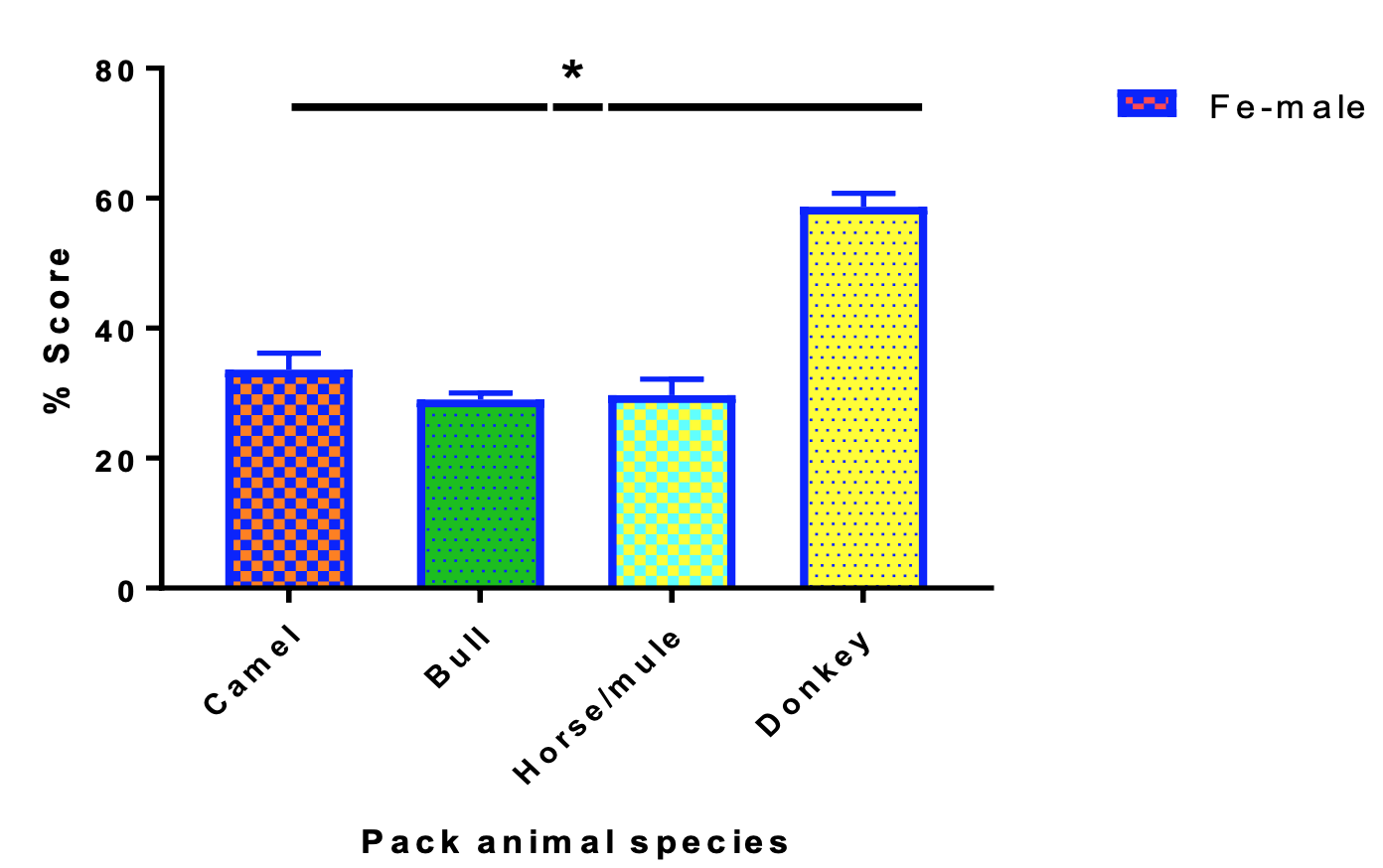
Graphical presentation of % score showing adoptability of different pack animals species by female respondents of rural livestock farmer’s family.
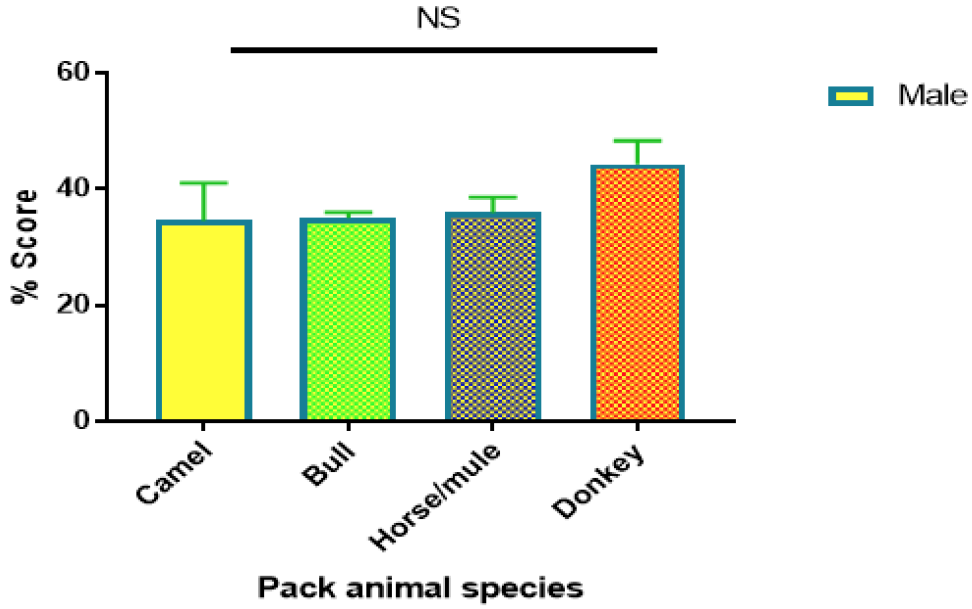
Graphical presentation of % score showing adoptability of different pack animals species by male respondents of rural livestock farmer’s family.
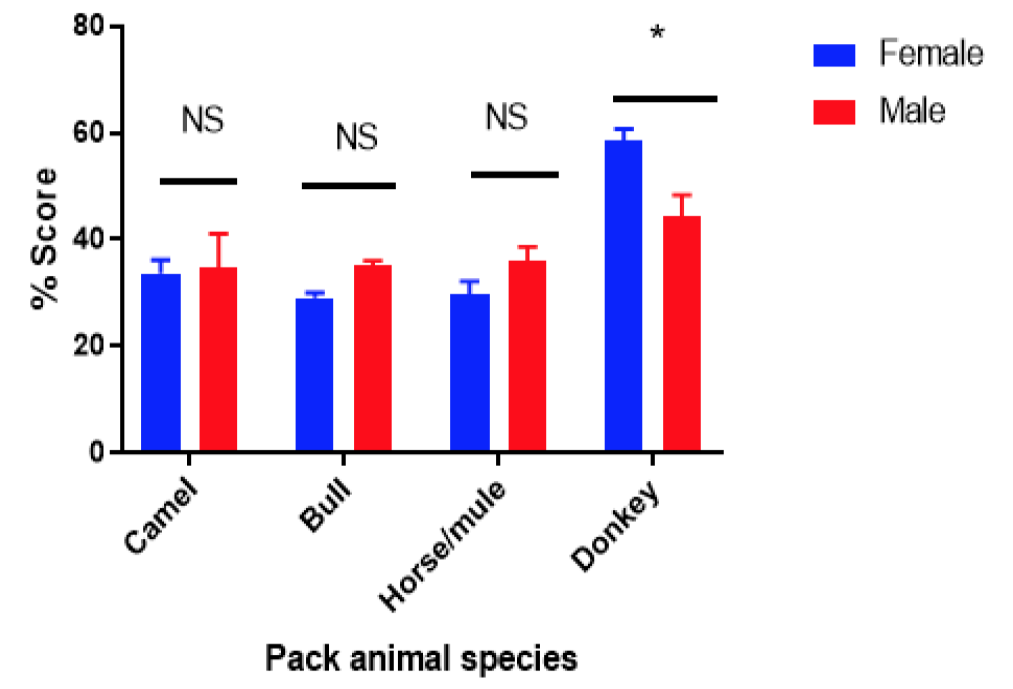
Graphical presentation of % score comparing adoptability of different pack animals species by Female and male respondents of rural livestock farmer’s family.
References
- Ansari-Renani, H.R., Rischkowsky, B., Mueller, J.P., Momen, S.M.S. and Moradi, S., 2013. Nomadic pastoralism in southern Iran. Pastoralism. Res. Pol. Prac., 3: 11. https://doi.org/10.1186/2041-7136-3-11[CrossRef]
- Baba, S.U., 2015. Mediated by men: Environmental change, land resources management and gender in rural Kano, Northern Nigeria: University of Birmingham.
- Begum, R. and Yasmeen, G., 2011. Contribution of Pakistani women in agriculture: Productivity and constraints. Sarhad J. Agric., 27: 637-643.
- Ewane, M., Ingram, V. and Awono, A., 2009. Market chain baseline for bush mango (Irvingia spp.) in the South West and Eastern Regions of Cameroon: GCP/RAF/408/EC. CIFOR and the European Commission, Yaounde, Cameroon.
- Jamali, H.A., 2006. Drought coping strategies in Nushki District, Pakistan and their policy implications: Thesis submitted for the partial fullfilment of the requirement for the Degree of Master in Public Administration in the School of Public Administration, University of Victoria.
- Kallioniemi, M., Raussi, S., Rautiainen, R. and Kymäläinen, H.R., 2011. Safety and animal handling practices among women dairy operators. J. Agric. Saf. Health., 17: 63-78. https://doi.org/10.13031/2013.36233[CrossRef]
- Khan, M.S., Shah, M.G.U. and Shah, S.A.H., 2013. Donkey traction, use and welfare needs at Daman region of Dera Ismail Khan, Pakistan. Sci. Res. Ess., 8: 953-959.
- Kristjanson, P., Waters-Bayer, A., Johnson, N., Tipilda, A., Njuki, J., Baltenweck, I., Grace, D., and MacMillan. S., 2014. Livestock and women’s livelihoods. In: Quisumbing A., Meinzen-Dick R., Raney T., Croppenstedt A., Behrman J., Peterman A. (eds), Gender in agriculture: Springer, Dordrecht; pp. 209-233. https://doi.org/10.1007/978-94-017-8616-4_9[CrossRef]
- Linseele, V., 2010. Did specialized pastoralism develop differently in Africa than in the Near East? An example from the West African Sahel. J. World Prehist., 23: 43-77. https://doi.org/10.1007/s10963-010-9033-3[CrossRef]
- Lochi, G.M., Shah, M.G.U. and Khan, M.S., 2014. Management and welfare needs of donkeys in the rural areas of Noushahro Feroze, Pakistan. Sci. Res. Ess., 9: 410-413. https://doi.org/10.5897/SRE2013.5363[CrossRef]
- Luqman, M., Ashraf, E., Hussan, M.Z.Y., Butt, T.M. and Iftikhar, N., 2012. Extent of Rural Women’s Participation in Agricultural Activities. Int. J. Agric. Manage. Dev., 2: 25-32.
- Naveed, M.A. and Anwar, M.A., 2013. Agricultural information needs of Pakistani farmers. Malays. J. Lib. Inf. Sci., 18: 13-23.
- Nüsser, M. and Holdschlag, A., 2012. Herding on high grounds: diversity and typology of pastoral systems in the eastern Hindukush (Chitral, northwest Pakistan). Pastoral practices in High Asia: Springer, pp. 31-52. https://doi.org/10.1007/978-94-007-3846-1_2[CrossRef]
- Olomola, A.S., 2010. Formal-informal institutional linkages in the Nigerian agribusiness sector and implications for pro-poor growth: IPPG discussion paper series.
- Patel, S., Patel, M., Patel, J., Patel, A. and Gelani, R., 2016. Role of women gender in livestock sector: A review. J. Livest. Sci., 7: 92-96.
- Phaniraja, K. and Panchasara, H., 2009. Indian draught animals power. Vet. World, 2: 404-407.
- Rossel, S., Marshall, F., Peters, J., Pilgram, T., Adams, M.D. and O’Connor, D., 2008. Domestication of the donkey: Timing, processes, and indicators. Proc. Nat. Acad. Sci., 105: 3715-3720. https://doi.org/10.1073/pnas.0709692105[CrossRef]
- Shah, M., Sarwar, A. and Reissmann, M., 2015. Phenotypic Characteristics and performance traits of kohi camel (Camelus Dromedarius). I. J. Biol. Pharm. Sci., 2: 13-19.
- Smith, D.C., 2016. The book of donkeys: A guide to selecting, caring, and training: Rowman and littlefield. Br. Lib. Cataloging Publ. Inf. Available. eBook 978-1-4930-2537-4.
- Ul-Allah, S., 2014. Towards a water and nutrient efficient forage production in semi-arid regions of Pakistan: Kassel university press GmbH.
- Usman, K.M., Muhammad, T. and Majid, M., 2016. Drip irrigation in Pakistan: status, challenges and future prospects. Russ. J. Agric. Socio-Eco. Sci., 56: 114-126.
- Yaqoob, A., 2011. Indus waters across 50 years: A comparative study of the management methodologies of India and Pakistan: Institute of regional studies, Spotlight on Regional Affairs, Vol. XXX, No. 9.
- Zahoor, A., Fakher, A., Ali, S. and Sarwar, F., 2013. Participation of rural women in crop and livestock activities: a case study of Tehsil Tounsa Sharif of Southern Punjab (Pakistan). Int. J. Adv. Res. Manage. Soc. Sci., 2: 98-121.
Cited by 1 article
In journals published by ResearchersLinks.
Services
Article usage statistics
Loading…