
Retrotransposons have become an inevitable source of genetic diversity due to their abundance in eukaryotic genomes and their insertion in coding regions leads to altered gene expression. We examined the diversity of retroelements in four consecutive generations of different strains of Sordaria fimicola. The parental strains werecollected from two contrasting environments of Evolution Canyon i.e. harsh South facing slope and neutral North facing slope. Retroelements profiles were generated in order to detect retrotransposons. Strains from South facing slope exhibited more copy number of Ty3-gypsy, LINEs and Ty1-copia as compared to strains from North facing slope. In total, 52 fragments of Metaviridae (Ty3-gypsy), 104 fragments of LINEs and 66 fragments of Ty1-copia were sequenced. In this way, strains from the contrasting environments were successfully discriminated on the basis of retrotransposons.
Short Communication · Volume 51, Issue 3, 28 April 2019 · Open Access
Diversity of Retrotransposons (Ty3-gypsy, LINEs and Ty1-copia) in Sordaria fimicola
· · · ·
Affiliations & Notes ⌄
- 1Molecular GeneticsResearch Laboratory, Department of Botany, University of the Punjab, Lahore 54590 , * Corresponding author: phdgenetics@gmail.com
Article Info ⌄
- Journal:
- Pakistan Journal of Zoology
- Published:
- 28 April 2019

From the article
- Retrotransposon based genetic analysis was used to dig variations between all the isolates of South and North strains of Sordaria fimicola (S1, S2, S3 and N5, N6, N7).
- In total, 52 fragments of Metaviridae (Ty3-gypsy), 104 fragments of LINEs and 66 fragments of Ty1-copia were sequenced.
- Among 52 fragments of Metaviridae (Ty3-gypsy), 17 were found in NFS strains and 35 in SFS strains (Supplementary Fig. S1).
- In conclusion, retrotransposons are the good molecular markers in order to determine genetic diversity.
Selected from the article's own text.
Abstract
Materials and methods
S. fimicola belongs to saprophytic genera and is homothallic; grows well on organic material, isolated from dung of herbivores and is wide spread in nature. It has high mutation rate . Less is known about its genetic diversity and population’s Eco genetic behavior . Stock strains of S. fimicola for S1, S2, S3, N5, N6 and N7 were provided by Molecular Genetics Research Lab, University of the Punjab, Lahore, Pakistan. These original fungal strains were collected from the two slopes which are opposing each other and situated in the valley in Evolution Canyon. Four generations (F1, F2, F3 and F4) of six parental strains of S. fimicola were raised from single spore culture technique and all were maintained and revived on potato dextrose agar media under sterile and controlled environmental conditions. DNA of mature strains was extracted by modified method of Pietro et al. (1995). Primers for the amplification of retrotransposons are listed in Table I and regions were amplified using polymerase chain reaction. TE-PCR reactions were done in a volume of 25μl containing 1.5µL DNA, 2.5 µL 10X PCR buffer, 2.5µL MgCl2, 2.5µL dNTPs, 0.5µL each primer (Forward and Backward, Sigma Aldrich), 0.5µL Taq polymerase, 14.5µL DEPC treated water. TE-PCR amplifications were performed in Veriti96 thermo cycler (Applied Biosystem). The optimum annealing temperature was determined for each primer pairs including other several PCR parameters (concentration of DNA, primers, MgCl2 and Taq DNA Polymerase).
The PCR reaction conditions were 94°C for 4 min, followed by 30 cycles of 94°C for 1 min, copia 47°C/LINE 44°C for 2 minutes, and 72°C for 1 min, ending with a final extension step of 72°C for 8 min. The amplified DNA fragments (4µL) were mixed with (1µL) of 6X loading dye. The PCR products were resolved electrophoretically on 1.5% Agarose gel at voltage of 100V for 30 min. The gels were stained with ethidium bromide (3µL) and photographed under UV illumination. The 100bp DNA ladder was used as a molecular marker to measure the size of amplified DNA band (Invitrogen). The PCR products were purified and sent for sequencing.
Results and discussion
Many TEs are ubiquitous and have been used as molecular markers to analyze genetic diversity. Retrotransposon based genetic analysis was used to dig variations between all the isolates of South and North strains of Sordaria fimicola (S1, S2, S3 and N5, N6, N7). Different Primer pairs of retrotransposons were used to amplify the DNA to determine polymorphism. Amplification revealed the unique banding patterns and thus clarified genetic diversity among strains. In total, 52 fragments of Metaviridae (Ty3-gypsy), 104 fragments of LINEs and 66 fragments of Ty1-copia were sequenced. Among 52 fragments of Metaviridae (Ty3-gypsy), 17 were found in NFS strains and 35 in SFS strains (Supplementary Fig. S1). Out of 104 fragments of LINEs, 45 were found in NFS strains and 59 in SFS strains (Supplementary Fig. S2). Out of 66 fragments of Ty1-copia, 40 were found in SFS and 26 in NFS (Table II). The differences found in copy number of these three retrotransposons in strains from opposite slopes of ‘Evolution Canyon’ might be due to the differences in environmental conditions. Sequences of gypsy and LINEs are given in Figure 1.
Table I.- List of primers for the amplification of Transposable elements in different strains of S. fimicola.
| Primer name | Primer No. | Primer sequence | Annealing temp. |
| Metaviridae (Ty3-gypsy) | Oligo 16 F | 5'-MRN ATG TGY GTN GAY TAY MG-3' | 47oC |
| Oligo 17 R | 5'-RCAYTTNSWNARYTTNGCR-3' | ||
| LINEs | Oligo 26 F | 5'-RVNRANTTYCGNCCNATHAG-3' | 44oC |
| Oligo 28 R | 5'-GAC ARR GGR TCC CCC TGN CK-3' | ||
| Copia | Oligo 30 F | 5'-GCNATGNANGANGAGATGGA-3' | 47 o C |
| Oligo 32 R | 5'-TGNTCCCAAATCTTTNATCTC-3' |
Table II.- Total Copy number of transposable element in different strains and subsequent generations of S. fimicola.
| NFS | Copy No. of Ty3 Gypsy | Copy No. of LINEs | Copy No. of Ty1-copia | SFS | Copy No. of Ty3 Gypsy | Copy No. of LINEs | Copy No of Ty1-copia |
| N7 | 1 | 3 | 3 | S1 | 2 | 3 | 3 |
| N7F1 | 1 | 4 | 3 | S1F1 | 2 | 4 | 3 |
| N7F2 | 1 | 2 | 3 | S1F2 | 2 | 4 | 3 |
| N7F3 | 1 | 3 | 1 | S1F3 | 3 | 4 | 3 |
| N7F4 | 1 | 4 | 1 | S1F4 | 3 | 4 | 3 |
| N5 | 1 | 4 | 2 | S3 | 2 | 4 | 4 |
| N5F1 | 1 | 4 | 2 | S3F1 | 2 | 4 | 3 |
| N5F2 | 1 | 4 | 1 | S3F2 | 2 | 4 | 3 |
| N5F3 | 2 | 4 | 1 | S3F3 | 3 | 4 | 2 |
| N5F4 | 2 | 4 | 1 | S3F4 | 3 | 4 | 2 |
| N6 | 1 | 3 | 3 | S2 | 1 | 4 | 3 |
| N6F1 | 1 | 3 | 1 | S2F1 | 2 | 4 | 3 |
| N6F2 | 1 | 3 | 1 | S2F2 | 2 | 4 | 3 |
| N6F3 | 1 | 3 | 1 | S2F3 | 2 | 4 | 1 |
| N6F4 | 1 | 3 | 2 | S2F4 | 3 | 4 | 1 |
The results also showed that the genome of comparative strains is closely related to one another. PAST analysis of multivariate showed that the retroelements in South strains are more diverse than the elements of other strains because Southern strains have defensive mechanism that controls the high mutation rate ; and expression of transposons is often measured in relation to mutation. In this work, we aimed to identify potentially active retrotransposons and identified different retrotransposons in the genomes of isolates from different environmental conditions. Similarity of these retrotransposons was found with Beta vulgaris and Glycine max retrotransposons when analyzed by GyDB (Gypsy Data Base).
In some plants rearrangements of chromosomes can be result of retrotransposons and multiple copies of these elements lead to genetic diversity . This diversity may increase virulence of pathogen and helps it to evolve, as more severe pathogen . Hence active TE near or within the gene change or deactivate gene and results in mutations and subsequent virulence .
Transposable elements tend to insert in genome at two regions i.e. near coding region or in the coding region. If transposable elements managed to insert itself near coding region it can greatly influence the model of gene expression and if it is inside coding region it directly alters gene product . If two same sequences get inserted at different positions they can generate two different types of point mutations and variations on the bases of host DNA sequences and insertion time of both sequences can be calculated by assessing variation at the ends of both sequences which were identical before insertion .
As many sites of transposable elements are present in Sordaria genome specially at south facing slope it can leads to its evolution by homologous recombination at insertion sites its effect can be negligible like inversions or considerable like duplication, translocation and deletion ; .
Conclusion
In conclusion, retrotransposons are the good molecular markers in order to determine genetic diversity. Our experiment amplified three types of retrotransposons in S. fimicola. But there was difference in TE abundance in both strains which means that they evolved simultaneously but strain from south facing slope exhibited more polymorphism because of adverse conditions. These findings suggest that occurrence of more TE elements may lead to mutations.
Supplementary material
There is supplementary material associated with this article. Access the material online at: http://dx.doi.org/10.17582/journal.pjz/2019.51.3.sc6
Statement of conflict of interest
The authors declare no conflict of interest.
Figures
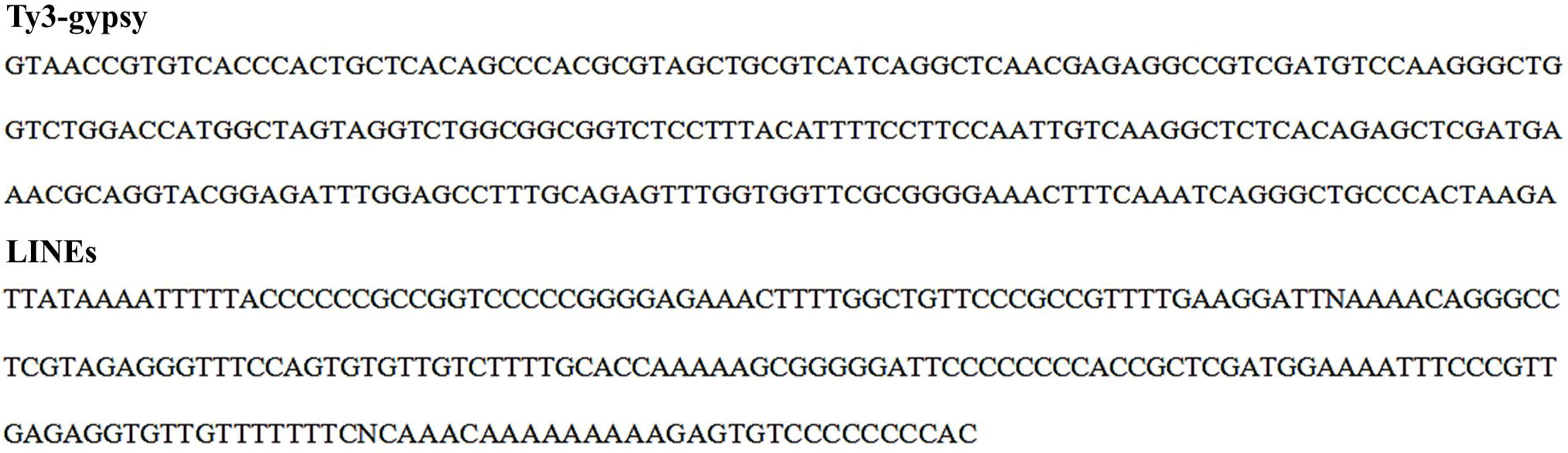
Sequence of Ty3-gypsy and LINEs in S1 strain of S. fimicola.
References
- Amyotte, S.G., Tan, X., Pennerman, K., del Mar Jimenez-Gasco, M., Klosterman, S.J., Ma, L.J., Dobinson, K.F. and Veronese, P., 2012. BMC Genomics, 13: 314. https://doi.org/10.1186/1471-2164-13-314[CrossRef]
- Arif, R., Bano, S., Ishfaq, M. and Saleem, M., 2017. Pakistan J. Zool., 49: 2079-2086. http://dx.doi.org/10.17582/journal.pjz/2017.49.6.2079.2086[CrossRef]
- Braumann, I., van den Berg, M.A. and Kempken, F., 2008. Mol. Genet. Genom., 280: 319. https://doi.org/10.1007/s00438-008-0367-9[CrossRef]
- Cordaux, R. and Batzer, M.A., 2009. Nat. Rev. Genet., 10: 691-703. https://doi.org/10.1038/nrg2640[CrossRef]
- Creighton, H.B. and McClintock, B., 1931. Proc. natl. Acad. Sci., 17: 492-497. https://doi.org/10.1073/pnas.17.8.492[CrossRef]
- de Jonge, R., Bolton, M.D., Kombrink, A., van den Berg, G.C., Yadeta, K.A. and Thomma, B.P., 2013. Genome Res., 23: 1271-1282. https://doi.org/10.1101/gr.152660.112[CrossRef]
- Delprat, A., Negre, B., Puig, M. and Ruiz, A., 2009. PLoS One, 4: 7883. https://doi.org/10.1371/journal.pone.0007883[CrossRef]
- Hua-Van, A., Le Rouzic, A., Boutin, T.S., Filée, J. and Capy, P., 2011. Biol. Direct., 6: 19. https://doi.org/10.1186/1745-6150-6-19[CrossRef]
- Kalogeropoulos, A. and Thuriaux, P., 1985. Genetics, 109: 599-610.
- Kass, L.B. and Chomat, P., 2009. In: Maize handbook, Volume II: Genetics and genomics (eds. J.L. Bennetzen and S.C. Hake). Springer Science + Business Media, LLC. Available at: https://www.springer.com/gp/book/9780387778624
- Kempken, F. and Kück, U., 1998. Bioessays, 20: 652-659. https://doi.org/10.1002/(SICI)1521-1878(199808)20:8<652::AID-BIES8>3.0.CO;2-K[CrossRef]
- Kidwell, M.G., 2002. Genetica, 115: 49-63. https://doi.org/10.1023/A:1016072014259[CrossRef]
- Kijima, T.E. and Innan, H., 2010. Mol. Biol. Evol., 27: 896-904. https://doi.org/10.1093/molbev/msp295[CrossRef]
- Marín, I. and Lloréns, C., 2000. Mol. Biol. Evol., 17: 1040-1049. https://doi.org/10.1093/oxfordjournals.molbev.a026407[CrossRef]
- Pietro, S., Fulton, T.M., Chunwongse, J. and Tanksley, S.D., 1995. Pl. mol. Biol. Rep., 13: 207.
- Piskurek, O., Nishihara, H. and Okada, N., 2009. Gene, 441: 111-118. https://doi.org/10.1016/j.gene.2008.11.030[CrossRef]
- Saleem, M., Lamb, B.C. and Nevo, E., 2001. Genetics, 159: 1573-1593.
- Slotkin, R.K. and Martienssen, R., 2007. Nat. Rev. Genet., 8: 272-285. https://doi.org/10.1038/nrm2160[CrossRef]
- Zhang, J., Yu, C., Pulletikurti, V., Lamb, J., Danilova, T., Weber, D.F., Birchler, J. and Peterson, T., 2009. Genes Dev., 23: 755-765. https://doi.org/10.1101/gad.1789209[CrossRef]
Services
Article usage statistics
Loading…