
Mantids is a fascinating and predatory small group of bulky insects and has been superbly engineered for speed and power. Object of this work is to see the stability and morphometrics of oothecae of mantids occurring in agricultural areas of Mirpurkhas. Due to the little exploration to this bio-control agent is the reason to conduct research in District Mirpurkhas, Sindh (May to Oct 2018). Total 319 specimens were collected and arranged into 06 genera and 08 species along with morphometrics of 40 oothecae which were sorted and a few healthy were allowed for hatching at the advanced research laboratory of Arachnology and Entomology. The collected samples were kept at an Average temperature and humidity between 28.2 ± 0.47 to 38.78 ± 0.47 0c, 57.6 ± 0.55 to 72.6%, respectively.
Short Communication · Volume 54, Issue 5, 19 July 2022 · Open Access
Diversity and Morphometric of Oothecae of Mantids in District Mirpurkhas, Sindh
· · · · ·
Affiliations & Notes ⌄
- 1Department of Zoology, University of Sindh, Jamshoro-76080, Pakistan. * Corresponding author: jawaid.khokhar@usindh.edu.pk
Article Info ⌄
- Journal:
- Pakistan Journal of Zoology
- Published:
- 19 July 2022

From the article
- For the present survey 03 families, Empusidae, Eremiaphilidae and Mantidae were collected from ten agricultural sites, The Mantidae is the largest occurring family and Empusidae is least occurring family, and 06 genera and 06 species recorded (Table I and II).
- Mantis religiosa religiosa (Linneaus 1758) species was found from almost all the visited localities of District Mirpurkhas.
- The species Tenodera attenuata was reared in the laboratory as is the foremost occurring species throughout Sindh province and grow huge and feed many insect pests in comparison of other species of praying mantids.
- Reared Tenodera species recorded longevity period in female is 165± days (around 6 months) and in male longevity observed is 134± days (around 4 months).
Selected from the article's own text.
Abstract
Materials and methods
During the present study (May to October, 2018) 319 specimens and 49 oothecae were collected from bushes, grasses, open grounds, crops, on the bark of the trees and the field where there is no tillage by hand picking, insect net and light trap methods. Oothecae of species were reared and processed according to . The oothecae were kept at an Average temperature and humidity between 28.2±0.47 to 38.78±0.47oC, 57.6±0.55 to 72.6% and were held in reserve in fish aquarium like glass houses and top of reserve enclosed with fine mesh nylon cloths. These houses were refined bushy and muddy as compared with the natural habitats of praying mantids. Soon after hatching in the same way nymphs were transferred in other glass houses with 2 feet height and width and 4 feet length. For maintaining glass house temperature during day and night a bulb was fixed, in winters bulb was brought closer to glass houses while during hot temperature it was maintained on distant or switched off.
Results
For the present survey 03 families, Empusidae, Eremiaphilidae and Mantidae were collected from ten agricultural sites, The Mantidae is the largest occurring family and Empusidae is least occurring family, and 06 genera and 06 species recorded (Table I and II). Maximum number of specimens was collected of family mantidae. Mantis religiosa religiosa (Linneaus 1758) species was found from almost all the visited localities of District Mirpurkhas. Other collected species were Tenodera attenuata (Stoll 1937), Sphoodromantis trancaucasica (Stoll, 1937), Empusa unicornis (Linnaeus, 1763), Microthespis dmitrievi (werner 1708), Humbetiella indica (Saussure, 1869). Together with specimens 40 Ootheca were also collected and after the assortment and identification the eggs were of three species i-e Mantis religiosa religiosa (Linnaeus 1758), Tenodera attenuata (Stoll 1937) and Humbetiella indica (Saussure, 1869).
Table I. Diversity of Mantodea in district Mirpurkhas.
| S. No | Name of families | No. of specimen | No. of genera | No. of species |
| 1. | Empusidae | 64 | 01 | 01 |
| 2. | Eremiaphilidae | 91 | 01 | 01 |
| 3. | Mantidae | 164 | 04 | 04 |
| Total | 03 | 319 | 06 | 06 |
Table II. Mantids and Ootheca collected from 10 sites of district Mirpurkhas.
| Name of species | MK | GQM | DL | KAS | BM | SA | KGM | JT | ST | HBT | # of species |
| Mantids | |||||||||||
| Mantis religiosa religiosa (Linnaeus 1758) | ⁺ | ⁺ | ⁺ | ⁺ | ⁻ | ⁺ | ⁺ | ⁺ | ⁺ | ⁺ | 74 |
| Sphoodromantis trancaucasica (Stoll, 1937) | ⁺ | ⁺ | ⁺ | ⁺ | ⁺ | ⁺ | ⁺ | ⁺ | ⁺ | ⁺ | 69 |
| Tenodera attenuata (Stoll 1937) | ⁺ | ⁺ | ⁺ | ⁺ | ⁺ | ⁺ | ⁺ | ⁺ | ⁺ | ⁺ | 105 |
| Empusa unicornis (Linnaeus, 1763) | ⁺ | ⁺ | ⁺ | ⁻ | ⁻ | ⁻ | ⁺ | ⁻ | ⁻ | ⁻ | 05 |
| Microthespis dmitrievi (werner 1708) | ⁻ | ⁻ | ⁻ | ⁺ | ⁻ | ⁻ | ⁻ | ⁺ | ⁻ | ⁻ | 07 |
| Humbetiella indica (Saussure, 1869) | ⁺ | ⁺ | ⁺ | ⁻ | ⁻ | ⁺ | ⁺ | ⁺ | 79 | ||
| Total | 319 | ||||||||||
| Oothecae | |||||||||||
| Mantis religiosa (Linnaeus 1758) | ₊ | ₋ | ₋ | ₋ | ₋ | ₋ | ₊ | ₊ | ₋ | ₋ | 09 |
| Tenodera attenuata (Stoll 1937) | ₊ | ₊ | ₋ | ₋ | ₋ | ₋ | ₋ | ₊ | ₊ | ₋ | 19 |
| Humbetiella indica (Saussure, 1869) | ₊ | ₊ | ₊ | ₋ | ₋ | ₋ | ₊ | ₋ | ₋ | ₋ | 12 |
| Total | 40 | ||||||||||
Note: (+) sign indicates the presence of species while (-) sign indicates absence of the species. MK, Mataro Khaskheli; GQM, Ghulam Qadir Mari; DL, Dolat Laghari; KS, Khadim Ali Shah; BM, Bair Mori; SA, Shuja Abad; KG, Kot Ghulam Mohammad; JT, Jhudo Taluka; ST, Sindhri Taluka; HT, Hussain Bux Mari Taluka.
Table III. Oothecae hatching status.
| Ootheca studies | Date of hatching | No. of hatching | No. of compartments/eggs | Hatching birth rate % |
| 1st | 17 Oct, 2017 | 209 | 355 | 59.714 |
| 2nd | 22 Oct, 2017 | 255 | 347 | 74.344 |
| 3rd | 27 Oct, 2017 | 220 | 312 | 70.512 |
The oothecae of species were reared in Zoology laboratory of DNMMGDC Village Sadiq Memon, Tando Allahyar near MirpurKhas and were processed according to and standard entomological methods to take measurement of Oothecae. Specimen’s progression was according to model entomological methods and Egg case or oothecae measured in mm (Table III) and were held in reserve in fish aquarium like glass houses and top of reserve enclosed with fine mesh nylon cloths. These houses were refined bushy and muddy as compared with the natural habitats of praying mantids (Fig. 1). Average temperature and humidity was adjusted between 28.2 ± 0.47 to 38.78 ± 0.47 oC, 57.6 ± 0.55 to 72.6%. 40 number of oothecae was collected out of which 3 species oothecae were sorted out (i.e. Tenodera attenuata, Mantis religiosa, Humbertiella indica). Some of the oothecae were remain unknown due to denatured state of Oothecae or their already hatching. Three healthy Oothecae of Tenodera attenuata species selected to see hatching status of eggs (Table IV).
Table IV. Morphometric (mm) of selected (03) oothecae of Tenodera attenuata.
| Oothecae | Length | Width | Vertical height | No. of compartments/ eggs/ oothecae |
| 1st | 19 | 13 | 16 | 350 |
| 2nd | 15 | 11 | 13 | 347 |
| 3rd | 09 | O8 | 10 | 312 |
Discussion
During survey it was observed that mantid biodiversity and species richness is somewhat stable at natural habitats where no tillage, no pesticides spray were used and also where there is no bi-annual cultivation. While in cultivated areas species richness decreases. The species Tenodera attenuata was reared in the laboratory as is the foremost occurring species throughout Sindh province and grow huge and feed many insect pests in comparison of other species of praying mantids. Reared Tenodera species recorded longevity period in female is 165± days (around 6 months) and in male longevity observed is 134± days (around 4 months). So, females have elongated longevity than males. During rearing it has been observed that the females of Tenodera attenuata species are more pitiless and eager prey feeders, spend more time in hunting and eating anything but adults males lazy and rarely hunting. However, the cannibalistic behavior was not recorded as both partners live freely, attack and feed on other insects rather to eat themselves. Mating takes 2 h to complete and after few days female deposited its eggs within a foamy light brown Oothecae. Females after mating laid 1-3 times oothecae but 1st Ootheca were healthy then 2nd and 3rd.
Acknowledgments
We are grateful to former Chairperson and Professor Tahira Jabeen Ursani, Department of Zoology, University of Sindh for going through the manuscript and giving valuable suggestions.
Statement of conflict of interest
The authors have declared no conflict of interest.
Figures
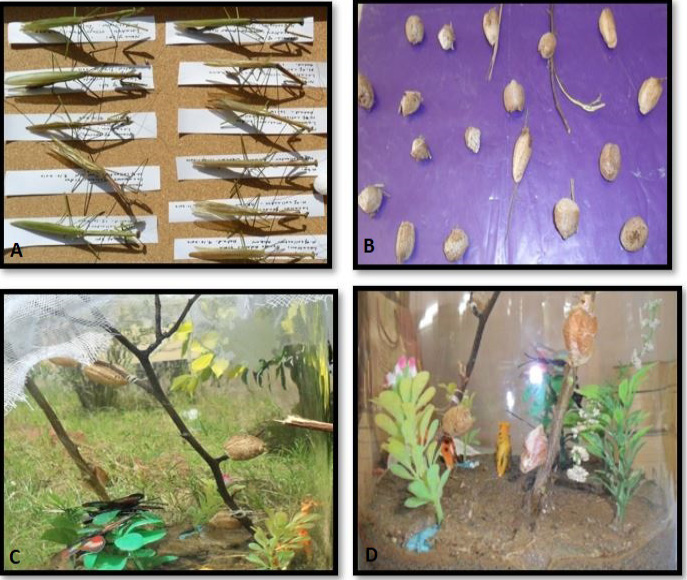
Praying mantids (A) and their ootheca (B) collected from Mirpurkhas C and D show oothecae of 3 species of praying mantids fixed in glass Houses in lab.
References
- Beier, M., 1968. Mantodea (Fangheuschrecken) (Vol. 12). Walter de Gruyter.
- Bertsch, D.J., Martin, J.P., Svenson, G.J. and Ritzmann, R.E., 2019. J. exp. Biol., 222.
- Bethoux, O. and Wieland, F., 2009. Zool. J. Linn. Soc., 156: 79-113. https://doi.org/10.1111/j.1096-3642.2008.00485.x[CrossRef]
- Bohn, H., Picker, M., Klass, K.D. and Colville, J., 2010. Arthrop. Syst. Phylog., 68: 53-69.
- Bowie, M.K. and Bowie, M.H., 2003. N. Z. Ent., 26: 3-5. https://doi.org/10.1080/00779962.2003.9722103[CrossRef]
- Chaturvedi, N. and Hegde, V., 2000. J. Bombay natl. Hist. Soc., 97: 295-296.
- Chaturvedi, N., Mukherjee, T.K. and Giri, V., 2005. J. Bombay natl. Hist. Soc., 102: 242.
- Devi, M.B., Joymati, L., Kananbala, A., Binarani, A. and Manoj, K., 2011. Ann. Pl. Prot. Sci., 19: 457-458.
- Ehrmann, R., 1992. Entomol. Z., 102: 153-162.
- Ehrmann, R., 2011. Articulata, 26: 1-42. https://doi.org/10.1111/j.1467-9604.2010.01476.x[CrossRef]
- Khokhar, J.A., Soomro, N.M., Ursani, T.J., Malik, S., Narejo, N.T. and Dhiloo, K.H., 2016. Eur. Acad. Res., 3: 12116-12123.
- Lim, J.R., Kwon, S.J., So, S.Y. and Cheon, H.K., 2019. J. Sericult. entomol. Sci., 55: 1-5.
- Metz, J.A.J. and Van Batenburg, F.H.D., 1985. J. math. Biol., 22: 209-238. https://doi.org/10.1007/BF00275716[CrossRef]
- Mohammad, S.K., Alla, S.M.G., El-Hamouly, H., Ehrmann, R. and El-Den Nasser, M.G., 2011. Zootaxa, 3044: 1-27. https://doi.org/10.11646/zootaxa.3044.1.1[CrossRef]
- Mukherjee, T.K., Das, B.C. and Hazra, A.K., 2005. Rec. Zool. Surv. India, 104: 143-149.
- Nalepa, C.A. and Lenz, M., 2000. Proc. R. Soc. Lond. Ser. B Biol. Sci., 267: 1809-1813. https://doi.org/10.1098/rspb.2000.1214[CrossRef]
- Prete, F.R. and McLean, T., 1996. Brain Behav. Evol., 47: 42-54. https://doi.org/10.1159/000113228[CrossRef]
- Prete, F.R., Theis, R., Komito, J.L., Dominguez, J., Dominguez, S., Svenson, G. and Wieland, F., 2012. J. Insect Physiol., 58: 648-659. https://doi.org/10.1016/j.jinsphys.2012.01.018[CrossRef]
- Ramsay, G.W., 1990. Mantodea (Insecta), with a review of aspects of functional morphology and biology. Fauna of New Zealand, pp. 19.
- Rivera, J., 2010. Zootaxa, 2638: 44-64. https://doi.org/10.11646/zootaxa.2638.1.3[CrossRef]
- Ursani, T.J., Khokhar, J.A., Dhiloo, K.H., Malik, S., Yaseen, M., Chandio, J.I., Soomro, A.R., Raza, U. and Chandio, W.A., 2017. J. Ent. Zool. Stud., 5: 2620-2624.
Services
Article usage statistics
Loading…