
Gut bacteria community associated with insects are crucial to understand their function in the physiology of the host. The hypothesis of the present study was that gut microbiota in phosphine resistant population inhabits phosphine degrading bacteria. The study demonstrated the differential gut bacteria in phosphine-resistant and susceptible populations in Tribolium castaneum. Phosphine bioassay of different populations of T. castaneum revealed that Jagatsinghpur (Odisha, India) population had the highest LC50 value (1.104 mg/l). Further, gut bacteria were isolated and characterized through biochemical and molecular techniques. Among nine isolates of bacteria from resistant and susceptible populations, six isolates belonged to gram positive bacteria and three belonged to gram-negative. The 16S rRNA gene sequences displayed 96 to 100 per cent homology to other 16S rRNA gene of strains within the National Centre for Biotechnological information (NCBI), Genbank. Among different bacteria strains, two, Bacillus subtilis and Staphylococcus saprophyticus were reported from resistant populations. Other species belonged to Staphylococcus sp., Enterobacter sp., Lysinibacillus fusiformis, Klebsiella pneumonia (all four from resistant populations) and Achromobacter sp (from a susceptible population). Present study provides a basis for elucidating the role of the gut bacteria in the phosphine resistance and design novel strategies for the management of T. castaneum.
Research Article · Volume 54, Issue 3, 26 February 2022 · Open Access
Differential Gut Bacteria in Phosphine Resistant and Susceptible Population of Tribolium castaneum (Herbst) and their Biochemical and Molecular Characterization
· · · · · · · · ·
Affiliations & Notes ⌄
- 1Division of Crop Protection, ICAR-National Rice Research Institute, Cuttack, Odisha, India * Corresponding author: basanagowda.g@icar.gov.in
Article Info ⌄
- Journal:
- Pakistan Journal of Zoology
- Published:
- 26 February 2022

From the article
- Results of bioassay indicated that each population responded strongly to the selected range of concentrations for phosphine.
- Adults of T. castaneum collected from five different locations along with a laboratory-susceptible strain were bioassayed with varied concentrations of phosphine and probit estimates are given Table I. Results indicated that among all locations, the population of Jagatsinghpur had the highest LC50 value (1.104 mg/l).
- In this study, we demonstrated the differential microbiota in phosphine-resistant and susceptible populations of T. castaneum.
- Gut microbial diversity in insect-resistant populations especially with phosphine resistance was not studied much.
Selected from the article's own text.
Abstract
INTRODUCTION
Globally for ever-increasing and affluent populations, cereals are prime sources of world food . India is one of the largest food grain consumers in the world with large-scale reserves of food grains. The marketable surplus is largely handled by the public sector comprising Food Corporation of India (FCI), Central Warehousing Corporation, State Warehousing Corporations, State Civil Supplies Corporations and Cooperative Sectors . Among cereals, rice (Oryza sativa L.) is the major calorie source for more than one-third of the world’s population, particularly Asia. Of different insect pests that infest stored rice, Tribolium castaneum (Herbst) is a cosmopolitan, polyphagous and major secondary pest that is known to infest 246 commodities worldwide . Both grubs and adults can cause qualitative (nutritional, industrial and marketing properties) as well as the quantitative loss (weight loss) to the stored produce .
Although, other methods of managing stored pests are available for rice but stored grain industry relies heavily on synthetic chemicals to protect grains from losses. The use of these chemicals not only has severe effects on the environment but also detrimental to consumers by causing serious health issues . Indiscriminate and extensive use of these chemicals against these stored grains pests have culminated in developing strong insecticide resistance in these insects. For the management of stored grain insect pests, fumigation with phosphine gas is mostly followed throughout the world . Due to the international agreements for phasing out of methyl bromide, the dependence on phosphine is increasing evidence in stored grain pest management. Grains need to be preserved with the aid of the available fumigants . In India, 80 per cent of food grains in the storage units are protected by phosphine fumigation only ; . Phosphine has been the choice fumigant for three decades for treating various commodities. Although commercial fumigations have been generally successful, the development of phosphine resistance is being increased ; due to the application of sub-lethal doses, leakages from the treated structures and lack of proper sealing techniques. Indiscriminate use of phosphine has resulted in developing phosphine resistant strains as well as residue problems in food grains ; ; . Phosphine resistance to stored product insects has been well known . Such detrimental impacts of phosphine on stored grain insect pests warrant detailed study.
Insect pests are known to have a symbiosis with several microbes and these microbes can significantly alter the physiology and ecology of their insect hosts . Many bacteria inhabiting the insect’s gut provide several benefits to their hosts, such as reproduction, digestion, immunity as well as resistance to pathogens and pesticides . The better understanding of microbiota associated with insecticide resistance will not only provide the information on evolution and function of insect microbial symbiosis but also lead to the development of effective management strategy by targeting these microbes. Thus, the identification of gut bacteria in the resistant and susceptible population of key stored grain insect pest, T. castaneum is crucial for the development of phosphine resistance management strategies. Hence, the current study aims at identifying gut bacteria in phosphine resistant and susceptible populations of T. castaneum.
MATERIALS AND METHODS
Insect populations
The insect populations of T. castaneum were collected from Central Warehouse Corporation (CWC) godowns from five different locations of Odisha, India (Dhenkanal, Bhubaneshwar, Cuttack, Jagatpur and Jagatsinghpur) where stored rice was frequently fumigated with phosphine. The laboratory susceptible population (has no history of phosphine exposure) was maintained without an external infusion of conspecifics for approximately 40 generations and is expected to be susceptible to phosphine fumigation. Beetles were maintained in plastic containers (1-liter capacity; 10cm dia) containing a kilogram of broken rice kernels at Grain Entomology laboratory (25 ± 1°C; 70% RH; 12:12 h L:D photoperiod) of ICAR-National Rice Research Institute, Cuttack.
Estimating discriminating dose
Phosphine fumigation was conducted as per the Food and Agriculture Organization (FAO) method number 16. As recommended by FAO, discriminating concentrations i.e. 0.04 mg L-1 for T. castaneum was used to detect phosphine resistance (FAO, 1975). Adult laboratory susceptible population of T. castaneum was used to discriminate resistant and susceptible populations. Populations of beetles that were survived based on the discriminating dose bioassay were tested in dose-response studies to determine the level of resistance.
Phosphine gas generation
Commercially available solid formulation of aluminum phosphide (QuickPhos®; UPL Pvt. Ltd.) was used to generate phosphine gas. The apparatus was set up by filling up the glass beaker (5L) and a collection tube with the solution of sulphuric acid (5%). The top of the collection tube was submerged below the surface of the liquid to remove the air. Then, a silicon septum was fitted to the top of the collection tube. A tablet (3 g) containing aluminum phosphide was wrapped in a muslin cloth and dropped into the glass jar. A glass funnel was then placed over the top of the tablet and the weight of the funnel carries the tablet to the bottom of the glass container. The collection tube was then maneuvered over the funnel opening and clamped in place.
To calculate the correct volume desiccators, it was fully assembled and filled with water. The weight of this water in gram closely equals the volume in milliliter. Dose volumes of the phosphine source were calculated using the following equation :

Where, d1 (µl), volume of phosphine gas to inject; x1 (mg/l), desired concentration in desiccators; v1, volume of desiccator; x2 (mg/l), concentration of PH3 source (1200mg/l).
The source concentration of phosphine (N1; mg L−1) and desiccators’ volume (V1) were used to estimate the volume of phosphine gas required (V2, µL) to achieve the required concentrations (N2)
Toxicological bioassay
All fumigation bioassays were conducted as per the standard method (FAO, 1975). Bioassays were conducted for 24h at laboratory conditions (25 ± 1°C; 70% RH; 12:12 h L:D photoperiod) . Bioassay was carried out in glass desiccators of approximately 2.5-L capacity. The lid was port equipped along with septum for the gas introduction. Adult test insects of similar age were placed as groups often together with two-gram rice kernel as food in a ventilated plastic box (40 ml capacity; 4 cm dia), five such replications (five boxes, total of 50 beetles per treatment) were placed inside gas-tight desiccators. Phosphine was drawn from the phosphine generation chamber using a gas-tight Hamilton syringe and injected into each desiccator through a septum. Before the use of syringe for injecting required concentration, checking for blockage was done by injecting air into acetone and checking for bubbles. The required dose volumes are withdrawn and injected into the appropriate desiccators, recording the time when each dose was applied.
The insects were held under the concentrations (0.2- 1.2 mg/l) for 24 h at the laboratory conditions mentioned above. After the exposure period is over, they were kept in fresh air for 7 days at laboratory conditions. After seven days of the recovery period, mortality was recorded underwent probit analysis to obtain the LC50 for each populations with the use of probit-regression analysis (SAS Institute Inc, 2013). Further, resistant factors (RF’s) were calculated by the formula:

Isolation of gut bacteria
To isolate the gut bacteria, 10 healthy beetles of each population were selected and starved for 24 h. Afterward, beetles were stored in glass vials (5 ml) and deep-frozen at –80°C. Thawing of beetles for 10 min. was ensured and washed with 70 per cent ethanol. Further to remove the external contaminants, beetles were subjected to surface sterilization (with 10% sodium hypochlorite) for 5 min followed by five times distilled water wash . Aseptic dissection of beetles was carried out with insect micro-scissor to take out the gut. The entire process of dissection was done on 50 µL of sterile distilled water on a sterilized glass slide under a stereomicroscope . Guts of beetles were pooled and homogenized in sterile Eppendorf vials (1.5 ml) in 1 ml 0.1 M phosphate buffer (pH 7.0). The supernatant (50μl) was pipetted and spread on plated Luria Bertani (LB) agar plates and were incubated in a BOD chamber (30±0.5°C and 60±2% RH) for 48 h. The broth cultures were preserved in 50% glycerol in deep freeze (−80 °C).
Biochemical characterization of bacteria
For gram staining of bacteria, few drops of the cultures were placed on the glass slide and are allowed to dry. The dried glass slide was flame exposed for 2 min. Then crystal violet was added over the slide for 30 sec. followed by washing with distilled water for a few seconds. Afterward, slides were added with an iodine solution for 30 sec. followed by washing with 95% ethyl alcohol until no further colour from the smear flows. Finally, the slide was washed with distilled water and safranin (counterstaining) was enforced for 30 sec. air-dried and then examined under a microscope . Potassium hydroxide (KOH) test was conducted by placing a drop of bacterial suspension was placed on a plain glass slide. Over that, a drop of 3% KOH was applied and mixed completely by using a needle. If, as a result, the chromosomes of bacteria separate as thin threads, these are gram-negative bacteria . For catalase test, a drop of 24 h old bacterial culture was placed on a glass slide and a few drops of 3% of hydrogen peroxide (H2O2) were added. Effervescence showed the presence of catalase in the culture .
Starch hydrolysis was conducted using nutrient agar (NA) medium comprising 0.2% starch (soluble). The test bacterial cultures were placed on the medium. After 48h of incubation, the starch hydrolysis test was confirmed by adding Lugol’s iodine solution on the agar surface. A colorless zone appeared around the bacterial growth which showed a positive reaction to starch hydrolysis test . For gelatin hydrolysis, the test medium (beef extract-3 g, peptone-5 g, gelatin-120 g, and distilled water 1 L) was prepared and sterilized before inoculation in a test tube. These were incubated at 20-22oC for three days after the bacterial inoculation and observations were noted . For oxidase test, bacterial cultures were spot inoculated on the oxidase disc and colour changes from white to purple or white to blue was noted. Bacterial growth growth in NaCl was done. The bacterial cultures were inoculated into the test tube comprising NA broth enriched with 3, 5 and 7 % NaCl and observed the bacterial growth up to 7 days.
Molecular characterization of bacteria
Bacterial colonies were isolated based on colony size, color, shape and growth. Minimum of three colonies per morphotype were considered and reisolated before molecular characterization. Qiagen bacterial DNA extraction kit was used to extract the genomic DNA of the bacterial isolates. Amplification was carried out in a thermal cycler (Biorad, USA) using universal 16S rRNA primers pA (5’-AGAGTTTGATCCTGGCTCAG-3’); pH (5-AAGGAGGTGATCCAGCCGGA- 3’) . The PCR conditions were denaturation at 94°C for 1 min; annealing at 58°C for 1 min; extension at 72°C for 1 min. Totally 35 number of cycles with a final extension time of 10 min. The PCR products were purified and sequenced at Eurofin Pvt. Ltd. Bangalore, India. Sequence results were compared with the GenBank database (NCBI) and the sequences were submitted. MEGA 6.0 was used for construction of phylogenic tree through Neighbour Joining method with 1000 bootstrap value and was condensed with a cut-off value of 80%.
RESULTS
Results of bioassay indicated that each population responded strongly to the selected range of concentrations for phosphine. Adults of T. castaneum collected from five different locations along with a laboratory-susceptible strain were bioassayed with varied concentrations of phosphine and probit estimates are given Table I. Results indicated that among all locations, the population of Jagatsinghpur had the highest LC50 value (1.104 mg/l). It was followed by population of Jagatpur (0.741mg/l), Cuttack (0.682 mg/l), Bhubaneshwar (0.243 mg/l), Dhenkanal (0.183 mg/l). Laboratory susceptible population had LC50 value of 0.040 mg/l. All the populations tested exhibited reduced susceptibility and resistance ratio ranging from 4.57 to 27.60 folds.
Biochemical characterization of bacteria
Among nine isolates performed using classical biochemical methods, six isolates were showed a positive reaction to the gram staining and the remaining three bacteria showed a negative reaction. All the isolates were showed a positive reaction to the starch hydrolysis test. Other test results of different bacteria were shown in Table II. The results obtained by analyzing primary character and utilization of nutrient source by bacteria indicated that six isolates belonged to gram-positive bacteria mostly Bacillus spp. and three isolates were found to be gram-negative bacteria.
Molecular characterization of bacteria
A total of nine bacteria were identified from resistant and susceptible populations. The 16S rRNA gene sequences displayed 96 to 100% homology to other 16S rRNA gene of strains within the NCBI, Genbank. Among different organism strains, two belong to B. subtilis which were reported from laboratory susceptible population. Two strains were of Staphylococcus saprophyticus and both were reported from resistant populations. Other reported species belonged to Staphylococcus sp., Enterobacter sp., Lysinibacillus fusiformis, Klebsiella pneumonia (all four from the resistant population) and one Achromobacter sp (from the susceptible population) (Table III). In the phylogeograph, 16S rRNA sequences of different strains were divided into two major clades. The strains, B. subtilis, Staphylococcus sp., Staphylococcus saprophyticus, Lysinibacillus fusiformis were grouped in clade I. The strains, Klebsiella pneumoniae Achromobacter sp. and Enterobacter sp. were found to be under clade II (Fig. 1).
DISCUSSION
Insects harbor a wide variety of gut symbionts, which play pivotal roles in their adaptation to the environment following exposure to pesticides ; . The identification of gut microbiota based on the structural differences is not possible to distinguish the bacterial species due to many bacteria are having same shape, size and arrangement. The biochemical characterization has been very useful, cost effective, and rapid method for identification of bacterial species. Characterization of bacterial species based on various biochemical methods have been well reported ; . Similarly, in this study, we used different biochemical methods to characterize the bacterial species. To identify potential disparities among resistant and susceptible T. castaneum in terms of their microbiota on phosphine toxicity, we cultured and sequenced the gut microbiota of each population. In this study, we demonstrated the differential microbiota in phosphine-resistant and susceptible populations of T. castaneum. Development of phosphine resistance was recorded in key stored grain insect pests like T. castaneum, S. oryzae and R. dominica . Among the different factors for resistance, frequent use of phosphine is one of the reasons for the development of phosphine resistance . Gut microbes give impacts on morphology, immunology, physiology and increasing tolerance against environmental stresses including the pesticides.
Gut microbial diversity in insect-resistant populations especially with phosphine resistance was not studied much. Our study reported differential gut bacteria in phosphine resistant and susceptible populations. Similar to our study, Barnard et al. (2019) reported insecticide resistant and susceptible strains of Anopheles arabiensis differ in their gut bacterial milieu. In the current study, the bacteria belonged to Class: Gammaproteobacteria [family: Enterobacteriaceae (Klebsiella pneumonia; Enterobacter sp.)], Class: Betaproteobacteria [family: Alcaligenaceae (Achromobacter sp.)], Class: Bacilli [family: Bacillaceae (Bacillus subtilis, Lysinibacillus fusiformis); family Staphylococcaceae (Staphylococcus saprophyticus, Staphylococcus sp.)]. Our results corroborate the findings of Naik et al. (2016), who reported that diverse bacterial phyla such as Betaproteobacteria, Bacteroidetes, Firmicutes Gammaproteobacteria, Alphaproteobacteria are commonly present in insect guts including Lactobacillus and Bacillus etc.
Among the different species microbiota found in the current study, few have been already reported by earlier researchers in different insects. A species of Enterococcus i.e. Enterococcus faecalis was found to decrease the pH of the midgut of European gypsy moth, Lymantria dispar dispar thereby making larvae Bt toxin susceptible
Table I. Relative susceptibility of Tribolium castaneum populations to phosphine.
| S. No. | Location | Df | Slope±SE | LC50 (mg/l) | Fiducial limit | χ2 for heterogenity | Resistance ratio |
| 1 | Dhenkanal | 4 | 1.35±0.54 | 0.183 | 0.139-0.274 | 1.521 | 4.57 |
| 2 | Bhubaneshwar | 3 | 2.28±.073 | 0.243 | 0.068-0.512 | 1.897 | 6.07 |
| 3 | Cuttack | 4 | 1.49±0.44 | 0.682 | 0.421-2.147 | 1.324 | 17.05 |
| 4 | Jagatpur | 5 | 2.12±0.32 | 0.741 | 0.471-1.998 | 1.196 | 18.52 |
| 5 | Jagatsinghpur | 4 | 1.89±0.99 | 1.104 | 0.378-1.272 | 0.671 | 27.60 |
| 6 | Lab Susceptible | 4 | 1.21±0.39 | 0.040 | 0.028-0.057 | 2.753 | 1 |
Table II. Biochemical characterization of gut bacteria.
| S. No | Isolates of population | Gram staining | Gelatin test | Catalase | Starch hydrolysis | KOH | Growth in NaCl | Oxidase test |
| 1 | Dhenkanal | ++ | ++ | ++ | ++ | -- | ++ | -- |
| 2 | Laboratory susceptible | ++ | ++ | ++ | ++ | -- | ++ | -- |
| 3 | Bhubaneshwar, Cuttack | -- | -- | -- | ++ | ++ | -- | |
| 4 | Jagatsinghpur, Dhenkanal | ++ | ++ | ++ | ++ | -- | -- | -- |
| 5 | Jagatpur, Jagatsinghpur, Bhubaneshwar | ++ | ++ | ++ | ++ | -- | ++ | -- |
| 6 | Dhenkanal, Bhubaneswar | ++ | ++ | ++ | ++ | -- | ++ | -- |
| 7 | Jagatsinghpur, Dhenkanal | -- | -- | -- | ++ | ++ | ++ | -- |
| 8 | Laboratory susceptible | -- | ++ | -- | ++ | ++ | -- | -- |
| 9 | Laboratory susceptible | ++ | ++ | ++ | ++ | -- | ++ | -- |
++, Positive; --, Negative.
Table III. Different microbiota identified from phosphine resistant and susceptible population.
| S. No. | Organism identified | Population identified from | NCBI Acc. No. |
| 1 | Bacillus subtilis strain Sus-1 | Laboratory susceptible | MK371549 |
| 2 | Bacillus subtilis strain Sus-2 | Laboratory susceptible | MK371550 |
| 3 | Achromobacter sp. strain Sus-C | Laboratory susceptible | MK371551 |
| 4 | Enterobacter sp. strain Res-1 | Jagatsinghpur, Dhenkanal | MK371552 |
| 5 | Staphylococcus saprophyticus strain Res-2 | Dhenkanal, Bhubaneswar | MK371553 |
| 6 | Staphylococcus sp. strain Res-3 | Jagatpur, Jagatsinghpur, Bhubaneshwar | MK371554 |
| 7 | Staphylococcus saprophyticus strain Res-4 | Jagatsinghpur, Dhenkanal | MK371555 |
| 8 | Klebsiella pneumoniae strain Res-5 | Bhubaneshwar, Cuttack | MK371556 |
| 9 | Lysinibacillus fusiformis Res-C | Dhenkanal | MK371557 |
, 2004). Similarly, Enterococcus sp. isolated from Hyles euphorbiae ensures tolerance to plant extracts and toxic natural latex and the same bacteria was also reported in the present study. In Plutella xylostella gut, Enterobacter sp. has been found to be associated with degradation of chlorpyrifos ; . Lysinibacillus fusiformis for the first time reported to have the role in biodegradability of organophosphorus pesticide acephate , the same species was also found in the current study.
The bacterial flora of other stored grain beetles viz., Bruchids and Angoumois grain moth showed the presence of Bacillus pumilus, Staphylococcus sp., Pantoea sp., Staphylococcus succinus, Enterococcus sp. and Staphylococcus sp. . Similarly, PrabhaKumari et al. (2011) studied the microflora of the red flour beetle (Tribolium castaneum) and isolated different bacteria including Staphylococcus, Pseudomonas, Bacillus, Escherichia and Enterobacter sp. Most of these genus/species reported in these two studies are similar to reports of our study, but they have not assigned the role of this microbiota. The resistance of insects due to the application of insecticides as supplemented by microbial symbionts led to the understanding mechanism of insecticide resistance evolution ; ; . Like ours gut bacteria in Plutella xylostella found to play an important role in chlorpyrifos resistance, however gut bacteria were not directly involved in detoxification . Further, Almeida et al. (2017) reported that resistant strains of Spodoptera frugiperda were excellent reservoir of insecticide-degrading bacteria. Hence, gut microbiota of insecticide-resistant population could be a promising tool for biotechnological exploration and pest management ; .
In conclusion, the present study attempted to catalog the gut bacteria of T. castaneum associated with phosphine resistance. The mechanism on how associated microbiota contributing to detoxifying phosphine in the beetle’s body in the line of evolution of resistance to phosphine remains to be further investigated. Such studies could facilitate the designing of novel strategies to manage T. castaneum by manipulating their gut bacteria. The bacteria identified in the current study can form the base for future studies on symbiont-based strategies for managing phosphine resistance in T. castaneum.
ACKNOWLEDGMENTS
Authors gratefully acknowledge Director, ICAR-National Rice Research Institute, Cuttack, India for constant support in formulating the project as well as providing all the facilities. Authors duly acknowledge Ms. Lopamudra Mandal, Mr. Rakesh Ranjan Nayak, Mr. Narendra Biswal, Mr. Rabi Bhoi for helping in various activities. This work was supported by the ICAR-National Rice Research Institute, Cuttack (Project 3.2).
Statement of conflict of interest
The authors have declared no conflict of interest.
Figures
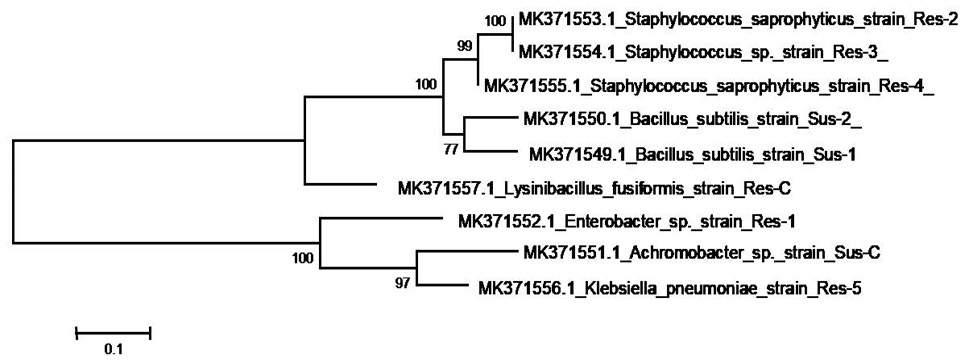
Phylogeograph of 16S rRNA sequences of different strains identified from phosphine resistant and susceptible population.
References
- Almeida, L.G., Moraes, L.A., Trigo, J.R., Omoto, C. and Cônsoli, F.L., 2017. The gut microbiota of insecticide-resistant insects houses insecticide-degrading bacteria: A potential source for biotechnological exploitation. PLoS One, 30: 12. https://doi.org/10.1371/journal.pone.0174754[CrossRef]
- Andongma, A.A., Wan, L., Dong, Y.C., Li, P., Desneux, N., White, J.A. and Niu, C.Y., 2015. Pyrosequencing reveals a shift in symbiotic bacteria populations across life stages of Bactrocera dorsalis. Sci. Rep., 5: 9470. https://doi.org/10.1038/srep09470[CrossRef]
- Aneja, K.R., 1993. Experiments in microbiology, plant pathology and tissue culture and mushroom cultivation. Wishwa Prakasham, New Delhi.
- Barnard, K., Jeanrenaud, A.C.S.N., Brooke, B.D. and Oliver, S.V., 2019. The contribution of gut bacteria to insecticide resistance and the life histories of the major malaria vector Anopheles arabiensis (Diptera: Culicidae). Sci. Rep., 24: 9117. https://doi.org/10.1038/s41598-019-45499-z[CrossRef]
- Benhalima, H., Chaudhry, M.Q., Mills, K.A. and Price, N.R., 2004. Phosphine resistance in stored-product insects collected from various grain storage facilities in Morocco. J. Stored Prod. Res., 40: 241–249. https://doi.org/10.1016/S0022-474X(03)00012-2[CrossRef]
- Ben-Yosef, M., Pasternak, Z., Jurkevitch, E. and Yuval, B., 2015. Symbiotic bacteria enable olive fly larvae to overcome host defences. J. R. Soc. Open Sci., 2: 150-170. https://doi.org/10.1098/rsos.150170[CrossRef]
- Bhatia, S.K., 1990. Development of resistance to insecticides. Proceedings of regional workshop on, warehouse management of stored food grains. Ministry of Food and Civil Supplies, Government of India, New Delhi, pp. 183–186.
- Broderick, N., Goodman, R., Handelsman, J. and Raffa, K., 2003. Effect of host diet and insect source on synergy of gypsy moth (Lepidoptera: Lymantriidae) mortality to Bacillus thuringiensis subsp. kurstaki. Environ. Ent., 32: 387–391. https://doi.org/10.1603/0046-225X-32.2.387[CrossRef]
- Broderick, N.A., Raffa, K.F., Goodman, R.M. and Handelsman, J., 2004. Census of the bacterial community of the gypsy moth larval midgut by using culturing and culture-independent methods. Appl. environ. Microbiol., 70: 293–300. https://doi.org/10.1128/AEM.70.1.293-300.2004[CrossRef]
- Champ, B.R. and Dyte, C.E., 1976. Report of the FAO global survey of pesticide susceptibility of stored grain pests. FAO Plant Production and Protect Series No. 5. Food and Agricultural Organisation of the United Nations, Rome, Italy, pp. 297.
- Chaudhry, M.Q., 2000. Phosphine resistance. Pest. Outlook, 11: 88-91. https://doi.org/10.1039/b006348g[CrossRef]
- Daglish, G.J., Collins, P.J., Pavic, H. and Kopittke, R.A., 2002. Effects of time and concentration on mortality of phosphine-resistant Sitophilus oryzae (L) fumigated with phosphine. Pest Manage. Sci., 58: 1015-1021. https://doi.org/10.1002/ps.532[CrossRef]
- Douglas, A.E., 2015. Multiorganismal insects: Diversity and function of resident microorganisms. Annu. Rev. Ent., 60: 17–34. https://doi.org/10.1146/annurev-ento-010814-020822[CrossRef]
- Dua, M., Singh, A., Sethunathan, N. and Johri, A.K., 2002. Biotechnology and bioremediation: Successes and limitations. Appl. Microbiol. Biotechnol., 59: 143–152. https://doi.org/10.1007/s00253-002-1024-6[CrossRef]
- Edwards, U., Rogall, T., Blocker, H., Emde, M. and Bottger, E.C., 1989. Isolation and direct sequencing of entire genes: Characterization of a gene coding for 16S ribosomal RNA. Nucl. Acids Res., 17: 7843–7853. https://doi.org/10.1093/nar/17.19.7843[CrossRef]
- Elanchezhiyan, K., Keerthana, U., Nagendran, K., Prabhukarthikeyan, S.R., Prabakar, K., Raguchander, T. and Karthikeyan, G., 2018. Multifaceted benefits of Bacillus amyloliquefaciens strain FBZ24 in the management of wilt disease in tomato caused by Fusarium oxysporum f.sp. lycopersici. Physiol. mol. Pl. Pathol., 103: 92–101. https://doi.org/10.1016/j.pmpp.2018.05.008[CrossRef]
- Food and Agriculture Organization, 1975. Recommended methods for the detection and measurement of resistance of agricultural pests to pesticides. Tentative method for adults of some major pest species of stored cereals, with methyl bromide and phosphine. FAO method no. 16. FAO Pl. Prot. Bull., 23: 12-25.
- Ghanim, M. and Kontsedalov, S., 2009. Susceptibility to insecticides in the Q biotype of Bemisia tabaci is correlated with bacterial symbiont densities. Pest Manage. Sci., 65: 939–942. https://doi.org/10.1002/ps.1795[CrossRef]
- Gowda, G.B., Patil, N.B., Adak, T., Pandi, G. P., Basak, N., Dhali, K., Annamalai, M., Prasanthi, G., Mohapatra, S.D., Jena, M., Pokhare, S. and Rath, P. C., 2019. Physico-chemical characteristics of rice (Oryza sativa L.) grain imparting resistance and their association with development of rice weevil, Sitophilus oryzae (L.) (Coleoptera:Curculionidae). Environ. Sustain., 2: 369–379. https://doi.org/10.1007/s42398-019-00087-9[CrossRef]
- Hagstrum, D.W. and Subramanyam, B., 2009. Insects and their natural enemies associated with stored products. Stored-product Insect Resource, St Paul MN, AACC International Inc, pp. 509-519.
- Kikuchi, Y., Hayatsu, M., Hosokawa, T., Nagayama, A., Tago, K. and Fukatsu, T., 2012. Symbiont-mediated insecticide resistance. Proc. natl. Acad. Sci. USA, 109: 8618–8622. https://doi.org/10.1073/pnas.1200231109[CrossRef]
- Liang, B., Lu, P., Li, H.H., Li, R., Li, S.P. and Huang, X., 2009. Biodegradation of fomesafen by strain Lysinibacillus sp. ZB-1 isolated from soil. Chemosphere, 77: 1614–1619. https://doi.org/10.1016/j.chemosphere.2009.09.033[CrossRef]
- Lorni, I., Collins, P.J., Daglish, G.J., Nayak, M.K. and Pavic, H., 2007. Detection and characterization of strong resistance to phosphine in Brazilian Rhyzopertha dominica (Coleoptera: Bostrychidae). Pest Manage. Sci., 63: 358–364. https://doi.org/10.1002/ps.1344[CrossRef]
- Meyer, J.M. and Hoy, M.A., 2008. Molecular survey of endosymbionts in Florida populations of Diaphorina citri (Hemiptera: Psyllidae) and its parasitoids Tamarixia radiata (Hymenoptera: Eulophidae) and Diaphorencyrtus aligarhensis (Hymenoptera: Encyrtidae). Fla. Entomol., 91: 294-304. https://doi.org/10.1653/0015-4040(2008)91[294:MSOEIF]2.0.CO;2[CrossRef]
- Moghadamnia, A.A., 2012. An update on toxicology of aluminum phosphide. J. Pharm. Sci., 20: 25. https://doi.org/10.1186/2008-2231-20-25[CrossRef]
- Mohankumar, S., 2017. New tools for effective fumigation. Proceedings of Regional workshop on preventing grain losses: Scientific approach, TNAU, Coimbatore.
- Naik, H., Mohankumar, S., Balachandar, D. and Chandrasekaran, S., 2016. Molecular characterization of endosymbiont in Rhyzopertha dominica (Fabricius) and Tribolium castaneum (Herbst.) populations of South India. J. Madras agric. Sci., 3: 344-348.
- Padin, S., DalBello, G. and Fabrizio, M., 2002. Grain loss caused by Tribolium castaneum, Sitophilus oryzae and Acanthoscelides obtectus in stored durum wheat and beans treated with Beauveria bassiana. J. Stored Prod. Res., 38: 69–74. https://doi.org/10.1016/S0022-474X(00)00046-1[CrossRef]
- Pattanaik, B.B., Navarro, S., Banks, H.J., Jayas, D.S., Bell, C.H., Noyes, R.T., Ferizli, A.G., Emekci, M., Isikber, A.A., Alagusundaram, K.T. and Antalya, 2012. Storage of food grains in India under central pool: Present status and future strategies. Proceedings of Ninth International Conference on Controlled Atmosphere and Fumigation in Stored Products,
- PrabhaKumari, C., Sivadasan, R. and Jose, A., 2011. Microflora associated with the red flour beetle, Tribolium castaneum (Coleoptera: Tenebrionidae). J. Agric. Technol., 7: 1625–1631.
- Prabhukarthikeyan, S.R., Karthikeyan, G. and Raguchander T., 2015. Biochemical characterization of fluorescent pseudomonads from turmeric rhizosphere. Biochem. cell. Archiv., 15: 299-303.
- Rafter, M.A., McCulloch, G.A., Daglish, G.J. and Walter, G.H., 2017. Progression of phosphine resistance in susceptible Tribolium castaneum (Herbst) populations under different immigration regimes and selection pressures. Evol. Appl., 10: 907– 918. https://doi.org/10.1111/eva.12493[CrossRef]
- Rajendran, S., 2001. Alternatives to methyl bromide as fumigant for stored food commodities. Pesticide Outlook, 12: 249–253. https://doi.org/10.1039/b110550g[CrossRef]
- Rajendran, S., 2016. Status of fumigation in stored grains in India. Indian J. Ent., 78: 28–38. https://doi.org/10.5958/0974-8172.2016.00022.5[CrossRef]
- Ramya, R.S., Srivatsava, C. and Subramanian, S., 2018. Monitoring of phosphine resistance in Indian populations of Tribolium castaneum (Herbst) from stored wheat. Indian J. Ent., 80: 19-23. https://doi.org/10.5958/0974-8172.2018.00005.6[CrossRef]
- Salem, S., Abou-Ela, R., Matter, M. and El-Kholy, M., 2007. Entomocidal effect of Brassica napus extracts on two store pests, Sitophilus oryzae (L.) and Rhizopertha dominica (Coleoptera). J. appl. Sci. Res., 3: 317–322.
- SAS Institute Inc., 2013. SAS/STAT® 13.1 User’s Guide. Cary, NC: SAS Institute Inc.
- Schaad, N.W., 1992. Laboratory guide for identification of plant pathogen bacteria. International Book Distributing Co., Lucknow.
- Scott, C., Pandey, G., Hartley, C.J., Jackson, C.J., Cheesman, M.J. and Taylor, M.C., 2008. The enzymatic basis for pesticide bioremediation. Indian J. Microbiol., 48: 65–79. https://doi.org/10.1007/s12088-008-0007-4[CrossRef]
- Sevim, A., Sevim, E. and Demirci, M., 2016. The internal bacterial diversity of stored product pests. Annls Microbiol., 66: 749–764. https://doi.org/10.1007/s13213-015-1155-5[CrossRef]
- Sharon, G., Segal, D., Ringo, J.M., Hefetz, A., Zilber-Rosenberg, I. and Rosenberg, E.M., 2010. Commensal bacteria play a role in mating preference of Drosophila melanogaster. Proc. natl. Acad. Sci. USA., 107: 20051-20056. https://doi.org/10.1073/pnas.1009906107[CrossRef]
- Singh, B.K., Walker, A., Morgan, J.A. and Wright, D.J., 2004. Biodegradation of chlorpyrifos by Enterobacter strain B-14 and its use in bioremediation of contaminated soils. Appl. Environ. Microbiol., 70: 4855–4863. https://doi.org/10.1128/AEM.70.8.4855-4863.2004[CrossRef]
- Stejskal, V., Hubert, J., Aulicky, R. and Kucerova, Z., 2015. Overview of present and past and pest-associated risks in stored food and feed products: European perspective. J. Stored Prod. Res., 64: 122–132. https://doi.org/10.1016/j.jspr.2014.12.006[CrossRef]
- Su, Q., Zhou, X. and Zhang, Y., 2013. Symbiont-mediated functions in insect hosts. Commun. Integr. Biol., 6: e23804–e23804-7. https://doi.org/10.4161/cib.23804[CrossRef]
- Tyler, P.S., Taylor, R.W. and Rees, D.P., 1983. Insect resistance to phosphine fumigation in food warehouses in Bangladesh. Int. Pest Cont., 25: 10–13.
- Vilanova, C., Baixeras, J., Latorre, A. and Porcar, M., 2016. The generalist inside the specialist: gut bacterial communities of two insect species feeding on toxic plants are dominated by Enterococcus sp. Front. Microbiol., 7: 1005. https://doi.org/10.3389/fmicb.2016.01005[CrossRef]
- Xia, X., Gurr, G.M., Vasseur, L., Zheng, D., Zhong, H. and Qin, B., 2017. Metagenomic sequencing of diamondback moth gut microbiome unveils key holobiont adaptations for herbivory. Front. Microbiol., 8: 663. https://doi.org/10.3389/fmicb.2017.00663[CrossRef]
- Xia, X., Sun, B., Gurr, G.M., Vasseur, L., Xue, M. and You, M., 2018. Gut microbiota mediate insecticide resistance in the diamondback moth, Plutella xylostella (L.). Front. Microbiol., 9: 25. https://doi.org/10.3389/fmicb.2018.00025[CrossRef]
Services
Article usage statistics
Loading…