
To evaluate the effects of sodium butyrate (NaBT) supplementation in high-fat diets on the growth performance and liver health of common carp (Cyprinus carpio), we formulated three isonitrogenous diets: the control diet (5.8% crude lipid, Control diet), the high-fat diet (10.8% crude lipid, HF diet), and the NaBT diet (10.8 % crude lipid and 0.1% NaBT, NaBT diet). Each diet was assigned to triplicate tanks (100 L) with 24 fish (14.52±0.08 g) in each tank. Experimental fish were fed twice daily for 8 weeks. The results showed that fish growth performance was not affected by experimental diets. Fish at HF group demonstrated higher content of triacylglyceride (TG) and total cholesterol (TCHO) in the liver. In addition, diet HF significantly increased hepatic oxidative stress by increasing malondialdehyde (MDA) content, decreasing activity levels of antioxidant enzymes and contents of reduced glutathione (GSH). Furthermoure, diet HF significantly decreased the mRNA expression of nuclear factor erythroid 2-related factor 2 (Nrf2) and heme oxygenase-1 (HO-1), and simultaneously increased the mRNA expression of tumor necrosis factor α (TNF-α), interleukin-1β (IL-1β), and IL-6 in liver of common carp compared to control diet (P<0.05). However, diet NaBT significantly improved fish liver health by decreasing contents of TCHO and MDA, down-regulating mRNA expression of pro-inflammatory cytokines (e.g., TNF-α, IL-1β and IL-6), increasing the activity levels of antioxidant enzymes, and upregulating the mRNA expression of Nrf2 and HO-1 in the liver (P<0.05). In conclusion, dietary NaBT supplementation could ameliorate the detrimental effects of high-fat diets on liver health by activating Nrf2 in common carp.
Research Article · Volume 55, Issue 5, 28 July 2023 · Open Access
Dietary Sodium Butyrate Supplementation Alleviates High-Fat Diet-Induced Liver Injury by Activating Nrf2 in Common Carp (Cyprinus carpio)
· · · · · ·
Affiliations & Notes ⌄
- 1College of Animal Science and Technology, Henan University of Science and Technology, Luoyang 471000, China 2Luoyang Agro-Tech Extension and Service Center, Luoyang 471000, China * Corresponding author: wjchen@haust.edu.cn
Article Info ⌄
- Journal:
- Pakistan Journal of Zoology
- Published:
- 28 July 2023

Abstract
Introduction
Aquafeed costs are a major consideration in aquaculture, generally accounting for 40%-50% of the total cost of production . Protein is considered as the most expensive part in aquafeed . Given this, many strategies have been implemented in aquaculture to decrease the protein content with other nutrients , such as lipids. The protein-sparing effects of dietary lipids have been proved in many fish species, such as Atlantic cod (Gadus morhua) , blunt snout bream (Megalobrama amblycephala) , and hybrid fish tambatinga (female Colossoma macropomum × male Piaractus brachypomus) .
Common carp (Cyprinus carpio) is a worldwide-distributed species (cultured in over 100 countries) and accounts for up to 10% (over 4 million metric tons in 2018) of annual freshwater aquaculture production in the world (FAO, 2020). In China, the aquaculture production of common carp has reached 2.89 million metric tons (China Fishery Stastical Yearbook, 2020). For the sake of maximum culture profit, inclusion of large amounts of non-protein energy (especially high fat) into diets of common carp has been a common phenomenon in China . Intake of high-fat diets reduced the growth performance and disrupted the lipid metabolism in common carp ; . Fish liver is a multifunctional organ acting in detoxification, metabolism of carbohydrates and fat, and scavenging foreign substances ; . Therefore, it is becoming increasing urgent to explore dietary strategies for counteracting the adverse effects of high-fat diets on the liver health in common carp.
Sodium butyrate (NaBT) is a salt of butyric acid and a commonly used additive to improve fish gut health and growth performance ; . Recently, numerous studies on mice have suggested that dietary supplementation with NaBT could reduce the negative effects of high-fat diets on liver health ; ; . In addition, ingestion of 300 mg/kg NaBT via gavage in rats fed high-fat diets reduced the oxidative stress , fat accumulation and inflammation in the liver . However, much less research has investitgated the effects of NaBT on the liver health of aquatic animals fed high-fat diets. Given this, we hypothesized that dietary supplementation with NaBT could improve the liver health of common carp fed high-fat diets.
To that end, the present study investigated the effect of dietary NaBT supplementation on the growth performance, lipid deposition, oxidative stress, and inflammation in liver of common carp fed high-fat diets.
Materials and Methods
Experimental feed
Three isonitrogenous (31% crude protein) diets with different fat content were formulated. The control diet (Control) contained medium fat (5.8%); the high fat diet (HF) contained high crude lipid (10.8%); the NaBT diet (NaBT) supplemented 0.1% NaBT in HF diet (Table I).
All ingredients were mixed thoroughly. Then the mixture were pelleted to pellets (2 mm) using a feed machine (Laifu Tk-12B, Guangdong, China). Pellets were dried to a moisture content of 8-10% and kept at -20 °C until used.
Experimental fish and feeding management
Common carp juveniles were purchased from a local fish pond (Luoyang, China) and were acclimated to laboratory conditions for 2 weeks. After starvation for 24 h, 216 experimental fish were randomly divided into 9 tanks (100 L). Each diet was assigned to triplicate tanks. Experimental fish were fed twice daily (8:00 and 17:00). Feed consumption of each tank was adjusted based on fish body weight which were weighted every two weeks. The experiment lasted for 8 weeks, during which water temperature was 25.7±1.4 °C, dissolved oxygen was above 6 mg/L, ammonia-nitrogen and nitrite were both below 0.1 mg/L.
Table I. Feed formula and feed proximate composition (g/kg dry matter).
| Control | HF | NaBT | |
| Ingredients | |||
| Casein | 28.0 | 28.0 | 28.0 |
| Gelatin | 7.0 | 7.0 | 7.0 |
| Dextrin | 25.0 | 25.0 | 25.0 |
| Soybean oil | 5.0 | 10.0 | 10.0 |
| Mineral and vitamin premix | 1.0 | 1.0 | 1.0 |
| Vitamin C | 1.0 | 1.0 | 1.0 |
| Ca(H2PO4)2 | 2.5 | 2.5 | 2.5 |
| Choline chloride | 0.5 | 0.5 | 0.5 |
| Sodium butyrate1 | 0.0 | 0.0 | 0.1 |
| Cellulose | 30.0 | 25.0 | 24.9 |
| Proximate composition (% dry matter) | |||
| Moisture | 9.97 | 9.83 | 9.45 |
| Crude protein | 31.43 | 31.63 | 31.54 |
| Crude lipid | 5.80 | 10.84 | 10.80 |
| Crude ash | 2.48 | 2.60 | 2.85 |
1Sodium butyrate was purchased from Shanghai Aladdin Biochemical Technology Co., Ltd., Shanghai, China.
Sampling
At the end of the feeding trial, all fish were starved for 24 h before sampling. All fish in each tank were anesthetized with benzocaine (50 mg/L), counted and weighed. Then the body weight and body length of 3 fish in each tank were recorded for the determination of condition factor (CF) and their blood were drawn from caudal vein to detect the activity levels of alanine aminotransferase (ALT) and aspartate aminotransferase (AST). Then liver samples of another 9 fish in each tank were sampled and divided to three portions. The first portion was collected and preserved at 4% paraformaldehyde for Oil Red O staining, and the second and third portions were stored at -80 °C for enzyme activity assay and quantitative real-time polymerase chain reaction (PCR).
The study protocol and all experimental procedures were approved by Experimental Animal Ethics Committee of Henan University of Science and Technology.
Proximate composition of experimental feed
Proximate composition of experimental diets was tested according to the procedures described by AOAC (1995). Moisture content was determined through drying samples to a constant weight at 105°C. Crude protein content was measured with the Kjeldahl method. Crude lipid content was determined in a Soxtec system. Ash content was determined with a muffle furnace for 2 h at 600°C.
Oil red O staining
Fixed liver samples were first dehydrated in a graded series of ethanol with concentration increasing from 75% to 100% and were embedded in parafflin. Then liver samples were sliced into sections (4 μm). Liver sections were stained with Oil Red O. The area stained with Oil Red O solution was analyzed by Image-Pro Plus 6.0 software (Media Cybernetics, Rockville, MD, USA).
Assay of biochemical parameters in blood and liver samples
Activity levels of ALT and AST in plasma were measured according to 2, 4-dinitrophenyl hydrazine (DNPH) method . Triglyceride (TG) content was measured with a peroxidase-coupled method and TCHO content were tested following the method described by Allain et al. (1974).
Determination of antioxidant parameters in liver
MDA content was determined with thiobarbituric acid (TBA) following the method of Esterbauer and Cheeseman (1990). Commercial reagent kits (Nanjing Jiancheng Bioengineering Institute, China) were used to detect the activity levels of catalase (CAT) and glutathione peroxidase (GPx), and contents of glutathione (GSH). Activity level of total superoxide dismutase (T-SOD) was assayed with xanthine/xanthine oxidase method . Protein content in liver samples was tested with coomassie brilliant blue method following Bradford (1976).
Quantitative real-time PCR
Total RNA in liver was isolated by acid guanidinium thiocyanate-phenol-chloroform extraction. After determination of RNA concentration and quality, total RNA (1 μg) was used to synthesize first-strand cDNA for RT-PCR with a commercial reagent kits (TransGen Biotech Co., Ltd.)
Primers were synthesized commercially from Tsingke Biotechnology (Wuhan, China) (Table II). Real time PCRs were performed on a Light Cycler 96 (Roche Diagnostics, Meylan, France). The total reaction volume was 15 μL, containing 7.5 μL Light Cycler 480 SYBR Green I Master mix (Roche Diagnostics), 2.0 μL cDNA template, 1.5 μL of primer (2.5 μM), and 4.0 μL PCR-grade water. Each sample was analyzed in duplicate with the following thermal cycling conditions: 95 °C for 10 min; followed by 40 cycles of 95 °C for 10 s, 60 °C for 20 s, and 72 °C for 20 s. Relative quantification of target gene transcripts were calculated using the 2-ΔΔCt method .
Calculations and statistical analysis
The growth performance parameters were calculated according to following formulae:
SR (%) = 100 × (1 - dead fish number/initial fish number)
WGR (%) = 100 × (final body weight - initial body weight)/initial body weight
SGR (% d-1) = 100 × [ln (final body weight) - ln (initial body weight)]/ days
Feed efficiency (FE, %) = 100 × (fresh body weight gain)/dry feed intake
CF (g/cm3) = 100 × body weight/body length3
Table II. Primer sequences for RT-PCR in the experiment.
| Gene | Sequence (5’-3’) | Product size (bp) | GenBank ID |
| Nrf2 | F: TTCCCGCTGGTTTACCTTAC | 158 | JX462955 |
| R: CGTTTCTTCTGCTTGTCTTT | |||
| HO-1 | F: TCAGCCCATCTACTTCCCTCA | 106 | JX257180.1 |
| R: GGCAGGCACTGTTACTCTCT | |||
| TNF-α | F: AGCCAGGTGTCTTTCCACAT | 110 | XM_019088899.1 |
| R: ATGTAGCCGCCATAGGAATCG | |||
| IL-1β | F: AAGGAGGCCAGTGGCTCTGT | 69 | AB010701 |
| R: CCTGAAGAAGAGGAGGCTGTCA | |||
| IL-6 | F:CATCTGGGGACGAGGTTCAG | 195 | XM_019073058.1 |
| R:AGGGTTTGAGGAGAGGGGTT | |||
| β-actin | F: TTGCTCCCTCCACCATGAAG | 126 | JQ619774.1 |
| R: ACTCCTGCTTGCTGATCCAC |
Nrf2, nuclear factor erythroid 2-related factor 2; HO-1, heme oxygenase-1; TNF-α, tumor necrosis factor α; IL-1β, interleukin-1β; IL-6, interleukin-6.
Prior to analysis, the Shapiro-Wilk and Levene tests were used to examine data normality and homogeneity of variance, respectively. Then Data that met the requirements were analyzed with one-way ANOVAs in SPSS v.20.0. P <0.05 was considered as statistically significant. All data were expressed as mean ± standard error of means (SEM).
Results
Growth performance
There was no difference among groups in final body weight (FBW), WGR, SGR, FE, SR, and CF (Table III).
Table III. Growth performance of common carp fed experimental diets for eight weeks.
| Control | HF | NaBT | |
| IBW (g) | 14.55±0.08 | 14.51±0.04 | 14.51±0.02 |
| FBW (g) | 33.38±0.70 | 31.34±1.51 | 36.37±1.70 |
| WGR (%) | 129.43±5.16 | 115.90±10.31 | 150.58±11.41 |
| SGR (%/d) | 1.47±0.03 | 1.37±0.07 | 1.63±0.09 |
| FE (%) | 64.71±1.95 | 66.85±7.24 | 76.48±1.38 |
| SR (%) | 100.00±0.00 | 98.13±1.87 | 98.13±1.87 |
| CF (g/cm3) | 2.56±0.11 | 2.56±0.08 | 2.69±0.05 |
IBW, initial body weight; FBW, final body weight; WGR, weight gain rate; SGR, specific growth rate; FE, feed efficiency; SR, survival rate; CF, condition factor.
Liver function
Experimental diets did not affect plasma ALT activity level. Diet HF increased AST activity level compared with the control. However, diet NaBT significantly decreased ALT activity level compared to diet HF (P<0.05) (Fig. 1).
Hepatic lipid accumulation
Common carp fed diet HF significantly increased liver TG and TCHO contents compared with that fed control diet. However, fish fed diet NaBT had a lower TG (P>0.05) and TCHO (P<0.05) contents in liver compared to that fed diet HF (Fig. 2). More lipid droplets in fish fed diet HF were observed than that in fish fed diets Control and NaBT (P<0.05) (Fig. 3).
Hepatic oxidative stress
Compared with diet control, diet HF significantly increased MDA content, and simultaneously decreased activity levels of T-SOD, CAT and GPx, as well as contents of GSH. However, diet NaBT significantly decreased MDA contents, and significantly increased T-SOD and CAT activity levels (P<0.05), compared with diet HF (Fig. 4).
Compared to control, common carp at the HF group had a lower expression level of nuclear factor erythroid 2-related factor 2 (Nrf2) and heme oxygenase-1 (HO-1) (P<0.05). However, common carp fed diet NaBT showed a significantly higher expression levels of Nrf2 and HO-1 compared with that fed the HF diet and exhibited a significantly lower expression levels of Nrf2 and HO-1 relative to that fed diet control (P<0.05) (Fig. 5).
Hepatic inflammation
Compared with the control, diet HF significantly upregulated the mRNA expression of tumor necrosis factor α (TNF-α), interleukin-1β (IL-1β), and IL-6 in liver (P<0.05), whereas diet NaBT significantly reduced the mRNA expression of TNF-α, IL-1β, and IL-6 (P<0.05) compared to fish fed diet HF. There were no significant difference in these genes in liver of fish fed diets control and NaBT (P>0.05) (Fig. 6).
Discussion
Effect of dietary NaBT supplementation in high-fat diets on fish growth performance
In the current study, high-fat diets did not affect fish growth and feed utilization, similar phenomenon were also found in previous studies on common carp and blunt snout bream . Moreover, dietary supplementation with 0.1% NaBT has no influence on fish growth, in agreement with results of common carp fed diets containing 300 mg/kg microencapsulated sodium butyrate (MSB) . However, in other studies, enhancement of growth performance was observed in fish fed diets contacting NaBT, such as grass carp fed diets added with 0.1% powdery sodium butyrate or 0.05%-0.2% MSB , and rice field eel (Monopterus albus) fed with high soybean meal diets containing 0.025%-0.1% MSB , and turbot (Scophthalmus maximus) fed 0.2% NaBT-containing diets . This discrepancy may be partly explained by the difference in fish species, dose and form of NaBT, feed composition, and rearing environment ; , 2019).
Dietary NaBT supplementation decreased lipid deposition and improved liver function
In line with previous studies ; , we found that high-fat diets significantly increased the deposition of TG and TCHO in the liver. However, dietary 0.1% NaBT supplementation significantly decreased hepatic TCHO content and lipid droplets. At present, few researches have examined the effect of dietary NaBT supplementation on the liver TCHO and lipid droplets in aquaculture. However, reports on rats and pigs suggested that NaBT could reduce lipid deposition through peroxisome proliferator-activated receptor α-mediated activation of β oxidation . In addition, studies on pigs suggested that dietary 0.1% NaBT supplementation could reduce triglyceride content in liver by reducing lipogenesis and enhance lipolysis via regulating related hormones and genes, such as down-regulating the expression of fatty acid synthase . Thus NaBT could decrease TCHO contents and lipid droplets by enhancing lipolysis and reducing lipogenesis, further study is needed to reveal the underlying mechanism.
The increased activity level of AST in plasma usually indicates liver damage or dysfunction ; . In the current study, dietary NaBT supplementation in high-fat diets significantly decreased AST activity levels, indicating that NaBT decreased the impairment of liver function induced by high fat. At present, reports on the effect of NaBT supplementation on the blood AST activity levels are scarce. However, accumulating data in terrestrial animals suggested that dietary NaBT supplementation could significantly reduce AST activity levels in blood of mice or rats fed high-fat diets (Mattace-Raso et al., 2013; , 2018). The reduction of AST activity in plasma of common carp fed NaBT diets may be due to antioxidant effect of NaBT. NaBT could reduce the hepatic oxidative stress, thereby stabilizing the membrane permeability and reducing the leakage of AST into the blood .
Dietary NaBT supplementation in high-fat diets increased liver antioxidant capacity
High-fat diets often leads to oxidative stress in fish ; ; . These oxidative stress includes increasing MDA contents and decreasing activity levels of antioxidant enzymes ; . In this study, high-fat diets significantly increased MDA content and decreased the activity levels of antioxidant enzymes (e.g, SOD and CAT), indicating that oxidative stress occurred in fish fed on high-fat diets. However, dietary 0.1% NaBT supplementation significantly decreased MDA content and increased the activity levels of SOD and CAT, suggesting that NaBT alleviated the high-fat diet-induced oxidative stress.
Decrease in hepatic oxidative stress by NaBT could be due to the activation of Nrf2/HO-1 pathway. Nrf2/HO-1 pathway plays an important role in defending oxidative stress . Nrf2 controls the expression of many antioxidant response element dependent genes and has been reported to upregulate the mRNA expression of CAT and SOD . Nrf2 could activate the transcription of HO-1 which degrades heme and generates the antioxidant molecules . In the present study, lower and higher expression levels of Nrf2 and HO-1 were found in fish fed high-fat diets and NaBT diet, respectively, indicating NaBT increased the activation of Nrf2/HO-1 pathway. NaBT is known as an activator of Nrf2 ; ; . In mammals, it has been proved that NaBT increased the expression of Nrf2 by inhibiting histone deacetylase ; . Whether NaBT activated Nrf2 expression through inhibiting HDAC in fish is an interesting question which was worthy of further investigation.
Dietary NaBT supplementation in high-fat diets decreased liver inflammation
Liver inflammation is a common phenomenon in aquatic animals ; . TNF-α, IL-1β, and IL-6 are commonly proinflammatory cytokines and have been identified as markers of inflammation in fish ; . In this study, high-fat diets significantly upregulated the mRNA expression levels of these proinflammatory cytokines in the liver, implying the occurrence of the liver inflammation in fish fed high-fat diets. However, dietary addition with NaBT in the high-fat diets significantly decreased the mRNA expression of these proinflammatory cytokines. Oxidative stress may partly account for the phenomenon. Oxidative stress and inflammation are closed linked; continued oxidative stress is known for leading to chronic inflammation through activating a variety transcription factors . In this study, NaBT reduced the oxidative stress, thus alleviating the liver inflammation.
Conclusion
In the present study, dietary 0.1% NaBT supplementation significantly reduced hepatic fat deposition and improved liver function of common carp fed high-fat diets. In addition, dietary supplementation with 0.1% NaBT in high-fat diets reduced hepatic oxidative stress and inflammation in common carp by activating Nrf2/HO-1 pathway.
Acknowledgements
The research is supported by the Doctoral Scientific Research Foundation of Henan University of Science and Technology (13480088), the Student Research Training Program (SRTP) in Henan University of Science and Technology (2021383, 2021373) and Henan Province (S202110464058), and the Key Research and Development and Promotion of Special (Science and Technology) Project of Henan Province (212102110368).
Statement of conflict of interest
The authors have declared no conflict of interest.
Figures
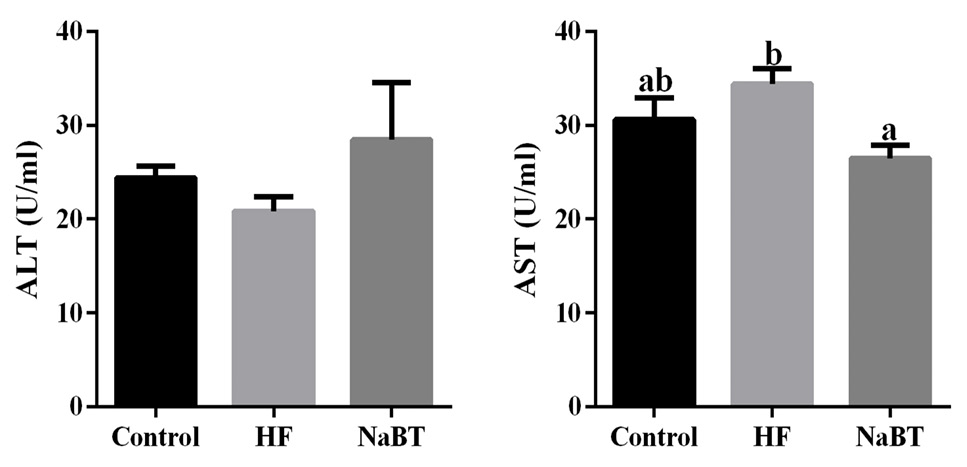
Plasma alanine aminotransferase (ALT) and aspartate aminotransferase (AST) activity levels of common carp fed experimental diets. Control, the control diet; HF, the high-fat diet; NaBT, the high-fat diet added with 0.1% sodium butyrate. Bars marked with different letters are significantly different (P<0.05).
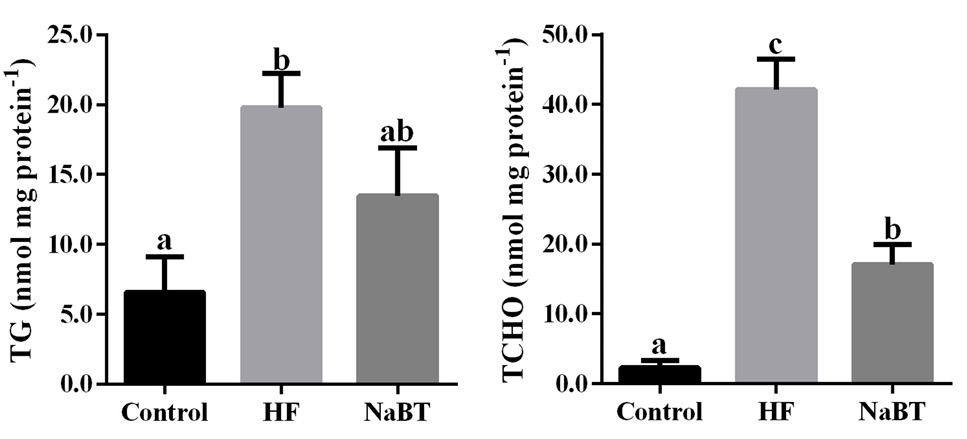
Liver triacylglyceride (TG) and total cholesterol (TCHO) contents of common carp fed experimental diets. Control, the control diet; HF, the high-fat diet; NaBT, the high-fat diet added with 0.1% sodium butyrate. Bars marked with different letters are significantly different (P<0.05).
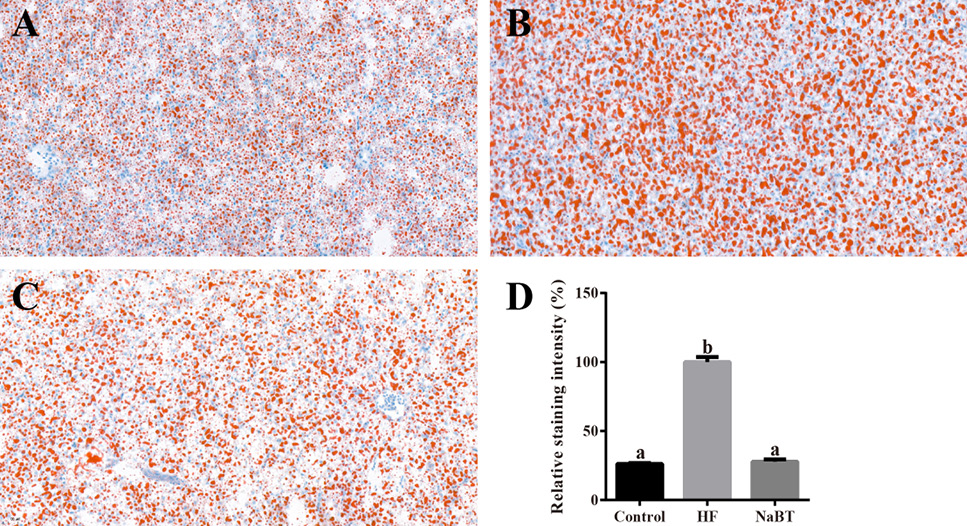
Effect of dietary NaBT supplementation on hepatic lipid accumulation of common carp. Lipid droplets and nuclei are dyed in red and blue by oil red staining, respectively (200× magnification). A, the control diet; B, the high-fat diet; C, the high-fat diet added with 0.1% sodium butyrate. D. lipid accumulation was quantified by measuring the intensity of the stained oil droplets. Bars marked with different letters are significantly different (P<0.05).
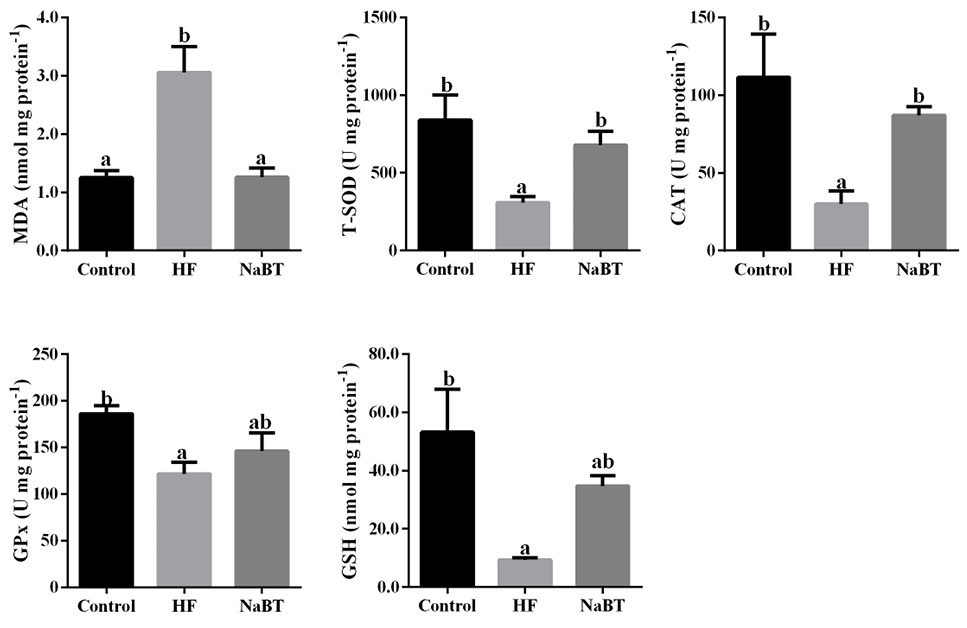
Liver antioxidant status of common carp fed experimental diets. Notes, MDA, malondialdehyde; T-SOD, total superoxide dismutase; CAT, catalase; GPx, glutathione peroxidase; GSH, glutathione. Control, the control diet; HF, the high-fat diet; NaBT, the high-fat diet added with 0.1% sodium butyrate. Bars marked with different letters are significantly different (P<0.05).
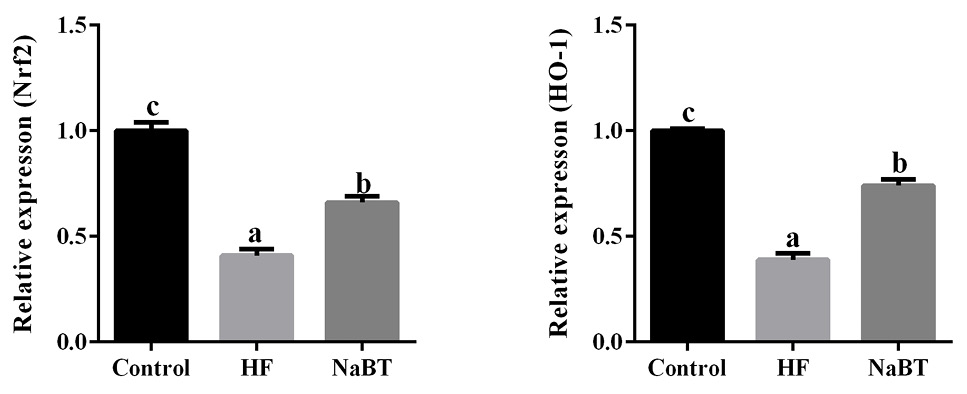
Relative expression of nuclear factor erythroid 2-related factor 2 (Nrf2) and heme oxygenase-1 (HO-1) in liver of common carp fed experimental diets. Control, the control diet; HF, the high-fat diet; NaBT, the high-fat diet added with 0.1% sodium butyrate. Bars marked with different letters are significantly different (P<0.05).
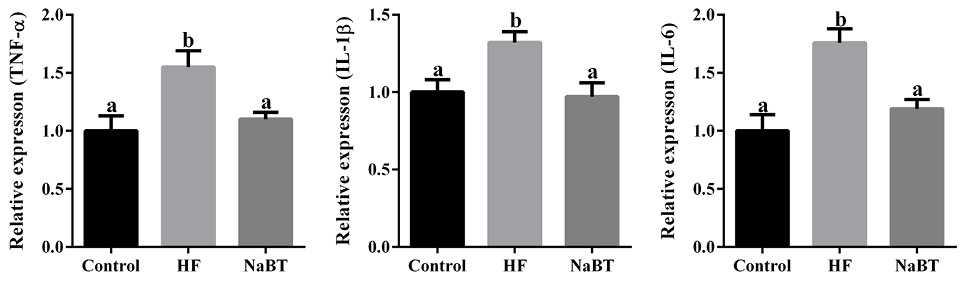
Relative expression of tumor necrosis factor α (TNF-α), interleukin-1β (IL-1β), and IL-6 in liver of common carp fed experimental diets. Control, the control diet; HF, the high-fat diet; NaBT, the high-fat diet added with 0.1% sodium butyrate. Bars marked with different letters are significantly different (P<0.05).
References
- Abasubong, K.P., Li, X.F., Zhang, D.D., Jia, E.T., Xiang-Yang, Y., Xu, C., and Liu, W.B., 2018. Dietary supplementation of xylooligosaccharides benefits the growth performance and lipid metabolism of common carp (Cyprinus carpio) fed high-fat diets. Aquacult. Nutr., 24: 1416-1424. https://doi.org/10.1111/anu.12678[CrossRef]
- Abdel-Latif, H.M.R., Abdel-Tawwab, M., Dawood, M.A.O., Menanteau-Ledouble, S., and El-Matbouli, M., 2020. Benefits of dietary butyric acid, sodium butyrate, and their protected forms in aquafeeds: A review. Rev. Fish. Sci. Aquacult., 28: 421-448. https://doi.org/10.1080/23308249.2020.1758899[CrossRef]
- Allain, C.C., Poon, L.S., Chan, C.S.G., Richmond, W., and Fu, P.C., 1974. Enzymatic determination of total serum cholesterol. Clin. Chem., 20: 470-475. https://doi.org/10.1093/clinchem/20.4.470[CrossRef]
- AOAC, 1995. Official methods of analysis, 16th ed. Association of Official Analytical Chemests, Arlington, VA.
- Ashouri, S., Keyvanshokooh, S., Salati, A.P., Johari, S.A., and Pasha-Zanoosi, H., 2015. Effects of different levels of dietary selenium nanoparticles on growth performance, muscle composition, blood biochemical profiles and antioxidant status of common carp (Cyprinus carpio). Aquaculture, 446: 25-29. https://doi.org/10.1016/j.aquaculture.2015.04.021[CrossRef]
- Biagi, G., Piva, A., Moschini, M., Vezzali, E., and Roth, F.X., 2007. Performance, intestinal microflora, and wall morphology of weanling pigs fed sodium butyrate. J. Anim. Sci., 85: 1184-1191. https://doi.org/10.2527/jas.2006-378[CrossRef]
- Bradford, M.M., 1976. A rapid and sensitive method for the quantitation of microgram quantities of protein utilizing the principle of protein-dye binding. Anal. Biochem., 72: 248-254. https://doi.org/10.1016/0003-2697(76)90527-3[CrossRef]
- Cao, X.F., Liu, W.B., Ai, Q.H., Li, X.S., Li, J.B., Fang, W., Huang, Y.Y., Wang, C.C., and Jiang, G.Z., 2020. High-fat diet-induced inflammation aggravates hepatic steatosis of blunt snout bream (Megalobrama amblycephala) through the transcription regulation of fatty acid synthesis and oxidation. Aquacult.Nutr., 26: 1493-1504. https://doi.org/10.1111/anu.13097[CrossRef]
- Chen, Q.Q., Liu, W.B., Zhou, M., Dai, Y.J., Xu, C., Tian, H.Y., and Xu, W.N., 2016. Effects of berberine on the growth and immune performance in response to ammonia stress and high-fat dietary in blunt snout bream Megalobrama amblycephala. Fish Shellf. Immunol., 55: 165-172. https://doi.org/10.1016/j.fsi.2016.05.023[CrossRef]
- China Fishery Stastical Yearbook, 2020. China fishery statistical yearbook. China Agriculture Press, Beijing, China.
- Craig, S., Helfrich, L.A., 2002. Understanding fish nutrition, feeds and feeding (Publication 420-256). Virginia Cooperative Extension, Yorktown (Virginia).
- Dai, Y.J., Cao, X.F., Zhang, D.D., Li, X.F., Liu, W.B., and Jiang, G.Z., 2019. Chronic inflammation is a key to inducing liver injury in blunt snout bream (Megalobrama amblycephala) fed with high-fat diet. Dev. Comp. Immunol., 97: 28-37. https://doi.org/10.1016/j.dci.2019.03.009[CrossRef]
- Dalmo, R.A., Ingebrigtsen, K., and Bøgwald, J., 1997. Non-specific defence mechanisms in fish, with particular reference to the reticuloendothelial system (RES). J. Fish Dis., 20: 241-273. https://doi.org/10.1046/j.1365-2761.1997.00302.x[CrossRef]
- Dong, W., Jia, Y., Liu, X., Zhang, H., Li, T., Huang, W., Chen, X., Wang, F., Sun, W., and Wu, H., 2017. Sodium butyrate activates NRF2 to ameliorate diabetic nephropathy possibly via inhibition of HDAC. J. Endocrinol., 232: 71-83. https://doi.org/10.1530/JOE-16-0322[CrossRef]
- Du, Z.Y., Clouet, P., Zheng, W.H., Degrace, P., Tian, L.X., and Liu, Y.J., 2006. Biochemical hepatic alterations and body lipid composition in the herbivorous grass carp (Ctenopharyngodon idella) fed high-fat diets. Br. J. Nutr., 95: 905-915. https://doi.org/10.1079/BJN20061733[CrossRef]
- Esterbauer, H., and Cheeseman, K.H., 1990. Determination of aldehydic lipid peroxidation products: Malonaldehyde and 4-hydroxynonenal. Methods Enzymol., 186: 407-421. https://doi.org/10.1016/0076-6879(90)86134-H[CrossRef]
- Fang, W.J., Xue, H.L., Chen, X., Chen, K., and Ling, W.H., 2019. Supplementation with sodium butyrate modulates the composition of the gut microbiota and ameliorates high-fat diet-induced obesity in mice. J. Nutr., 149: 747-754. https://doi.org/10.1093/jn/nxy324[CrossRef]
- FAO, 2020. The state of world fisheries and aquaculture 2020. Food and Agriculture Organization, Rome, Italy.
- Jia, R., Cao, L.P., Du, J.L., He, Q., Gu, Z.Y., Jeney, G., Xu, P., and Yin, G.J., 2020. Effects of high-fat diet on antioxidative status, apoptosis and inflammation in liver of tilapia (Oreochromis niloticus) via Nrf2, TLRs and JNK pathways. Fish Shellf. Immunol., 104: 391-401. https://doi.org/10.1016/j.fsi.2020.06.025[CrossRef]
- Jia, Y., Jing, Q., Niu, H., and Huang, B., 2017. Ameliorative effect of vitamin E on hepatic oxidative stress and hypoimmunity induced by high-fat diet in turbot (Scophthalmus maximus). Fish Shellf. Immunol., 67: 634-642. https://doi.org/10.1016/j.fsi.2017.06.056[CrossRef]
- Jiao, A., Yu, B., He, J., Yu, J., Zheng, P., Luo, Y., Luo, J., Mao, X., and Chen, D., 2020. Short chain fatty acids could prevent fat deposition in pigs via regulating related hormones and genes. Fd. Funct., 11: 1845-1855. https://doi.org/10.1039/C9FO02585E[CrossRef]
- Li, X., Jiang, Y., Liu, W., and Ge, X., 2012. Protein-sparing effect of dietary lipid in practical diets for blunt snout bream (Megalobrama amblycephala) fingerlings: effects on digestive and metabolic responses. Fish Physiol. Biochem., 38: 529-541. https://doi.org/10.1007/s10695-011-9533-9[CrossRef]
- Liu, W., Yang, Y., Zhang, J., Gatlin, D.M., Ringø, E., and Zhou, Z., 2014. Effects of dietary microencapsulated sodium butyrate on growth, intestinal mucosal morphology, immune response and adhesive bacteria in juvenile common carp (Cyprinus carpio) pre-fed with or without oxidised oil. Br. J. Nutr., 112: 15-29. https://doi.org/10.1017/S0007114514000610[CrossRef]
- Liu, Y., Chen, Z., Dai, J., Yang, P., Xu, W., Ai, Q., Zhang, W., Zhang, Y., Zhang, Y., and Mai, K., 2019. Sodium butyrate supplementation in high-soybean meal diets for turbot (Scophthalmus maximus L.): Effects on inflammatory status, mucosal barriers and microbiota in the intestine. Fish Shellf. Immunol., 88: 65-75. https://doi.org/10.1016/j.fsi.2019.02.064[CrossRef]
- Loboda, A., Damulewicz, M., Pyza, E., Jozkowicz, A., and Dulak, J., 2016. Role of Nrf2/HO-1 system in development, oxidative stress response and diseases: an evolutionarily conserved mechanism. Cell. Mol. Life Sci., 73: 3221-3247. https://doi.org/10.1007/s00018-016-2223-0[CrossRef]
- Lu, K.L., Wang, L.N., Zhang, D.D., Liu, W.B., and Xu, W.N., 2017. Berberine attenuates oxidative stress and hepatocytes apoptosis via protecting mitochondria in blunt snout bream Megalobrama amblycephala fed high-fat diets. Fish Physiol. Biochem., 43: 65-76. https://doi.org/10.1007/s10695-016-0268-5[CrossRef]
- Ma, Q., 2013. Role of Nrf2 in oxidative stress and toxicity. Annu. Rev. Pharmacol. Toxicol., 53: 401-426. https://doi.org/10.1146/annurev-pharmtox-011112-140320[CrossRef]
- Matheus, V.A., Monteiro, L.C.S., Oliveira, R.B., Maschio, D.A., and Collares-Buzato, C.B., 2017. Butyrate reduces high-fat diet-induced metabolic alterations, hepatic steatosis and pancreatic beta cell and intestinal barrier dysfunctions in prediabetic mice. Exp. Biol. Med., 242: 1214-1226. https://doi.org/10.1177/1535370217708188[CrossRef]
- Mattace Raso, G., Simeoli, R., Russo, R., Iacono, A., Santoro, A., Paciello, O., Ferrante, M.C., Canani, R.B., Calignano, A., and Meli, R., 2013. Effects of sodium butyrate and its synthetic amide derivative on liver Inflammation and glucose tolerance in an animal model of steatosis induced by high fat diet. PLoS One, 8: e68626. https://doi.org/10.1371/journal.pone.0068626[CrossRef]
- McCord, J.M., and Fridovich, I., 1969. Superoxide dismutase. An enzymic function for erythrocuprein (hemocuprein). J. biol. Chem., 244: 6049-6055. https://doi.org/10.1016/S0021-9258(18)63504-5[CrossRef]
- McGowan, M.W., Artiss, J.D., Strandbergh, D.R., and Zak, B., 1983. A peroxidase-coupled method for the colorimetric determination of serum triglycerides. Clin. Chem., 29: 538-542. https://doi.org/10.1093/clinchem/29.3.538[CrossRef]
- Moeller, A.-M., Korytar, T., Koellner, B., Schmidt-Posthaus, H., and Segner, H., 2014. The teleostean liver as an immunological organ: Intrahepatic immune cells (IHICs) in healthy and benzo a pyrene challenged rainbow trout (Oncorhynchus mykiss). Dev. Comp. Immunol., 46: 518-529. https://doi.org/10.1016/j.dci.2014.03.020[CrossRef]
- Morais, S., Bell, J.G., Robertson, D.A., Roy, W.J., and Morris, P.C., 2001. Protein/ lipid ratios in extruded diets for Atlantic cod (Gadus morhua L.): Effects on growth, feed utilisation, muscle composition and liver histology. Aquaculture, 203: 101-119. https://doi.org/10.1016/S0044-8486(01)00618-4[CrossRef]
- Nasr, A.Y., 2014. Protective effect of aged garlic extract against the oxidative stress induced by cisplatin on blood cells parameters and hepatic antioxidant enzymes in rats. Toxicol. Rep., 1: 682-691. https://doi.org/10.1016/j.toxrep.2014.09.003[CrossRef]
- Pfaffl, M.W., 2001. A new mathematical model for relative quantification in real-time RT–PCR. Nucl. Acids Res., 29: e45. https://doi.org/10.1093/nar/29.9.e45[CrossRef]
- Rauta, P.R., Nayak, B., and Das, S., 2012. Immune system and immune responses in fish and their role in comparative immunity study: A model for higher organisms. Immunol. Lett., 148: 23-33. https://doi.org/10.1016/j.imlet.2012.08.003[CrossRef]
- Reitman, S., and Frankel, S., 1957. A colorimetric method for the determination of serum glutamic oxalacetic and glutamic pyruvic transaminases. Am. J. clin. Pathol., 28: 56-63. https://doi.org/10.1093/ajcp/28.1.56[CrossRef]
- Reuter, S., Gupta, S.C., Chaturvedi, M.M., and Aggarwal, B.B., 2010. Oxidative stress, inflammation, and cancer: how are they linked? Free Radic. Biol. Med., 49: 1603-1616. https://doi.org/10.1016/j.freeradbiomed.2010.09.006[CrossRef]
- Sargent, J.R., Tocher, D.R., and Bell, J.G., 2003. The lipids, In: Fish nutrition (eds. J.E. Halverand R.W. Hardy). 3rd ed. Academic Press, San Diego. pp. 181-257. https://doi.org/10.1016/B978-012319652-1/50005-7[CrossRef]
- Sun, B., Jia, Y., Hong, J., Sun, Q., Gao, S., Hu, Y., Zhao, N., and Zhao, R., 2018. Sodium butyrate ameliorates high-fat-diet-induced non-alcoholic fatty liver disease through peroxisome proliferator-activated receptor alpha-mediated activation of beta oxidation and suppression of inflammation. J. Agric. Fd. Chem., 66: 7633-7642. https://doi.org/10.1021/acs.jafc.8b01189[CrossRef]
- Sun, B., Jia, Y.M., Yang, S., Zhao, N.N., Hu, Y., Hong, J., Gao, S.X., and Zhao, R.Q., 2019. Sodium butyrate protects against high-fat diet-induced oxidative stress in rat liver by promoting expression of nuclear factor E2-related factor 2. Br. J. Nutr., 122: 400-410. https://doi.org/10.1017/S0007114519001399[CrossRef]
- Tian, L., Zhou, X.-Q., Jiang, W.-D., Liu, Y., Wu, P., Jiang, J., Kuang, S.-Y., Tang, L., Tang, W.-N., Zhang, Y.-A., Xie, F., and Feng, L., 2017. Sodium butyrate improved intestinal immune function associated with NF-κB and p38MAPK signalling pathways in young grass carp (Ctenopharyngodon idella). Fish Shellf. Immunol., 66: 548-563. https://doi.org/10.1016/j.fsi.2017.05.049[CrossRef]
- Tran, N.T., Li, Z., Wang, S., Zheng, H., Aweya, J.J., Wen, X., and Li, S., 2018. Progress and perspectives of short-chain fatty acids in aquaculture. Rev. Aquacult., 12: 283-298. https://doi.org/10.1111/raq.12317[CrossRef]
- Urán, P.A., Gonçalves, A.A., Taverne-Thiele, J.J., Schrama, J.W., Verreth, J.A.J., and Rombout, J.H.W.M., 2008. Soybean meal induces intestinal inflammation in common carp (Cyprinus carpio L.). Fish Shellf. Immunol., 25: 751-760. https://doi.org/10.1016/j.fsi.2008.02.013[CrossRef]
- Wang, B., Zhu, X., Kim, Y., Li, J., Huang, S., Saleem, S., Li, R.-c., Xu, Y., Dore, S., Cao, W., 2012. Histone deacetylase inhibition activates transcription factor Nrf2 and protects against cerebral ischemic damage. Free Radic. Biol. Med., 52: 928-936. https://doi.org/10.1016/j.freeradbiomed.2011.12.006[CrossRef]
- Wang, Y.J., Chien, Y.H., and Pan, C.H., 2006. Effects of dietary supplementation of carotenoids on survival, growth, pigmentation, and antioxidant capacity of characins, Hyphessobrycon callistus. Aquaculture, 261: 641-648. https://doi.org/10.1016/j.aquaculture.2006.08.040[CrossRef]
- Welengane, E., Sado, R.Y., and de Almeida Bicudo, A.J., 2019. Protein-sparing effect by dietary lipid increase in juveniles of the hybrid fish tambatinga (female Colossoma macropomum x male Piaractus brachypomus). Aquacult. Nutr., 25: 1272-1280. https://doi.org/10.1111/anu.12941[CrossRef]
- Wu, J., Jiang, Z., Zhang, H., Liang, W., Huang, W., Zhang, H., Li, Y., Wang, Z., Wang, J., Jia, Y., Liu, B., and Wu, H., 2018. Sodium butyrate attenuates diabetes-induced aortic endothelial dysfunction via P300-mediated transcriptional activation of Nrf2. Free Radic. Biol. Med., 124: 454-465. https://doi.org/10.1016/j.freeradbiomed.2018.06.034[CrossRef]
- Yaku, K., Matsui-Yuasa, I., Konishi, Y., and Kojima-Yuasa, A., 2013. AMPK synergizes with the combined treatment of 1’-acetoxychavicol acetate and sodium butyrate to upregulate phase II detoxifying enzyme activities. Mol. Nutr. Fd. Res., 57: 1198-1208. https://doi.org/10.1002/mnfr.201200809[CrossRef]
- Ze, F., Jinghui, L., Zhenyan, C., Baolong, Z., Mu, Q., Jinhui, S., Dongqing, B.A.I., and Xiuting, Q., 2015. Protein sparing effect of lipid in diets for common carp (Cyprinus carpio). Proceedings of the 2015 International Symposium on Energy Science and Chemical Engineering. Atlantis Press, pp. 357-368.
- Zhai, S., Qin, S., Li, L., Zhu, L., Zou, Z., and Wang, L., 2019. Dietary butyrate suppresses inflammation through modulating gut microbiota in high-fat diet-fed mice. FEMS Microbiol. Lett., 366. https://doi.org/10.1093/femsle/fnz153[CrossRef]
- Zhang, J., Zhong, L., Chi, S., Chu, W., Liu, Y., and Hu, Y., 2020. Sodium butyrate supplementation in high-soybean meal diets for juvenile rice field eel (Monopterus albus): Effects on growth, immune response and intestinal health. Aquaculture, 520: 734952. https://doi.org/10.1016/j.aquaculture.2020.734952[CrossRef]
- Zhong, Y., Pan, Y., Liu, L., Li, H., Li, Y., Jiang, J., Xiang, J., Zhang, J., and Chu, W., 2020. Effects of high fat diet on lipid accumulation, oxidative stress and autophagy in the liver of Chinese softshell turtle (Pelodiscus sinensis). Comp. Biochem. Physiol. B Biochem. mol. Biol., 240: 110331. https://doi.org/10.1016/j.cbpb.2019.110331[CrossRef]
- Zhou, D., Pan, Q., Xin, F.-Z., Zhang, R.-N., He, C.-X., Chen, G.-Y., Liu, C., Chen, Y.-W., and Fan, J.-G., 2017. Sodium butyrate attenuates high-fat diet-induced steatohepatitis in mice by improving gut microbiota and gastrointestinal barrier. World J. Gastroenterol., 23: 60-75. https://doi.org/10.3748/wjg.v23.i1.60[CrossRef]
- Zhou, D., Chen, Y.-W., Zhao, Z.-H., Yang, R.-X., Xin, F.-Z., Liu, X.-L., Pan, Q., Zhou, H., and Fan, J.-G., 2018. Sodium butyrate reduces high-fat diet-induced non-alcoholic steatohepatitis through upregulation of hepatic GLP-1R expression. Exp. mol. Med., 50: 1-12. https://doi.org/10.1038/s12276-018-0183-1[CrossRef]
- Zhou, Y.L., Guo, J.L., Tang, R.J., Ma, H.J., Chen, Y.J., and Lin, S.M., 2020. High dietary lipid level alters the growth, hepatic metabolism enzyme, and anti-oxidative capacity in juvenile largemouth bass Micropterus salmoides. Fish Physiol. Biochem., 46: 125-134. https://doi.org/10.1007/s10695-019-00705-7[CrossRef]
Services
Article usage statistics
Loading…