
In this study, sixteen SNP (single nucleotide polymorphism) markers were developed from EST (expressed sequence tag) database of Portunus trituberculatus. Polymorphism evaluation was tested on 30 wild individuals of P.trituberculatus collected from Xiangshan, Zhejiang province, China. The minor allele frequency ranged between 0.292 and 0.500, with an average of 0.384. The expected and observed heterozygosities (He and Ho) ranged from 0.422 to 0.545 and from 0.000 to 1.000 respectively. Four loci were found deviate significantly from Hardy-Weinberg equilibrium. Blast results give significant hits for nine confirmed SNP-associated sequences, some of these genes are associated with important immunological functions. These EST-derived SNP markers will be useful tools for fisheries management and conservation programme of P.trituberculatus.
Short Communication · Volume 54, Issue 2, 27 January 2022 · Open Access
Development of Expressed Sequence Tag-Single Nucleotide Polymorphism Markers in Swimming Crab, Portunus trituberculatus
· · · ·
Affiliations & Notes ⌄
- 1Key Laboratory of Applied Marine Biotechnology, Ministry of Education, Ningbo University, Ningbo 315211, China 2Collaborative Innovation Center for Zhejiang Marine High-efficiency and Healthy Aquaculture, Ningbo University, Ningbo 315211, China * Corresponding author: lironghua@nbu.edu.cn
Article Info ⌄
- Journal:
- Pakistan Journal of Zoology
- Published:
- 27 January 2022

From the article
- Here, we report 16 SNP markers in P. trituberculatus which will provide a useful complement to currently available genetic markers.
- Analysis of gene-based single nucleotide polymorphisms (SNPs) is one of the efficient approaches for discovery of markers that can be used for MAS.
- In this study, blast results give significant hits for nine confirmed SNP-associated sequences, some of these genes are associated with important immunological functions, such as hemocyanin, lectin and anti-lipopolysaccharide factor, which provide useful resources for MAS programs of P. trituberculatus.
- In conclusion, these polymorphic EST-derived SNP markers we developed in the present study were expected to be valuable for researches involving population genetic diversity and marker assisted selection programs of P. trituberculatus.
Selected from the article's own text.
Abstract
Material and methods
A total of 14,340 P. trituberculatus EST sequences were downloaded from GeneBank. The EST dataset was aligned and assembled using SeqMan Pro sequence assembly software (DNASTAR Inc., Madison, WI, USA). The contigs that contained four or more sequences were identified for searching candidate SNPs upon visual inspection. In total, 176 sequences with sufficient flanking regions were selected for primer design with PRIMER 5.0 program (http://www.premierbiosoft. com/).
Polymorphism evaluation was tested using 30 wild individuals of adult P. trituberculatus collected randomly from Xiangshan, Zhejiang province, China. Genomic DNA was extracted from the muscle tissue by using a genomic DNA extraction kit (Bio Teke, Beijing, China) following the manufacturer protocols. Polymerase chain reaction (PCR) was performed in 10-μL volumes containing 2×Power Taq PCR Master Mix (Bio Teke, Beijing, China) 5μL, 1μM of each primer set, and about 100ng template DNA. PCR was performed on a Master-cycler gradient thermal cycler (Eppendorf) with the following program: 3 min at 94 °C; 35 cycles of 1 min at 94°C, annealing at 55°C for 1 min, 72°C for 1 min per cycle; followed by 5 min at 72°C. Amplification products were resolved via 2% agarose gel, DL2000 DNA Marker (Takara, Dalian, China) was used as a reference marker for allele size determination. PCR products of clear bands and predicted length were then sequenced in both directions with forward and reverse primers using Sanger technology on the ABI3730 platform (Applied Biosystems).
Alignment of the sequenced fragments was performed using Vector NTI 10.0 (Invitrogen, Carlsbad, CA), and putative SNPs were checked manually. Minor allele frequency (MAF), expected and observed heterozygosities (He and Ho, respectively) were calculated with the software CERVUS 3.0 . Test for deviation from Hardy-Weinberg equilibrium (HWE) and linkage disequilibrium at each locus were performed using GENEPOP 4.0.10 . Sequential Bonferroni corrections were applied for all multiple tests (P<0.05). The putative functions of SNP-associated sequences were searched against the NCBI database (http://www. ncbi.nlm.nih.gov) with E-value of <1.00 E-7 using BLASTX.
Results and discussion
SNP markers provide a powerful resource for genetic researches of genome-wide linkage disequilibrium and association studies, population structure estimation, marker-assisted breeding, individual identification and parentage analysis. In this study, 176 primer pairs were designed. Among them, 39 primer pairs provided readable sequences, and 10 sequences containing 16 polymorphic SNPs were confirmed successfully (Table І).
The minor allele frequency ranged between 0.292 and 0.500, with an average of 0.384. The expected and observed heterozygosities (He and Ho) ranged from 0.422 to 0.545 and from 0.000 to 1.000 respectively. Significant departure from HWE was found at four loci after Bonferroni correction for multiple tests. Significant pairwise linkage disequilibrium was detected in SNPs from the same sequences (PtSNP1a and PtSNP1b, PtSNP2a and PtSNP2b, PtSNP5a and PtSNP5b, PtSNP7a and PtSNP7b), which should be considered when used for population genetics and parentage studies.
To date, genetic markers for population studies of P. trituberculatus have been generally limited to mitochondrial DNA gene and microsatellites ; . By taking advantage of EST database, EST-derived SNPs can be easily discovered, which possess a number of advantages for the study of population structure . Here, we report 16 SNP markers in P. trituberculatus which will provide a useful complement to currently available genetic markers.
Analysis of gene-based single nucleotide polymorphisms (SNPs) is one of the efficient approaches for discovery of markers that can be used for MAS. In aquatic species, association between SNP in functionally important genes and immune response was reported in many species ; ; ; . In this study, blast results give significant hits for nine confirmed SNP-associated sequences, some of these genes are associated with important immunological functions, such as hemocyanin, lectin and anti-lipopolysaccharide factor, which provide useful resources for MAS programs of P. trituberculatus.
In conclusion, these polymorphic EST-derived SNP markers we developed in the present study were expected to be valuable for researches involving population genetic diversity and marker assisted selection programs of P. trituberculatus.
Acknowledgements
This work was supported by the Grants from Ministry of Agriculture of China & China Agriculture Research System (no: CARS-48), Natural Science Foundation of Zhejiang Province (LY17C190005), Major Program of Ningbo (2017C110007, 2016C10037), Open Fund of Zhejiang Provincial Top Key Discipline of Aquaculture in Ningbo University (xkzsc1505) and KC Wong Magana Fund in Ningbo University.
Statement of conflict of interest
Authors have declared no conflict of interest.
Figures
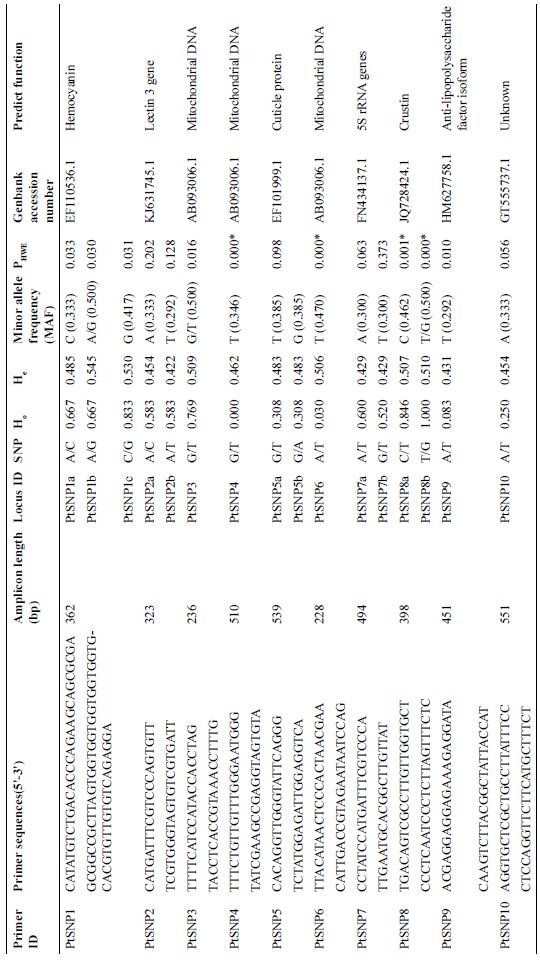
Characterization of 16 SNP markers in swimming crab, Portunus trituberculatus.
Ho: observed heterozygosity; He: expected heterozygosity; * Significant deviation from HWE after Bonferroni correction (P < 0.05).
References
- Dai, A.Y., Yang. S.L. and Song, Y.Z., 1986. Marine crabs in China Sea. Marine Publishing Company, Beijing, pp. 213-221.
- Glenn, K.L., Grapes, L., Suwanasopee, T., Harris, D.L., Li, Y., Wilson, K. and Rothschild, M.F., 2005. Anim. Genet., 36: 235-236. https://doi.org/10.1111/j.1365-2052.2005.01274.x[CrossRef]
- Guo, E., Cui, Z., Wu, D., Hui, M., Liu, Y. and Wang, H., 2013. Biochem. Syst. Ecol., 50: 313-321. https://doi.org/10.1016/j.bse.2013.05.006[CrossRef]
- Hao, G., Lin, F., Mu, C., Li, R., Yao, J., Yuan, X., Pan, X., Shen, J. and Wang, C., 2015. Aquaculture, 442: 125-131. https://doi.org/10.1016/j.aquaculture.2015.02.007[CrossRef]
- Houston, R.D., Taggart, J.B., Cézard, T., Bekaert, M., Lowe, N.R., Downing, A., Talbot, R., Bishop, S.C., Archibald, A.L., Bron, J.E., Penman, D.J., Davassi, A., Brew, F., Tinch, A.E., Gharbi, K. and Hamilton, A., 2014. BMC Genomics, 15: 90. https://doi.org/10.1186/1471-2164-15-90[CrossRef]
- Jin, M., Wang, M.Q., Huo, Y.W., Huang, W.W., Mai, K.S. and Zhou, Q.C., 2015. Aquaculture, 448: 1-7. https://doi.org/10.1016/j.aquaculture.2015.05.021[CrossRef]
- Kalinowski, S.T., Taper, M.L. and Marshall, T.C., 2007. Mol. Ecol., 16: 1099-1106. https://doi.org/10.1111/j.1365-294X.2007.03089.x[CrossRef]
- Leitwein, M., Gunand, B., Pouzadoux, J., Desmarais, E., Berrebi, P. and Gagnaire, P.A. 2017. G3, 7: 1365–1376. https://doi.org/10.1534/g3.116.038497[CrossRef]
- Li, X., Cui, Z., Liu, Y., Song, C., Shi, G. and Wang, C., 2013. Fish Shellf. Immunol., 34: 1560-1568. https://doi.org/10.1016/j.fsi.2013.03.373[CrossRef]
- Liu, L., Li, J., Liu, P., Zhao, F.Z., Gao, B.Q. and Du, Y., 2012. Aquaculture, 344: 66-81. https://doi.org/10.1016/j.aquaculture.2012.01.034[CrossRef]
- Liu, L., Li, J., Liu, P., Zhao, F.Z., Gao, B.Q. and Du, Y., 2015. Aquacul. Res., 46: 850-860. https://doi.org/10.1111/are.12239[CrossRef]
- Morin, P.A., Luikar,t G., Wayne, R.K. and TSW Group, 2004. Trends Ecol. Evol., 19: 208-216. https://doi.org/10.1016/j.tree.2004.01.009[CrossRef]
- Mu, C., Song, W., Li, R., Chen, Y., Hao, G. and Wang, C., 2014. Aquaculture, 426–427: 148-153. https://doi.org/10.1016/j.aquaculture.2014.01.006[CrossRef]
- Morin, P.A., Luikart, G., Wayne, R.K. and SNP Workshop Group, 2004. Trends Ecol. Evol., 19: 208-216. https://doi.org/10.1016/j.tree.2004.01.009[CrossRef]
- Raymond, M. and Rousset, F., 1995. J. Hered., 86: 248-249. https://doi.org/10.1093/oxfordjournals.jhered.a111573[CrossRef]
- Rice, R.W., 1989. Evolution, 43: 223-225. https://doi.org/10.1111/j.1558-5646.1989.tb04220.x[CrossRef]
- Salem, M., Vallejo, R.L., Leeds, T.D., Palti, Y., Liu, S., Sabbagh, A., Rexroad, C.E 3rd. and Yao, J., 2012. PLoS One, 7: e36264-e36264. https://doi.org/10.1371/journal.pone.0036264[CrossRef]
- Santos, C.A., Andrade, S.C.S. and Freitas, P.D., 2018. Peer J., 6: e5154. https://doi.org/10.7717/peerj.5154[CrossRef]
- Sauvage, C., Bierne, N., Lapegue, S. and Boudry, P. 2007. Gene, 406: 13-22. https://doi.org/10.1016/j.gene.2007.05.011[CrossRef]
- Xu, Q.H., Liu, R.L. and Liu, Y., 2009. J. Exp. Mar. Bio. Ecol., 371: 121-129. https://doi.org/10.1016/j.jembe.2009.01.014[CrossRef]
- Yu, H., He, Y., Wang, X., Zhang, Q., Bao, Z. and Guo, X., 2011. Fish Shellf. Immunol., 30: 757–762. https://doi.org/10.1016/j.fsi.2010.12.015[CrossRef]
Services
Article usage statistics
Loading…