
Imported fish feeds entering Iraq through the Al-Shaib border crossing were evaluated for compliance with national mycotoxin limits. Samples were collected under the supervision of the Animal Resources Department and analyzed at the Wasit Quality Control Laboratory from June to September using Veratox® quantitative ELISA kits specific for each mycotoxin. All samples contained detectable but very low levels of the target mycotoxins, with mean concentrations ranging from 0.286 to 0.857 ppb for aflatoxins, 1.378 to 15.39 ppb for T 2/HT 2, and 0.150 to 0.312 ppb for ochratoxin A, which are well below the Iraqi permissible limits of 20, 100, and 5 ppb, respectively. Some seasonal variation was observed, including slightly higher aflatoxin and ochratoxin A concentrations in July and a transient decrease in T 2/HT 2, but none approached regulatory thresholds. Overall, these findings indicate that imported fish feeds examined during the study period complied with national mycotoxin standards, while underscoring the importance of routine border control monitoring to protect fish health, aquaculture productivity, and public health.
Research Article · Volume 12, Issue 1, 28 June 2026 · Open Access
Detection of Mycotoxins in Imported Fish Feeds Analyzed by the Quality Control Laboratories, Wasit Province, Iraq
· · · · ·
Affiliations & Notes ⌄
- 1Department of Animal Resources, Ministry of Agriculture, Iraq
- 2Department of Agricultural Biotechnology, Kut-Technical Institute, Middle Technical University, Iraq
- 3State Company for Private Transport, Ministry of Transport, Thi-Qar, Iraq. *Correspondence | Raad M. Sayed Lafi, State Company for Private Transport, Ministry of Transport, Thi-Qar, Iraq
- 4Email: Raadelsayed@hotmail.com
Article Info ⌄
- Journal:
- Veterinary Sciences: Research and Reviews
- Published:
- 28 June 2026
From the article
- In this study, Table 2 presents the levels of mycotoxins in imported fish feed samples analyzed at the Quality Control Laboratory in Wasit during June, July, August, and September, following activation of the laboratory.
- This study demonstrated that imported fish feeds entering Iraq through the Al-Shaib border crossing contained detectable but very low levels of aflatoxins, T-2/HT-2 toxin, and ochratoxin A, with all values remaining well below the national permissible limits during the monitoring period.
- The generally low contamination suggests that current preventive measures during production, transport, and storage are effective in limiting mycotoxin exposure in imported feeds.
- However, the observed seasonal fluctuations, together with Iraq’s growing dependence on imported feed ingredients under climate-induced pressure on local agriculture, underline the need for continuous mycotoxin surveillance at border crossings and feed reception centers.
Selected from the article's own text.
Abstract
Introduction
Fish production in aquaculture has increased rapidly over recent decades, leading to a parallel rise in the number of farmed fish and, consequently, a growing demand for formulated feeds . To meet this demand, aquaculture increasingly relies on compound feeds rich in plant-derived ingredients, which are particularly prone to fungal contamination and, therefore, to mycotoxin occurrence, as a result, mycotoxins are now commonly detected in such feeds, especially those based on cereals and oilseed by-products .
The problem of mycotoxin contamination in feed ingredients is believed to have worsened due to climate change and the globalization of trade, which facilitates the spread of toxigenic fungal species and often leads to higher contamination levels in grains . Several mycotoxins also show considerable stability during heat treatment, and improper storage of both raw materials and finished feeds further contributes to increased levels of these toxins in fish feeding systems . Mycotoxin production depends on the toxigenic capacity of specific fungi and on environmental conditions, including physical, chemical, and biological factors ; . Moreover, processing steps such as cleaning, sorting, grinding, and thermal treatment can influence fungal growth and mycotoxin levels in final products. At the same time, while contamination often starts in the field and may be aggravated by inadequate storage .
The most important mycotoxins found in feed ingredients due to their known toxicity and frequent occurrence at high concentrations include aflatoxin B1 (AFB1), deoxynivalenol (DON), nivalenol (NIV), zearalenone (ZEN), ochratoxin A (OTA), T-2 toxin (T-2), fumonisin B1 (FB1), moniliformin (MON), enniatins (ENNs), and beauvericin (BEA) ; . Mycotoxins in contaminated feeds can severely impair fish health and performance, causing reduced growth, increased mortality, immunosuppression, and damage to the liver, spleen, and kidneys, as well as DNA damage and carcinogenic effects; Mycotoxins present in contaminated feeds can severely impair fish health and performance and, in some cases, may also be transferred from feed to edible tissues, making fish consumption a potential route of mycotoxin entry into the human food chain ; . In addition, mycotoxin contamination can markedly reduce animal productivity , underlining the need to control aflatoxin levels in feeds, apply good agricultural practices, and implement effective post-harvest and storage strategies.
Accordingly, there is a need to monitor mycotoxin contamination in imported aquafeeds under local conditions. In this context, monitoring mycotoxin contamination in imported aquafeeds under local climatic and storage conditions is crucial, the present study aimed to qualitatively and quantitatively detect the major mycotoxins aflatoxin, ochratoxin A, and T-2/HT-2 toxins in imported fish feeds entering Iraq through the Al-Shaib border crossing, to compare the detected levels with international maximum permissible limits, and to provide reliable laboratory data to support regulatory decisions by the Quality Control Laboratories, Wasit Branch.
Materials and Methods
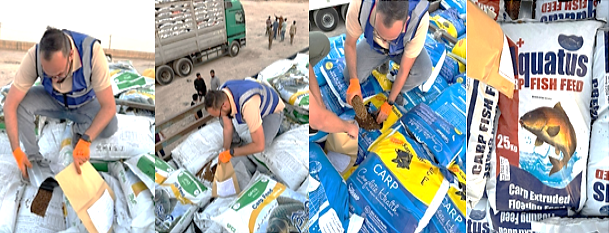
The study was conducted at the Quality Control Laboratory, Wasit Branch, under the supervision of the Director of the Animal Resources Department. Fish feed samples were collected at the Al-Shaib border crossing upon arrival of imported feed trucks, after recording all relevant shipment information, including producing company, product details, and truck identification numbers (Figure 1).
The collected samples were then transported to the Quality Control Laboratory in Wasit to evaluate their suitability and freedom from mycotoxins. At the laboratory, samples were analyzed for aflatoxins, ochratoxin A, and T-2/HT-2 toxins using the specific inspection methods assigned to each test in order to decide whether shipments should be accepted or rejected (Table 1).
All analyses were performed according to the manufacturer’s instructions provided in the kit manuals for each specific mycotoxin.
Statistical analysis
The Statistical Analysis System (SAS, 2018) program was used to detect the effect of different months in parameters study. Duncan’s multiple range (ANOVA: Completely randomized design-CRD) was used to significantly compare between means at probability on 0.05 and 0.01. The following statistical model:
Yij = µ + Ti + eij.
Where; Yii is the observed value of the j-th experimental unit under the i-th treatment (month), μ is the overall mean, Ti is the fixed effect of treatment (month), and eij is the random error term, assumed to be normally distributed with mean zero and variance σe2.
Results and Discussion
In this study, Table 2 presents the levels of mycotoxins in imported fish feed samples analyzed at the Quality Control Laboratory in Wasit during June, July, August, and September, following activation of the laboratory. All tested samples remained within the permissible limits specified in the Iraqi standard, and the generally low mycotoxin concentrations are likely related to preventive measures applied during feed production, storage, and transport in this period . Mean toxin levels were very low, reaching 0.286, 12.84, and 0.195 ppb for aflatoxins, T-2/HT-2 toxin, and ochratoxin A, respectively, which are all below the corresponding maximum limits of <20 ppb, 100 ppb, and 5 ppb set for these toxins.
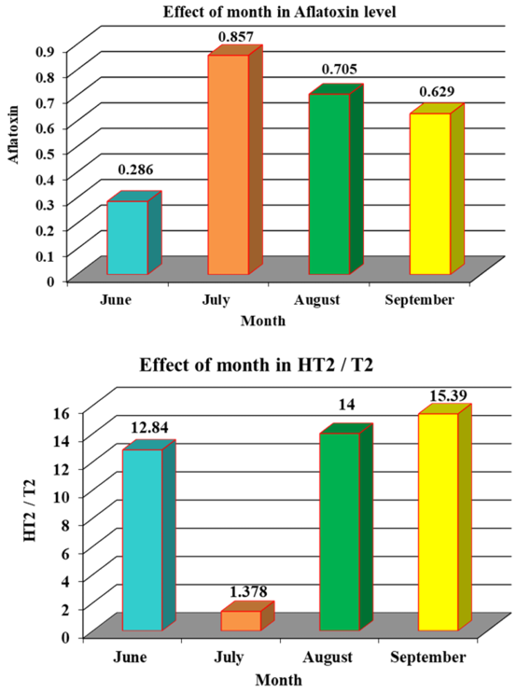
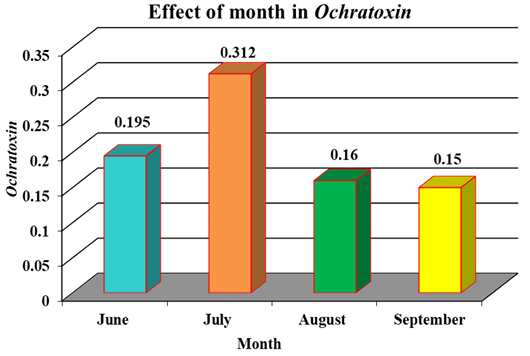
A slight but statistically significant increase (P≤0.05) in aflatoxin concentration was observed in July and August, with mean values of 0.857 and 0.705 ppb, respectively, compared with June and September. However, these values remained far below the permissible limit of 20 ppb, indicating that aflatoxin contamination in the analyzed samples did not pose an immediate regulatory concern. For T-2/HT-2 toxin, levels decreased significantly (P ≤ 0.01) in July, reaching 1.378 ppb compared with 15.39 ppb in September, which is still below the maximum limit of 100 ppb. However, Ochratoxin A showed a significant increase (P≤0.05) in July (0.312 ppb) compared with September, which recorded the lowest mean level (0.150 ppb); nevertheless, all values remained within the permissible range for ochratoxin A (<5 ppb).
Overall, these findings indicate that, during the study period, imported fish feeds entering through the Al-Shaib border crossing were compliant with current national safety standards for aflatoxins, T-2/HT-2 toxin, and ochratoxin A. Although low-level mycotoxin contamination has been reported to potentially affect fish health under prolonged exposure, the concentrations detected here suggest a low immediate risk from a regulatory perspective, while still underscoring the importance of continuous monitoring and preventive measures along the feed supply chain.
Table 1: Kit Information for the Detection of Aflatoxin, Ochratoxin A, and T2/HT-2 Toxins in imported fish feeds.
| Test type | Aflatoxins | Ochratoxin A | T-2/HT-2 toxins |
| Kit name | Veratox® for Aflatoxin | Veratox® for Ochratoxin A | Veratox® for T-2/HT-2 Toxins |
| Manufacturer | NEOGEN Corporation, Lansing, MI, USA (food safety diagnostic company; https://www.neogen.com) | Same as aflatoxin kit | Same as aflatoxin kit |
| Principle | Quantitative ELISA (enzyme-linked immunosorbent assay) | Quantitative ELISA | Quantitative ELISA |
| Storage | 2–8 °C (refrigerated) | 2–8 °C | 2–8 °C |
| Country of origin | United States of America | United States of America | United States of America |
Table 2: Levels (mean ± SE) of aflatoxins, T-2/HT-2 toxin, and ochratoxin A (ppb) in imported fish feeds from June to September, compared with the Iraqi permissible limits (20, 100, and 5 ppb, respectively).
| Month | Aflatoxins (20 ppb) | T-2/HT-2 (100 ppb) | Ochratoxin A (5 ppb) |
| June | 0.286 ± 0.12 b | 12.84 ± 4.35 a | 0.195 ± 0.05 ab |
| July | 0.857 ± 0.21 a | 1.378 ± 0.48 b | 0.312 ± 0.07 a |
| August | 0.705 ± 0.19 a | 14.00 ± 3.87 a | 0.160 ± 0.06 ab |
| September | 0.629 ± 0.12 ab | 15.39 ± 1.62 a | 0.150 ± 0.04 b |
Means within the same column bearing different superscript letters differ significantly. * P ≤ 0.05, ** P ≤ 0.01 (Duncan’s multiple range test).
In addition to evaluating individual mycotoxin levels, it is important to consider the risks associated with chronic exposure and the co-occurrence of multiple mycotoxins. Although the concentrations detected in the present study were below established permissible limits, prolonged exposure to low levels of mycotoxins may still induce subclinical effects in fish, including reduced growth performance, immunosuppression, and increased susceptibility to diseases ; . These effects are often cumulative and may not be immediately evident, particularly under intensive aquaculture conditions. Furthermore, the co-occurrence of multiple mycotoxins in feed may result in additive or synergistic toxic effects, potentially enhancing their overall impact even when individual toxin levels remain within safe limits ; . Therefore, assessing mycotoxin contamination based solely on individual regulatory thresholds may underestimate the actual risk, highlighting the need for integrated monitoring approaches that consider combined exposure scenarios.
The seasonal pattern of mycotoxin levels is further illustrated in Figure 2. The highest aflatoxin concentrations were recorded in July and August, whereas the lowest mean value occurred in June, with September showing an intermediate level. This pattern may be related to the high temperatures and relatively variable humidity prevailing during midsummer, as such conditions can favor the growth of Aspergillus flavus and Aspergillus parasiticus, the main aflatoxin-producing fungi . Maintaining storage conditions at a relative humidity below about 60% is generally recommended to minimize aflatoxin contamination and ensure feed safety during storage and transport .
Previous studies have reported that aflatoxin-producing fungi are active over a wide temperature range, roughly between 20–37 °C, with maximum aflatoxin production typically occurring around 25–30 °C when moisture and relative humidity are sufficiently high ; . These environmental conditions are often encountered in Iraq during the summer months, particularly in inadequately conditioned warehouses or during transport across border crossings, which may help explain the modest increase in aflatoxin levels observed in July and August. In contrast, HT-2/T-2 toxin levels showed a significant decrease in July compared with other months, in agreement with reports suggesting that hot and dry conditions can reduce the prevalence of HT-2/T-2 contamination in stored commodities .
Regarding ochratoxin A, the results of the quality control laboratory (Figure 3) showed that the highest mean level was recorded in July, whereas the lowest level was observed in September. July in Iraq is characterized by relatively high ambient temperatures, which, together with suboptimal storage conditions, can promote the growth of ochratoxin A–producing fungi in stored commodities ; ; . This pattern is similar to the one observed for aflatoxins, where warm conditions and inadequate storage may favor fungal development and toxin formation.
To minimize this risk, mycotoxin testing is routinely performed on imported feed samples before they are used in fish farming, and appropriate storage conditions such as controlled humidity, adequate ventilation, and good warehouse management are recommended to limit fungal growth and ochratoxin A production . However, Abdulhameed et al. (2023) further emphasized that mycotoxins represent a global public-health concern, and that residues in animal feeds are critical within food-safety frameworks that call for strict adherence to regulations governing the feed–food chain in commercial markets and feed reception centers.
Given the impact of global climate change over the past years, Iraq has been significantly affected by heat waves and reduced rainfall, leading to drought and a consequent decline in agricultural activity and livestock numbers. The country has become heavily dependent on international trade to supply consumers and farmers with essential feed ingredients .
Conclusion
This study demonstrated that imported fish feeds entering Iraq through the Al-Shaib border crossing contained detectable but very low levels of aflatoxins, T-2/HT-2 toxin, and ochratoxin A, with all values remaining well below the national permissible limits during the monitoring period. The generally low contamination suggests that current preventive measures during production, transport, and storage are effective in limiting mycotoxin exposure in imported feeds. However, the observed seasonal fluctuations, together with Iraq’s growing dependence on imported feed ingredients under climate-induced pressure on local agriculture, underline the need for continuous mycotoxin surveillance at border crossings and feed reception centers. Strengthening routine testing, enforcing good storage and handling practices, and maintaining clear regulatory criteria will be critical to safeguarding fish health, sustaining aquaculture productivity, and protecting public health along the feed–food chain.
Acknowledgments
We would like to express our sincere gratitude to Prof. Dr. Nasr N. Al-Anbari, Department of Animal Breeding, Statistics and Genetics, College of Agricultural Engineering Sciences, University of Baghdad, Iraq, for his valuable assistance in performing the statistical analyses for this study.
Novelty Statement
This study provides the first systematic, border-level surveillance data on multiple mycotoxins in imported fish feeds entering Iraq through the Al-Shaib crossing, demonstrating that aflatoxins, T2/HT2, and ochratoxin A are consistently present at trace but sub-regulatory levels and exhibit seasonal fluctuations while still complying with national limits, thereby validating the current border-control system and highlighting its critical role in safeguarding fish health and aquaculture biosecurity.
Author’s Contribution
All Authors contributed equally to the manuscript.
Generative AI and AI assisted technology statement
Conflict of interest
The authors have declared no conflict of interest.
Figures
References
- Abdulhameed, M.F., Sayhood, M.H. and Al-Wan, N.A., 2023. Mycotoxins hazard assessment of feedstuffs from multiple sources products commercially imported for Iraq. Al-Mustansiriyah J. Sci., 33: 101–107. https://doi.org/10.23851/mjs.v33i5.1323[CrossRef]
- Ali, M.D., Al-Musawi, M.L., Fouad, F.A., Kalifd, A.H., Abdulla, K.G., Kanaan, H.M. and Hassan, Z.A.A., 2017. Comparison of mycotoxin contamination levels of local and imported corn in Iraq. Technol. Sci. Am. Sci. Res. J. Eng., 28: 181–186.
- Alshannaq, A. and Yu, J.H., 2017. Occurrence, toxicity, and analysis of major mycotoxins in food. Int. J. Environ. Res. Public Health, 14(6): 632. https://doi.org/10.3390/ijerph14060632[CrossRef]
- Czerwiecki, L., Czajkowska, D., Witkowska-Gwiazdowska, A., 2002. On Ochratoxin A A and fungal flora in Polish cereals from conventional and ecological farms. Part 1: Occurrence of ochratoxin A A and fungi in cereals in 1997. Food Addit. Contam., 19: 470–477. https://doi.org/10.1080/02652030110113726[CrossRef]
- Dobolyi, C., Sebok, F., Varga, J., Kocsubé, S., Szigeti, G., Baranyi, N., Szécsi, A., Tóth, B., Varga, M., Kriszt, B., Szoboszlay, S., Krifaton, C. and Kukolya, J., 2013. Occurrence of aflatoxin producing Aspergillus flavus isolates in maize kernel in Hungary. Acta Aliment. 42: 451–459. https://doi.org/10.1556/AAlim.42.2013.3.18[CrossRef]
- Grenier, B. and Oswald, I.P., 2011. Mycotoxin co-contamination of food and feed: Meta-analysis of publications describing toxicological interactions. World Mycotoxin J., 4(3): 285–313. https://doi.org/10.3920/WMJ2011.1281[CrossRef]
- Hjelkrem, A.G.R., Aamot, H.U., Brodal, G., Strand, E.C., Torp, T., Edwards, S.G., Dill-Macky, R. and Hofgaard, I.S., 2018. HT-2 and T-2 toxins in Norwegian oat grains related to weather conditions at different growth stages. Eur. J. Plant Pathol., 151: 501–514. https://doi.org/10.1007/s10658-017-1394-3[CrossRef]
- Mannaa, M. and Kim, K.D., 2017. Influence of temperature and water activity on deleterious fungi and mycotoxin production during grain storage. Mycobiology, 45: 240–254. https://doi.org/10.5941/MYCO.2017.45.4.240[CrossRef]
- Mousa, W., Ghazali, F.M., Jinap, S., Ghazali, H.M., Radu, S. and Salama, A.E.R., 2016. Temperature, water activity and gas composition effects on the growth and aflatoxin production by Aspergillus flavus on paddy. J. Stored Prod. Res., 67: 49–55. https://doi.org/10.1016/j.jspr.2016.01.003[CrossRef]
- Muga, F.C., Marenya, M.O. and Workneh, T.S., 2019. Effect of temperature, relative humidity and moisture on aflatoxin contamination of stored maize kernels. Bulg. J. Agric. Sci., 25: 271–277.
- Munguti, J., Muthoka, M., Chepkirui, M., Kyule, D., Obiero, K., Ogello, E., Madalla, N.A., Kwikiriza, G., 2024. The fish feed sector in Kenya, Uganda, Tanzania, and Rwanda: Current status, challenges, and strategies for improvement. A comprehensive review. Aquacult. Nutr., 2024. https://doi.org/10.1155/2024/8484451[CrossRef]
- Oliveira, M. and Vasconcelos, V., 2020. Occurrence of mycotoxins in fish feed and its effects: A review. Toxins, 12(3): 160. https://doi.org/10.3390/toxins12030160[CrossRef]
- Pietsch, C., 2020. Food safety: The risk of mycotoxin contamination in fish. Mycot. Food Saf., https://doi.org/10.5772/intechopen.89002[CrossRef]
- Piotrowska, M., Slizewska, K. and Biernasiak, J., 2013. Mycotoxins in cereal and soybean-based food and feed. Soybean- Pest Resist., https://doi.org/10.5772/54470[CrossRef]
- SAS, 2018. Statistical analysis system, user’s guide. Statistical. Version 9.6th ed.
- Tacon, A.G.J. and Metian, M., 2008. Global overview on the use of fish meal and fish oil in aquafeeds. Aquaculture, 285(1–4): 146–158. https://doi.org/10.1016/j.aquaculture.2008.08.015[CrossRef]
Services
Article usage statistics
Loading…