

ResearchersLinks

Short Communication · Volume 3, Issue 2, Pages 123–127, 23 January 2015 · Open Access

Detection of <i>Bordetella</i> <i>bronchiseptica</i> in Serum of Apparently Healthy and Clinically Sick Pet Dogs

· · · · · · ·

Article Info ⌄
Journal:
Advances in Animal and Veterinary Sciences
Published:
23 January 2015

From the article

  • The study concluded that PCR with serum extracted DNA template can be an option for rapid detection of Bordetella infection in pet dogs.
  • Findings indicated the superiority of serum samples for PCR based detection of Bordetella bronchiseptica infection over nasal swabs.
  • Further there appeared to be no significant (p= 0.72) association of sex of dogs with probability of detection of Bordetella DNA in serum samples.
  • However, in the present study probability of detection of B. bronchiseptica DNA in serum of sick dogs (9.86%) was only insignificantly higher (p= 0.35) than detection of the pathogen from apparently healthy dogs (6.14%).

Selected from the article's own text.

Abstract

Polem Lenin Singh1, Bhoj Raj Singh1*, Monika Bhardwaj2, Prassanvadhana2, Dharmendra Kumar Sinha1, Nongthombam Boby3, Ravi Kant Agrawal4, Abhijit M Pawde5

1Division of Epidemiology, 2Division of Bacteriology and Mycology, 3Division of Animal Biotechnology, 4Division of Livestock Products Technology, 5Referral Veterinary Polyclinic, Indian Veterinary Research Institute (IVRI), Izatnagar- 243122, Bareilly, India.

*Correspondence | Bhoj Raj Singh, Indian Veterinary Research Institute, Izatnagar, Bareilly, India; Email: brs1762@gmail.com

Abstract
DNA extracted from serum samples collected from 114 apparently healthy and 71 clinically sick pet dogs of different age, sex, breed and place was used as templet for detection of Bordetella infection through genus specific PCR (gPCR) targeting alc gene and species specific PCR (sPCR) targeting fim gene. Bordetella DNA could be detected in serum of 7 apparently healthy and 7 sick dogs both with gPCR and sPCR. Clinical status (p= 0.35), age (p= 0.31) and sex (p= 0.72) had no significant association with detection of Bordetella DNA in serum samples. Of the 14 samples positive 12 (85.7%) were from Kerala and two (14.3%) from Manipur dogs. Sequencing of the gel purified gPCR product targeting alc gene revealed 95% homology with alc gene sequence of several species of Bordetella and sequencing of the gel purified sPCR product targeting fim gene revealed 100% identity with Bordetella bronchiseptica fim gene. The study suggested that B. bronchiseptica might be the most common bordetellae affecting pet dogs irrespective of clinical illness. The study concluded that PCR with serum extracted DNA template can be an option for rapid detection of Bordetella infection in pet dogs.

Keywords | Bordetellosis, Bordetella bronchiseptica, PCR, Serum-PCR, dogs, Kennel cough
Lanes 1-3:Study samples; Lane 4: Positive control; Lane 5: Negative control; Lane M: 100bp DNA ladder

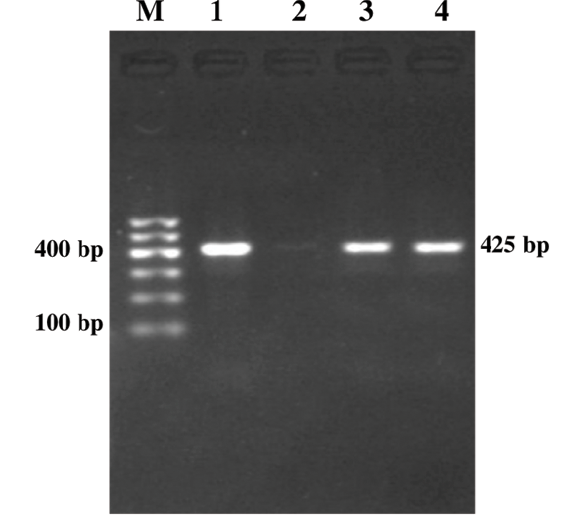
Lane M: 100bp DNA ladder; Lane 1: Positive control; Lane 2: Negative control; Lanes 3-4: Study samples

Table 1: Primers for Bordetella bronchiseptica detection

Name of primers

Sequence 5' → 3'

Target gene and product length (bp)

References

B688Bbalc-F

ACCAACCGCATTTATTCCTACTA

alc, 324

Bharadwaj, 2013

B1012Bbalc-R

GGCCCTGGAGTTCGTATTTATG

425BBfim-1 F

TGAACAATGGCGTGAAAGC

fim, 425

Xin et al., 2008

425BBfim-2 R

TCGATAGTAGGACGGGAGGAT

Note: (F), Forward primer; (R), Reverse primer

Table 2: Detection of Boretella DNA in serum of pet dogs in relation to their sex and health status

Sex

Health status

Total samples tested

Positive for gPCR

Positive for sPCR

Male

Apparently healthy

77

5

5

Sick

37

3

3

Female

Apparently healthy

37

2

2

Sick

34

4

4

Total

185

14

14

The association of B. bronchiseptica infection with kennel cough is well documented and reported frequently at several places ; ; . However, in the present study probability of detection of B. bronchiseptica DNA in serum of sick dogs (9.86%) was only insignificantly higher (p= 0.35) than detection of the pathogen from apparently healthy dogs (6.14%). The findings are in concurrence to earlier studies in India on bordetellosis and kennel cough in dogs , b). The study also indicated that just colonization of B. bronchiseptica in dog nares or detection of pathogen’s DNA in serum may not be sufficient for diagnosis of bordetellosis and other factors might be important for precipitation of clinical disease in dogs.

All 14 positive samples with genus specific (alc gene) PCR were also positive for species specific PCR targeting fim gene in the study indicating that only B. bronchiseptica was able to invade the dog tissues. However, earlier study on nasal swabs indicated that although B. bronchiseptica was the major bordetellae colonizing dog nares other bodetellae might be present in nasal swabs of dogs . In earlier studies on dogs , out of total 7 nasal swabs positive to gPCR only four samples shown fim and fla genes amplification indicating that other species of Bordetella might be colonizing nasal mucosa of dogs.

Sequencing result of alc and fim gene PCR products revealed that the PCR performed in the study was true and specific in detecting only Bordetella.Sequences alignment of genus specific alc gene sequence amplified in the study had 95% identity with sequences of several species of Bordetella available in database and species specific fim gene sequence matched 100% with B. bronchiseptica sequences in database. The study concluded that PCR with serum extracted DNA might be an option for diagnosis of Bordetella infection in dog however there seems to be no association between kennel cough and Bordetella detection in dogs in India.

The study concluded that DNA extracted from serum samples can be used in molecular detection of Bordetella DNA for diagnosis of Bordetella infection in pet dogs. Clinical status and sex had no significant association with detection of Bordetella DNA in dog’s serum samples. Genus specific (alc gene) and species specific (fim genes) PCR results revealed that B. bronchiseptica is probably the most common invading Bordetella species affecting dogs.

Samples (deep nasal swabs and serum) were collected from 114 apparently (77 male and 37 female) healthy and 71 clinically sick (37 male and 34 female) pet dogs. Template DNA was extracted from serum samples using QIAmp DNA Mini kit (Qiagen, Germany) following the protocol recommended. From nasal swabs DNa was extracted after pre-enrichment step using the same kit. The concentration and purity of the DNA extracted from the serum as well as nasal swab samples were measured by Nano drop (Thermo Scientific, USA) and DNA samples with sufficient amount of concentration and purity indicated by 260/280 showing reading 1.6 to 1.8 were used as template for PCR reaction. The DNA extracted from the serum and nasal swabs was stored at -20°C till used in PCR. The amplification of genus specific and species specific primers were carried out using custom synthesized (Eurofin Pvt. Ltd., India) primers (Table 1). PCR reaction was optimized in 25µl reaction volume using 5 µl of DNA template, 1 µl each of 10 pMol forward and reverse primers, 12.5 µl of master mix and 5.5 µl of nuclease free water. The amplification of PCR was carried out in a thermal cycler (Eppendorf, Germany) with an initial denaturation at 95oC for 10 min, 35 cycles of denaturation at 94oC for 30 s, annealing at 53oC for 30 s, extension at 72oC for 45 s, followed by final extension step at 72oC for 7 min. Amplicons of 324 bp for genus specific PCR targeting alc gene and amplicon of 425 bp for species specific PCR targeting fim gene were analysed under UV-gel documentation system (Alpha Innotech Co., USA) after electrophoresis on 1% agarose gel (IBI Scientific, Peosta Lowa) containing 0.2 mg/ ml ethidium bromide at 80 volts using 1× TBE electrophoresis buffer (Bio Basic Inc. USA). For confirmation of identity of PCR amplicons gel purified (Mini Elute Gel Extraction kit, Qiagen, Germany) amplicons were custom sequenced (Eurofins Genomics Laboratory, India). DNA extracted from reference strain of B. bronchiseptica (MTCC 6838) available in the laboratory was used as positive control.

The study concludes that serum samples may be better sample for diagnosis of bordetellosis for identification of pathogens DNA instead of deep nasal swabs in dogs.

ACKNOWLEDGEMENT

Authors are thankful to Director IVRI, Izatnagar, Joint Director (Academics), and Joint Director (R) IVRI, Izatnagar for providing fellowship to Lenin, Monika and Prasannavadhna, and funds for undertaking the study. We are also thankful to the dog owners, veterinary institutions, and clinicians. Technical assistance by HC Joshi and Laik of Epidemiology Laboratory was instrumental in carrying out this study.

CONFLICT OF INTEREST

There is no conflict of interest among all or any of the authors and also with the funding agencies.

References

  1. Akane A, Matsubara K, Nakamura H, Takahashi S, Kimura K (1994). Identification of the heme compound copurified with deoxyribonucleic acid (DNA) from blood stains, a major inhibitor of polymerase chain reaction (PCR) amplification. J. Forensic Sci. 39(2): 362-362.
  2. Appel M, Binn LN (1987). Canine infectious tracheobronchitis. Short review: Kennel cough. In: Appel, M. J. (Ed.), Virus infections of carnivores, Elsevier Science Publisher, Amsterdam. Pp. 201–211.
  3. Bauwens JE, Spach DH, Schacker TW, Mustafa MM, Bowden RA (1992). Bordetella bronchiseptica pneumonia and bacteremia following bone marrow transplantation. J. Clin. Microbiol. 30(9): 2474-2475.
  4. Bhardwaj M (2013). Evaluation of molecular and serological techniques for diagnosis of bordetellosis in dogs. M. V. Sc Thesis Submitted to the Deemed University Indian Veterinary Research Institute Izatnagar -243 122 (U.P.), India.
  5. Bhardwaj M, Singh BR, Kumar S, Pawde AM (2013a). Poor association of Bordetella bronchiseptica infection with kennel cough in dogs in northern India. Universal J. Microbiol. Res. 1(1): 10-14.
  6. Bhardwaj M, Singh BR, Vadhana P (2013b). Bordetella bronchiseptica Infection and Kennel Cough in Dogs. Adv. Anim. Vet. Sci. 1(3S): 1 – 4.
  7. Bougnoux ME, Dupont C, Mateo J, Saulnier P, Faivre V, Payen D, Nicolas Chanoine MH (1999). Serum is more suitable than whole blood for diagnosis of systemic candidiasis by nested PCR. J. Clin. Microbiol. 37(4): 925-930.
  8. De Madaria E, Martinez J, Lozano B, Sempere L, Benlloch S, Such J, Pérez-Mateo M (2005). Detection and identification of bacterial DNA in serum from patients with acute pancreatitis. Gut. 54: 1293-1297. http://dx.doi.org/10.1136/gut.2004.047514[CrossRef]
  9. Ford RB (2006). Canine infectious tracheobronchitis. In: Infectious diseases of the dog and cat. C. E. Greene (ed.). St. Louis, MO: Saunders Elsevier. 54–61p.
  10. Kawamura S, Maesaki S, Noda T, Hirakata Y, Tomono K, Tashiro T, Kohno S (1999). Comparison between PCR and detection of antigen in sera for diagnosis of pulmonary aspergillosis. J. Clin. Microbiol. 37 (1): 218-220.
  11. Keil DJ, Fenwick B (1998). Role of Bordetella bronchiseptica in infectious tracheobronchitis in dogs. J. Am. Vet. Med. Ass. 212(2): 200-207.
  12. Kumar S, Singh BR, Bhardwaj M, Singh V (2014). Occurrence of Bordetella infection in pigs in Northern India. Int. J. Microbiol. Article ID 238575. http://dx.doi.org/10.1155/2014/238575[CrossRef]
  13. Lo Re V, Brennan PJ, Wadlin J, Weaver R, Nachamkin I (2001). Infected branchial cleft cyst due to Bordetella bronchiseptica in an immunocompetent patient. J. Clin. Microbiol. 39(11): 2410–2412. http://dx.doi.org/10.1128/JCM.39.11.4210-4212.2001[CrossRef]
  14. Murdoch DR, Walford EJ, Jennings LC, Light GJ, Schousboe MI, Chereshsky AY, Town GI (1996). Use of the polymerase chain reaction to detect Legionella DNA in urine and serum samples from patients with pneumonia. Clin. Infect. Dis. 23(3): 475-480. http://dx.doi.org/10.1093/clinids/23.3.475[CrossRef]
  15. Rapuntean Gh, Rapuntean S (2010). Bacteriologie veterinara speciala (Special veterinary bacteriology). Editura Academic Pres Cluj-Napoca, 354 p., ISBN. 973-7950-95-X.
  16. Sacco RE, Register KB, Nordholm GE (2000). Restriction endonuclease analysis discriminates Bordetella bronchiseptica isolates. J. Clin. Microbiol. 38: 4387-4393.
  17. Woolfrey FB, Moody JA (1991). Human infections associated with Bordetella bronchiseptica. Clin. Microbiol. Rev. 4(3): 234–255.
  18. Zerva L, Bourantas K, Mitka S, Kansouzidou A, Legakis NJ (2001). Serum is the preferred clinical specimen for diagnosis of human brucellosis by PCR. J. Clin. Microbiol. 39(4): 1661-1664. http://dx.doi.org/10.1128/JCM.39.4.1661-1664.2001[CrossRef]

Services

Article usage statistics

Loading…

Detection of <i>Bordetella</i> <i>bronchiseptica</i> in Serum of Apparently Healthy and Clinically Sick Pet Dogs · ResearchersLinks