
Oionchus sindhicus n. sp., is described from specimens collected from soil around the roots of cotton (Gossypium hirsutum L.) from Umerkot, Sindh, Pakistan. The new species is characterized by having a combination of characters: body length of female 0.7-1.0 mm, vulva at 56-59 percent of body length, anterior part of buccal cavity 5-7 µm wide, pharynx 198-238 µm long, tail 30-33 µm long, post uterine sac 10-16 µm in length, apex of dorsal tooth 3-5 µm from anterior end. Morphometric and morphological data of O. paraobtusus Jairajpuri and Khan, 1982 and O. obtusus Cobb, 1913 are also given. These species are described and redescribed for the first time from Pakistan.
Short Communication · Volume 54, Issue 2, 28 January 2022 · Open Access
Description of Oionchus sindhicus n. sp., and Morphometric Data on O. paraobtusus Jairajpuri and Khan, 1982 and O. obtusus Cobb, 1913 (Nematoda:Mononchida) from Pakistan
· · · ·
Affiliations & Notes ⌄
- 1National Nematological Research Centre, University of Karachi, Karachi 2Department of Botany, University of Karachi, Karachi 3Department of Agriculture and Agribusiness Management, University of Karachi, Karachi, Pakistan * Corresponding author: erum_i@yahoo.com
Article Info ⌄
- Journal:
- Pakistan Journal of Zoology
- Published:
- 28 January 2022

From the article
- The new species is characterized by having a combination of characters: body length of female 0.7-1.0 mm, vulva at 56-59 percent of body length, anterior part of buccal cavity 5-7 µm wide, pharynx 198-238 µm long, tail 30-33 µm long, post uterine sac 10-16 µm in length, apex of dorsal tooth 3-5 µm from anterior end.
- Amphidial aperture 2-3µm wide, located at 2-4 µm from anterior end of body, slightly anterior to the tooth apex.
- L, body length; a, body length/body width; b, body length/oesophagus length; c, body length/tail length; c׀, tail length/anal body width; V, vulval length/body length x 100; G1, Anterior ovary/bodylength x 100.
- Tail short, hemispheroid 33-40 µm or more than anal body diameter long.
Selected from the article's own text.
Abstract
Materials and methods
Nematodes were isolated from soil samples by Cobb’s wet sieving technique followed by a modified Baermann funnel method . Extracted nematodes were killed by gradual heat, fixed in TAF and mounted in dehydrated glycerine . Illustrations were made by using a drawing tube attached to the compound microscope. Nikon Eclipse E400 and photographed with a Nikon DS-Fi1 Camera, attached to the same microscope, and edited by Adobe Photoshop. The classification of mononchs given by Ahmad and Jairajpuri (2010) was followed here.
Oionchus sindhicus new species
Description
Female: Body stout, almost straight upon fixation. Cuticle smooth under light microscope, 2-4 µm thick at mid body and 4-5 µm on tail. Lip region separated from adjacent body by week depression 3-4 times as wide as high (a’=54-64). Lips and labial papillae prominent. Amphidial aperture 2-3µm wide, located at 2-4 µm from anterior end of body, slightly anterior to the tooth apex. Pharynx nearly cylindrical muscular, slightly thickening posteriorly 23-26% of body length. Buccal walls strong. Anterior wider part of buccal cavity 13-14 µm long, 5-7 µm diameter. Buccal cavity encircled by pharyngeal tissues. Tooth large, subventral walls bearing two transverse rows of denticles. Nerve ring located at 60-66 µm from anterior and or at 30-44% of neck length. Three cardiac glands present, 8-10 µm diameter. Distance between posterior end of pharynx and vulva equal to 2.2-2.7 pharyngeal length. Female reproductive organs mono-prodelphic, rather short and simple occupying 10-12%of body length. Posterior branch represented by a small post uterine sac, measuring 10-16 µm, less than corresponding body diameter long. Gonad 2.1-2.4 body width long. No mature eggs observed. Vulva somewhat posterior to middle 56-59%. Sphincter not present at oviduct-uterus junction. Vulva-anus distance as long as 8-13 times tail. Tail hemispheroid 30-33 µm long, 35-41% of entire body length. Rectum 16-20 µm long less than one anal body width. Caudal glands well developed, arranged in grouped, spinneret opening terminally.
Male: Not known.
Table I. Morphometric data of Oionchus sindhicus n. sp. All measurements are in µm except L are shown as Mean±SD (range).
| Characters | Female | |
| Holotype | Paratypes (n=10) | |
| L | 0.76 | 0.82 ± 0.73 (0.76-1.0) |
| a | 17.7 | 19.8 ± 1.36 (17.7-21.2) |
| b | 3.8 | 3.88 ± 0.07 (3.8-4.0) |
| c | 23 | 24.8 ± 1.16 (23-27) |
| c׀ | 1.1 | 1.18 ± 0.03 (1.1-1.3) |
| V | 56 | 58.4 ± 0.95 (56-59) |
| G1 | 88 | 90.4±5.8 9 (85-106) |
| Lip region diameter | 13 | 13.7 ± 0.91 (13-15) |
| Anterior buccal cavity width | 5 | 6.2 ± 0.60 (5-7) |
| Posterior buccal cavity width | 3 | 4.1 ± 0.56 (3-5) |
| Tooth from anterior end | 3 | 3.77 ± 0.78 (3-5) |
| Amphid aperture from anterior end | 2 | 3.12 ± 0.78 (2-4) |
| Nerve ring from anterior end | 62 | 63 ± 2.0 (60-66) |
| Pharynx length | 208 | 212.4 ± 11.4 (198-238) |
| Vulva from anterior end | 456 | 490 ± 46.9 (446-580) |
| Body diameter: Neck base | 40 | 40.5±1.16(39-42) |
| Body diameter: Mid body | 40 | 40.9 ± 1.49 (39-43) |
| Body diameter: Anus | 25 | 26 ± 0.89 (25-27) |
| Rectum length | 18 | 18 ± 1.41 (16-20) |
| Tail length | 31 | 31.8 ± 1.09 (30-33) |
| Tail length as % of total body length | 3.9 | 3.8±0.33(3-4.1) |
| Post uterine sac | 12 | 12.6 ± 2.0 (10-16) |
L, body length; a, body length/body width; b, body length/oesophagus length; c, body length/tail length; c׀, tail length/anal body width; V, vulval length/body length x 100; G1, Anterior ovary/bodylength x 100
Type habitat and locality
The specimens were recovered from soil around the roots of cotton (Gossypium hirsutum L.) at Umerkot, Sindh, Pakistan.
Type material
Holotype female and nine paratypes female deposited in the Nematode Collection of National Nematological Research Centre, University of Karachi, Karachi, Pakistan.
Etymology
The specific epithet refers to the locality where the species has been recovered.
Diagnosis and relationship
Oionchus sindhicus n.sp., has females with 0.7-1.0 (0.82) mm long body; vulva at 56-59 (58.4) percent of body length, anterior part of buccal cavity 5-7 (6.2) µm wide; pharynx 198-238 µm long. Tail 30-33 (31.8) µm or 1.1-1.3 times anal body width long. Post vulval uterine sac 10-16 (12) µm long; apex of dorsal tooth 3-5 (3.7) µm from anterior end.
Oionchus sindhicus n. sp., comes close to O. paraobtusus , but differs in the thicker body (a = 17.7-21.2 vs 23-30) in slightly greater ‘b’ values (b = 3.8-4.0 vs 3.2-3.7), in more anteriorly located vulva and nerve ring. (V = 56-59 vs 60-64; nerve ring = 60-66 vs 80-90 µm), smaller tail (30-33 vs 33-40 µm) and opening of caudal gland ducts (terminally vs sub ventral position of spinneret).
Oionchus paraobtusus Jairajpuri and Khan, 1982
(Table II)
Description
Female: Body comparatively short, slightly ventrally arcuate upon fixation. Cuticle smooth 3-4 µm thick at mid body. Lip region slightly offset with neck 12-15µm wide and 4-5µm high (a’=61.7-79.1). Body at posterior end of oesophagus 2.5-2.6 times as wide as head region. Amphids apertures slit like, slightly anterior to the tooth apex. Anterior wider part of buccal cavity 5-6 µm wide, 14-16µm long. Nerve ring 66-70 µm from head end. Female genital system monoprodelphic, posterior branch represented by a small sac, 8-10µm less than corresponding body diameter. Sphincter indistinct at oviduct-uterus junction. Tail short, hemispheroid 33-40 µm or more than anal body diameter long. Caudal glands arranged in group. Spinneret terminal.
Male: Not known.
Remarks
Specimens for the present study were obtained from around the roots of cotton (Gossypium hirsutum L.) from Umerkot, Sindh. Measurements and morphological characters are quite similar to those given by . Only difference was found in terminal spinneret against spinneret subterminal ventrally.
Oionchus obtusus Cobb, 1913
(Table II)
Table II. Morphometric data of Oionchus paraobtusus and O. obtusus . All measurements are in µm except L are shown as Mean±SD (range).
| Characters | O. paraobtusus Females (n=7) | O. obtusus Female (n=4) |
| L | 0.97 ± 0.06 (0.86-1.07) | 0.80 ± 0.03 (0.75-0.84) |
| a | 26.7 ± 1.90 (23.7-29.5) | 25.3 ± 0.46 (24.7-26.0) |
| b | 3.8 ± 0.21 (3.5-4.2) | 3.81 ± 0.05 (3.74-3.9) |
| c | 29 ± 2.10 (25.7-30) | 46.6 ± 0.28 (46.2-47.0) |
| c׀ | 1.41 ± 0.21 (1.23-1.6) | 0.81 ± 0.02 (0.8-0.85) |
| V% | 61.5 ± 2.00 (59-64.1) | 58.7 ± 0.14 (58.6-59.0) |
| Maximum body width | 38 ± 4.1 (30-42) | 33.5 ± 0.5 (33-34) |
| Lip width | 14.2 ± 1.1 (12-16) | 9.5 ± 0.5 (9-10) |
| Lip height | 4.3 ± 0.44 (4-5) | 2.5 ± 0.5 (2-3) |
| Amphid aperture from anterior end | 5.5 ± 0.41 (5-6) | - |
| Anterior buccal cavity width | 5.4 ± 0.49 (5-6) | 4.37 ± 0.41 (4-5) |
| Anterior buccal cavity length | 14.5 ± 0.33 (14-15) | 5.5 ± 1.11 (4-7) |
| Tooth from anterior end | 3.5 ± 0.38 (3-4) | 2.3 ± 0.41 (2-3) |
| Nerve ring from anterior end | 66 ± 2.20 (66-70) | 49.25 ± 0.82 (40-50) |
| Pharynx length | 256.4 ± 22.2 (228-290) | 217.2 ± 0 (214-220) |
| Tail length | 34 ± 2.87 (33-40) | 18.37 ± 0.41 (18-19) |
| Anal body width | 23.8 ± 2.69 (19-27) | 21.5 ± 0 (21-22) |
| Post uterine sac | 9.1 ± 0.65 (8-10) | 11.5 ± 1.65 (10-14) |
Description
Female: Body short, straight to slightly ventrally curved when relaxed by heat, cuticle smooth 2 µm thick at mid body. Lip region 9-10 µm wide and 2-3 µm high. Buccal cavity encircled by pharyngeal tissue. Anterior wider part of buccal cavity 4-5 µm wide and 4-7 µm long. Pharynx 214-220 µm long, cylindrical, slightly thickening posteriorly. Cardiac glands present. Nerve ring at 48-50 µm from head end. Reproductive system monoprodelphic with posterior branch represented by a small sac 10-14 µm or less than on vulval body diameter. Ovary reflexed. Sphincter indistinct. Vulva slightly posterior to mid body. Rectum 14 µm or less than one anal body width long. Tail short hemispheroid, less than one anal body width long. Caudal gland present. Spinneret subterminal dorsally.
Male: Not found.
Remarks
Specimens of O. obtusus were collected from soil around the roots of cotton (Gossypium hirsutum L.) from Umerkot Sindh Pakistan. Morphometric characters are quite similar to those given by Ahmad and Jairajpuri (2010).
Statement of conflict of interest
The authors have declared no conflict of interest.
Figures
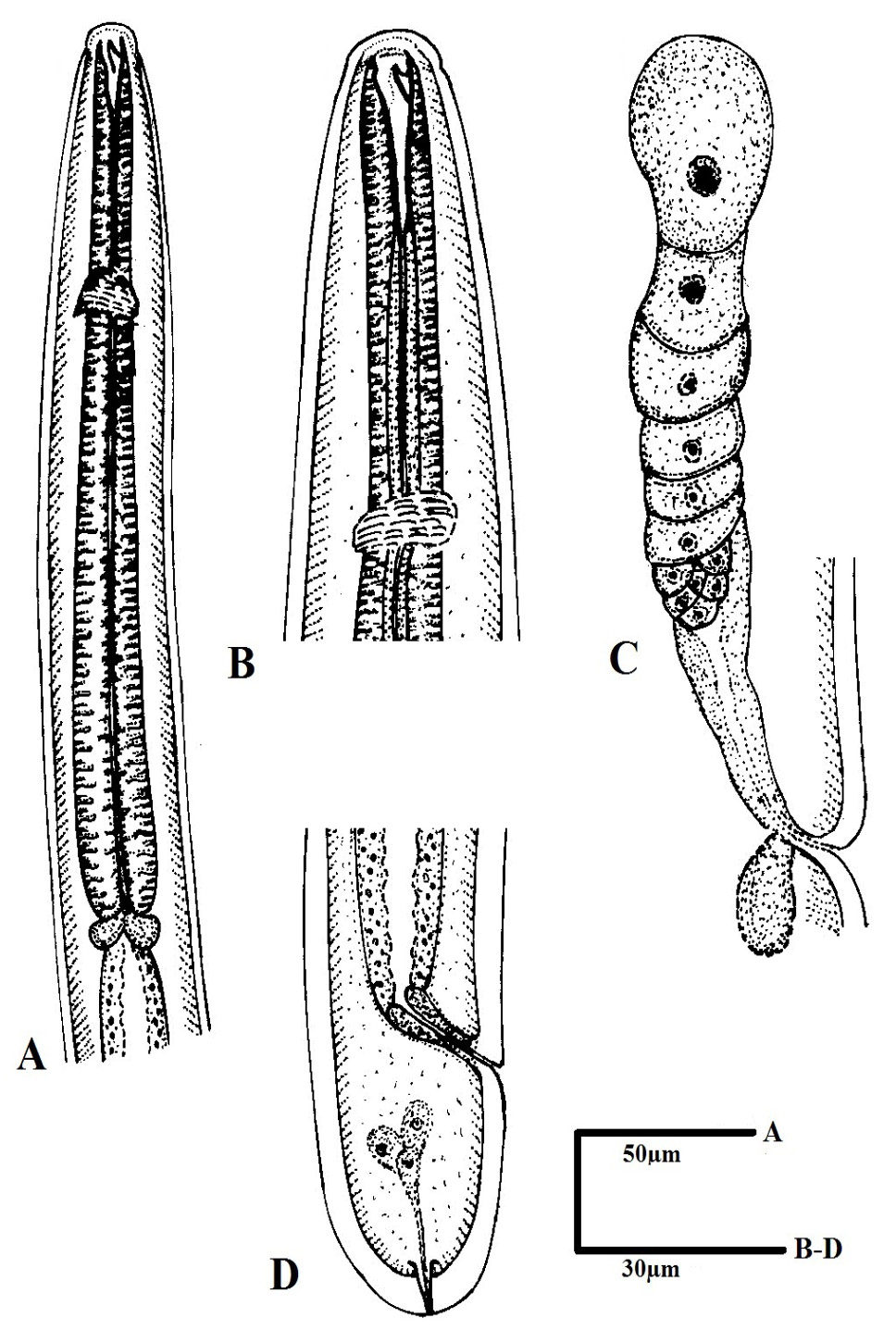
A-D. Oionchus sindhicus n. sp. Female: A, Pharyngeal region; B, Anterior region; C, Female genital system; D, Tail region.
References
- Ahmad, W. and Jairajpuri, M.S., 2010. Nematol. Monogr. Perspect., 7: 298.
- Baermann, G., 1917. Tijdschr. Nederland, 57: 131-137.
- Cobb, N.A., 1913. J. Washington Acad. Sci., 3: 432-444. https://doi.org/10.5962/bhl.part.20323[CrossRef]
- Cobb, N.A., 1918. Contrib. Sci. Namatol., 7: 189-212.
- Coomans, A. and Loof, P.A.A., 1970. Nematologica, 16: 180-196. https://doi.org/10.1163/187529270X00199[CrossRef]
- De, Coninck, L.A.P., 1965. Systematique de nematodes. In: Traite de Zoologie, Anatomie, Systematique, Biologie (ed. P.P. Grasse). Masson Cie 4, Paris, France. pp. 586-681.
- Jairajpuri, M.S. and Khan, W.U., 1982. Predatory nematodes (Mononchida). Associated Publishing, New Delhi, India. pp. 131.
- Kreis, H.A., 1932. Z. Parasitenkund., 5: 184-194. https://doi.org/10.1007/BF02120641[CrossRef]
- Siddiqi, M.R., 1986. Tylenchida: Parasites of plants and insects. Common wealth Agricultural Bureaux, Farnham Royal, Slough, UK. pp. 646.
- Thorne, G., 1935. Proc. helminthol. Soc. Washington, 2: 96-98.
Services
Article usage statistics
Loading…