
Present study is conducted to collect the information about current fish diversity at famous public place at Panjnad Headworks, Punjab, Bahawalpur, Pakistan. All fish samples were collected from three different sites (Panjnad, Abasia, Abu Dhabi canal) during February 2020 to January 2021 using different fish inclusive. The evident fish groups found were Cyprinids, Catfishes and others including (Channa punctata, Oreochromis niloticus, Oreochromis mossambicus, Bagarius bagarius). The data was statistically analyzed using ANOVA. Further relative abundance (Panjnad canal=57.81%, Abbasia canal=25.56%, Abu Dhabi canal=16.61%) and Simpson diversity index (D) (Panjnad canal=0.957335, Abbasia canal=0.923277, Abu Dhabi canal=0.893188) and Shannon-Wiener index (H) (Panjnad canal=3.19433, Abbasia canal=1.54355, Abu Dhabi canal=1.067311) were also calculated. Results revealed the diversity of fish population at Panjnad Headworks may be varied with seasonal variations. Maximum species originated belongs to family Cyprinidae which were 12 in number. It is suggested that there is a need of comprehensive strategies to conserve the nearly extinct group of fish species.
Research Article · Volume 55, Issue 6, 2 October 2023 · Open Access
Current Status of Fish Diversity and Abundance at Panjnad Headworks Bahawalpur, Punjab, Pakistan
· · · · · · · ·
Affiliations & Notes ⌄
- 1Department of Zoology, Government Sadiq College Women University, PK63100, Bahawalpur, Punjab, Pakistan 2Department of Entomology, Faculty of Agriculture and Environment, The Islamia University of Bahawalpur, PK63100, Bahawalpur, Punjab, Pakistan 3College of Veterinary Sciences, Faculty of Animal Husbandry and Veterinary Sciences, The University of Agriculture, Peshawar, Pakistan * Corresponding author: rukhan@aup.edu.pk
Article Info ⌄
- Journal:
- Pakistan Journal of Zoology
- Published:
- 2 October 2023

From the article
- These fish species belong to the Schizothorax (Heckle) and Schizothoraicthys (Misra).
- The present study is conducted at Panjnad Headworks, Punjab, Bahawalpur, Pakistan to observe the diversity of existing fish.
- Samples of all the fish were collected from February 2020 to January 2021 by adding different fish from three different locations (Panjnad, Abbasia, Abu Dhabi Canal).
- The Fisheries Department of Bahawalpur District should also play an active role in conserving the fishes of Panjnad Headworks.
Selected from the article's own text.
Abstract
INTRODUCTION
In the whole world, fish contributes half of the total number of vertebrates. Mostly they inhabit all possible aquatic surroundings. Out of 39,900 vertebrate’s species, almost 21,723 fish species have been documented, from which freshwater species are recognized as 8,411 and marine species are 11,650 in figure . Fish identification is one of the most important measures of taxonomy which is commonly counted on observable external morphology. Most identification of fish has been conceded with the use of standard keys . Further studies have been completed in this concern on diverse lentic and lotic areas of province Khyber Pakhtunkhwa as 94 fish species have been identified .
Pakistan represented the largest canal system correspondingly with more than 225 wetlands while only 19 are enumerated as Ramsar sites. About 780,000 hectares area has been covered by Pakistan which comprises 26.06% of coastal wetland areas out of total wetland area of the country and consequently 73% of freshwater area ; . Approximately more than 27,977 fish species have been recorded which are represented by 515 families and 62 orders . Additional studies have been accompanied about the aquatic fish fauna of different places at different times in Pakistan , 1980, 1990; ; . Another study revealed that Pakistan has more than171 species including marine and freshwater fishes ; . Minimum 193 fish species were also documented during a study which relates to class Actinopterygii, subclass Teleostei, three cohorts, thirteen orders, six super orders, thirty families and eighty-six genera .
Fish health and abundance describe the health of whole aquatic life . Population growth and economic aspects also become infected by a decline in population of fishes and fisheries . Pakistan has presented a number of alien exotic fish species listed as common carp (Cyprinus carpio), silver carp (Hypophthalmichthys molitrix), grass carp (Ctenopharyngodon idella), gold fish (Carassius auratus), bighead carp (Hypophthalmichthys nobilis) and 3 species of tilapia as Oreochromis aureus, Oreochromis mossambicus, Oreochromis niloticus in warm waters along with 2 other trout species known as rainbow trout (Oncorhynchus mykiss) and brown trout (Salmo trutta fario) in colder areas which concerning for particular objectives such as yield improvement, sport fishing, biological control of mosquitoes and aquatic weeds .
Status of three major carps called Cirrhinus mrigala, Catla catla and Labeo rohita was analyzed at Downstream Indus River. In one study 77 freshwater fish species were confirmed which comprises 6 exotic and 71 native fish species . Another study was conducted at River Barandu, KPK which is the most familiar water line system as it links all local rural areas and ultimately falls into the Indus River at Kala Dhaka . Fish fauna of Pakistan with specific IUCN status was discussed in a study. Total 86 fish species were identified, out of which 34 species have been revealed as endemic, 31 commercially essential, 11 with special IUCN status and 8 recognized as very rare species . A study was conducted by at 3 heads of River Chenab named as Head Khanki, Head Marala and Head Qadir Abad. Total 34 species were recorded during sampling. A diversity index shows the highest rate of fish diversity at Head Qadir Abad as compared to Head Khanki and Head Marala. Total 11 species were recorded from Barandu River district Buner Khyber Pakhtunkhwa, Pakistan which belongs to 3 orders and 4 families . Head Panjnad is river which located at Bahawalpur, Punjab, Pakistan. This river is formed by consecutive confluence of 5 rivers of district Punjab (Rive, Sutlej, Jhelum, Base, Chenab). Ravi and Jhelum both rivers join at river Chenab, Base join river Sutlej and both Chenab and Sutlej rivers join to form this Panjnad Head. A dam on this headworks has been constructed which provide Channels for irrigation of both Provinces (Punjab and Sindh) of east of Indus River and south of Sutlej Rivers. Previously, no study has been conducted on fish species diversity on this Panjnad Head. This research was, therefore, is to investigate the diversity of fish fauna and their distribution of Panjnad Headworks Punjab, Bahawalpur, Pakistan.
Materials and Methods
Location of sampling areas
Sample collection was carried out at different locations of Panjnad Headworks targeted as Abu Dhabi, Abbasia and Panjnad Canal as shown in Figure 1. Fish samples were collected randomly at daytime using different types of available nets such as common fish trap nets, drag nets, cast nets, bait hooks and hand nets. Sampling was done for the duration of 12 months starting from February 2020 to January 2021.
Sampling
All fish samples were labeled and kept at ˗20°C. Initial identification and common name of fish species was confirmed with the assistance of common fish catchers and fish sellers. All species photographs were taken from a digital camera and these photographs were labeled temporarily. Later all species were identified taxonomically, and misidentifications were removed by an expert taxonomist using systematic keys .
Diversity and relative abundance
The relative abundance of all fish species is calculated by applying the specific formula given as:
R.A (%) = ni/N×100
Here ni is taken as the number of individuals of a single fish species in one month and N represents the number of individuals of fish species in all months (calculated relative abundance shown in Table I).
Table I. Relative abundance and diversity indices of fish in Panjnad canal, Abbasia canal and Abu Dhabi canal.
| Scientific name | Local name | Panjnad canal | Abbasia canal | Abu Dhabi canal | ||||||
| n | RA (%) | FO (%) | N | RA (%) | FO (%) | N | RA (%) | FO (%) | ||
| Family Clariidae 1. Clarias batrachus | Asian catfish | 26 | 2.11 | 66.6 | 2 | 0.36 | 8.3 | 0 | 0 | 0 |
| Family Ailiidae 2. Clupisa garua | Bachwa, Sher mahi | 43 | 3.50 | 91.6 | 8 | 1.47 | 16.6 | 8 | 2.26 | 25 |
| Family Schilbeidae 3. Eutropiichthys vacha | Jhali | 19 | 1.54 | 41.6 | 2 | 0.36 | 16.6 | 52 | 14.73 | 91.6 |
| Family Siluridae 4. Wallago attu | Mulli | 6 | 0.48 | 16.6 | 2 | 0.36 | 8.3 | 50 | 14.16 | 75 |
| Family Bagridae 5. Rita rita 6. Sperata sarwari | Desi khagga Singhari | 46 39 | 3.74 3.17 | 66.6 50 | 3 3 | 0.55 0.55 | 25 16.6 | 35 42 | 9.91 11.89 | 75 66.6 |
| Family Channidae 7. Channa marulius 8. Channa punctata | Soul Daula, Gudo | 53 44 | 4.31 3.58 | 75 58.3 | 1 18 | 0.18 3.31 | 8.3 33.3 | 5 7 | 1.41 1.98 | 8.3 16.6 |
| Family Cyprinidae 9. Catla catla 10. Cirrhinus mrigala 11. Cyprinus carpio 12. Labeo rohita 13. Labeo calbasu 14. Labeo gonius 15. Labeo boga 16. Ctenopharyngodon Idella 17. Hypophthalmichthys molitrix 18. Carassius auratus 19. Crossocheilus diplocheilus 20. Aristichthys nobilis | Thaila Mori Gulfaam Rohu Kalbans Sereeha Bhangan Grass Carp Silver Carp Goldfish Dogra Bighead carp | 69 58 46 47 55 51 54 60 74 25 44 18 | 5.61 4.72 3.74 3.82 4.47 4.15 4.39 4.88 6.02 2.03 3.58 1.46 | 91.6 83.3 75 50 75 66.6 75 83.3 91.6 66.6 75 58.3 | 47 48 43 30 39 46 56 54 50 3 1 0 | 8.65 8.83 7.91 5.52 7.18 8.47 10.31 9.94 9.20 0.55 0.18 0.0 | 75 83.3 58.3 41.6 66.6 58.3 66.6 66.6 66.6 8.3 8.3 0 | 7 2 7 34 1 3 2 1 1 0 5 2 | 1.98 0.56 1.98 9.63 0.28 0.84 0.56 0.28 0.28 0 1.41 0.56 | 25 8.3 25 50 8.3 8.3 8.3 8.3 8.3 0 8.3 8.3 |
| Family Cichlidae 21. Oreochromis niloticus 22. Oreochromis mossambicus | Nile tilapia Chira | 73 67 | 5.94 5.45 | 75 75 | 44 36 | 8.10 6.62 | 66.6 50 | 1 1 | 0.28 0.28 | 8.3 8.3 |
| Family Sisoridae 23. Bagarius bagarius | Mujahid | 55 | 4.47 | 75 | 1 | 0.18 | 8.3 | 0 | 0 | 0 |
| Family Notopteridae 24. Notopterus notopterus 25. Chitala chitala | But Pari Cheetal Pari | 66 60 | 5.37 4.88 | 75 66.6 | 2 1 | 0.36 0.18 | 16.6 8.3 | 10 17 | 2.83 4.81 | 16.6 25 |
| Family Ambassidae 26. Parambassis ranga | Sheesha | 13 | 1.05 | 41.6 | 1 | 0.18 | 8.3 | 0 | 0 | 0 |
| Family Mastacembelidae 27. Mastacembelus armatus | Baam | 17 | 1.38 | 25 | 2 | 0.36 | 16.6 | 60 | 16.99 | 75 |
Further diversity indices i.e., Shannon-Wiener index (H) and Simpson diversity index (D) were also calculated using the formula mentioned below:

Here, ni signifies an individual’s number and N indicates total species number.
RESULTS AND DISCUSSION
In the present study, survey of fish fauna of Panjnad Head Works district Bahawalpur Punjab, Pakistan was inclusively carried out for 12 months of the year 2020 to 2021. During this investigation total 27 species were recorded which belongs to Phylum Chordata, Class Actinopterygii, 7 Orders siluriformes, Anabantiformes, Cypriniformes, Cichliformes, Osteoglossiformes, Perciformes and Synbranchiformes and 12 families Clariidae, Ailiidae, Schilbeidae, Siluridae, Bagridae, Channidae, Cyprinidae, Cichlidae, Sisoridae, Notopteridae, Mastacembelidae. In this study we explored maximum specimens of family Cyprinidae as 601, 417 and 65 at and minimum specimens of family Ambassidae as 13, 1 and 0 specimens were found at Panjnad, Abbasia and Abu Dhabi canal respectively. All groups belong to Phylum Chordata and Class Actinopterygii (ray-finned fishes). A similar study conducted by Akhtar et al. (2014) at river Barandu District Buner, Khyber Pakhtunkhwa, Pakistan, they reported that 10 species belong to 3 orders and 4 families, including: Tor putitora, Schizothorax plagiostomus, Channa gachua, Schistura punjabensis, Barilius pakistanicus, Garra gotyla, Mastacembelus armatus, Crossocheilus latius, Puntius sophore, and Triplophysa naziri. In another study, in the spring of 2015, 28 samples of fish were collected from the Swat River. These fish species belong to the Schizothorax (Heckle) and Schizothoraicthys (Misra). Six species of Schizothoraicthys macropthalmus, Schizothoraicthys labiatus, Schizothorax richardsonii, Schizothoraicthys esocinus, Schizothorax sinuautus and Schizothorax plagiostomus were identified from 12 different locations on the Swat River. Schizothtorax plagiostomus was recorded among the most abundant (46.82%) species of Swat River, followed by Schizothoraicthys esocinus (17.85 %), Schizothoraicthys labiatus (14.28 %), Schizothorax richardsonii (10.92 %), Schizothorax sinuautus (7.14 %) and Schizothoraicthys macrophthalmus (3.57 %). Schizothtorax plagiostomus was the only species that was distributed throughout the Swat River . All studies have shown differences between the number of actual fish caught and the number of species of fish at different locations (Hassan et al., 2013; . The number of indigenous fish species has decreased due to various factors such as water pollution, irreversible effects of heavy metals, construction of dams, loss of habitat, drainage of wetlands, eutrophication ; . Therefore, effective measures have been proposed to stabilize large carp and other fish species on the river Indus . It is predicted that the population of the species has deteriorated by more than 50% in the past and no unnecessary conditions remain, the population may be affected by up to 80% in the future . In the last three decades, the distribution of some species has shrunk dramatically. Environmental degradation and habitat loss has a strong effect on various species such as, Rita rita, Megarasbora elanga, Monopterus cuchia, Nandus nandus, Danio rerio, Macrognathus aral and Badis badis .
In present research, fish species showed a high frequency of occurrence (≥50%). One-way ANOVA demonstrated a significant difference (P<0.000, df=26, F=2.451) between abundance of different fish species. Other fish species such as Clarias batrachus, Parambassis ranga and Aristichthys nobilis occurred infrequently with very low abundance (≤ 20%). On the other hand, relative abundance of different fish species among families also highlights a significant result as P<0.001, df =11, F=2.86 between groups. Two-way ANOVA between relative abundance of different fish species according to different locations and seasons demonstrated that results are highly significant (P<0.000, df=6, F=13.375). Similarly, research on Indus River with Pakistan’s freshwater fish , 1994; ; ; . Fish samples (22) which belonging to sixteen genera and ten families were recorded from the Lentic aquifer of the Indus River at Ghazi Ghat, Dera Ghazi Khan. There are 10 species of cyprinids, 5 catfish, 3 percids and 4 belonged to other groups. Most abundant fish is Labeo rohita followed by Catla catla, Cirrhinus mrigala, Labeo gonius, Oreochromis mossambicus, Wallagu attu and Aorichthys aor throughout the study. These species also showed high frequency of occurrence (≥50%). One way ANOVA showed a significant difference between the abundance of fish species (P <0.001, df = 21, F = 3.90). Other species such as, Cirrhinus reba, Clupisoma garua, Labeo bata, Rita rita, Colisa fasciata and Gadusia chapra are rarely occurring with very low frequency (≤ 20%) . Habitat loss and degradation, water scarcity, wetland drainage, dam construction, pollution and eutrophication have led to declining population of some species. These factors have led to significant reductions and/ or changes in domestic fish species . Olán-González et al. (2020) compared fish diversity (taxonomic and functional) between four local bodies with analyzes of mutations (ANOVA). A general distribution (only to convert density to log) was applied to the data, but different characteristics of the difference between regions were found. They found a positive and significant, weak, relationship between genetic and species diversity for marine and freshwater fish (modified T-test for locally dependent variants = 0.21; p = 0.010 for marine species); modified t-test 0.36, p 0.015 freshwater types). Specifically, the average value of genetic diversity per cell is twice as high in freshwater (0.011% interquartile range: 0.0041-0.0200) as compared to marine fish (0.0052; interquartile range: 0.0023-0.012). Species diversity per cell is greater for freshwater (median= 300 species; interquartile range= 109–741 species) marine fish (median = 268 species; interquartile range = 97–797 species, subspecies), although no significant difference is accounting for latitude .
At Panjnad canal, the cyprinids (Catla catla, Cirrhinus mrigala, Cyprinus carpio, Labeo rohita, Labeo calbasu, Labeo gonius, Labeo boga, Ctenopharyngodon idella, Hypophthalmichthys molitrix, Carassius auratus, Crossocheilus diplocheilus, Aristichthys nobilis) constituted 48.87% of total relative abundance, while cichlidae (Oreochromis niloticus and Oreochromis mossambicus) formed 11.39% and others (Channa punctata, , Bagarius bagarius, Notopterus notopterus, Chitala chitala, Parambassis ranga, Mastacembelus armatus, Clarias batrachus, Clupisoma garua, Eutropiichthys vacha, Wallago attu, Rita rita, Sperata sarwari and Channa marulius) contributed as 39.74% (Fig. 2). The maximum occurrence percent was calculated as 91.6% regarding Clupisoma garua, Catla catla and Hypophthalmichthys molitrix and minimum recorded as 25% of Mastacembelus armatus (Table I). Similar results were obtained by Ortega et al. (2007) in which they studied many fish species at Peru. Nevertheless, a comprehensive study is required to diagnose complete fish fauna in Pakistan and to study the role of invasive fish if one is close to the declining diversity of fish. A comprehensive strategy is needed to protect the endangered species of fish. Basically, hilly and sub-mountainous areas are important components of Pakistan’s native fish. Due to dam construction, site, blocking rivers and streams which can lead to the disappearance of this important component . Total 480 specimens of fish belong to 4 families and 10 species were collected from Malakand District, Khyber Pakhtunkhwa, Pakistan. About 11 (78.57%) of individuals to eleven species belonged to family Cyprinidae followed by 1 (7.1%) of individual of Channa punctata belonged to Channidae 1 (7.1%) of individual Mastacembalus armatus belonged to Mastacembelidae and 1 (7.1%) of individual Acanthobitis biota belonged to Nemachelidae. It clearly shows that the family Cyprinidae is the most dominant family in Malakand KP District, Pakistan. Small and large fish are found in the streams of Malakand district. Barilius pakistanicus, Danio devario, Puntius chola, Barilius vagra, Acanthocobitis botia, Ompak pabda, Puntius conchonius, Crossocheilus diplocheilus are small fish of Malakand District. These small fish have no marketing values because of their size, but because of their biodiversity, they play a significant role in the aquatic ecosystem .
At Abbasia canal, the cyprinids (Catla catla, Cirrhinus mrigala, Cyprinus carpio, Labeo rohita, Labeo calbasu, Labeo gonius, Labeo boga, Ctenopharyngodon idella, Hypophthalmichthys molitrix, Carassius auratus, Crossocheilus diplocheilus, and Aristichthys nobilis) constituted 68.09% of total relative abundance, Cichlidae (Oreochromis niloticus and Oreochromis mossambicus) formed 14.72% and others (Channa punctata, Bagarius bagarius, Notopterus notopterus, Chitala chitala, Parambassis ranga, Mastacembelus armatus, Clarias batrachus, Clupisoma garua, Eutropiichthys vacha, Wallago attu, Rita rita, Sperata sarwari and Channa marulius ) contributed as 17.19% (Fig. 2). The maximum occurrence percent was calculated as 83.3% regarding Cirrhinus mrigala and minimum recorded as 8.3% of Clarias batrachus, Wallago attu, Channa marulius, Carassius auratus, Crossocheilus diplocheilus, Bagarius bagarius, Chitala chitala and Parambassis ranga. Aristichthys nobilis show zero percent of occurrence (Table II). The Kabul River was divided into two zones (upstream and downstream) with six sampling sites (3 sites per zone). Total 1,190 fish were collected in which Cypriniformes was the dominant order with one family, six genera, and eight species. Cyprinidae was the dominant family (n = 969) in this order, with 81.4% of the total fish population. In almost all study, the abundance of species was recorded heigh at upstream level. Upstream sites recorded 11 species, while seven species were recorded from downstream sites. The abundance of fish species was significantly more at higher upstream than in the downstream (9.67 ± 1.53 vs. 6.33 + .58; U = .00, z = -1.99, .04, r = .81). The diversity of species was significantly higher than the upward flow (H‘= 1.90 ± 0.15, D1= 0.81±0.02). Low diversity, abundance, and access to downstream potential are due to human activities affecting the city of Kabul and its environs .
At Abu Dhabi canal, the cyprinids constituted 18.36% of total relative abundance, Bagridae formed 21.8% and others 59.84% (Fig. 2). The maximum occurrence percent was calculated as 91.6% regarding to Eutropiichthys vacha and minimum recorded as 8.3% of Channa marulius, Cirrhinus mrigala, Labeo calbasu, Labeo gonius, Labeo boga, Ctenopharyngodon idella, Hypophthalmichthys molitrix, Crossocheilus diplocheilus, Aristichthys nobilis, Oreochromis niloticus and Oreochromis mossambicus. Clarias batrachus, Bagarius bagarius and Parambassis ranga show zero percent of occurrence (Table III). Total 9355 fish were identified into 107 species, 69 genera and 18 families at middle and lower reaches of the Ganjiang River. Cypriniformes were the most abundant fish species oder (67.3%) followed by Siluriformes (15.0%), Beloniformes and Synbranchiformes (0.9%) which were the lowest of total population of fish. Squalidus argentatus, Cyprinus carpio, Carassius auratus and Silurus asotus were the dominant fish species. There were 43 Chinese endemic species which contributed 40.20 % of total fish population. The species of fish which is least concern contributing 79.4% of the total population according to the Chinese Red List . Critically endangered species of fish were Myxocyprinus asiaticu and Ochetobius elongatus. Siniperca roulet and Pseudobagrus pratti were vulnerable species, but Siniperca obscura was near threatened fish species. Sampling completeness was relatively high, with Chao I estimate more than 95% of each sample section. The last slopes of the observed and estimated species accumulation for fish in each section were closed for non-symbolic .
Table II. Shannon-Wiener index and relative abundance.
| Sampling sites | Total no. of species found | R.A (%) | H | D |
| Panjnad canal | 1228 | 57.81 | 3.19433 | 0.957335 |
| Abbasia canal | 543 | 25.56 | 1.54355 | 0.923277 |
| Abu zehbi canal | 353 | 16.61 | 1.067311 | 0.893188 |
The Shannon-Wiener index (H) of three different sites showed variations ranged from 3.19-1.06. The highest fish diversity was recorded at Panjnad canal followed by Abbasia canal and Abu Dhabi canal. Relative abundance (RA%) of Panjnad canal, Abbasia and Abu Dhabi canal was 57.81%, 25.56% and 16.61% respectively. Simpson’s diversity index (D) of three different sites also showed variation ranged from 0.95- 0.89. Total number of species that were found at Panjnad, Abbasia and Abu Dhabi canal are 1228,543 and 353 respectively (Table II). Same research was done by Hussin et al. (2016). They calculated that Simpson Diversity Index Value as 0.13, Shannon Weiner Index Value as 2.34, Margalif Index Value as 2.44 and Evenness Index Value as 0.76 throughout the study period. Simpson’s diversity index minimum value (0.11) was observed in April 2008 and maximum (0.18) in March 2008; The Shannon Weiner Index minimum value (1.88) was observed in March 2008 and maximum (2.38) in April 2008. The Margaleff Index minimum value (1.07) was found in September 2008 and maximum (2.44) in April 2008. While evenness index minimum value (0.82) was found in December 2007 and maximum (0.94) in May 2008. The Shannon-Weaver diversity (H), Margalef’s richness (D) index and Pielou’s evenness (e) of the Dharla River during the study period ranged from 3.00 (July) to 3.71 (January), 3.94 (July) to 7.95 (January), and 0.62 (September) to 0.94 (June). The higher value of Shannon-Weaver diversity and Margalef’s richness indices were found between October and February, whereas Pielou’s evenness was higher between May and August . The Shannon Weaver Diversity Index (H) showed a low value in the months of April to August because the water level was high, which making it very difficult to catch fish . The low values of the Shannon Weaver Diversity Index during the monsoon months also due to environmental stress . Shannon Weaver’s diversity values (H) (3.49-3.66) and Margalef’s richness (D) values (6.00-7.72) were higher in the winter months, but evenness rates were lower (0.89-0.75), indicating the fish species are not evenly distributed in the water column. This is because the absence of deep-water levels hindered the separation of the niche .
Conclusions and Recommendation
The present study is conducted at Panjnad Headworks, Punjab, Bahawalpur, Pakistan to observe the diversity of existing fish. Samples of all the fish were collected from February 2020 to January 2021 by adding different fish from three different locations (Panjnad, Abbasia, Abu Dhabi Canal). Specific fish groups found include cyprinids, catfish and others, including Bagarius bagarius, Channa punctata, Oreochromis mossambicus, Oreochromis niloticus. Oil spills are also a major factor affecting aquatic life. It is suggested that fisheries authorities investigate and practice proper exploitation and management of inland fishing resources in accordance with environmental principles. They should recommend and determine storage standards and reasonable introduction according to the productivity of the fish and the role of this aquifer. Work is to be done on scientific fishing standards and fishing quotas. It will play an important role in protecting the environment and water resources and its biodiversity. Therefore, every individual needs to play an active role in achieving the goals of sustainable development of fisheries and handing over resources to future generations in healthy conditions. Identify the industrial units that pollute river water the most in Buner district. Drainage system should be improved. Introduce regular government oversight to improve environmental conditions. The EPA should inspect and strictly monitor these marble factories. The Fisheries Department of Bahawalpur District should also play an active role in conserving the fishes of Panjnad Headworks. The government should set up fish hatcheries in Buner district to improve fish conservation and production. Awareness should be created among the people about the extinction of aquatic animals in Panjnad Headworks. Tree planting can be started to reduce water pollution.
Acknowledgements
Authors are thankful to Department of Zoology, Government Sadiq College Women University, Pakistan, Bahawalpur.
Statement of conflict of interest
The authors have declared no conflict of interest.
Figures
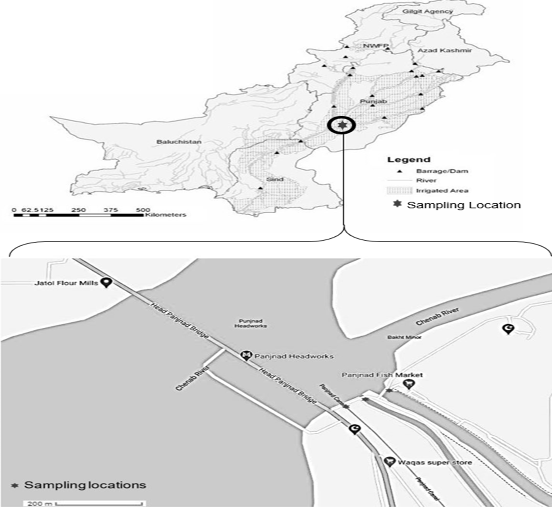
Map showing the location of sampling areas.
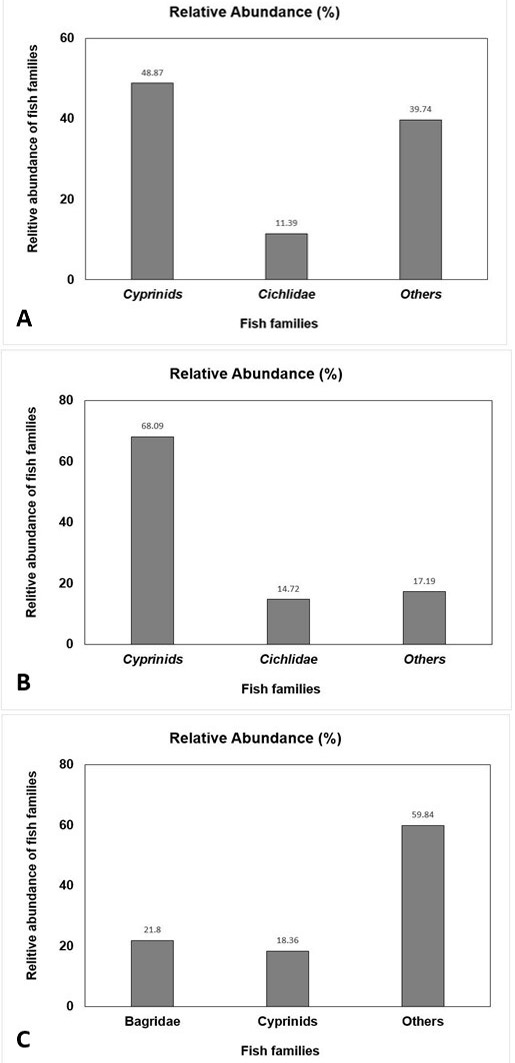
Relative abundance (%) of various fish species groups at Panjnad Canal (A), Abbasia Canal (B) and Abu Dhabi Canal (C).
References
- Acharjee, M.L., and Barat, S., 2014. Seasonal dynamics of ichthyodiversity in a hill stream of the Darjeeling Himalaya, West Bengal, India. J. Threat. Taxa, 6: 6635-6648. https://doi.org/10.11609/JoTT.o3404.6635-48[CrossRef]
- Alam, M.D., Ashraful, A.Y., Parvez, I., Roy, J.K., and Khan, M.A., 2021. Fish diversity and its threatened status of the Dharla river in Bangladesh. Croatian J. Fish., 79: 163-172. https://doi.org/10.2478/cjf-2021-0018[CrossRef]
- Ali, U., Zaman, Q., Farooq, M., Ali, J., and Ullah, R., 2020. 14. Identification and distribution of fishes in fresh water of District Malakand, Khyber Pakhtunkhwa Pakistan. Pure appl. Biol. (PAB), 9: 2297-2304. https://doi.org/10.19045/bspab.2020.90244[CrossRef]
- Altaf, M., Javid, A., and Umair, M., 2014. Biodiversity of Ramsar sites in Pakistan wildlife and ecology. LAP.
- Akhtar, N., Saeed, K., Khan, N. and Rafiq, N., 2015. Fish fauna of River Barandu with new record (Cyprinus carpio) from District Buner, Khyber Pakhtunkhwa Pakistan. World J. Fish Mar. Sci., 7: 418-420. https://doi.org/10.5829/idosi.wjfms.2015.7.6.94275[CrossRef]
- Galib, S.M., Naser, S.A., Mohsin, A.B.M., Chaki, N., and Fahad, M.F.H., 2013. Fish diversity of the River Choto Jamuna, Bangladesh: present status and conservation needs. Int. J. Biodivers. Conserv., 5: 389-395.
- Guo, Q., Liu, X., Ao, X., Qin, J., Wu, X. and Ouyang, S., 2018. Fish diversity in the middle and lower reaches of the Ganjiang River of China: Threats and conservation. PLoS One, 13: e0205116. https://doi.org/10.1371/journal.pone.0205116[CrossRef]
- Hamzah, N., 2007. Assessment on water quality and biodiversity within Sungai Batu Pahat. Doctoral dissertation, University Technology Malaysia.
- Hasan, Z., Ahmad, I., Yousuf, M., and Khan, J., 2013. Fish biodiversity of river Swat. Pakistan J. Zool., 45: 283-289.
- Helfman, G.S., Collette, B.B., Facey, D.E. and Bowen, B.W., 2009. The diversity of fishes, biology, evolution, and ecology. A John Wiley and Sons, Ltd. Publication.
- Hussain, M.Z., Latif, A., Shahzadah, W.A., Hussain, S., Iqbal, R., and Ali, M., 2016. Diversity, abundance and seasonal variations of fish community in lentic water bodies of Indus River at Ghazi Ghat, Pakistan. Pakistan J. Zool., 48: 59-65.
- IUCN, 1989. Pakistan fact sheet water. Journalist Resource Centre for the Environment, IUCN Pakistan.
- IUCN, 2011. IUCN red list of threatened species.
- Jiang, Z., Jiang, J., Wang, Y., Zhang, E., Zhang, Y., Li, L., Xie, F., Cai, B., Cao, L., Zheng, G. and Dong, L., 2016. Red list of China’s vertebrates. Biodivers. Sci., 24: 500. https://doi.org/10.17520/biods.2016076[CrossRef]
- Kelzang, U., Habibi, A.F., and Thoni, R.J., 2021. Evaluation of fish diversity and abundance in the Kabul River with comparisons between reaches above and below Kabul City, Afghanistan. J. Threat. Taxa, 13: 19743-19752. https://doi.org/10.11609/jott.7532.13.12.19743-19752[CrossRef]
- Khan, A.M., Ali, Z., Shelly, S.Y., Ahmad, Z., and Mirza, M.R., 2011. Aliens a catastrophe for native fresh water fish diversity in Pakistan. J. Anim. Pl. Sci., 21: 435-440.
- Khan, M.A. and Hasan, Z., 2011. A preliminary survey of fish fauna of Changhoz dam, Karak, KPK, Pakistan. World J. Fish. mar. Sci., 3: 376-378.
- Khan, M.A., Khan, S. and Miyan, K., 2012. Length–weight relationship of giant snakehead, Channa marulius and stinging catfish, Heteropneustes fossilis from the River Ganga, India. J. appl. Ichthyol., 28: 154–155. https://doi.org/10.1111/j.1439-0426.2011.01901.x[CrossRef]
- Khan, M.R., Rakha, B.A., and Ansari, M.S., 2020. Diversity and distribution of genera Schizothorax and Schizothorichthyes in River Swat, Pakistan. Pakistan J. Zool., 52: 2419. https://doi.org/10.17582/journal.pjz/20180904060941[Full text][CrossRef]
- Limburg, K.E., Hughes, R.M., Jackson, D.C. and Brain, C.Z., 2011. Human population increase economic growth, and fish conservation collision course or savvy stewardship. Fisheries, 36: 27-34. https://doi.org/10.1577/03632415.2011.10389053[CrossRef]
- Majagi, S., Vijaykumar, K., Rajshekhar, M. and Vasanthkumar, B., 2008. Chemistry of groundwater in Gulbarga district, Karnataka, India. Environ. Monit. Assess., 136: 347-354. https://doi.org/10.1007/s10661-007-9690-6[CrossRef]
- Manel, S., Guerin, P.E., Mouillot, D., Blanchet, S., Velez, L., Albouy, C. and Pellissier, L., 2020. Global determinants of freshwater and marine fish genetic diversity. Nat. Commun., 11: 1-9. https://doi.org/10.1038/s41467-020-14409-7[CrossRef]
- Mirza, M.R., 1975. Freshwater fishes and zoogeography of Pakistan. Bijdr. Dierkd., 45: 143-180. https://doi.org/10.1163/26660644-04502001[CrossRef]
- Mirza, M.R., 1980. The systematic and zoogeography of the freshwater fishes of Pakistan and Azad Kashmir. Proceedings of 1st Pakistan Congress Zool, Part A.
- Mirza, M.R., 1990. Freshwater fishes of Pakistan. Published by Urdu Science Board Lahore. pp. 125.
- Mirza, M.R., 1994. Geographical distribution of freshwater fishes in Pakistan: A review. Punjab Univ. J. Zool., 9: 93-108.
- Mirza, M.R., 2004. Fresh water fishes of Pakistan. Published by Urdu Science Board, 1: 256.
- Mirza, M.R., and Sadiq, M., 1978. Barilius vagra pakistanicus (Pisces, Cyprinidae), a new fish from Pakistan. Biologia (Lahore), 24: 1-5.
- Muhammad, H., Iqbal, Z., and Saleemi, S., 2017. Diversity and distribution of fish fauna of Indus river at Taunsa barrage in Punjab, Pakistan. Pakistan J. Zool., 49. 149-154. https://doi.org/10.17582/journal.pjz/2017.49.1.149.154[CrossRef]
- Olán-González, M., Reyes-Bonilla, H., Álvarez-Filip, L., Pérez-España, H., and Olivier, D., 2020. Fish diversity divergence between tropical eastern pacific and tropical western Atlantic coral reefs. Environ. Biol. Fishes, 103: 1323-1341. https://doi.org/10.1007/s10641-020-01026-y[CrossRef]
- Ortega, H.H, Guerra and Ramirez, R., 2007. The introduction of nonnative fishes into freshwater system of Peru.. Ecol. Genet. Implicat. Aquac. Activit., pp. 247–278. https://doi.org/10.1007/978-1-4020-6148-6_14[CrossRef]
- Peter, T., 1999. Coldwater fish and fisheries in Pakistan. FAO Rome Fish. Tech. Pap., 385: 122-137.
- Rafique, M. and Khan, N.U., 2012. Distribution and status of significant freshwater fishes of Pakistan. Rec. Zool. Surv. Pakistan, 21: 90-95.
- Rafique, M., 2007. Biosystematics and distribution of the freshwater fishes of Pakistan with special references to the subfamilies Noemacheilinae and Schizothoracinae. Doctoral dissertation, Ph. D. dissertation, UAAR. pp. 220.
- Rafique, M., Akhtar, S. and Niazi, H.K., 2003. Fish fauna of Jinnah Barrage and adjoining areas. Pakistan J. Zool., 35: 95-98.
- Regnier, C., Fontaine, B. and Bouchet, P., 2009. Not knowing, not recording, not listing: Numerous unnoticed mollusk extinctions. Conserv. Biol., 23: 1214–1221. https://doi.org/10.1111/j.1523-1739.2009.01245.x[CrossRef]
- Saeed, K., Khan, S. and Haq, F., 2013. Diversity and population status of fish fauna of river Barandu district Buner Khyber Pakhtunkhwa Province Pakistan. J. Biodiver. Environ. Sci., 3: 83-88.
- Samal, N.R., Roy, P.K., Majumadar, M., Bhattacharya, S. and Biswasroy, M., 2014. Six years major historical urban floods in west Bengal state in India: Comparative analysis using neuro-genetic model. Am. J. Water Resour., 2: 41-53. https://doi.org/10.12691/ajwr-2-2-3[CrossRef]
- Sheikh, M., Laghari, M.Y., Lashari, P.K., Khooharo, A.R. and Narejo, N.T., 2017. Current Status of Three Major Carps (Labeo rohita, Cirrhinus mrigala and Catla catla) In the Downstream Indus River, Sindh. Fish Aquac. J., 8: 222. https://doi.org/10.4172/2150-3508.1000222[CrossRef]
- Shinde, S.E., Pathan, T.S., Bhandare, R.Y. and Sonawane, D.L., 2009. Ichthyofaunal diversity of Harsul Savangi dam, district Aurangabad, (M.S) India. World J. Fish. Mar. Sci., 1: 141-143.
- Urooj, N., Sahato, G.A., Lashari, K.H., Korai, A.L., Palh, Z.A. and Naqvi, H.S., 2011. Ichthyodiversity of River Indus, at Jamshoro District, Sindh. Sind. Univ. Res. J., Sci. Ser., 43: 13-18.
- Ward, R.D., 2009. DNA barcode divergence among species and genera of birds and fishes. Mol. Ecol. Res., 9: 1077–1085. https://doi.org/10.1111/j.1755-0998.2009.02541.x[CrossRef]
Cited by 2 articles
In journals published by ResearchersLinks.
Services
Article usage statistics
Loading…