Research Article · Volume 10, Issue 7, 28 June 2022 · Open Access
Cross Reactivity of Febrile Malaria with Brucellosis and Typhoid
· · · ·
Affiliations & Notes ⌄
1Department of Zoonotic Diseases, National Research Centre, 33 Bohouth St., Dokki, Giza, P.O. 12622, Egypt
2Department of Parasitology, Faculty of Medicine, Fayoum University, El Fayoum Egypt. *Correspondence | Raafat Mohamed Shaapan, Department of Zoonotic Diseases, National Research Centre, 33 Bohouth St., Dokki, Giza, P.O. 12622, Egypt
In this study 29 out of 504 (5.75%) patients attending to the El Faiyum and El Zagazig fever hospitals presenting with malaria symptoms were positive for malaria RDTs and 100% negative for malaria by expert Leishmania blood film microscopy.
In the present study cross reactivity of malaria parasite antigen (RDTs) with typhoid salmonellae (3.6%) was determined and S. typhi infection could lead to a false positive malaria RDT.
Brucellosis is a potentially missed diagnosis amongst patients presenting with symptoms which are indistinguishable from other febrile diseases like malaria and highly accurate laboratory diagnostic tools are integral for proper febrile disease management.
Because of this misunderstanding, and to rule out any cases of malaria with similar symptoms, the use of culture methods for typhoid fever diagnosis should be encouraged in our clinical laboratories.
Selected from the article's own text.
Abstract
Malaria misdiagnosis is a common condition that receives insufficient medical attention. It is remarkable that clinical signs of human malaria are not pathologically indicative and shared with a variety febrile diseases. The study aimed to screen patients attending El Fayoum and El Zigzag (El Sharkaria governorate) fever hospitals presenting with malaria-like symptoms for the possibility of false-positive malaria diagnosis by card test RDT (Rapid Diagnostic Test) due to typhoid fever and brucellosis and finally to determine if the associated individual characteristics were serologically positive to these diseases. The collected 504 blood samples were screened for malaria (card test ‘RDTs and microscopic blood film examination), typhoid fever (Widal test, blood culture and stool analysis) and brucellosis (Rose Bengal test ‘RBT’ and also standard agglutination test ‘SAT’) a similar time. The results showed that 29 of 504 examined cases (5.75%) were RDTs positive while all examined blood samples were negative for malaria by microscopic blood film examination. Out of the 29 positive RDTs cases 11 were positive for brucellosis (2.18%) and 18 for typhoid fever (3.57%). Our finding concluded that, it should be emphasized the practical application of cultural approaches for the identification of brucellosis and typhoid fever or any other acute febrile illness (AFI) in our clinical laboratories must rule out any cases of malaria that have symptoms that are similar to the symptoms of the disease and improve patient management by lowering treatment costs and removing other risks related with antibiotic misuse.
Malaria is one of the most serious public health issues in the globe, in many parts of Sub-Saharan Africa, South and Southeast Asia, and Central and South America, human malaria is endemic. . Although the prevalence of malaria infections (including both symptomatic and asymptomatic infections) has decreased significantly in Africa, the number of people infected is still estimated to be 200 million in 2020 . The WHO African Region is responsible for a disproportionately large amount of the worldwide malaria burden. In 2016, 90 percent of malaria cases and 91 percent of malaria deaths occurred in the region. (WHO, 2017).
Malaria misdiagnosis gets little attention, yet it’s still a problem that affects disadvantaged populations the most. Clinical algorithms have traditionally been used to manage malaria cases in low-resource settings by health care facilities . Because the symptoms of non-severe malaria resemble those of most acute febrile illnesses, clinical algorithms for malaria typically result in fewer true-negatives and a higher rate of false positives, but because the symptoms of non-severe malaria resemble those of most acute febrile illnesses, clinical algorithms for malaria typically result in fewer true-negatives and a higher rate of false positives , as a result, differential diagnosis is hampered. Because the presence of fever in endemic areas is frequently misinterpreted as malaria, even when malaria is not present , diseases including typhoid, brucellosis, influenza, and dengue fever have certainly underestimated their full impact . This was a role in the WHO’s 2010 revision of malaria care guidelines, which recommended that all suspected malaria cases be confirmed by a parasitological test. However, even when evidence-based standards for malaria diagnosis exist, health care provider adherence can be challenging (WHO, 2015).
It is noteworthy that clinical signs of human malaria are not pathognomonic and shared with various febrile diseases (e.g. brucellosis, typhoid). Consequently, a diagnosis based solely on clinical symptoms is unreliable, thereby highlighting the need for laboratory confirmation . Cross reactivity was reported between Leishmania. infantum (L. infantum) (causative of visceral leishmaniasis-VL) and malaria, tuberculosis, brucellosis and typhoid fever by using patient serum samples of these diseases as the antibody source and the causative factor of VL, as the antigen using indirect fluorescent antibody (IFA) test. False-positive results (cross reactivity with VL) were malaria (P. falciparum 13.2%, P. vivax 19.8%), brucellosis (3.8%), tuberculosis (6.4%), and typhoid fever (2.8%) .
There is observed Malaria parasites and Salmonella antigens cross react, resulting in a false positive Widal agglutination test . In developing countries, typhoid fever is one of the most prevalent febrile infections, a result of Salmonella typhi and paratyphi and the ingestion of food or water contaminated with an infected person’s excrement can spread the disease . The bacteria subsequently perforate the intestinal wall and are phagocytized by macrophages. The organism is a Gram-negative short bacillus that is motile due to its peritrichous flagella and thrives best at 37 °C/99 °F, which is human body temperature . The onset of fever and malaise occurs 7 to 14 days after the incubation period. Chills, headache, lethargy, anorexia, nausea, vague stomach discomfort, and myalgia accompany the fever. Coated tongue, painful belly, hepatomegaly, and splenomegaly are the next symptoms to appear .
Malaria and typhoid fever are two of the most common tropical diseases. Both diseases have been linked to poverty and underdevelopment, as well as high morbidity and mortality rates . Malaria and typhoid continue to be a hazard to many people in Sub-Saharan Africa due to a variety of etiological reasons, including rising poverty, decreasing public health services, worsened by HIV/AIDS, and increased malaria parasite resistance to antimalarial drugs , a lack of safe drinking water and frequent misapplication of the Widal agglutination test for typhoid fever diagnosis . Despite the fact that most industrialised countries have successfully managed it, Brucellosis remains a global public health problem, with an estimated 500,000 new instances of human infection every year across all Brucella species . Ingestion of unpasteurized milk or undercooked meat from infected animals, or close contact with their secretions, causes this extremely contagious zoonosis. It has a significant impact on cattle output and human health around the world. The illness might last anywhere from a few weeks to months or even years . The symptoms are similar to those of many other febrile illnesses, with a focus on muscle soreness and nocturnal sweats and it is under-diagnosed worldwide . Brucella abortus, Brucella melitensis, and Brucella suis are the bacteria that cause Brucellosis in cattle, small ruminants, and swine, respectively .
Therefore, our study aimed to screen febrile patients attending El Fayoum and El Zigzag (El Sharkaria governorate) fever hospitals presenting with malaria-like symptoms for the possibility of false-positive malaria diagnosis by card test RDT (Rapid Diagnostic Test) due to typhoid fever and brucellosis and finally to determine if associated individual factors were serologically positive to these diseases.
MATERIALS AND METHODS
Subjects of Study
This was a cross-sectional investigation conducted during June 2020- June 2021for screening of febrile patients with history suggestive of malaria who were referred to El Fayoum and El Zigzag fever hospitals, Egypt using the rapid diagnostic tests kits (RDTs).
Blood samples collection and diagnosis of malaria
Fifty-four blood samples were taken from feverish patients attending El Fayoum (309) and El Zigzag (195) fever hospitals. Blood samples were screened for detection of malaria by using the Malaria (Pf/Pan) One Step Rapid Test (Accurate, Poly-Med Therapeutics, Inc., USA) (Whole blood) according the manufacture instructions. A thick and thin smear (regarded the gold standard) stained with Leishman’s stain was created for the identification of malaria parasites in peripheral blood. The presence of malaria parasites within red blood cells in thin films was investigated microscopically. The ring forms, trophozoites, and gametocytes were looked for in thick films. If no parasites were found after inspecting at least 100 microscopic areas, the smear was termed negative for malaria parasites .
Diagnosis of brucellosis
Brucellosis was identified by clinical signs and symptoms combined with a serial testing approach that begins with a screening of all blood samples collected (504) by the Rose Bengal Test (RBT) and the Standard Agglutination Test (SAT) was used to confirm the results (SAT) . When the seroprevalence result from the SAT shows partial or total agglutination, it is considered positive. The cutoff point for SAT serology to identify positive cases was 1:160 with a prior positive RBT .
Diagnosis of typhoid fever
Clinical signs and symptoms of typhoid fever were used to make the diagnosis of typhoid coupled with laboratory testing of all collected blood samples (504) including the following:
Widal test
All blood samples were subjected to the Widal agglutination test, titres with TH>1:160; TO>1:80 were judged significant for the somatic O and flagellar H antigens. Patients who tested positive on the Widal test had their blood and stool samples bacteriologically cultured for S. typhi or paratyphi A and B .
Bacteriological culture of blood
A minimum of 10 mL of blood was obtained aseptically from Widal test positive people and put into a HiMedia blood culture bottle (HiMedia Laboratories Pvt. Limited) containing 50 ml of glucose broth. All blood culture bottles were incubated for 24 hours at 37°C before being subcultured on MacConkey agar after 24 hours, 72 hours, and ultimately on the seventh day. Standard culture, microscopy, and biochemical characterization were used to identify S. typhi/paratyphi A and B organisms. (Abd El Wahb et al., 2018). If there was no growth after seven days, the inoculated blood culture material was rejected as negative.
Bacteriological stool culture
After 2 weeks, a stool specimen was taken from patients whose blood cultures were proven to be sterile. (The sensitivity of stool culture is proportional to the amount of faeces cultured, and the positive rate rises with sickness duration) and plated on MacConkey agar and deoxycholate citrate agar (DCA). After enrichment in Selenite F broth for 18-24 hours, another batch of MacConkey and DCA were plated. Biochemical tests and antisera testing were used to identify NLF (non-lactose fermenting) colonies .
Statistical analysis
The data was statistically assessed, standard deviation is calculated by computing the mean value and P value (significant at 0.05) for associated factors analysis using SPSS 10 program for Windows .
Results
Prevalence of brucellosis and typhoid among RDTs positive patients
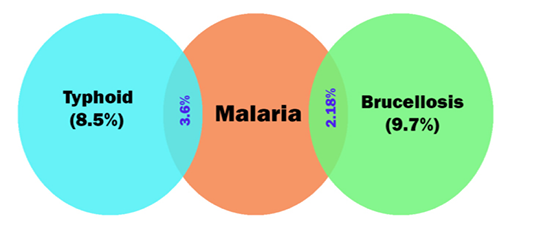
Clinical signs and symptoms of typhoid and brucellosis in addition to laboratory findings were used to call a sample positive for Brucella or Salmonella. Considering clinical signs and symptoms; for brucellosis, emphasis was spotted on undulant fever, muscular pain and night sweats and for typhoid fever, headache, vague abdominal discomfort, backache, hepatomegaly and splenomegaly. To determine the extent to which malaria was misdiagnosed due to cross-reactivity with Brucella and Salmonella, we tested all febrile patients (n=504) for each of these organisms. Testing was performed by screening the full cohort and performing additional confirmatory testing on samples that screened positive. In the present study, all collected blood samples (504) were negative for malaria by microscopic blood film examination but 29 blood samples were RDTS positive. 49 out of 504 examined cases (9.7%) were positive for brucellosis including 11 cases positive for malaria RDTs (2.18%) (Cross reactive cases) (Figure 1). All the 11 cross reactive cases were positive for Malta fever (B. abortus and B. melitensis 1/320 and 1/640) by RBT and SAT. 43 out of 504 examined cases (8.5%) were positive for typhoid testing and out of 43cases 18 were positive for malaria RDTs (3.6%). The 18 cross reactive cases displayed positive Widal test (S. typhi O: 1/160 and 1/320 and H: 1/320) and 12 and 6 Widal positive samples were positive by blood culture and stool analysis respectively.
Associated factors analysis
Considering inclusion criteria we found that patients living in rural areas in contact with domestic animals displayed higher percent of brucellosis (10.4%) than to those who weren’t (7.7%) with p= 0.05, patients assisting birthing of animals had a higher percentage for catching brucellosis (14.1%) than those who weren’t (2.2%) with p= 0.002 (Table 1). Regarding associated factors; age, younger age individuals (17-47 year) showed the higher percentage of
Table 1: Associated factors in the study patients with brucellosis (n=504).
Variable
No. (%)
Brucellosis
positive
Brucellosis
negative
Significance
(p-value)
Age
17-47
48-67
(49±1.2303)
358 (71.0)
146 (29.0)
39(10.9)a
10 (6.8)b
319(29.0)
136(93.2)
0.045
Gender
Male
Female
278 (55.2)
226 (44.8)
27(9.7)a
22(9.7)a
251(90.3)
204(90.3)
0.132
Education
-No education
-Basic education
-College
209 (41.5)
231(45.8)
64(12.7)
21(10.0)a
25(10.8)a
3(4.7)b
188(90.0)
206(89.2)
61(95.3)
0.05
Residence
Rural
Urban
378(75.0)
126(25.0)
38(10.0)a
11(8.7)b
340(90.0)
115(91.3)
0.02
Occupation
-Farmer
-Farm worker
-Employer
265(52.6)
121(24.0)
118(23.4)
29 (10.9)a
13 (10.7)a
7(5.9)b
236(89.1)
108(89.3)
111(94.1)
0.002
Duration of sickness before presenting to hospital
0 till 7
>7days
245(48.6)
259(51.4)
25(10.2)a
24(9.3)a
240 (98.0)
235(90.7)
0.307
Malaria status and history of antimalarial drugs
yes
No.
-(0.0)
504(100.0)
-(0.0)
49(9.7)
-(0.0)
455(90.3)
----
Assisting birthing of animals
Yes
No
320(63.5)
184(36.5)
45(14.1)a
4(2.2)b
275(86.0)
180(97.8)
0.002
contact with cattle as well as sheep and goats
Yes
No
387(69.8%)
117(23.2)
40(10.4)a
9 (7.7)b
347(89.6)
108(92.3)
0.05
Consumption of non-boiled raw milk
Yes
No
167(33.1)
337(66.9)
44(26.3)a
5(1.5)b
123(73.7)
332(98.5)
0.001
Different letters means significance (p≤0.05) while similar letters means no significance (p≥0.05)
Table 2: Associated factors in the study patients with typhoid fever (n=504).
Variable
No. (%)
Typhoid
positive
Typhoid
negative
Significance
(p-value)
Age
17-47
48-67
(49±1.2303)
358 (71.0)
146 (29.0)
31(8.7)a
12(8.3)a
327(91.3)
134(91.7)
0.121
Gender
Male
Female
278 (55.2)
226 (44.8)
32(11.5)a
11(4.9)b
246(88.5)
(95.1)
0.01
Education
-No education
-Basic education
-College
209 (41.5)
231(45.8)
64(12.7)
21(10.0)a
19(8.3)a
3(4.7)b
188(90.0)
(91.7)
(95.3)
0.03
Residence
Rural
Urban
378(75.0)
126(25.0)
33(8.7)a
10(7.9)a
345(91.3)
116(92.1)
0.133
Occupation
-Farmer
-Farm worker
-Employer
265(52.6)
121(24.0)
118(23.4)
24(9.1)a
11(9.1)a
8(6.8)b
241(90.9)
110(90.9)
110(93.2)
0.04
Duration of sickness before presenting to hospital
0 till 7
>7days
245(48.6)
259(51.4)
21(8.6)a
22(8.5)a
224(91.4)
237(91.5)
0.324
history of antimalarial drugs or antibiotic intake
yes
No
-(0.0)
504(100.0)
0(0.0)
43(8.5)
504(100.0)
461(91.5)
-----
Eating unwashed produce
Yes
No.
206(40.1)
298(59.1)
28(13.6)a
15(5.0)b
178(86.4)
283(95.0)
0.001
Interrupted water availability
Yes
No
199 (39.5)
305(60.5)
20(10.0)a
23(7.5)b
179(90.0)
282(92.5)
0.02
Hand washing after defecating
Yes
No
304(60.3)
200(39.7)
27(8.9)a
16(8.0)a
277(91.1)
184(92.0)
0.352
Unimproved or damaged sanitation facility
Yes
No
301(59.7)
203(40.3)
28(9.3)a
15(7.4)b
273(90.7)
188(92.6)
0.01
catching brucellosis (10.4) than older age individuals (48-67 year) (6.8) with p=0.45 (Table 1) while there was no effect of age in acquiring typhoid fever (Table 2). Young age individuals are more active and responsible for doing their work with the possibility of more contact with diseased animals. Gender is a very important factor for acquiring typhoid fever where males showed higher percentage (11.5) for acquiring typhoid fever than females (4.9) with (p=0.01) (Table 2) while there was no effect of gender in acquiring brucellosis (Table 1), males might be more exposed to infection than females as they might be working in places with high risk of infection with typhoid bacilli. Participants having college degree displayed the lowest infection rate of brucellosis and typhoid fever (4.7 for both) with (p=0.05 and 0.03, respectively) (Table 1 and 2) as they might be aware of the preventive measures e.g. consumption of boiled milk, eating washed produce and hand washing after defecating. It was found that participants living in rural area have higher rate of catching brucellosis (10%) compared with those living in urban ones (8.7%), p=0.02 (Table 1).Considering occupation we found that employers showed the lowest infection rate with brucellosis and typhoid fever (Table 1 and 2) with p= 0.002 and 0.04 respectively. Also Patients consuming unpasteurized and raw dairy products from cow, goats and sheep showed higher affection by brucellosis 26.3% compared to those who weren’t (1.5%) p=0.001. No participant gave prior history of malaria and antimalarial drugs intake (Table 1 and 2) and this coincided with this study finding (all malaria tests applied were negative).
Discussion
Malaria usually manifests itself as fevers that come and go, with bouts of weariness in between, but otherwise the patient appears to be in good health. High fever, rigours, sweats, and headache are all symptoms of febrile paroxysms, as are myalgia, back pain, stomach discomfort, vomiting, nausea, diarrhoea, jaundice and pallor . Due to the development of immunity, rising resistance to antimalarial medications, and the indiscriminate use of antimalarial treatments in endemic areas, malaria might present with atypical symptoms . Malaria is frequently detected late or goes unnoticed as a result of a lack of knowledge of atypical signs, resulting in severe sickness or death. Also, false positive malaria cases resulting from cross reactivity could lead to inappropriate use of antimalarial to stimulate the development of resistance by circulating Plasmodium spp. So malaria diagnosis should be confirmed by blood film examination by highly expert professionals or PCR which possesses a high level of sensitivity and specificity .
In this study 29 out of 504 (5.75%) patients attending to the El Faiyum and El Zagazig fever hospitals presenting with malaria symptoms were positive for malaria RDTs and 100% negative for malaria by expert Leishmania blood film microscopy. The absence of any significant association between the observed clinical signs and the diagnostic outcome provided additional evidence for the inherent challenge of making a clinical diagnosis of febrile patients . Because a positive rapid diagnostic test does not always indicate a true active malaria infection, distinguishing malaria from other fever-causing infections remains difficult. The study’s relatively high number of malaria RDT false positive results is consistent with those reported by several investigators ; . Our results showed much lower percentage (5.75%), many investigations have found that the RDT- HRP-2 has a declining specificity and positive predictive value up to 3–4 weeks after successful malaria treatment ; . During this phase of antigen persistence, HRP-2-based assays cannot be used to diagnose the patient.
Cross reactivity of malaria parasite antigen (RDTs) with B. abortus & B. melitensis the present study (2.18%) was determined. In comparable pastoralist areas, brucellosis accounted for 13% of patients with malaria-like symptoms, although confirmation was done using the Serum Agglutination Test (SAT) and the Rose Bengal Test (RBT) . Because brucellosis and malaria are clinically indistinguishable and both present with diagnostic challenges which will inevitably lead to malaria over diagnosis contributing to brucellosis under diagnosis . Therefore in patients with febrile symptoms from rural, pastoral environments endemic for brucellosis, systematic and combined testing for brucellosis should be considered. While, in the current work, the brucellosis prevalence in the investigated patients was 9.7% (49/504) and this result agrees with the reported prevalence of human brucellosis in African regions which has great dispersion (between 1 and 13.3%) . In the present study cross reactivity of malaria parasite antigen (RDTs) with typhoid salmonellae (3.6%) was determined and S. typhi infection could lead to a false positive malaria RDT. The presence of an interfering chemical linked to typhoidal illness can result in a false positive rapid test. . This emphasizes the significance of professional microscopy and/or PCR in the confirmation of RDT presumptive results. Using latent class and receiver operating curve analysis, it has previously been proven that expert microscopy and PCR offer superior analytical sensitivity to RDTs . It was reported that 48.7% of malaria patients who had a positive Widal test result cross reactivity between S. typhi and malaria parasite antigens could be present .
CONCLUSIONS AND RECOMMENDATIONS
Brucellosis is a potentially missed diagnosis amongst patients presenting with symptoms which are indistinguishable from other febrile diseases like malaria and highly accurate laboratory diagnostic tools are integral for proper febrile disease management. Salmonella Typhi appears to be spread through drinking polluted surface water and eating unwashed vegetables, with poor sanitation facilities being a main source. Improved sanitation facilities, as well as the protection of surface water sources and produce from contamination by human excrement, are likely to aid in typhoid prevention. Because of this misunderstanding, and to rule out any cases of malaria with similar symptoms, the use of culture methods for typhoid fever diagnosis should be encouraged in our clinical laboratories. This will also help patients by lowering treatment costs and removing additional dangers linked with antibiotic abuse. In general, understanding risk factors and epidemiology through integrated surveillance, health promotion and treatment campaigns for both typhoid and brucellosis are important strategies to control these endemic diseases in Africa.
ACKNOWLEDGMENTS
The authors are grateful to the late Prof Dr. Mohey A. Hassanain Professor of Parasitology, Department of Zoonotic Diseases, National Research Centre, Egypt, for his encouragement and significant direction in the completion of this work.
Novelty Statement
The current research indicated that, it should be emphasized the practical apply of cultural methods for the detection of brucellosis and typhoid fever and this study understanding risk factors and epidemiology through integrated surveillance, health promotion and treatment for malaria, typhoid and brucellosis are important strategies to control these endemic diseases.
Conflict of interest
The authors declare that they have no conflict of interest.
AUTHOR’S CONTRIBUTION
The Authors worked cooperatively developed the concept, designed the study and were involved in all aspects of the study while, Nawal A. Hassanain, Raafat M. Shaapan and Ahmed Maher collect tested human sera and microscopically examined the blood samples. Raafat M. Shaapan, Ahmed B. Yousef and Gomaa D. Emam apply blood film examination & Screening for malaria by card test. Ahmed B. Yousef and Gomaa D. Emam carried out the Rose Bengal test ‘RBT’ and standard agglutination test ‘SAT. All authors share in the statistical analysis and revised and edited the manuscript also, read and approved the final draft of the manuscript for publication.
Figures
Figure 1. Figure 1.
A Venn diagram for Cross Reactivity of malaria with brucellosis and typhoid Cases
References
Abd El Wahb WM, Shaapan RM, Abd El Hafiz Hassanain, Elfadaly HA, Hamdy DA. (2018) Toxoplasma gondii infection and associated sociodemographic and behavioral risk factors among blood donors. Asian J. Epidemiol. 11(2):52-58. http://dx.doi.org/10.3923/aje.2018.52.58[CrossRef]
Abu-Sarea EY, Ismael MA, Shaapan RM, Gawad SS, Ghieth MA (2020) Malaria among immigrant s workforce return from endemic districts in alwosta city, Egypt. J. Egypt. Soc. Parasitol. (JESP), 50(3): 483– 487. https://dx.doi.org/10.21608/jesp.2020.131065[CrossRef]
Alanazi AD, Abdullah S, Helps C, Wall R, Puschendorf R, ALHarbi SA, Abdel-Shafy S, Shaapan RM (2018). Tick-borne pathogens in ticks and blood samples collected from camels in Riyadh Province, Saudi Arabia. Int. J. Zool. Res., 14 (1): 30-36. https://dx.doi.org/10.3923/ijzr.2018.30.36[CrossRef]
Allen LK, Hatfield JM, Manyama MJ (2013). Reducing microscopy-based malaria misdiagnosis in a low-resource area of Tanzania. Tanzania journal of health research. 2013; 15(1): 1-9. https://doi.org/10.4314/thrb.v15i1.4[CrossRef]
Chau TT, Campbell JI, Galindo CM, Hoang NV, Diep TS, Nga TT, Chau NV, Tuan PQ, Page AL, Ochiai RL, Schultsz C (2007). Antimicrobial drug resistance of Salmonella enterica serovar Typhi in Asia and molecular mechanism of reduced susceptibility to the fluoroquinolones. Antimicrobial agents and chemotherapy. 51(12):4315-4323. https://doi.org/10.1128/AAC.00294-07[CrossRef]
Crump JA, Morrissey AB, Nicholson WL, Massung RF, Stoddard RA, Galloway RL, Ooi EE, Maro VP, Saganda W, Kinabo GD, Muiruri C (2013). Etiology of severe non-malaria febrile illness in Northern Tanzania: a prospective cohort study. PLoS neglected tropical diseases. 7(7):e2324. https://doi.org/10.1371/journal.pntd.0002324[CrossRef]
Dean AS, Crump L, Greter H, Hattendorf J, Schelling E, Zinsstag J (2012). Clinical manifestations of human brucellosis: a systematic review and meta-analysis. PLoS neglected tropical diseases. 6(12):e1929. https://doi.org/10.1371/journal.pntd.0001929[CrossRef]
Earhart K, Vafakolov S, Yarmohamedova N, Michael A, Tjaden J, Soliman A (2009). Risk factors for brucellosis in Samarqand Oblast, Uzbekistan. Int J Infect Dis; 13(6):749-753. https://doi.org/10.1016/j.ijid.2009.02.014[CrossRef]
Elfadaly HA, Hassanain NA, Hassanain MA, Barakat AM, Shaapan RM (2018). Evaluation of primitive ground water supplies as a risk factor for the development of major waterborne zoonosis in Egyptian children living in rural areas. J Infect Public Health. 11(2):203-208. https://doi.org/10.1016/j.jiph.2017.07.025[CrossRef]
Franco MP, Mulder M, Gilman RH, Smits HL. Human brucellosis (2007). The Lancet infectious diseases. 7(12):775-786. https://doi.org/10.1016/S1473-3099(07)70286-4[CrossRef]
Frimpong EH, Feglo P, Essel-Ahun M, Addy PA (2000). Determination of diagnostic Widal titres in Kumasi, Ghana. West African journal of medicine. 19(1):34-38. https://europepmc.org/article/med/10821084
Gething PW, Elyazar IR, Moyes CL, Smith DL, Battle KE, Guerra CA, Patil AP, Tatem AJ, Howes RE, Myers MF, George DB (2012). A long neglected world malaria map: Plasmodium vivax endemicity in 2010. PLoS neglected Trop. Dis. 6(9): e1814. https://doi.org/10.1371/journal.pntd.0001814.[CrossRef]
Hassanain MA, Khalil FA, Abd El-Razik KA, Shaapan RM (2011). Prevalence and molecular discrimination of Cryptosporidium parvum in calves in Behira Provinces, Egypt. Res. J. Parasitol., 6(3):101-108. http://scialert.net/abstract/?doi=jp.2011.101.108
Hassanain N, Shaapan R, Saber M, Kabary H, Zaghloul A. (2021). Adverse impacts of water pollution from agriculture (Crops, livestock, and aquaculture) on human health, environment, and economic activities. Egyptian J. Aquat. Biol. Fisher. (EJABF). 25(2):1093–1116. https://dx.doi.org/10.21608/ejabf.2021.171677[CrossRef]
Hassanain NA, Hassanain MA, Ahmed WM, Shaapan RM, Barakat AM, El-Fadaly HA (2013). Public health importance of foodborne pathogens. W J. Med. Sci.; 9(4):208-222. http://dx.doi.org/10.5829/idosi.wjms.2013.9.4.8177[CrossRef]
Ilombe G, Maketa V, Mavoko HM, da Luz RI, Lutumba P. Performance of HRP2-based rapid test in children attending the health centre compared to asymptomatic children in the community. Malaria J. 2014; 13(1):308. https://doi.org/10.1186/1475-2875-13-308[CrossRef]
Kiemde F, Tahita MC, Lompo P, Rouamba T, Tinto H, van Hensbroek MB, Mens PF, Schallig HD. Accuracy of a Plasmodium falciparum specific histidine-rich protein 2 rapid diagnostic test in the context of the presence of non-malaria fevers, prior anti-malarial use and seasonal malaria transmission. Malar J. 2017; 16:294. https://doi.org/10.1186/s12936-017-1941-6.[CrossRef]
Kohanteb J, Ardehali S. (2005) Cross-reaction of sera from patients with various infectious diseases with Leishmania infantum. Med. Princ. Pract.; 14(2):79-82. https://doi.org/10.1159/000083915[CrossRef]
Mahmoud MA, Ghazy AA, Shaapan RM (2019) Diagnosis and control of foot and mouth disease (FMD) in dairy small ruminants; sheep and goats. Int. J. Dairy Sci.; 14:45-52.2. https://doi.org/10.3923/IJDS.2019.45.52[CrossRef]
Mahmoud MA, Ghazy AA, Shaapan RM (2021). Review of diagnostic procedures and control of some viral diseases causing abortion and infertility in small ruminants in Egypt. Iraqi J. Vet. Sci.; 35(3): 513–521. http://dx.doi.org/10.33899/ijvs.2020.127114.1461[CrossRef]
Mawazo A, Bwire GM, Matee MI (2019). Performance of Widal test and stool culture in the diagnosis of typhoid fever among suspected patients in Dar es Salaam, Tanzania. BMC Res. Notes; 12(1):1-5. https://doi.org/10.1186/s13104-019-4340-y[CrossRef]
Mbuh FA, Galadima M, Ogbadu L (2003). Rate of co-infection with malaria parasites and Salmonella Typhi in Zaria, Kaduna State, Nigeria. Ann. Afr. Med.; 2(2):64-67. https://www.ajol.info/index.php/aam/article/view/8280
McMorrow ML, Aidoo M, Kachur SP (2011). Malaria rapid diagnostic tests in elimination settings—can they find the last parasite. Clin. Microbiol. Infec.; 17(11):1624-1631. https://doi.org/10.1111/j.1469-0691.2011.03639.x[CrossRef]
Meatherall B, Preston K, Pillai DR (2014). False positive malaria rapid diagnostic test in returning traveler with typhoid fever. BMC Infect. Dis. 14(1):377. https://doi.org/10.1186/1471-2334-14-377[CrossRef]
Mufinda FC, Boinas F, Nunes C (2017). Prevalence and factors associated with human brucellosis in livestock professionals. Revist. saud. publ.; 22: 51:57. https://doi.org/10.1590/S1518-8787.2017051006051[CrossRef]
Park HM (2016). Comparing group means: t-tests and one-way ANOVA using Stata, SAS, R, and SPSS; 1-51. https://hdl.handle.net/2022/19735
Parry CM, Hien TT, Dougan G, White NJ, Farrar JJ (2002). Typhoid fever. N. Engl. J. Med.; 347: 1770-1782. https://doi.org/10.1056/NEJMra020201[CrossRef]
Schachterle SE, Mtove G, Levens JP, Clemens EG, Shi L, Raj A, Munoz B, Reller ME, West S, Dumler JS, Sullivan D (2011). Prevalence and density-related concordance of three diagnostic tests for malaria in a region of Tanzania with hypoendemic malaria. J. Clin. Microbiol. 49(11):3885-3891. https://doi.org/10.1128/JCM.01157-11[CrossRef]
Sedky D, Ghazy AA, Soliman NA, Shaapan RM (2020). Comparative diagnosis of infectious bacteria in bovine milk. J. Anim. Health Prod.; 8(4):171-82. http://dx.doi.org/10.17582/journal.jahp/2020/8.4.171.182[Full text][CrossRef]
Shaapan RM, Abo-ElMaaty AM, El-Razik KA, El-Hafez SM (2012). PCR and serological assays for detection of Toxoplasma gondii infection in sport horses in Cairo, Egypt. Asian J. Anim. Vet. Adv.; 7(2):158-65. http://scialert.net/abstract/?doi=ajava.2012.158.165.
Shell WS, Saad MA, Abd El-Razik KA, Sayed ML, Shaapan RM (2012). Brucella ovis as a Common Antigen for Rapid Diagnosis of Rough Brucellosis in Cattle and Sheep. Res. J. Microbiol.; 7(1): 68-74. (http://scialert.net/abstract/?doi=jm.2012.68.74).
Shibeshi MA, Kifle ZD, Atnafie SA (2020). Antimalarial drug resistance and novel targets for antimalarial drug discovery. Infect. Drug Resistan. 13:4047. https://dx.doi.org/10.2147%2FIDR.S279433
Soliman WS, Shaapan RM, Mohamed LA, Gayed SS. Recent biocontrol measures for fish bacterial diseases, in particular to probiotics, bio-encapsulated vaccines, and phage therapy (2019). Open vet J;. 9(3):190-195. http://dx.doi.org/10.4314/ovj.v9i3.2[CrossRef]
Stoler J, al Dashti R, Anto F, Fobil JN, Awandare GA (2014). Deconstructing “malaria”: West Africa as the next front for dengue fever surveillance and control. Acta Tropica. 134:58-65. https://doi.org/10.1016/j.actatropica.2014.02.017[CrossRef]
Thiam S, Thior M, Faye B, Ndiop M, Diouf ML, Diouf MB, Diallo I, Fall FB, Ndiaye JL, Albertini A, Lee E (2011). Major reduction in anti-malarial drug consumption in Senegal after nation-wide introduction of malaria rapid diagnostic tests. PloS one.; 6(4):e18419. https://doi.org/10.1371/journal.pone.0018419[CrossRef]
Uneke CJ. Concurrent malaria and typhoid fever in the tropics: the diagnostic challenges and public health implications (2008). J. Vector. Borne Dis.; 452133:133-142. https://pubmed.ncbi.nlm.nih.gov/18592842/
Verma D, Kishore S, Siddique ME (2014). Comparative evaluation of various tests for diagnosis of concurrent malaria and typhoid fever in a tertiary care hospital of Northern India. J. Clin. Diagn. Res.; 8(5):DC41. https://dx.doi.org/10.7860%2FJCDR%2F2014%2F7745.4403
WHO (2015). World Health Organization, guidelines for the treatment of malaria. 2nd ed. World Health Organization; Aug 13. https://who.int/iris/handle/9789241549127_eng.pdf
WHO (2017). The World malaria report draws on data from 91 countries and areas with ongoing malaria transmission Geneva, WHO; 2017: 1-196. https://who.int/media/docs/ /world-malaria-report-2017.pdf?=8b7b573a_0
Ye Y, Madise N, Ndugwa R, Ochola S, Snow RW (2009). Fever treatment in the absence of malaria transmission in an urban informal settlement in Nairobi, Kenya. Malaria J. 8(1):160. https://doi.org/10.1186/1475-2875-8-160[CrossRef]