ResearchersLinks

Short Communication · Volume 4, Issue 6, Pages 315–319, 19 June 2016 · Open Access

Cooling of the Carcases for Veterinary Medico Legal Use

·

Article Info ⌄
Journal:
Advances in Animal and Veterinary Sciences
Published:
19 June 2016

From the article

  • The temperature of cadavers reached the ambience within 27 - 117 hours after the death of animals in dependence on environmental conditions.
  • Keywords | animals, body weights and measures, carcases, temperature, time.
  • Determining the time of death by measuring the temperature of the cooling cadaver requires the mapping of all external and internal factors which could influence the cooling.
  • We observed that the temperature dropwas slower in cadavers with higher weight.

Selected from the article's own text.

Abstract

Gabriela Vargová*, Daniela Takáčová

Institute of Forensic and Public Veterinary Medicine and Economy, University of Veterinary Medicine and Pharmacy in Kosice, Komenskeho 73, Slovakia - 04181.

Abstract | Knowing the time of death of companion animals as well as monitoring the cooling curve of a cadaver can be helpful for forensic determination of the time of death of animals that died due to cruelty, poaching, etc. The subject of our interest were carcases of dogs and cats (24 animals) divided into 7 groups according to weight, species and environmental conditions that would best imitate the real conditions to which the dead animals may have been exposed. Differences in body temperatures measured and displayed as temperature curves showed the dependence of temperature drop on the weight of carcasses, character of the base on which the animal had rested and internal and external environmental conditions. According to the general rule the cooling rate ranges from 0.6°C to 0.8°C /hour. Within the first hour the temperature in the monitored groups dropped from 1. 2°C to 4°C in all groups. The temperature of cadavers reached the ambience within 27 - 117 hours after the death of animals in dependence on environmental conditions.

Keywords | animals, body weights and measures, carcases, temperature, time
W –weight; T amb – ambient temperature

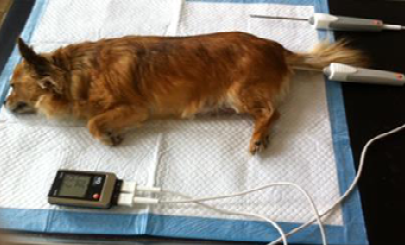
Animals were euthanized at the internal clinic of the University of Veterinary Medicine and Pharmacy (UVMP) in Košice because of old age or incurable disease which would cause suffering and pain to survivors. The decrease in body temperature was measured by a special thermometer, with one probe inserted in the animal rectum and the other used for measurement of ambient temperature (Figure 1). The initial 10 min measuring interval proved to be insufficient so we used 30 min interval to obtain one temperature recording (until the temperature of cadaver dropped to ambient level) (Table 1) (Figure 1).

Our observations proved that the main factors influencing the course of cooling are the animal weight and the temperature of the environment where the cadaver was located. According to the general rule, animal cadavers cool at the rate of 0.6 – 0.8°C per hour, though this does not consider all factors influencing the cooling, e.g. air flow which can speed up the cooling or immersion in water causing 3-fold faster cooling. In our experiment we recorded the fastest cooling of cadavers in group 2 (1.2°C within the first 4 hours). Cadavers from group 1 cooled at a rate of 2.5°C/hour, those from group 3 at a rate of 2.4°C/hour on average, and cadaver from group 7 (body weight 56 kg, placed outside in winter) cooled within the first hours at a rate of 1.7°C/hour.

Figure 1: Measuring of the body temperature by using of thermometer Testo 175 T3

The temperature drop 2.8°C /hour was recorded in cadavers from group 4, which were exposed to air flow. The cadavers from group 6 exposed to conditions which imitated drowning cooled at a rate of 4oC/hour during the first hours of cooling. After 15 hours, the temperature decrease has stabilised in individual groups and reached the rate of 0.7 – 0.5°C/hour. We recorded also occurrence of the so-called plateau phases (several hours without drop of temperature), but in time intervals differing from those recorded in human corpses. The plateau phase was followed by a decline (0.3 – 0.2°C/ hour). During the last hours of cooling, the cadavers cooled at a rate of about 0.1°C until the temperature of both the cadaver and environment became equal which occurred within 27 – 117 hours. When comparing with the results obtained by human forensic pathologists, the temperature measured in the rectum drops very slightly or not at all for about half an hour after death (post mortem temperature plateau). This is followed by a linear rate of cooling (between 0.5 to 1°C per hour) for the next 12 to 16 hours. Then the cooling rate is relatively uniform in its slope. Then it gradually becomes slower, and when the temperature is within about 4°C of the environment, rate of algor mortis cooling becomes very slow .

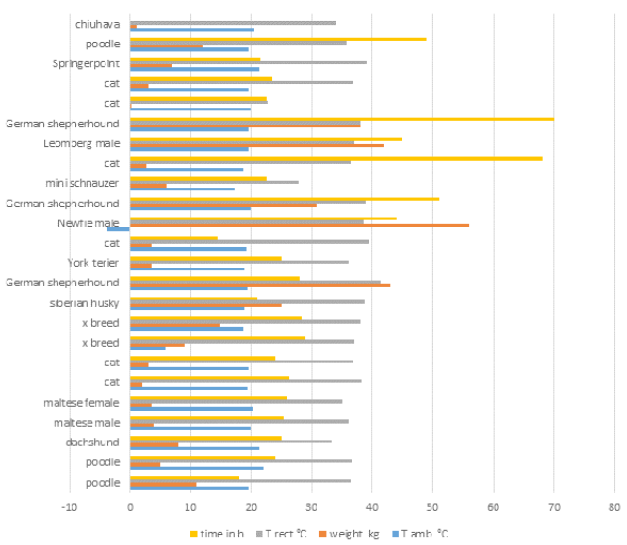
Comparison of the values presented in (Table 2) shows that the rate of cadaver cooling is affected by both the carcass weight and the environmental conditions to which the cadaver was exposed. We observed that the temperature dropwas slower in cadavers with higher weight. This indicates that the rule determining the cooling rates of cadavers equal to 0.6 to 0.8°C per hour is very general. Information obtained from crime scene are useful for establishing the

Table 2: Decline of body temperature in hours in each group separately

Group 1

Hour

0 - 4

6

10

15

19

20

22

25

30

< 30

Decline °C

2.5

1.4

1.0

0.9

0.7

0.5

0.4

0.3

0.2

0.1

Group 2

Hour

0 - 4

4 - 7

7 - 10

10 - 16

16 - 24

24 - 32

< 32

Decline °C

2.2

1.0

0.9

0.7

0.5

0.2

0.1

Group 3

Hour

0 - 12

13

18

19

22

23 - 27

27 - 37

< 38

Decline °C

2.4

0.9

0.5

0.4

0.3

0.5

0.2

0.1

Group 4

Hour

0 -7

11

17

21

25

26

27

44

Decline °C

2.8

0.9

0.6

0.5

0.4

0.3

0.1

0.1

Group 5

Hour

0 - 4

8

14

18

20

23

24 - 30

33

< 33

Decline °C

1.2

1.0

0.9

0.5

0.5

0.3

0.3

0.2

0.1

Group 6

Hour

0 -4

7

9

13

15

25 – 32

Decline °C

4

3

1.5

0.6

0.2

0.1

Group 7

Hour

0 - 14

20

20 - 31

31 - 34

41

43

50

59

62

62 – 71

Decline °C

1,7

1,0

0,9

0,6

0,5

0,3

0,4

0,3

0,2

0,1

Figure 2:Time of death

T amb – ambient temperature; T rect (oC) – initial temperature at the time of euthanasia

time of death (Figure 2). The values determined in this study will be used to draw nomograms for later use by veterinarians when performing reconnaissance as well as for procuring the grounds for determining the time of animal´s death.

Establishing an accurate and precise TOD persist as the holy grail of forensic pathology, despite decades of research. Determining time of death is a constantly evolving research area. In summary, the amount of information available for determining TOD in veterinary species is extremely limited. Given the limited amount of information, as well as the persistently imperfect and inexact science of time of death determination, currently veterinary pathologists may be as well served by personal experience as by sophisticated rectal probes . Potentially pertinent information may be gleaned from some human research based on animal models such as decompositional scoring. Veterinary forensic pathologists should strongly consider documenting and developing a database of known decomposition findings associated with known environmental conditions in their area based on all necropsies performed, not just forensic .

Authors’ Contribution

Gabriela Vargova carried out the experiments and wrote the draft of manuscript. Daniela Takáčová checked the experimental design and supported in English writing manuscript.

Conflict of Interests

The authors have no conflict of interests.

Acknowledgments

Our thanks goes to the staff of the Clinic of the Small Animals (Internal clinc), as well as owners of pets that were left them at clinic for making our experiments.

References

  1. Abdulazeez IO, Noordin MM (2010). Algor Mortis Pattern in Dogs: A guide to estimation of time of death. Pertanika J. Trop. Agric. Sci. 33(1): 105 – 111.
  2. Algor Mortis / health Drop (2012). Forensic Medicine, General Health. http://healthdrip.com/algor – mortis/.
  3. Erlandsson M, Munro R (2007). Estimation of the post mortem interval in beagle dogs. Sci. Justice. 47: 150 – 154. http://dx.doi.org/10.1016/j.scijus.2007.09.005[CrossRef]
  4. Gerdin JA, McDonough SP (2013). Forensic pathology of companion animal abuse and neglect. Vet. Pathol. 50: 994 – 1006. http://dx.doi.org/10.1177/0300985813488895[CrossRef]
  5. Merck MD (2014). Clinician’s brief (capsule). http://www.cliniciansbrief.com//article/veterinary-forensic-priniciples-not-always-same-humans
  6. Pounder D (2013). Lecture Notes in Forensic Medicine. http://www.gsmu.by/file/biblio/uchlit/lecturesnd.doc
  7. Proctor KW (2007). Estimating the Early Post Mortem Interval in Domestic Canines (Master´s thesis), Knoxvill, Univerisity of Tennessee.
  8. Craig Adam (2010). Essential mathematics and statistics for Forensic Science, Wiley – Blackwell by John Wiley & Sons Ltd.

Services

Article usage statistics

Loading…

Cooling of the Carcases for Veterinary Medico Legal Use · ResearchersLinks