
The goal of this research was to determine the composition and tree structure of a dry forest fragment on Ecuador central coast. The DRYFLOR protocol was used on a 5000 m2 plot with 10 x 10 m subplots. Data on diameter at breast height (DBH) of individuals with DBH > 5 cm were recorded. We found 156 individuals within 13 families, 16 genera and 17 species. The results show that the forest is homogeneous with dominance of species such as C. lutea, C. trichistandra, E. ruizii, these 3 species represent 78.66% of those present. The families with the greatest ecological importance are: Malvaceae, Boraginaceae and Capparaceae. The area under study contains many young individuals, so it is assumed that, despite anthropogenic intervention, the forest is in a state of regeneration and maintains its ecological functions.
Specail Issue: Memories of the Agricultural and Livestock Area of the VI CCIUTM, Ecuador · Volume 39, Issue 2, 13 May 2025 · Open Access
Composition and Tree Structure of a Dry Forest Fragment in the Ecuadorian Coast
· · · · ·
Affiliations & Notes ⌄
- 1Agricultural Engineering Career, Faculty of Agricultural Engineering, Universidad Laica “Eloy Alfaro” de Manabí, Manta, Ecuador
- 2Department of Research and Innovation, EcuadorianHands, Manta, Ecuador
- 3Laboratory of Agroecosystems Functioning and Climate Change – FAGROCLIM, Departamento de Ciencias Agronómicas. Facultad de Ingeniería Agronómica. Universidad Técnica de Manabí. Km 15 vía Portoviejo-Santa Ana. Lodana, 131302. Ecuador. , *Correspondence | Carlos Salas-Macías, Department of Agricultural Sciences, Faculty of Agricultural Engineering, Universidad Técnica de Manabí, Km 13 vía Portoviejo-Santa Ana, Lodana, Ecuador, 131302
- 4Email: carlos.salas@utm.edu.ec
Article Info ⌄
- Journal:
- Sarhad Journal of Agriculture
- Published:
- 13 May 2025
From the article
- The species with the most significant ecological weight according to the IVI are C. lutea (27.51 %), C. trischistandra (20.19 %), E. ruizii (18.97 %), Capparis sp. (6.04 %), and P. excelsum (5.92 %), representing 78.66 % of the species found in the study area (Figure 2).
- The results show that the area exhibits low species diversity compared to other dry forest ecosystems yet maintains a similar number of individuals to those recorded in comparable regions.
- The species C. lutea, C. trischistandra, E. ruizii, C. angulata, and P. excelsum play a key ecological role, exhibiting high abundance, frequency, and dominance in the study area.
- The inverted J-shaped diameter distribution suggests that young individuals dominate the forest.
Selected from the article's own text.
Abstract
Introduction
Dry forests are ecosystems with a high level of endemism and have a wide variety of species ; ; ; ; ; . Their main characteristic is their presence in areas with a prolonged dry season where the clay soils form mudflats during the rainy season that crack in the dry season . These forests are primarily dominated by species with adaptations to adverse climatic conditions ; Singh and Chaturvedi, 2017; Banda et al., 2016; ; . One of the most common strategies is deciduousness, where trees shed their leaves to withstand seasonal drought ; Hubbell, 1979).
Despite their ecological importance, dry forests are among the most vulnerable and threatened ecosystems worldwide (Manchego et al., 2017). They face severe degradation due to land-use change, particularly for activities such as extensive cattle ranching and agriculture areas which has significantly impacted biodiversity (Ballesteros et al., 2019). In Ecuador, these forests are found in the provinces of Esmeraldas, Manabí, Guayas, El Oro, and Loja, extending into northwestern Peru along the coastal region west of the Andes ; Aguirre and Geada-Lopez. 2017; . Despite their vulnerability, they receive less protection and conservation efforts compared to evergreen forests on the Ecuadorian coast ; .
Beyond their biodiversity, dry forests play a crucial role in providing ecosystem services. These include carbon sequestration, soil stabilization, water regulation, and biodiversity conservation ; . Additionally, they offer provisioning services by supplying timber, fuelwood, fodder, and non-timber forest products essential for local livelihoods . However, the overexploitation of these resources, coupled with insufficient knowledge about their composition, structure, and ecological functions, can lead to resource scarcity, negatively impacting surrounding communities ; ; ; .
In this context, vegetation studies provide critical insights into species composition, structure, and endemism, allowing for biodiversity assessments and a better understanding of forest conservation status. Such information is essential for ecosystem management and sustainable planning, ensuring that dry forests continue to deliver key ecological and socio-economic benefits ; .
Materials and Methods
The study area lies in Los Bajos, a sector of Montecristi, a canton of Manabí, Ecuador, located in the southeastern region of the province. It has a total area of 734.2 km² and has a tropical dry subhumid climate, with rainfall concentrated between January and March. However, due to consistently high temperatures, with an annual average of 24°C, evapotranspiration rates exceed monthly precipitation throughout the year, resulting in a negative humidity coefficient . The sampling plots were established in a dry forest under the management of the Los Bajos de Pechiche community in Montecristi. This area represents a typical Ecuadorian dry forest characterized by seasonal water limitations and floristic adaptation to arid conditions.
The methodology follows the protocol proposed by Moonlight et al. (2020), which randomly establishes a 50 × 100-meter sampling plot using a random sampling approach. To ensure objectivity in plot selection, we utilized Geographic Information Systems (GIS) to randomly assign the sampling location within the study area. The plot was then subdivided into 10 × 10 m subplots, where we recorded the diameter at breast height (DBH) for all trees with a DBH of 5 cm or greater. Using these data, we conducted the structural study, which includes the following variables:
Abundance: It refers to the number of individuals per species; two types of abundance are considered:
Absolute abundance (Aab) = number of individuals per species
Relative abundance (Ar) = number of individuals per species concerning the total number of individuals found in the study area (ni)
Ar = (ni/N) × 100
Where: ni = number of individuals of the i species. N = number of total individuals in the sample.
Frequency: This allows us to determine the number of plots in which a particular species appears; we use two frequencies:
Absolute frequency (Fab) = Presence/absence of a particular species in the plots.
Relative frequency (Fr) = number of plots where a particular species appears concerning the inventoried plots.
Fr= (Fab i / Fab t) × 100
Where: Fabi = Absolute frequency of the i species. Fabt= Total of the frequencies in the sample.
Dominance: Represents the space they occupy or the sum of the horizontal projections of the trees on the ground. Sometimes, this determination is somewhat complicated by the vertical structure of some types of forests, which is represented by the relationship between the basal area of the individuals of a species and the sampled area. Differentiating between two types of dominance.
Absolute dominance (Dab)
Dab = Gi/Gt
Where: Gi = Basal area in m2 for the ith species. Gt= Basal area in m2 of all species
Relative dominance (Dr)
Dr = (Dab i / Dab t) × 100
Where: Dai = Absolute dominance of the i species. Dat = Absolute dominance of all species.
Importance value index (IVI): The IVI is calculated for each species as the sum of its relative abundance, frequency, and dominance, following the methodology proposed by Curtis and McIntosh (1951). This index provides a comprehensive measure of the ecological significance of species within a forest ecosystem, integrating structural and functional attributes . The IVI is widely used in vegetation studies to identify dominant and keystone species, aiding in conservation and management decisions ; .
IVI = Ar + Fr + Dr
Where: Ar= Relative abundance, Fr= relative frequency, Dr= Relative dominance
By incorporating multiple ecological parameters, the IVI allows for a more robust interpretation of species composition and forest structure, making it a valuable tool in ecological and biodiversity assessments .
Results
We identified 156 individuals, divided into 16 genera and 17 species within 13 families (Table 1). Boraginaceae was the most abundant family (67 individuals), followed by Malvaceae (25 individuals) and Capparaceae (18 individuals).
Regarding dominance, C. trischistandra, E. ruizii, and C. lutea occupy around 95% of the study area in terms of the space used by the species (Figure 1). It is possible to observe that the most abundant species is C. lutea, followed by E. ruizii, with 66 and 18 individuals, respectively. The species with less presence in the sampled area are Cordia sp. and B. graveolens, with only one individual each. Similarly, C. lutea and E. ruizii are the most frequent species in the sampling plots, adding P. excelsum to this variable. In this same sense, it is possible to note that Cordia sp., B. granveolens, and A. arborescens do not have a notable frequency.
Table 1: Species identified in the dry forest in Los Bajos of Montecristi.
| Familia | Especies | Nombre común | Individuos |
| Boraginaceae | Cordia lutea Lam. | Moyuyo | 66 |
| Malvaceae | Eriotheca ruizii (K. Schum.) A. Robyns | Jaile | 18 |
| Capparaceae | Capparis angulata Ruiz and Pav. ex DC. | Sebastian | 13 |
| Fabaceae | Pithecellobium excelsum (Kunth) Mart. | Porotillo | 11 |
| Ebenaceae | Diospyros inconstans Jacq. | Caimitillo | 9 |
| Malvaceae | Ceiba | 7 | |
| Caricaceae | Vasconcellea sp. | Papaya de monte | 5 |
| Capparaceae | Colicodendron scabridum (Kunth) Seem. | Zapote de perro | 5 |
| Achatocarpaceae | Achatocarpus pubescens C.H. Wright | Negrito | 4 |
| Muntingiaceae | Muntingia calabura L. | Cerezo | 3 |
| Fabaceae | Mimosa acantholoba (Humb. and Bonpl. ex Willd.) Poir. | Litayo | 3 |
| Primulaceae | Jacquinia sprucei Mez. | Barbasco | 3 |
| Rutaceae | Zanthoxylum sp. | 3 | |
| Erythroxylaceae | Erythroxylum glaucum O.E. Schulz | Arrayan | 2 |
| Solanaceae | Acnistus arborescens (L.) Schltdl. | Cojojo | 2 |
| Burseraceae | Bursera graveolens (Kunth) Triana and Planch. | Palo santo | 1 |
| Boraginaceae | Cordia sp. | 1 |
The species with the most significant ecological weight according to the IVI are C. lutea (27.51 %), C. trischistandra (20.19 %), E. ruizii (18.97 %), Capparis sp. (6.04 %), and P. excelsum (5.92 %), representing 78.66 % of the species found in the study area (Figure 2). The diameter distribution of individuals in this study followed an inverted J-shaped curve, indicating a high concentration of individuals in the smaller diameter classes. In general, the number of individuals gradually decreases as the diameter class increases (Figure 3).
Discussion
The study area has a diversity of tree species comparable to that found by Muñoz et al. (2014) in the fifth experimental forest Haro-Carrión et al. (2021), in secondary forests of Jama and Pedernales; Salas et al. (2020) in an area with dry forest in Joa, Jipijapa; among others. C. lutea had greater abundance
as in the protective forest and vegetation “El Artesan, EcuadorianHands” in Jipijapa (Salas et al., 2020). Similarly, C. trischistandra is situated as a typical dry forest species, a situation already established in Ecuador in studies such as that of Aguirre et al. (2001), Aguirre and Delgado (2005), Aguirre and Kvist (2005, 2009), Best and Kessler (2005), Aguirre et al. (2006), Salas et al. (2020); among others. In this way, C. trischistandra, E. ruizii are the ones that present greater dominance in the study area, coinciding with the results of Jaramillo et al. (2018) in the dry forest of the Bramaderos sector in the Province of Loja, which is also evident that these two species predominate said forest. This situation could occur as a response to land abandonment after its use, as Aguirre and Delgado (2005) mentioned, and its abundance would depend on the conservation status of each area .
The species C. lutea, C. trischistandra, E. ruizii, C. angulata, and P. excelsum have the highest IVI, accumulating 78.66 %, showing that they are the ones that best adapt to the seasonal conditions that prevail in the dry forest. The data obtained coincide with those presented by Salas et al. (2020), whose study shows that some of these species account for 74 % of the total ecological value of the El-Artesan-Ecuadorian Hands protective forest.
The dominance of some species in the study area can be attributed to their physiological and morphological adaptations to dry environments. C. lutea thrives in seasonally dry forests due to its high drought tolerance, rapid growth, and adaptability to nutrient-poor soils (Aguirre and Geada-Lopez. 2017). Its deep root system allows it to access water stored in deeper soil layers, enabling survival during extended dry periods . Similarly, C. trischistandra and E. ruizii exhibit key drought-resistant traits, such as water storage capacity in their trunks, thick bark, and deciduous habit, which minimize water loss and enhance survival in arid conditions ; . These characteristics make them structural keystone species in the dry forest ecosystem, as they contribute to canopy formation, microclimate regulation, and habitat provision for other species. The dominance of these species reflects their ability to withstand extreme climatic conditions, highlighting the selective pressures that shape dry forest composition and dynamics.
Additionally, it is possible to mention that some abundant woody species in the dry forest (E. ruizzi, for example) could contribute significantly to the functioning of ecosystems because they are hosts of other species, such as epiphytic lichens . that have implications for various processes of ecological importance ; ; ; , 1996; ; ; .
When observing the diameter distribution, it is evident that many of the registered individuals (137) are found in DBH ranges from 5 to 14.99 cm, this being the behavior of a self-regenerative community, that is, in this case, the plant community is in a development process ; reinforcing the theory of human intervention for wood extraction and subsequent abandonment of the area.
Conclusions and Recommendations
The results show that the area exhibits low species diversity compared to other dry forest ecosystems yet maintains a similar number of individuals to those recorded in comparable regions. The predominance of small-diameter individuals suggests that past timber extraction has shaped the forest structure. However, the presence of regeneration patterns indicates that the forest has the potential to recover if stakeholders implement sustainable management practices. The species C. lutea, C. trischistandra, E. ruizii, C. angulata, and P. excelsum play a key ecological role, exhibiting high abundance, frequency, and dominance in the study area. The inverted J-shaped diameter distribution suggests that young individuals dominate the forest. These findings enhance the understanding of dry forest dynamics and underscore the importance of monitoring and managing these ecosystems to ensure their long-term resilience. Future research should assess biotic and abiotic factors influencing regeneration and examine how anthropogenic activities affect species composition and forest structure.
Acknowledgements
We extend our gratitude to EcuadorianHands and El Artesan for their logistical support in conducting this research. We sincerely appreciate Fabrizio Vera Cedeño and Dante Bolcato Bolcato for their trust and commitment to dry forest conservation in Manabí. A special thanks to the Los Bajos commune for granting access to their lands and actively participating in the generation of knowledge. We also acknowledge the support of the Eloy Alfaro University of Manabí, with special thanks to George García Mera, Edisson Macías Álvarez, Don Quino, and Franklin for their valuable contributions. Finally, we express our deep appreciation to DRYFLOR (Red Florística Latinoamericana del Bosque Tropical Estacionalmente Seco) for fostering research and collaboration in the study of seasonally dry tropical forests across Latin America.
Novelty Statement
Our manuscript presents relevant information on the composition and structure of the dry forest in Los Bajo commune in the Province of Manabí on the Ecuadorian coast. Our results show that the study area has suffered strong deforestation processes over time and currently, despite anthropic intervention, it is in a state of natural regeneration and maintains its ecological functions, which is especially important in regarding the provision of ecosystem services.
Authors’ Contribution
Jimmy Alexander Vinces-Aguayo, Alex Mora-Arcentales, Anthony Narvaéz-Calderon: Collect the data and make the original draft writing.
Paola Alcívar-Vaca: Review and editing.
Adrián Murillo-Choez: Review and editing, research and resources.
Carlos Salas-Macías: Conceived and designed the analysis, performed the analysis, wrote the paper, review and editing.
Conflict of interest
The authors have no conflict to interested to declare.
Figures
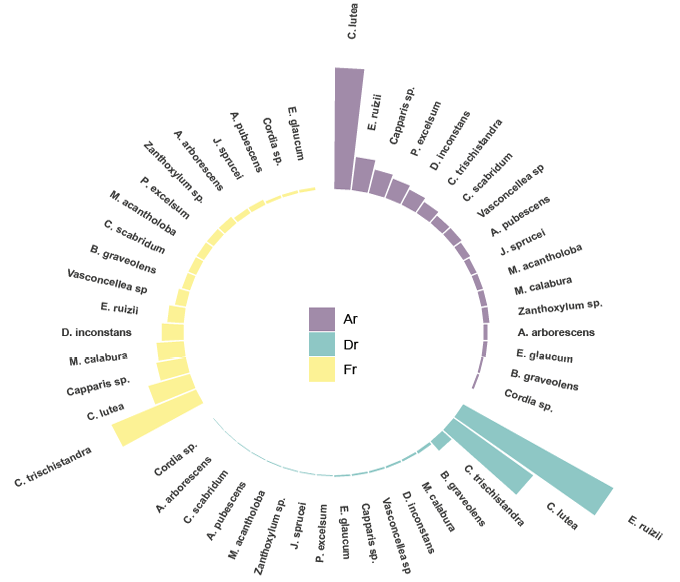
Relative abundance (Ar), relative frequency (Fr) and relative dominance (Dr) of the species present in the study area.
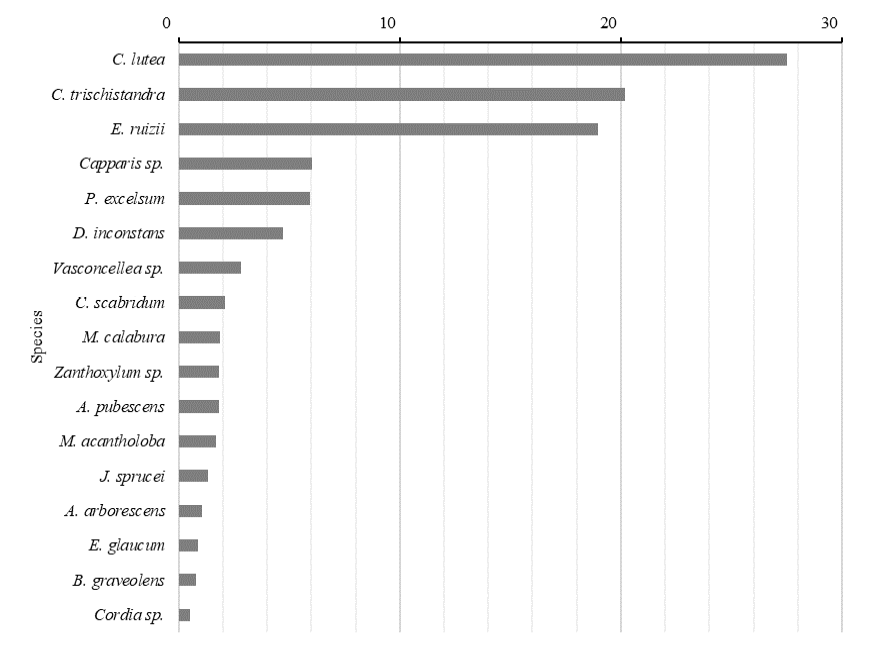
Importance value index (IVI) of the species in the dry forest of Los Bajos of Montecristi.
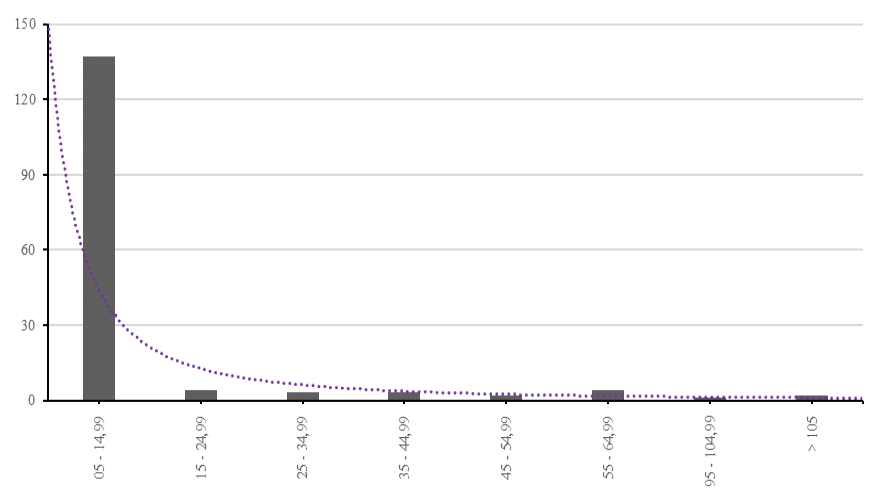
Diametric distribution of individuals present in the dry forest in Los Bajos de Montecristi.
References
- Aguirre, N., J. Alvarado, L. Ruiz, J. Granda. 2018. Bienes y servicios ecosistémicos de los bosques secos de la provincia de Loja. Bosques Latitud Cero, 8(2): 118-130.
- Aguirre, N. and L, Erazo. 2017. Valoración económica ambiental del compartimiento leñoso como una alternativa para conservar la biodiversidad del bosque seco de la provincia de Loja, Ecuador. Bosque Latitud Cero, 7(1): 19.
- Aguirre, Z., 2012. Especies forestales de los bosques secos del Ecuador. Guía dendrológica para su identificación y caracterización. Proyecto Manejo Forestal Sostenible ante el cambio climático. MAE/FAO-Finlandia. Quito, Ecuador. pp. 140.
- Aguirre, Z., 2013. Guía de métodos para medir la biodiversidad. Área Agropecuaria y de Recursos Naturales Renovables. Carrera de Ingeniería Forestal, Universidad Nacional de Loja. Loja-Ecuador, 37(6): 82.
- Aguirre, Z., E. Cueva, B. Merino, W. Quizhpe and A. Valverde. 2001. Evaluación ecológica rápida de la vegetación en los bosques secos de La Ceiba y Cordillera Arañitas, provincia de Loja, Ecuador. En Vásquez, MA., M. Larrea, L. Suárez, P. Ojeda. (eds.). Biodiversidad en los Bosques Secos del Sur-Occidente de la Provincia de Loja. EcoCiencia, Ministerio del Ambiente, Herbario LOJA y Proyecto Bosque Seco, Quito. Ecuador. pp. 15-35.
- Aguirre, Z. and G. Geada-Lopez. 2017. Estado de conservación de los bosques secos de la provincia de Loja, Ecuador. Arnaldoa, 24(1): 207-228. https://doi.org/10.22497/arnaldoa.241.24107[CrossRef]
- Aguirre, Z. and L. Kvist. 2009. Composición florística y estructura de bosques estacionalmente secos en el sur-occidental de Ecuador, provincia de Loja, municipios de Macara y Zapotillo. Arnaldoa, 16(2): 87-99.
- Aguirre, Z. and L.P. Kvist. 2005. Composición florística y estado de conservación de los bosques secos del sur-occidente del Ecuador. Lyonia, 8(2): 41-67.
- Aguirre, Z., P. Kvist and R. Linares. 2006. Especies leñosas y formaciones vegetales en los bosques estacionalmente secos de Ecuador y Perú. Arnaldoa. 13(2): 324 – 350.
- Aguirre, Z. and T. Delgado. 2005. Vegetación de los bosques secos de Cerro Negro-Cazaderos, occidente de la Provincia de Loja. En: (eds. M.A. Vásquez, J.F. Freile and L. Suárez). Biodiversidad en los bosques secos de la zona de Cerro Negro-Cazaderos, occidente de la provincia de Loja: un reporte de las evaluaciones ecológicas y socioeconómicas rápidas. EcoCiencia, MAE y Proyecto Bosque Seco. Quito, Ecuador. pp. 9-24.
- Aguirre-Padilla, N.I., J. Alvarado-Espejo and J. Granda-Pardo. 2018. Bienes y servicios ecosistémicos de los bosques secos de la provincia de Loja. Bosques Latitud Cero, 8(2).
- Allen, K., J. Dupuy, M. Gei, C. Hulshof, D. Medvigy, C. Pizano, B. Salgado-Negret, C. Smith, A. Trierweiler and S. Van Bloem. 2017. Will seasonally dry tropical forests be sensitive or resistant to future changes in rainfall regimes? Environ. Res. Lett., 12(2): 023001. https://doi.org/10.1088/1748-9326/aa5968[CrossRef]
- Arruda, D.M., D.O. Brandao, F.V. Costa, G.S. Tolentino, R.D. Brasil, S.N. D´ângeloneto, Y.R. Nunes-Ferreira. 2011. Structural aspects and floristic similarity amongtropical dry forest fragments with different management histories in Northern Minas Gerais, Brazil. Rev. Árvore, 35: 131-142. https://doi.org/10.1590/S0100-67622011000100016[CrossRef]
- Ballesteros-Correa, J., L. Morelo-García and J. Pérez-Torres. 2019. Composición y estructura vegetal de fragmentos de bosque seco tropical en paisajes de ganadería extensiva bajo manejo silvopastoril y convencional en Córdoba, Colombia. Caldasia, 41(1): 224-234. https://doi.org/10.15446/caldasia.v41n1.71320[CrossRef]
- Banda, K.R., A. Delgado-Salinas, K.G. Dexter, R. Linares-Palomino, A. Oliveira-Filho, D. Prado, M. Pullan, C. Quintana, R. Riina, G.M. Rodríguez, J. Weintritt, P. Acevedo-Rodríguez, J. Adarve, E. Álvarez, A.B. Aranguren, J.C. Arteaga, G. Aymard, A. Castaño, N. Ceballos-Mago and R.T. Pennington. 2016. Plant diversity patterns in neotropical dry forests and their conservation implications. Science, 353(6306). https://doi.org/10.1126/science.aaf5080[CrossRef]
- Benítez, A., G. Aragón and M. Prieto. 2019. Lichen diversity on tree trunks in tropical dry forests is highly influenced by host tree traits. Biodiv. Conserv., 28(11): 2909-2929. https://doi.org/10.1007/s10531-019-01805-9[CrossRef]
- Best, B. and M. Kessler. 2005. Biodiversity and conservation in Tumbesian Ecuador and Peru. Cambridge, UK. Birdlife Internacional.
- Birhanu, L., T. Bekele and S. Demissew. 2018. Woody species composition and structure of Amoro forest in west Gojjam zone, north western Ethiopia. J. Ecol. Natl. Environ., 10(4): 53-64. https://doi.org/10.5897/JENE2018.0688[CrossRef]
- Brunner, I., C. Herzog, M. Dawes, M. Arend and C. Sperisen. 2015. How tree roots respond to drought. Front. Plant Sci. 6: 547. https://doi.org/10.3389/fpls.2015.00547[CrossRef]
- Curtis, J.T. and R.P. McIntosh. 1951. An upland forest continuum in the prairie‐forest border region of Wisconsin. Ecology, 32(3): 476–496. https://doi.org/10.2307/1931725[CrossRef]
- Espinosa, C.I., M. de la Cruz, A. Luzuriaga and A. Escudero. 2012. Bosques tropicales secos de la región Pacífico Ecuatorial: diversidad, estructura, funcionamiento e implicaciones para la conservación. Rev. Ecosist., 21: 167–179.
- Hanley, T., C. Robbins and D. Spalinger. 1989. Forest habitats and the nutritional ecology of Sitka black-tailed deer: A research synthesis with implications for forest management. General Technical Report No. PNW-GTR-230. USDA Forest Service, PNW Research Station. https://doi.org/10.2737/PNW-GTR-230[CrossRef]
- Haro-Carrión, X., B. Loiselle and F.E. Putz. 2021. Tree species diversity, composition and aboveground biomass across dry forest land-cover types in coastal Ecuador. Trop. Conserv. Sci., pp. 1-3. https://doi.org/10.1177/1940082921995415[CrossRef]
- Hasnat, G.T. and M.K. Hossain. 2020. Global overview of tropical dry forests. Handbook of Research on the Conservation and Restoration of Tropical Dry Forests, pp. 1-23. https://doi.org/10.4018/978-1-7998-0014-9.ch001[CrossRef]
- Helle, P. and T. Helle. 1989. Arboreal lichens as a resource in winter ecology of mammals and birds. Aquilo Ser Zool., 24: 59-64.
- Hernández-Stefanoni, J., J. Dupuy, F. Tun-Dzul and F. May-Pat. 2011. Influence of landscape structure and stand age on species density and biomass of a tropical dry forest across spatial scales. Landsc. Ecol., 26: 355–370. https://doi.org/10.1007/s10980-010-9561-3[CrossRef]
- Howard, M., H. Pearl, B. McDonald, Y. Shimizu, S.K. Srivastava and A. Shapcott. 2024. The conservation of biodiverse and threatened dry rainforest plant communities is vital in a changing climate. Conservation, 4(4): 657-684. https://doi.org/10.3390/conservation4040040[CrossRef]
- Hubbell, S.P., 1979. Tree dispersion, abundance, and diversity in a tropical dry forest. Science, 203(4387): 1299–1309. https://doi.org/10.1126/science.203.4387.1299[CrossRef]
- Jaramillo, N., Z. Aguirre and C. Yaguana. 2018. Componente florístico del bosque seco, sector Bramaderos, parroquia Guachanama, cantón Paltas, suroccidente de la provincia de Loja, Ecuador. Arnaldoa, 25(1): 87-104. https://doi.org/10.22497/arnaldoa.251.25105[CrossRef]
- Jiménez, A., F. Pincay, M. Ramos, O. Mero and C. Cabrera. 2017. Utilización de productos forestales no madereros por pobladores que conviven en el bosque seco tropical. CFORES, 5(3): 270-286.
- Kent, M. and P. Coker. 2012. Vegetation description and data analysis; A practical approach. Wiley-Black Well, Oxford, Reino Unido.
- Knops, J.M., T.H. Nash, V.L. Boucher and W.H. Schlesinger. 1991. Mineral cycling and epiphytic lichens: Implications at the ecosystem level. Lichenologist, 23(3): 309-321. https://doi.org/10.1017/S0024282991000452[CrossRef]
- Knops, J.M., T.H. Nash and W.H. Schlesinger. 1996. The influence of epiphytic lichens on the nutrient cycling of an oak woodland. Ecol. Monogr., 66(2): 159-179. https://doi.org/10.2307/2963473[CrossRef]
- Lamprecht, H., 1989. Silviculture in the tropics: Tropical forest ecosystems and their tree species possibilities and methods for their long-term utilization. GTZ.
- Lehmkuhl, J.F., 2004. Epiphytic lichen diversity and biomass in low-elevation forests of the eastern Washington Cascade Range, USA. For. Ecol. Manage., 187(2-3): 381-392. https://doi.org/10.1016/j.foreco.2003.07.003[CrossRef]
- Linares-Palomino, R., L. Kvist, Z. Aguirre-Mendoza and C. Gonzales-Inca. 2010. Diversity and endemism of woody plant species in the Equatorial Pacific seasonally dry forests. Biodiv. Conserv., 19(1): 169-185. https://doi.org/10.1007/s10531-009-9713-4[CrossRef]
- Magurran, A.E., 2021. Measuring biological diversity. Curr. Biol., 31(19). https://doi.org/10.1016/j.cub.2021.07.049[CrossRef]
- Manchego, C.E., P. Hildebrandt, J. Cueva, C.I. Espinosa, B. Stimm and S. Günter. 2017. Climate change versus deforestation: Implications for tree species distribution in the dry forests of southern Ecuador. PLoS One, 12(12): e0190092. https://doi.org/10.1371/journal.pone.0190092[CrossRef]
- Manrique-Ascencio, A., D.A. Prieto-Torres, F. Villalobos, J. Mercado Gómez and R. Guevara. 2025. Limited drought tolerance in the neotropical seasonally dry forest plants impairs future species richness. Plant Biol. J., https://doi.org/10.1111/plb.13683[CrossRef]
- Moonlight, P.W., K. Banda-R, O. Phillips, K.G. Dexter, R.T. Pennington, T. Baker, H. Cavalcante de Lima, L. Fajardo, M.R. González, R. Linares-Palomino, J. Lloyd, M. Nascimento, D. Prado, C. Quintana, R. Riina, G.M. Rodríguez, D. Maria-Villela, A.C. Aquino, L. Arroyo, C. Bezerra, A. Tadeu-Brunello, R. Brienen, D. Cardoso, K Chao, I.A. Cotta-Coutinho, J. Cunha, T. Domingues, M.M. do Espirito Santo, T.R. Feldpausch, M. F. Fernandes, Z. Goodwin, E.M. Jiménez, A. Levesley, L. Lopez-Toledo, B. Marimon, R.C. Miatto, M. Mizushima, A. Monteagudo, M. Soelma-Beserra, de Moura, A. Murakami, D. Neves, R. Nicora-Chequín, R., T. César de Sousa-Oliveira, E. Almeida de Oliveira, L. Paganucci de Queiroz, A. Pilon, D. Marques-Ramos, C.Reynel, P.M. Rodrigues, R. Santos, T. Särkinen, V. Fernando da Silva, R. M. S. Souza, M. Vasquez and M. E. Veenendaal. 2020. Expanding tropical forest monitoring into Dry Forests: the DRYFLOR protocol for permanent plots. Plants People Planet, 00: 1-6. https://doi.org/10.1002/ppp3.10112[CrossRef]
- Mori, S.A., B.M. Boom, A.M. de Carvalino and T.S. dos Santos. 1983. Ecological importance of myrtaceae in an Eastern Brazilian Wet Forest. Biotropica, 15(1). https://doi.org/10.2307/2388002[CrossRef]
- Muñoz, J., D. Armijos-Ojeda and S. Erazo. 2019. Flora y fauna del Bosque Seco de la provincia de Loja, Ecuador. Ediloja. Ecuador. 107 pp. ISBN 978-9978-355-50-3
- Muñoz, J., S. Erazo and D. Armijos. 2014. Composición florística y estructura del bosque seco de la quinta experimental “El Chilco” en el suroccidente del Ecuador. Cedamaz, 4(1).
- Ouyang, L., J. Wu, P. Zhao, Y. Li, L. Zhu, G. Ni and X. Rao. 2021. Consumption of precipitation by evapotranspiration indicates potential drought for broadleaved and coniferous plantations in hilly lands of South China. Agric. Water Manage., 252. https://doi.org/10.1016/j.agwat.2021.106927[CrossRef]
- Palma, R., 2016. Aprovechamiento forestal y su impacto sobre la diversidad florística del bosque seco en Santa Elena. Año 2016. Programa de reforestación. Maestría en manejo y aprovechamiento forestal. Unidad de posgrado. UTEQ. 116 p.
- Pennington, R.T., M. Lavin and A. Oliveira-Filho. 2009. Woody plant diversity, evolution, and ecology in the tropics: Perspectives from seasonally dry tropical forests. Ann. Rev. Ecol. Evol. Systemat., 40. https://doi.org/10.1146/annurev.ecolsys.110308.120327[CrossRef]
- Preece, C., G. Farré-Armengol, J. Llusià and J. Peñuelas. 2018. Thirsty tree roots exude more carbon. Tree Physiol., 38(5): 690–695. https://doi.org/10.1093/treephys/tpx163[CrossRef]
- Quintana, C., M. Girardello and H. Balslev. 2019. Balancing plant conservation and agricultural production in the ecuadorian dry Inter-Andean Valleys. PeerJ, 7: e6207. https://doi.org/10.7717/peerj.6207[CrossRef]
- Quintana, C., M. Girardello, A.S. Barfod and H. Balslev. 2017. Diversity patterns, environmental drivers and changes in vegetation composition in dry inter-Andean valleys. J. Plant Ecol., 10(3). https://doi.org/10.1093/jpe/rtw036[CrossRef]
- Raffelsbauer, V., S. Spannl, K. Peña, D. Pucha-Cofrep, K. Steppe and A. Bräuning. 2019. Tree circumference changes and species-specific growth recovery after extreme dry events in a montane rainforest in southern ecuador. Front. Plant Sci., 10. https://doi.org/10.3389/fpls.2019.00342[CrossRef]
- Richardson, D.H. and C.M. Young. 1977. Lichens and vertebrates. Lichen Ecol., pp. 121-144.
- Rivas, C., R. Navarro-Cerillo, J. Johnston and J. Guerrero-Casado. 2020. Dry forest is more threatened but less protected than evergreen forest in Ecuador’s coastal region. Environ. Conserv., 47(2): 79-83. https://doi.org/10.1017/S0376892920000077[CrossRef]
- Rominger, E.M., C.T. Robbins and M.A. Evans. 1996. Winter foraging ecology of woodland caribou in northeastern Washington. J. Wildl. Manage., pp. 719-728. https://doi.org/10.2307/3802370[CrossRef]
- Salas-Macías, C., K. Montes-Escobar, G. Sánchez-Sancán, W. Alcívar-Chávez, A. Murillo-Choez, F. Vera-Cedeño, D. Bolcato-Bolcato and S. Iglesias-Abad. 2020. Influencia del gradiente altitudinal sobre la Composición y estructura del “Bosquey vegetación protector El-Artesan- EcuadorianHands”, Joa, Jipijapa. Rev. Fac. Agron. (LUZ), 37: 148-168.
- Singh, J.S. and R.K. Chaturvedi. 2018. Tropical dry deciduous forest: Research trends and emerging features. In: Tropical dry deciduous forest: Research trends and emerging features. https://doi.org/10.1007/978-981-10-7260-4[CrossRef]
- Sosa, V., J.A. De-Nova and M. Vásquez-Cruz. 2018. Evolutionary history of the flora of Mexico: Dry forests cradles and museums of endemism. J. Syst. Evol., 56(5). https://doi.org/10.1111/jse.12416[CrossRef]
- Thomas, D.C., E.J. Edmonds and W.K. Brown. 1996. The diet of woodland caribou populations in west-central Alberta. Rangifer, pp. 337-342. https://doi.org/10.7557/2.16.4.1275[CrossRef]
- Uslar, Y.V., B. Mostacedo and M. Saldias. 2004. Composición, estructura y dinámica de un bosque seco semideciduo en Santa Cruz, Bolivia. Ecol. Bolivia, 39(1): 25-43.
Services
Article usage statistics
Loading…