
The complete mitogenomes of three species (O. lacepedii, O. rebecca and O. sp.) were sequenced, their genomic structure examined, and their genome organization, arrangement and codon usage analyzed. Phylogenetic Bayesian and ML analyses were conducted, using a concatenated set of 12 protein-coding genes, and adding 16 other species of gobies (Gobiidae). The mitogenome sequences of O. lacepedii, O. rebecca and O. sp. were all circular double-strand molecules, 17245 bp, 17009 bp and 17004 bp long, respectively. Compared with other bony fishes, the three species shared the similar features in gene arrangements, base composition and tRNA structure. The control region spanned 1571 bp, 1336 bp and 1332 bp in O. lacepedii, O. rebecca and O. sp., respectively, and was A+T-rich. Three species were only detected termination-associated sequence domain (TAS) and conserved sequence blocks domain (CSB-1, CSB-2 and CSB-3). The Bayesian and ML tree topologies of 19 Gobiidae represented two groups: one large group consisted of Amblyopinae, Gobionellinae, Oxudercinae and Sicydiinae, and the other was the monophyletic Gobiinae. Phylogenetic analysis also demonstrated clade Amblyopinae included all three species and that O. lacepedii has been proved to be a much closer affinity to O. sp. than O. rebecca. Our study theoretically provided a supplementary proof and significant information for future taxon studies.
Research Article · Volume 49, Issue 1, 4 November 2016 · Open Access
Complete Mitochondrial Genome of Three Fish Species (Perciformes: Amblyopinae): Genome Description and Phylogenetic Relationships
· · · · · ·
Affiliations & Notes ⌄
- 1Institute of Evolution and Marine Biodiversity, Ocean University of China, Qingdao 266003, China p.p1 {margin: 0.0px 0.0px 0.0px 0.0px
- 2text-align: justify
- 3font: 10.0px 'Times New Roman'} 2National Research Institute of Fisheries Science, Fisheries Research Agency, Yokohama 2368648, Japan 3Fishery College, Zhejiang Ocean University, Zhoushan 316022, China Corresponding author: gaotianxiang0611@163.com p.p1 {margin: 0.0px 0.0px 0.0px 0.0px
- 4font: 9.0px 'Times New Roman'} spa
Article Info ⌄
- Journal:
- Pakistan Journal of Zoology
- Published:
- 4 November 2016

From the article
- The mtDNA genome of three species (O. lacepedii, O. rebecca and O. sp.) were all similar with other bony fishes including genome organization, gene arrangement and codon usage.
- An unexpected structure in the control region among the three species was discovered that only termination-associated sequence domain (TAS) and conserved sequence blocks domain (CSB-1, CSB-2 and CSB-3) were found.
- Three species are distinguished authoritatively by analysis of the complete mitochondrial DNA.
Selected from the article's own text.
Abstract
Introduction
The vertebrate mitochondrial DNA is a double-stranded circular molecule of 16-18kb in length consisting of genes for 22 transfer RNA genes (tRNA), 2 ribosomal RNA genes (rRNA) and 13 protein-coding genes as well as two non-coding regions: origin of light strand replication (OL) and control region . The usefulness of mitogonomes was becoming increasingly important in solving the long-term controversial phylogenetic relationship and confusing taxon . In recent years, longer mitochondrial DNA sequences were used to reconstruct higher level phylogenetic relationships and those studies were necessary to resolve these controversial problems.
The suborder Gobioidei consisted of six divided families , and Gobiidae was the largest family including five subfamilies (Gobiidae, Gobionellinae, Sicydiinae, Oxudercinae and Amblyopinae) . Moreover, studies on Gobiidae taxonomy have been controversial and attract extensive attention for a long time. The subfamily Amblyopinae are usually inshore, mud-dwelling fishes which are generally given the vernacular name of “eel gobies” or “worm gobies”. The genus Odontamblyopus within Amblyopinae was firstly proposed by Bleeker (1874). Since then, Norman (1966) was the only recent author who clarified Odontamblyopus into more than two species. Murdy and Shibukawa (2001) demonstrated that Odontamblyopus comprised 4 species. In 2003, Odontamblyopus rebecca was found in Vietnam by Murdy and Shibukawa. Up to now, the genus Odontamblyopus consists of 5 species including Odontamblyopus rubicundus, Odontamblyopus roseus, Odontamblyopus lacepedii, Odontamblyopus tenuis and Odontamblyopus rebecca. Due to the similar morphological characters, some taxon problems still exist.
In this paper, we sequenced the complete mitogenome sequences and examined the genomic structure of three species (O. lacepedii, O. rebecca and O. sp.), and we analyzed the main features in terms of the genome organization, gene arrangement and codon usage. Furthermore, combined with 12 protein-coding genes of other Gobiidae fishes, the phylogenetic relationships were conducted using Bayesian and ML analyses. This study aims to solve confusing taxon problems using longer sequences and comparison between gobies.
Materials and methods
Sample collection
The three species (O. lacepedii, O. rebecca and O. sp.) were collected from Ariake Bay in Japan and from Zhujiang and Zhoushan in China, respectively. All samples were
Table I.- Species downloaded from GenBank for phylogenetic analysis
| Family | Subfamily | Species | GenBank accession number |
| Gobiidae | Gobiinae | Glossogobius olivaceus Temminck and Schlegel, 1845 | JQ001860 |
| Acentrogobius pflaumii Bleeker, 1853 | JX029961 | ||
| Amoya chusanensis Herre, 1940 | NC_020347 | ||
| Oxudercinae | Boleophthalmus pectinirostris Linnaeus, 1758 | JN631352 | |
| Oxuderces dentatus Eydoux and Souleyet, 1850 | JN831381 | ||
| Scartelaos histophorus Valenciennes, 1837 | JQ654459 | ||
| Periophthalmus minutus Eggert, 1935 | LK391944 | ||
| Amblyopinae | Trypauchen vagina Bloch and Schneider, 1801 | NC_016693 | |
| Gobionellinae | Tridentiger bifasciatus Steindachner, 1881 | JN244650 | |
| Lophiogobius ocellicauda Günther, 1873 | KC480264 | ||
| Mugilogobius abei Jordan and Snyder, 1901 | KF128984 | ||
| Rhinogobius giurinus Rutter, 1897 | KF371534 | ||
| Acanthogobius hasta Temminck and Schlegel, 1845 | KJ958906 | ||
| Chaenogobius gulosus Sauvage, 1882 | KP696748 | ||
| Sicydiinae | Stiphodon alcedo Maeda, Mukai and Tachihara, 2012 | AB613000 | |
| Sicyopterus japonicus Tanaka, 1909 | JX628620 | ||
| Odontobutidae | Micropercops swinhonis Dabry de Thiersant, 1872 | NC_021763 | |
| Perccottus glenii Dybowski, 1877 | KM657956 |
morphologically discriminated to the species level based on Wu and Zhong (2008), Murdy and Shibukawa (2001) and (2003). Muscles excised were used for DNA extraction and preserved in 95% ethanol until use.
DNA extraction, PCR amplification and sequencing
Whole genomic DNA was extracted from muscle tissue by proteinase-K digestion followed by the standard phenol/chloroform method and used as a template for subsequent PCR reactions to determine the complete mitogenome sequences of O. lacepedii, O. rebecca and O. sp. Six sets of primers were designed for long-PCR amplification based on the aligned mitogenome sequences of Trypauchen vagina (NC_016693) as previously determined. New pairs of primers were designed for the subsequent amplification by primer walking method. Thirty-two normal PCR primer sets were used to accomplish the entire mitogenome. Essentially every contiguous segment overlapped by at least 50 bp to explicit the accuracy of the sequences.
All PCRs were performed in an Eppendorf thermal cycler. TaKaRa Ex-Taq and LA-Taq Kits (Takara Biomedical) were used for normal and long-PCR reactions, respectively. Long-PCR reactions were carried out in 25 μl reaction mixture containing 15.25 μl of sterile distilled H2O, 2.5 μl of 10×Buffer, 4 μl of dNTP, 1μl of each primer (5μM), 0.25 μl of LA Taq polymerase (1 unit/μl, Takara), and 1 μl of DNA template. The long-PCR reactions consisted of an initial denaturing step at 94°C for 2 min, followed by 30 cycles of denaturing at 94°C for 30 s, annealing at 58°C for 3 min and a final extension at 72°C for 10 min. The normal PCR was performed following the standard procedure . Negative controls were included in all PCR amplifications to conform the absence of contaminants. PCR product was purified with a Gel Extraction Mini Kit (Watson BioTechnologies Inc., China). The purified product was then sequenced on ABI Prism 3730 (Applied Biosystems) from both strands with the same primers as those used for PCRs.
Sequence assembling and sequence analysis
Sequences of overlapping fragments were assembled manually and aligned initially against the complete mitochondrial genome sequences of T. vagina using SEQMAN software and DNASTAR software with default parameters and further adjusted manually. The boundaries for rRNAs and protein-coding genes were determined by DOGMA comparing with published mitochondrial sequences. The codon usage of the 13 protein-coding genes and the base composition of 37 genes for three species were analyzed using the program MEGA 4.0. Translation initiation and translation termination codons were identified using genetic codon table for mitochondrion in MEGA 4.0. The putative OL and control region were determined by sequence homology and proposed secondary structures. The secondary structure of the putative OL was analyzed with the software RNAstructure 5.4. The complete mitochondrial sequences of three species (O. lacepedii, O. rebecca and O. sp.) have been deposited in GenBank with accession number KR815520, KT633953 and KT633954.
Phylogenetic analysis
Phylogenetic relationship using homologous sequences downloaded from GenBank (Table I) were performed. Only 12 protein-coding regions were used for the subsequent phylogenetic analyses with the exception of ND6 (Fig. 1) because of its heterogeneous base composition and consistently poor performance . Multiple alignments of sequences were performed using Clustal X version 1.8. Alignment of all protein coding genes was triplet and no internal stop codons were found in any fragments. To explore the degree of saturation present in the datasets, we plotted sequence divergence (GTR-based distance) vs. number of transition and transversion substitutions for all pairwise comparisons among taxa for each codon position in DAMBE. If the codon position sites were saturated, we would expect to see a plateau in such a plot, where little or no additional substitution is detectable with increased p distance.
Phylogenetic analyses of the concatenated genes were conducted under Bayesian Inferences (BI) and maximum likelihood (ML) with the programs MrBayes and PAUP 4.0, respectively. Appropriate evolution substitution models were screened by the ‘‘decision-theoretic performance-based’’ approach (DT; selection strategy in jModeltest 2.1.1 with partition strategies of all nucleotide sites and each codon. The best-fit model of all nucleotide sites was used for reconstructed phylogenetic trees in BI and ML analyses. BI was also conducted for the combined dataset using the optimal models with each codon position. Micropercops swinhonis and Perccottus glenii were chosen as outgroups. A total of 100 ML bootstrap replicates (MLBS) were performed using PAUP. Bayesian inferences using Markov chain Monte Carlo (MCMC) sampling were performed with four chains which ran simultaneously for 2,000,000 generations with tree sampled every 100 generations. The average standard deviation of split support (ASDOSS) and effective sample size (ESS) were used to assess convergence of MCMC. When value of ASDOSS was less than 0.01, the runs were stopped; ESSs detected by Tracer v.1.5 were more than 200, achieving convergence. The burn-in trees sampled prior to convergence (25% of trees from each run; 5000 sampled trees) were discarded, and the subsequent trees sampled independently from the posterior probability distribution were combined to produce phylogram and 50% majority-rule consensus trees.
Results and discussion
Genome content
The complete mitogenome sequences were 17245bp, 17009bp and 17004bp in O. lacepedii, O.rebecca and O. sp., respectively (Supplementary Table S1, Fig. 1). The length and gene order of protein-coding genes were highly in agreement with previous reports ; ; . The length variation of mitochondrial DNA was mainly due to the different length of control region for most vertebrates ; .
The overall base compositions of three species were listed in Supplementary Table S2. The G content was 15.3% (O. lacepedii), 15.3% (O. rebecca) and 15.4% (O. sp.) showing an obvious bias against G, supporting by previous studies ; ; . The A+T content exhibited higher values than G+C content indicating that the codon usage with A and T nucleotides preferred to C and G nucleotides at the third codon position (Supplementary Table S2).
Protein-coding genes and codon usage
The total length of 13 protein-coding genes was 11415 bp, 11412 bp and 11415 bp in O. lacepedii, O. rebecca and O. sp., respectively. As with the common features of other bony fishes ; , three reading-frames overlap were noted on the same strand: ATPase8 and ATPase6 overlapped by 4 nucleotides, ATPase6 and COIII overlapped by 1 nucleotide, and ND4L and ND4 overlapped by 7 nucleotides (Supplementary Table S1). The pair of genes ND5-ND6 encoding on the different strands overlapped by 4 nucleotides.
All the initiation and stop codons were examined according to the corresponding genes and proteins of other goby fishes . Most protein-coding genes began with ATG codon (Supplementary Table S1) except
COI gene and ATP6 gene used the initiation codon GTG and ATA. Differring from initiation codons ; , complete stop codons and incomplete codons were identified. ATG seemed to be the most common initiation codon, though there were exceptions . The open reading frames for ND6 genes ended with TAG in O. lacepedii and O. rebecca, however, O. sp. ended with TAA. All other reading frames of three species ended with TAA (ND1, ND2, ND4L and ND5), AGG (COI) and TAG (ATPase8). Six protein-coding genes ended with incomplete stop codons TA (ATPase6), as well as in complete stop codons T (COII, COIII, ND3, ND4 and Cytb). Based on Ojala et al. (1981), the presence of such noncanonical stop codons can be converted into a fully functional TAA stop codon via post-transcriptional polyadenylation.
Comparative base composition analysis at each codon position (Supplementary Table S2) reflected that the proportion of G at third codon position showed a relatively low value ; ; and a clearly excess of pyrimidines over purines probably as a result of the hydrophobic character of the proteins . The patterns of codon usage were exhibited in Figures 2, 3 and 4. Codons for Leucine accounted for the highest percent value, however codon usage for Cysteine were the least (Fig. 2). The overall codons ending with A or C were all used more frequently than those ending with T and G (Fig. 3). Moreover, evidence also can be observed codon usage of genes oriented in opposite directions. For amino acids with fourfold degenerate codons, third position ending with A were the most frequently employed, followed by codon families ending with C and U. Otherwise, among twofold degenerate codons, C seemed to be more often used than T in pyrimidine codon families; purine codons encoded mostly with A (Fig. 4). The codon usage pattern of 13 protein-coding genes of the three species was in common with other fishes .
Transfer and ribosomal RNA genes
Mitogenomes of three species examined included 22 typital tRNA genes dispersed between rRNA and protein-coding genes (Table I). The tRNA genes varied from 64 bp to 76 bp and gene inversion of tRNA genes has been observed in some fishes ; . Among these tRNA genes, two forms of tRNA-Leu (UUR and CUN) and tRNA-Ser (UCN and AGY) were determined (Table I). The three tRNA clusters-IQM (isoleucine, glutamine and methionine), WANCY (tryptophan, alanine, asparagines, cysteine and tyrosine) and HSL (histidine, serine and leucine) were well conserved. The A:T:C:G base composition of 22 tRNA genes was exhibited in Supplementary Table S2, among which A+T content was the highest in O. rebecca (56.6%).
Similar to other Gobiidae fishes , 2015), small encoding subunit (12S rRNA) and large subunit (16S rRNA) located between the tRNA-Phe and tRNA-Leu (UUR) genes on the H-strand and separated by the tRNA-Val genes (Supplementary Table S1, Fig. 1) were identified among three species. The 12S rRNA genes were 950 bp in O. rebecca and 949bp in O. lacepedii and O. sp. However, the 16S rRNA genes were in different length (1693 bp in O. lacepedii, 1695 bp in O. rebecca and 1692 bp in O. sp., respectively). The rRNA genes showed a slightly lower A+T contents comparing with the protein-coding genes and tRNA genes (Supplementary Table S2), however, slightly richer than other bony fishes .
Non-coding regions
The OL region located between tRNA-Asn and tRNA-Cys comprised 35 bp in length within the WANCY region (Supplementary Table S1) and predictably had the capacity to fold into a stable stem-loop hairpin structure consisting of 13 bp in the stem and 11 bp in the loop. While, both O. lacepedii and O. sp. had single base difference with O. rebecca in the loop (Supplementary Fig. S1). In addition, the OL region had a strong asymmetry in the codon usage in the stem with an obvious over-representation of pyrimidines in the 5’ side in the sequence (Supplementary Fig. S1). The conserved motif (5’-GCCGG-3’) at the base of the stem within tRNA-Cys among three species seemed to be in connection with the transition from RNA synthesis to DNA synthesis . T-rich or C-rich loop was highly in agreement with previous reports ; . It was suggested that tRNA genes can be functional as origins of replication as they can form OL-like structure without loss of other main functions .
Control region was characterized by discrete and conserved sequence blocks and exhibited the typical tripartite structure with termination-associated sequence domain (TAS), central conserved sequence blocks domain (CSB) and conserved sequence block domain ; . Three species were detected termination-associated sequence domain (TAS) (Fig. 5), which may be predicted to be treated as an identification for the termination of H-strand. In addition, conserved sequence blocks domain (CSB-1, CSB-2 and CSB-3) (Fig. 5) were identified and thought to be related to positioning RNA polymerse for both transcription and priming replication . Normally, transcripts originating from the promoters were responsible for priming replication . While the most striking central conserved sequences (CSB-D, CSB-E and CSB-F) and conserved motifs commonly emerging in fish control region cannot be observed in the three species.
Phylogenetic analysis
Substitution saturation decreased phylogenetic information contained in sequences and had plagued the phylogenetic analysis . When sequences had experienced full substitution saturation, the similarity between the sequences will depend entirely on the similarity in nucleotide frequencies , which often didn’t reflect phylogenetic relationships. To identify the mutation saturation in phylogeny, an analysis was conducted using GTR-based models by ploting transitions and transversions (Supplementary Fig. S2). The results implied that the 1st positions, 2nd positions and 3rd positions were in unsaturation. Thus, the whole 12 protein-coding genes will be used for phylogeny.
Phylogenetic relationships were constructed based on the concatenated 12 protein-coding genes adding 16 Gobiidae species. As a result, Bayesian analysis was practically identical to ML analysis. Bayesian analysis with each codon indicated insignificant difference (data not shown). The Bayesian analyses was supported by high Bayesian posterior probabilities, however, the bootstrap values for ML analyses were low in some nodes (Fig. 6). The Gobiidae comprised five subfamilies (Amblyopinae, Gobionellinae, Gobiinae, Oxudercinae and Sicydiinae). According to previous studies, the relationship among Gobiidae has been poorly resolved. We provided a more comprehensive relationship using longer mitochondrial DNA especially among the three species. Consequently, the tree topologies represented two groups (Group A and Group B): the large group A consisted of Amblyopinae, Gobionellinae, Oxudercinae and Sicydiinae, however group B was only the Gobiinae . In group A, four clades were found in which clade Amblyopinae and Oxudercinae were paraphyletic with high supported value and the result was endorsed by Thacker (2003), Thacker and Roje (2011) and Tornabene et al. (2013). However, the topological relationship in Oxudercinae was diverged from You et al. (2014) and Murdy (1989). In this study, Boleophthalmus was sister to Oxuderces, while You et al. (2014) suggested Boleophthalmus and Scartelaos were in close relationship and Murdy (1989) indicated Boleophthalmus was clustered with Periophthalmus. Also, an unexpected relationship that Amblyopinae contained B. pectinirostris and O. dentatus, was not supported by traditional taxon . Moreover, the result seemed to suggest that the relationship between Amblyopinae and Oxudercinae was the closest in Gobiidae. In group B, the monophyletic Gobiinae was sister to the clade Gobionellinae .
In this paper, we discussed the phylogenetic relationship based on the 12 protein-coding genes and the analysis demonstrated that clade Amblyopinae included three species (O. lacepedii, O. rebecca and O. sp.). In addition, O. lacepedii has been proved to be a much closer affinity to O. sp. than O. rebecca. The result was in agreement with previous records that Tang et al. (2010) found the cryptic species O. sp. which was similar to O. lacepedii based on collected molecular and morphological data; The two species were sister species and cannot easily be differentiated with naked eye. Agorreta et al. (2013) analyzed sequences data of five molecular makers (two mitochondrial DNA and three nuclear DNA) averaging 222 species of gobioids, while the phylogenetic relationship included only O. sp. within Odontamblyopus and the relationship among three species hasn’t been described with such numberous species studied. Briefly, the phylogenetic relationship among the Godiidae species still remains poorly understood, and our study is confirmed to be a validly supplementary proof and expected to provide significant information for future taxon studies.
Conclusion
The mtDNA genome of three species (O. lacepedii, O. rebecca and O. sp.) were all similar with other bony fishes including genome organization, gene arrangement and codon usage. An unexpected structure in the control region among the three species was discovered that only termination-associated sequence domain (TAS) and conserved sequence blocks domain (CSB-1, CSB-2 and CSB-3) were found.
Phylogenetic relationships based on the concatenated 12
protein-coding genes indicated the tree topologies represented
two groups, and also demonstrated clade Amblyopinae included all three goby species and that O. lacepedii has been proved to be a much closer affinity to O. sp. than O. rebecca. Three species are distinguished authoritatively by analysis of the complete mitochondrial DNA.
Acknowledgements
We are grateful to Xiaozhe Pan for sample collection and Mr. Wei Zhou and Ms. Nan Zhang for offering technical assistance during the paper writing. We also would like to acknowledge Ms. Lu Liu and Mr. Yuman Ju for proofing the manuscript. This study is supported by Public Science and Technology Research Funds Projects of Ocean (201305043; 201405010).
Conflict of Interest Statement
The authors declare that there is no conflict of interests regarding the publication of the manuscript.
Supplementary Material
There is supplementary material associated with this article. Access the material online at: http://dx.doi.org/10.17582/journal.pjz/2017.1.107.115
Figures
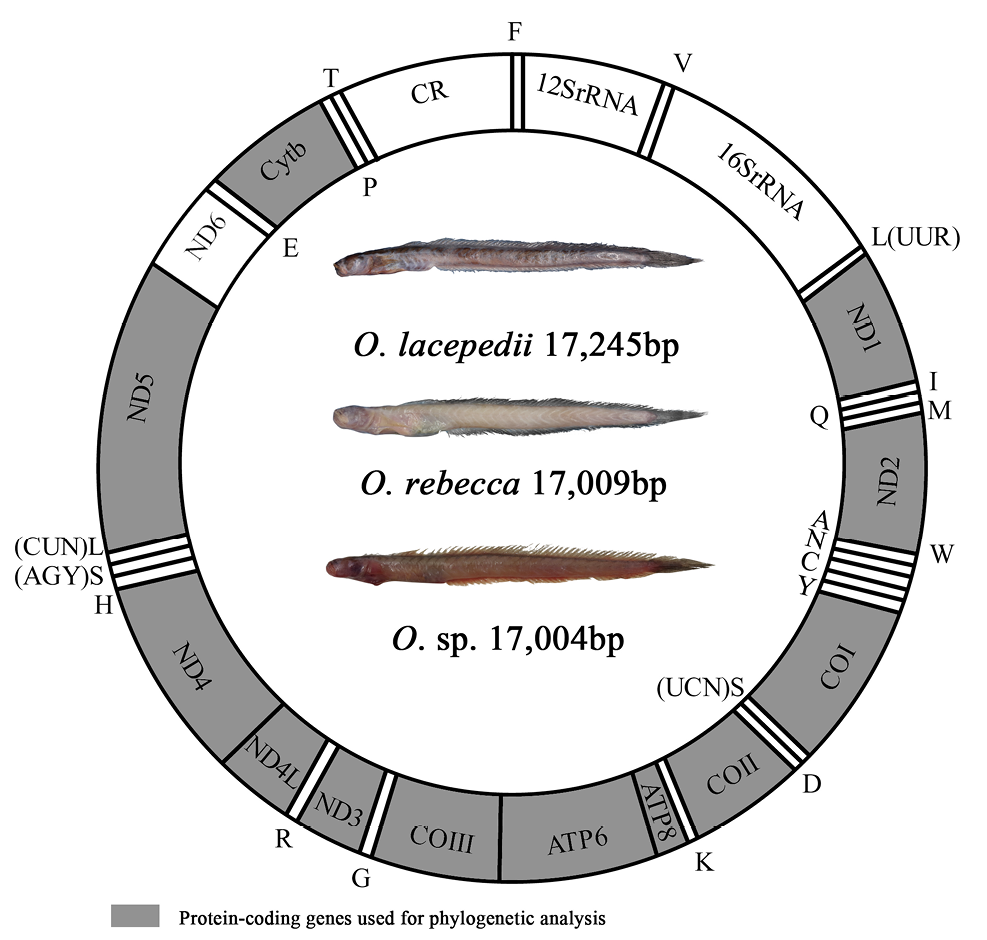
Gene organization of the mitochondrial genome of O. lacepedii, O. rebecca and O. sp. All protein-coding genes are encoded on the H-strand, with the exception of ND6 which is encoded on the L-strand. The two ribosomal RNA genes are encoded on the H-strand. Transfer RNA genes are designated by single-letter amino acid codes. Genes encoded on the H-strand and L-strand are shown outside and inside the circular gene map, respectively.
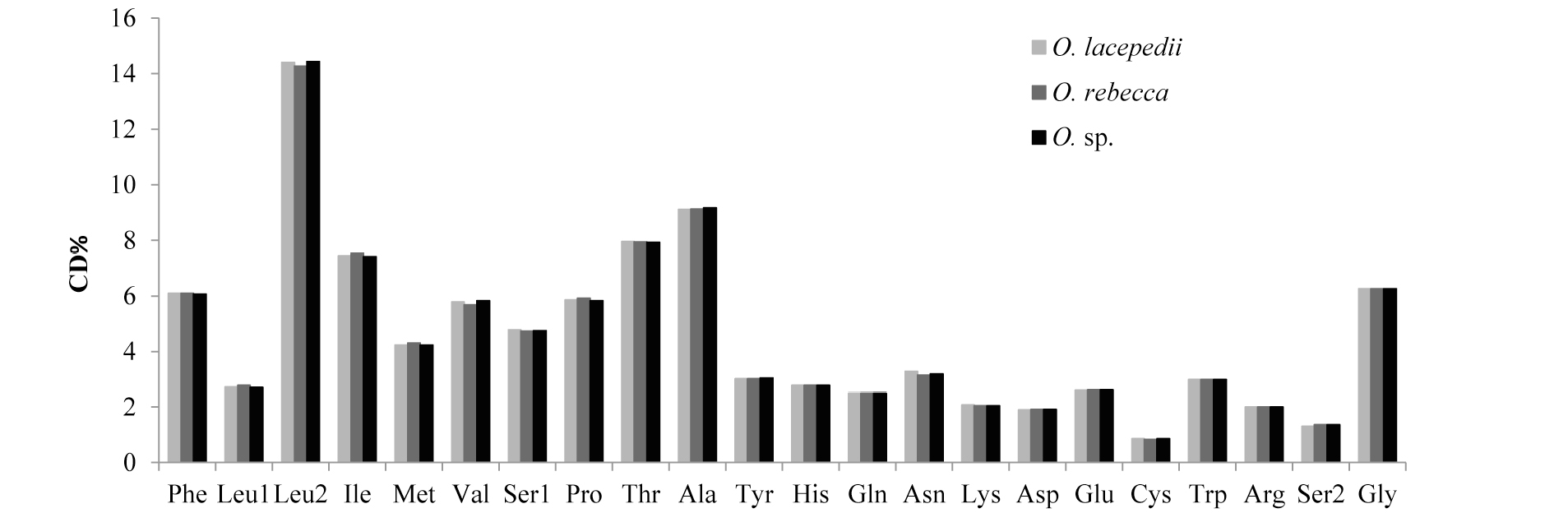
Codon distribution in 13 protein-coding genes of O. lacepedii, O. rebecca and O. sp. with 3805 codons, 3804 codons and 3805 codons, respectively, for each mitochondrial sequence analysis, excluding all stop codons. CDs%, the percentage of codons.
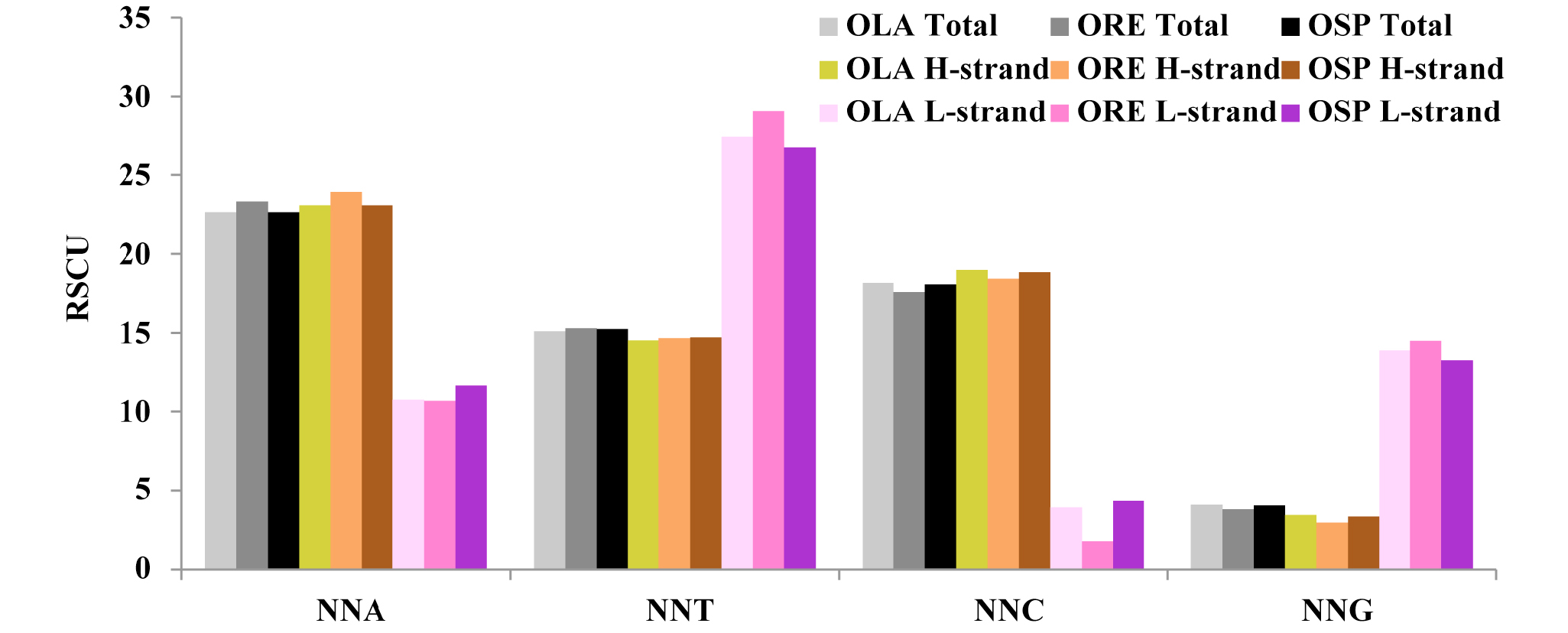
Frequencies of codons ended with the same nucleotide on total and each strand (H, L) of O. lacepedi, O. rebecca and O. sp. mitogenomes. Values on the y-axis indicate the sum of RSCU values of codons ended with the same nucleotide across all codon families (x-axis). RSCU, relative synonymous codon usage. OLA, O. lacepedi. ORE, O. rebecca. OSP, O. sp.
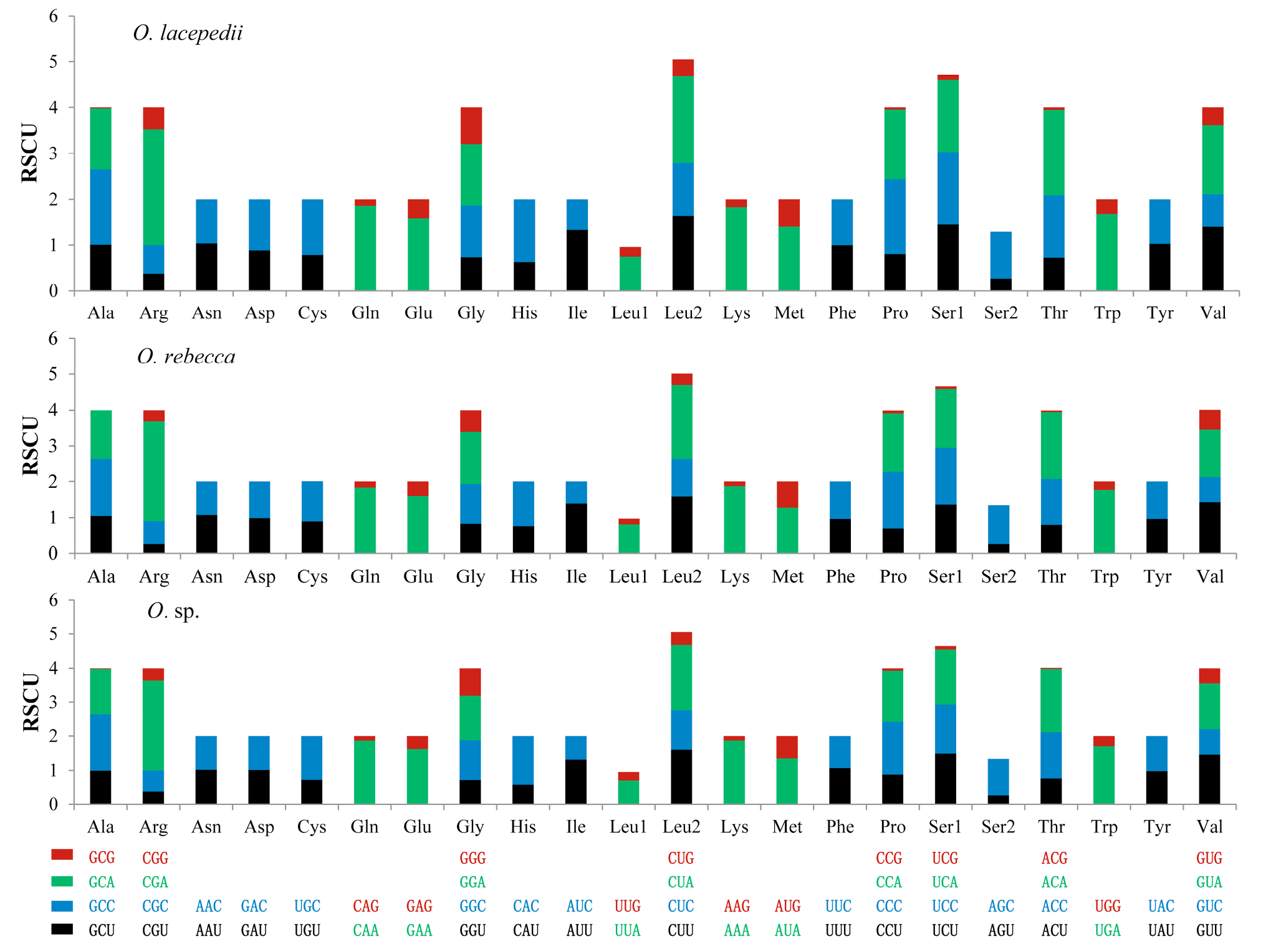
RSCU in 13 protein-coding genes of O. lacepedii, O. rebecca and O. sp. Codon families are provided on the x-axis.
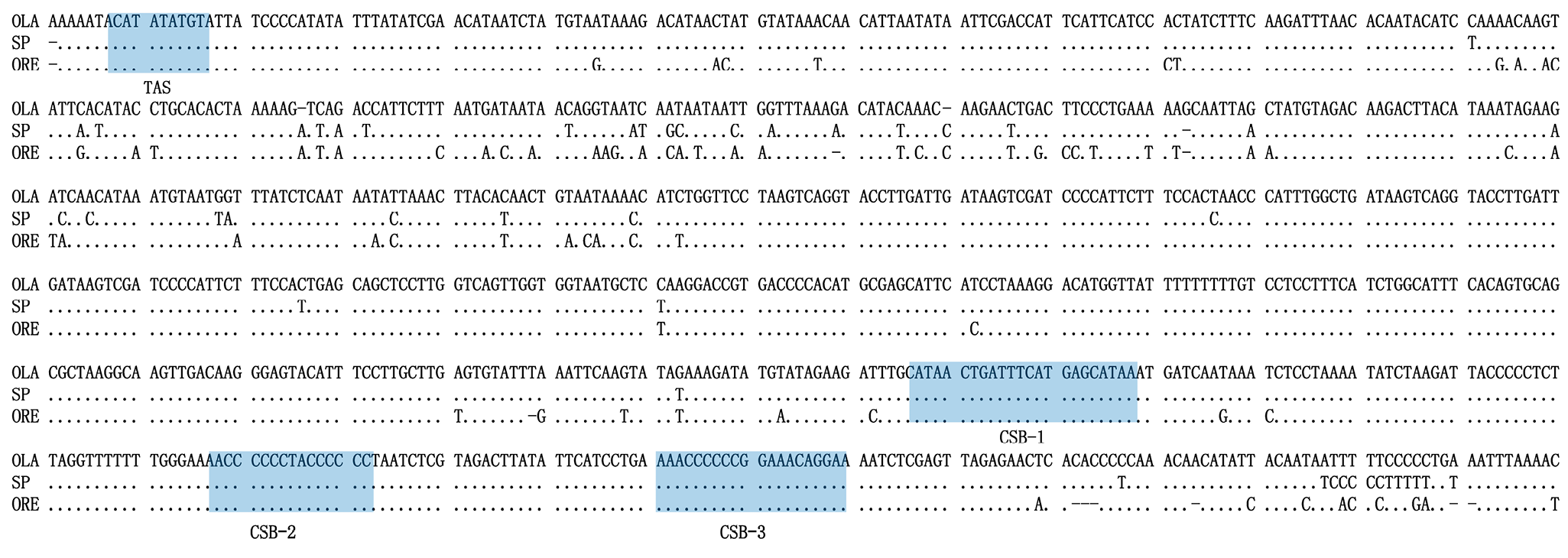
Comparison of the characteristics of mitochondrial control region of three gobies. TAS: termination-associated sequence; CSB-1, 2, 3: conserved sequence blocks 1, 2 and 3.
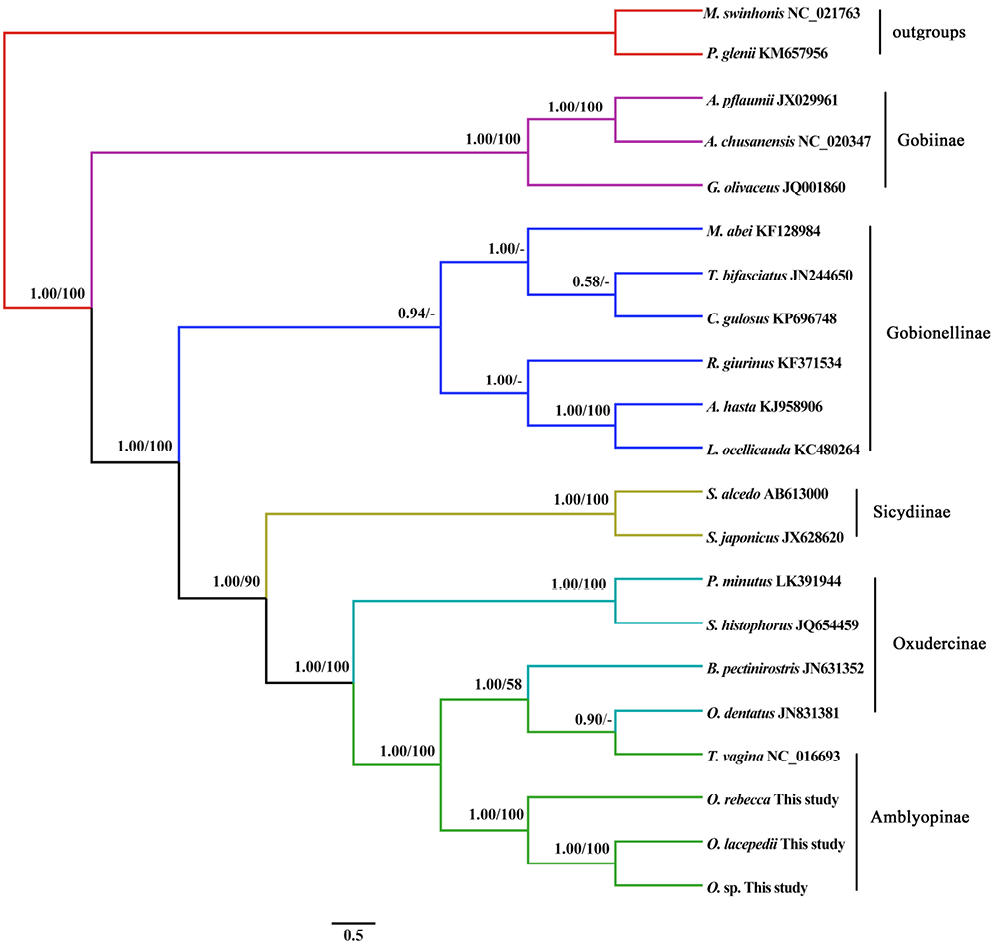
Phylogenetic tree of Gobiidae fishes based on 12 protein-coding genes excluding ND6 gene. The tree was built based on the TIM3+I+G model (-ln L= 119,585.39, A:C:G:T= 0.3172, 0.3187, 0.1016, 0.2625, I= 0.2830, G= 0.4140). The topology generated by Bayesian inference is shown, and is identical to the result of maximum likelihood analyses. Bayesian posterior probabilities and bootstrap support values above 50% replicates are shown adjacent to each internode. M. swinhonis and P. glenii were used as outgroups.
References
- Agorreta, A., San Mauro, D., Schliewen, U., Van Tassell, J.L., Kovačić, M., Zardoya, R. and Rüber, L., 2013. Molecular phylogenetics of Gobioidei and phylogenetic placement of European gobies. Mol. Phylogen. Evol., 69:619-633. http://dx.doi.org/10.1016/j.ympev.2013.07.017[CrossRef]
- Bibb, M.J., Van Etten, R.A., Wright, C.T., Walberg, M.W. and Clayton, D.A., 1981. Sequence and gene organization of mouse mitochondrial DNA. Cell, 26:167-180. http://dx.doi.org/10.1016/0092-8674(81)90300-7[CrossRef]
- Bleeker, P., 1874. Esquisse d’un système naturel des Gobioïdes. Archiv. Nerland. Sci. Exact. Natur., 9:289-331.
- Boore, J.L., Macey, J.R. and Medina, M., 2005. Sequencing and comparing whole mitochondrial genomes of animals. Method. Enzymol., 395:311-348. http://dx.doi.org/10.1016/S0076-6879(05)95019-2[CrossRef]
- Catanese, G., Manchado, M. and Infante, C., 2010. Evolutionary relatedness of mackerels of the genus Scomber based on complete mitochondrial genomes: strong support to the recognition of Atlantic Scomber colias and Pacific Scomber japonicus as distinct species. Gene, 452:35-43. http://dx.doi.org/10.1016/j.gene.2009.12.004[CrossRef]
- Chang, D.D. and Clayton, D.A., 1986. Precise assignment of the light-strand promoter of mouse mitochondrial DNA: A functional promoter consists of multiple upstream domains. Mol. Cell. Biol., 6:3253-3261. http://dx.doi.org/10.1128/MCB.6.9.3253[CrossRef]
- Cheng, Y.Z., Xu, T.J., Shi, G. and Wang, R.X., 2010. Complete mitochondrial genome of the miiuy croaker Miichthys miiuy (Perciformes, Sciaenidae) with phylogenetic consideration. Mar. Genom., 3:201-209. http://dx.doi.org/10.1016/j.margen.2010.10.003[CrossRef]
- Cheng, J., Ma, G.Q., Miao, Z.Q., Shui, B.N. and Gao, T.X., 2012. Complete mitochondrial genome sequence of the spinyhead croaker Collichthys lucidus (Perciformes, Sciaenidae) with phylogenetic considerations. Mol. Biol. Rep., 39:4249-4259. http://dx.doi.org/10.1007/s11033-011-1211-6[CrossRef]
- Cui, Z., Liu, Y., Li, C.P., You, F. and Chu, K.H., 2009. The complete mitochondrial genome of the large yellow croaker, Larimichthys crocea (Perciformes, Sciaenidae): Unusual features of its control region and the phylogenetic position of the Sciaenidae. Gene, 432:33-43. http://dx.doi.org/10.1016/j.gene.2008.11.024[CrossRef]
- Desjardins, P. and Morais, R., 1990. Sequence and gene organization of the chicken mitochondrial genome. A novel gene order in higher vertebrates. J. mol. Biol., 212:599-634. http://dx.doi.org/10.1016/0022-2836(90)90225-B[CrossRef]
- Hixson, J.E., Wong, T.W. and Clayton, D.A., 1986. Both the conserved stem-loop and divergent 5′-flanking sequences are required for initiation at the human mitochondrial origin of light-strand DNA replication. J. biol. Chem., 261:2384-2390.
- Hoese, D.F., 1984. Gobioidei: relationships. Ontogeny and systematics of fishes. American Society Ichthyologists and Herpetologists, pp. 588-591.
- Jin, X.X., Wang, R.X., Xu, T.J. and Shi, G., 2012. Complete mitochondrial genome of Oxuderces dentatus (Perciformes, Gobioidei). Mitochond. DNA, 23:142-144. http://dx.doi.org/10.3109/19401736.2012.660930[CrossRef]
- Jin, X., Wang, R., Wei, T., Tang, D. and Xu, T., 2015. Complete mitochondrial genome sequence of Tridentiger bifasciatus and Tridentiger barbatus (Perciformes, Gobiidae): A mitogenomic perspective on the phylogenetic relationships of Gobiidae. Mol. Biol. Rep., 42:253-265. http://dx.doi.org/10.1007/s11033-014-3768-3[CrossRef]
- Ketmaier, V. and Bernardini, C., 2005. Structure of the mitochondrial control region of the Eurasian Otter (Lutra lutra; Carnivora, Mustelidae): Patterns of genetic heterogeneity and implications for conservation of the species in Italy. J. Hered., 96:318-328. http://dx.doi.org/10.1093/jhered/esi037[CrossRef]
- Kim, I.C., Kweon, H.S., Kim, Y.J., Kim, C.B., Gye, M.C., Lee, W.O., Lee, Y.S. and Lee, J.S., 2004. The complete mitochondrial genome of the javeline goby Acanthogobius hasta (Perciformes, Gobiidae) and phylogenetic considerations. Gene, 336:147-153. http://dx.doi.org/10.1016/j.gene.2004.04.009[CrossRef]
- Kim, I.S., Choi, Y., Lee, C.L., Lee, Y.J., Kim, B.J. and Kim, J.H., 2005. Illustrated book of Korean fishes. Kyo-Hak Publishing Co. Seoul, pp. 615.
- Lin, G., Lo, L.C., Zhu, Z.Y., Feng, F., Chou, R. and Yue, G.H., 2006. The complete mitochondrial genome sequence and characterization of single-nucleotide polymorphisms in the control region of the Asian seabass (Lates calcarifer). Mar. Biotechnol., 8:71-79. http://dx.doi.org/10.1007/s10126-005-5051-z[CrossRef]
- Liu, J.X., Gao, T.X., Wu, S.F. and Zhang, Y.P., 2007. Pleistocene isolation in the Northwestern Pacific marginal seas and limited dispersal in a marine fish, Chelon haematocheilus (Temminck and Schlegel, 1845). Mol. Ecol., 16:275-288. http://dx.doi.org/10.1111/j.1365-294X.2006.03140.x[CrossRef]
- Mabuchi, K., Miya, M., Azuma, Y. and Nishida, M., 2007. Independent evolution of the specialized pharyngeal jaw apparatus in cichlid and labrid fishes. BMC Evol. Biol., 7:1-12. http://dx.doi.org/10.1186/1471-2148-7-10[CrossRef]
- Minin, V., Abdo, Z., Joyce, P. and Sullivan, J., 2003. Performance-based selection of likelihood models for phylogeny estimation. System. Biol., 52:674-683. http://dx.doi.org/10.1080/10635150390235494[CrossRef]
- Miya, M., Takeshima, H., Endo, H., Ishiguro, N.B., Inoue, J.G., Mukai, T., Satoh, T.P., Yamaguchi, M., Kawaguchi, A., Mabuchi, K., Shirai, S.M. and Nishida, M., 2003. Major patterns of higher teleostean phylogenies: a new perspective based on 100 complete mitochondrial DNA sequences. Mol. Phylogenet. Evol., 26:121-138. http://dx.doi.org/10.1016/S1055-7903(02)00332-9[CrossRef]
- Murdy, E.O., 1989. A taxonomic revision and cladistic analysis of the oxudercinae gobies (Gobiidae: Oxudercinae). Rec. Austral. Mus. Suppl. 11:1-93.
- Murdy, E.O. and Shibukawa, K., 2001. A revision of the gobiid fish genus Odontamblyopus (Gobiidae: Amblyopinae). Ichthyol. Res., 48:31-43. http://dx.doi.org/10.1007/s10228-001-8114-9[CrossRef]
- Murdy, E.O. and Shibukawa, K., 2003. Odontamblyopus rebecca, a new species of amblyopine goby from Vietnam with a key to known species of the genus (Gobiidae: Amblyopinae). Zootaxa, 138:1-6.
- Naylor, G.J., Collins, T.M. and Brown, W.M., 1995. Hydrophobicity and phylogeny. Nature, 373:565-566. http://dx.doi.org/10.1038/373565b0[CrossRef]
- Norman, J.R., 1966. A draft synopsis of the orders, families and genera of recent fishes and fishlike vertebrates. Bristish Museum (Natural History), London.
- Oh, D.J., Kim, J.Y., Lee, J.A., Yoon, W.J., Park, S.Y. and Jung, Y.H., 2007. Complete mitochondrial genome of the rock bream Oplegnathus fasciatus (Perciformes, Oplegnathidae) with phylogenetic considerations. Gene, 392:174-180. http://dx.doi.org/10.1016/j.gene.2006.12.007[CrossRef]
- Ojala, D., Montoya, J. and Attardi, G., 1981. tRNA punctuation model of RNA processing in human mitochondria. Nature, 290:470-474. http://dx.doi.org/10.1038/290470a0[CrossRef]
- Randi, E., Mucci, N., Pierpaoli, M. and Douzery, E., 1998. Organization and evolution of the mitochondrial DNA control region in the avian genus Alectoris. J. mol. Evol., 47:149-162.
- Shadel, G.S. and Clayton, D.A., 1997. Mitochondrial DNA maintenance in vertebrates. Annu. Rev. Biochem., 66:409-435. http://dx.doi.org/10.1146/annurev.biochem.66.1.409[CrossRef]
- Tang, W., Fu, C., Yin, W., Li, G., Chen, H., Wu, Q. and Li, B., 2010. Cryptic species and historical biogeography of eel gobies (Gobioidei: Odontamblyopus) along the northwestern Pacific coast. Zool. Sci., 27:8-13. http://dx.doi.org/10.2108/zsj.27.8[CrossRef]
- Thacker, C.E., 2003. Molecular phylogeny of the gobioid fishes (Teleostei: Perciformes: Gobioidei). Mol. Phylogenet. Evol., 26:354-368. http://dx.doi.org/10.1016/S1055-7903(02)00361-5[CrossRef]
- Thacker, C.E., 2009. Phylogeny of Gobioidei and placement within Acanthomorpha, with a new classification and investigation of diversification and character evolution. Copeia, 2009:93-104. http://dx.doi.org/10.1643/CI-08-004[CrossRef]
- Thacker, C.E. and Roje, D.M., 2011. Phylogeny of Gobiidae and identification of gobiid lineages. System. Biodiv., 9:329-347. http://dx.doi.org/10.1080/14772000.2011.629011[CrossRef]
- Tornabene, L., Chen, Y. and Pezold, F., 2013. Gobies are deeply divided: phylogenetic evidence from nuclear DNA (Teleostei: Gobioidei: Gobiidae). System. Biodiv., 11:345-361. http://dx.doi.org/10.1080/14772000.2013.818589[CrossRef]
- Wang, C., Chen, Q., Lu, G., Xu, J., Yang, Q. and Li, S., 2008. Complete mitochondrial genome of the grass carp (Ctenopharyngodon idella, Teleostei): insight into its phylogenic position within Cyprinidae. Gene, 424:96-101. http://dx.doi.org/10.1016/j.gene.2008.07.011[CrossRef]
- Wu, H.L. and Zhong, J.S., 2008. Fauna Sinica-Osteichthyes: Perciformes Gobioidei. Science Press, Beijing.
- Xia, X. and Xie, X., 2001. DAMBE: software package for data analysis in molecular biology and evolution. J. Hered., 0:1-3. http://dx.doi.org/10.1093/jhered/92.4.371[CrossRef]
- Xia, X. and Lemey, P., 2009. Assessing substitution saturation with DAMBE. Cambridge University Press, pp. 611-626. http://dx.doi.org/10.1017/cbo9780511819049.022[CrossRef]
- You, X.X., Bian, C., Zan, Q.J., Xu, X., Chen, J.M., Wang, J.T., Ying, Q., Li, W.J., Zhang, X.H., Sun, Y., Chen, S.X., Hong, W.S., Li, Y.X., Cheng, S.F., Fan, G.Y., Shi, C.C., Liang, J., Tang, Y.T., Yang, C.Y., Ruan, Z.Q., Bai, J., Peng, C., Mu, Q., Lu, J., Fan, M.J., Yang, S., Huang, Z.Y., Jiang, X.T., Fang, X.D., Zhang, G.J., Zhang, Y., Polgar, G., Yu, H., Li, J., Liu, Z.J., Zhang, G.Q., Rav, V., Coon, S.L., Wang, J., Yang, H.M., Venkatesh, B., Wang, J. and Shi, Q., 2014. Mudskipper genomes provide insights into the terrestrial adaptation of amphibious fishes. Nature Commun., 5. http://dx.doi.org/10.1038/ncomms6594[CrossRef]
- Zardoya, R., Garrido-Pertierra, A. and Bautista, J.M., 1995. The complete nucleotide sequence of the mitochondrial DNA genome of the rainbow trout, Oncorhynchus mykiss. J. mol. Evol., 41:942-951.
- Zhu, Z.Y. and Yue, G.H., 2008. The complete mitochondrial genome of red grouper Plectropomus leopardus and its applications in identification of grouper species. Aquaculture, 276:44-49. http://dx.doi.org/10.1016/j.aquaculture.2008.02.008[CrossRef]
Supplementary material
Services
Article usage statistics
Loading…