
Mitochondrial genome is a very useful marker for determining the phylogenetic relationships. Hence in this study, the complete mitochondrial genome of Turdus merula was sequenced, described, and analyzed with Sanger sequencing technology. The complete mitochondrial genome of T. merula was 16,734 bp in length and encoded 37 genes, including 13 protein-coding genes, 22 tRNAs, 2 rRNA gene fragments, a control region (D-loop region) and gene arrangement was identical to that of other Passeriformes mitogenomes. The overall base composition included A, 29.34%; C, 32.50%; G, 14.82% and T, 23.34%. The motifs obtained by sequence comparison, “ATGAACCTAA” between ATP8 and ATP6, and “ATGCTAA” between ND4L and ND4, and “CAAGAAAGG” between COXI and tRNASer(UCN) were highly conservative in Passeriformes species. The monophyly of Passeriformes is divided into four major clades: Musicicapoidea, Sylvioidea, Passeroidea, and Corvoidea. The phylogeny analyses of Passerida was conducted with the clear support of dividing the group into three superfamilies: the Muscicapoidea, the Sylvioidea, and the Passeroidea, and Passeroidea is a sister taxon for Muscicapoidea and Sylvioidea, which are closely related to each other. We suggest that the genus Paradoxornis will be classified as family Sylviidae, while these two species (Luscinia cyanura and Monticola gularis) are placed in the family Muscicapidae. Moreover, Turdidae formed a sister group with Muscicapidae, which indicates that they are closely related and form the superfamily Muscicapoidea together with the Sturnidae families. The relationships between some species of the order Passeriformes may remain difficult to resolve despite an effort to collect additional characters for phylogenetic analysis. Current research of avian phylogeny should focus on adding molecular markers and taxa samples and use both effectively to reconstruct a better resolution for disputed species.
Research Article · Volume 56, Issue 3, 8 April 2024 · Open Access
Complete Mitochondrial Genome of Turdus merula (Aves: Passeriformes: Turdidae) and Related Species: Genome Characteristics and Phylogenetic Relationships
· · · · · ·
Affiliations & Notes ⌄
- 1Ecological Security and Protection Key Laboratory of Sichuan Province, Mianyang Normal University, Mianyang, Sichuan 621000, P.R. China 2Key Laboratory for Molecular Biology and Biopharmaceutics, School of Life Science and Technology, Mianyang Normal University, Mianyang, Sichuan 621000, P.R. China. 3School of Agriculture and Food Sciences, The University of Queensland, Brisbane QLD 4072, Australia. 4School of Resources and Environmental Engineering, Anhui University, Hefei 230601, P.R. China *
Article Info ⌄
- Journal:
- Pakistan Journal of Zoology
- Published:
- 8 April 2024

From the article
- In this study, the complete mitochondrial genome of T. merula was determined and analyzed, and it is similar to other Passeriformes with many significant features.
- The motifs obtained by sequence comparison, “ATGAACCTAA” between ATP8 and ATP6, and “ATGCTAA” between ND4L and ND4, and “CAAGAAAGG” between COXI and tRNASer(UCN) were highly conservative in Passeriformes species.
- We suggest that the genus Paradoxornis will be classified as Sylviidae, while these two species (Luscinia cyanura and Monticola gularis) are placed in the family Muscicapidae.
- The relationships between some species of the order Passeriformes may remain difficult to resolve despite an effort to collect additional characters and samples for phylogenetic analysis and our results could be useful in future research on population genetic structure, phylogeny, and conservation genetics.
Selected from the article's own text.
Abstract
INTRODUCTION
The fast evolutionary rate, relatively conserved gene content and organization, maternal inheritance, and limited recombination make mitochondrial genomes an useful neutral molecular marker for studies related to species identification, verification taxonomic levels, and identification phylogenetic relationships ; ; ; ; . The new sequencing and PCR technologies have made the utilization of the mitochondrial genome easier and more frequent in recent decades ; ; . Since the identification first complete mitochondrial genome of birds (Desjardins and Morais, 1992), nearly 2000 mtDNA sequence of birds have been submitted to NCBI (http://www.ncbi.nlm.nih.gov/). The vertebrate mtDNA is a compact double-stranded closed circular molecule that contains 2 ribosomal RNAs (rRNA), 13 protein-coding genes (PCGs), 22 transfer RNAs (tRNA), and a non-coding control region (CR) . Some of these genes such as Cytb, COXI, and COXII have frequently been used for population genetic studies ; .
Nevertheless, genetic information may lack sufficient resolution and may not be always rightly based on these short mitochondrial regions ; . Compared with single or partial mitochondrial gene fragments, such as COX I and Cytb, mitochondrial genome sequence can provide more information and faster substitution rate and more insight and better resolution from higher-level groups to closely related species ; .
The monophyly of the order Passeriformes is strongly supported by the morphological characteristics and molecular data ; ; ; . This order is divided into two major clades, the suboscines and oscines. The oscines can be further split into two suborders: Corvida and Passerida. Corvida is further divided into three superfamilies: Menuroidea, Meliphagoidea and Corvoidea. Passerida can be also divided into three superfamilies: Muscicapoidea, Sylvioidea, and Passeroidea ; . However, the taxonomic status of passerines is rather confusing, since most of the evolutionary groups underwent very rapid radiation during the Paleogene . In addition, in some studies, the monophyly of Sylvioidea has not been supported ; ; , thus owing to the monophyletic taxonomic relationship of Passeridae and Sylviidae, Paridae should be removed from Sylvioidea. However, Alström et al. (2006) thought that the Alaudidae originally belonged to Passeroidea and should therefore be included in the Sylvioidea. These controversies are at a deep level of the taxonomic status between Muscicapoidea, Sylvioidea, Passeroidea, and Paridae ; ; ; .
Turdus merula, the national bird by Sweden, is a passerine bird of the family Turdidae (Passeriformes), a large family which is composed of 341 species in 24 genera ; . They are widespread in temperate Eurasia, North Africa, the Canary Islands, and South Asia, and have been introduced to Australia and New Zealand . The T. merula may be a resident, partially migratory, or fully migratory depending on latitude . In China, the T. merula is a resident bird extending from the Yangtze River to the Tianshan Mountains (in Nanchong, Sichuan, and Zipeng mountain in Hefei province). However, in Hainan province, they are winter migratory birds ; ; . In recent years, although T. merula population is increasing, due to their natural habitat loss and urbanization part of the T. merula has colonized from original forest to urban .Thus the T. merula was listed as less concern species by IUCN in 2021 (http://www.iucnredlist.org/search). To strengthen the protection of T. merula and marginal species of it, many scholers have studied the classification of T. merula and Turdidae, and some achievements have been made. Because of its easy amplification, lack of insertion and deletion, and sufficient variation, the COX1 gene in mtDNA plays an important role in bird identification and phylogeny . Thus, Xu et al. (2010) studied 14 birds of the subfamily Turdidae and explored their phylogenetic relationships with COX1 genes in the year 2010, and the results showed that the family of Turdidae can be divided into 2 large branches, including Turdus, Zoothera; Phoeicurus, Tarsiger, Enicurus, and Myiophonus . Some phylogenetic relationships strongly suggest that Muscicapidae is not monophyletic or paraphyletic with mitochondrial genes and multilocus study ; . Furthermore, the relationships between the family Turdidae species are suspected as a monophyletic group ; . In addition, there is a parallel relationship between generic level in Turdidae or Muscicapidae ; .
In this study, we extracted, measured, and analyzed the characterization of the complete mitochondrial genome sequence of T. merula. Moreover we analyzed and compared its complete mitochondrial genome DNA sequence with 78 mitochondrial genome sequences of other Passeriformes to provide insight into their genome evolution as well as the phylogeny. We reconstructed the phylogenetic tree within this order based on 13 PCGs of the selected birds to understand the sequence characteristics and evolutionary status and to infer their higher phylogeny.
MATERIALS AND METHODS
Sample and DNA extraction
A single specimen of T. merula was obtained from Zitong County, Mianyang City, Sichuan Province in China (105°4’14.04”, 31°49’49.95”, 555m above sea level). Tissue samples (2 mL) were obtained and preserved with heparin anticoagulant tube prior to the analysis. The complete mitogenome was extracted and purified from the preserved muscle tissue by the Proteinase K/SDS digest extraction method followed by phenol–chloroform isolation and ethanol precipitation . After the quality of the obtained genomic DNA was checked by using 0.9 % agarose gel, it was stored at -20°C until needed for PCR.
Primer design, PCR amplification and sequencing
The twelve overlapping fragments that we amplified with normal PCR and LA-PCR covered the entire mtgenome of T. merula, and each of them overlapped more than 120-230 bp. Complete mtDNA was amplified as concatenated sequences using selectively amplified mtDNA template and seven primer pairs derived from the literature ; . The remaining PCR primers were designed based on the alignments of the relatively conserved nucleotide sequences in 6 homologous Turdidae species in GenBank and designed by using Primer (Premier 5.0 software). Twelve pairs of primers (Table I) used for PCR amplification were used in the reaction volume of 25 μl which contained 2.5μl 10×loading buffer, 2.0μl of MgCl2 (2.5mol/L), 1.5μl dNTP mix (2.5mM/L each), 1.0 µL of each primer (10 μmol/L), 1.0 μl DNA template (20 ng/µL), 0.6μl (5U/µL) of LA Taq polymerase and sterilized distilled water. The thermal cycle comprised an initial denaturation at 94 °C for 2.5 min, 33 cycles each of denaturation at 94 °C for 45s, annealing at 50-61 °C for 40 s, extension at 72 °C for 80-180 s, and a final extension at 72 °C for 9 min. The products of PCR were separated by 1.0 % TAE agarose gel electrophoresis and recovered using a Gel Extract Purification System (Omega bio-tek, U.S.A) and sequenced by using an ABI 3730 sequencer, either directly or following sub-cloning into the pUC19 DNA vector (TaKaRa, Japan).
Sequence analysis
The sequence assembly and annotation were performed using DNA Baser Assembler and manual screening (http://www.DNABaser.com). The primary DNA sequence data were homologous alignment using BLAST searches at NCBI (https://blast.ncbi.nlm.nih.gov/Blast.cgi). Protein-coding genes (PCGs) and rRNA genes were identified by multiple sequence alignments with previouslysubmitted sequences of three Turdus species as well as by secondary structure search ; ; . Both transfer RNAs genes and their secondary structures of the stem-loop were identified by tRNAscan-SE Search Server v.1.21 (http://lowelab.ucsc.edu/cgi-bin/tRNAscan-SE2.cgi) using the default arguments . And the cloverleaf secondary structures of T. merula were painted by using Photoshop. The tandem repeats of noncoding regions were analyzed with the Tandem Repeats Finder program (http://tandem.bu.edu/trf/trf.advanced.submit.html) . The base composition of the complete mitochondrial genome, 13 PCGs, 22 tRNAs, 2 rRNAs, D-loop, codon usage of 13 PCGs were analyzed using MEGA 6.06 . Composition skew was calculated according to the following formulas: AT-skew = [A–T]/[A + T] and GCskew = [G–C]/[G + C], respectively ; . The complete mtDNA sequence of T. merula reported in this article was deposited in GenBank under the accession number MN248536.
Table I. PCR primers covering the mitochondrial genome of the T. merula.
| Primer name | Upper primer sequence(5'→3') | Lower primer sequence(5'→3') |
| T1 | GGGCCATCAACTTCATCACTACT | GGAGAAGGTGAATCAGGTTAGGA |
| T2 | GTAACAAGGTAAGTGTACCGGAAGG | GCTAGGGAGAGGATTTGAACCTC |
| T3 | TTCGAAGCAACCCTAATCCCAAC | AGGCCAAATTGAGCGGATTTTCC |
| T4 | GCTGAGARGGNGTRGGAATCATRTC | CCCTCAGAATGATATTTGTCCTCA |
| T5 | AACATCTCCGCATGATGAAA | CTTTTCAAGCCGTAGKYCTYGG |
| T6 | ACAAAAACTACCAGCATACCCC | CGATTACAGAACAGGCTCCTCTA |
| T7 | GAGCAATCCAGGTCGGTTTCTA | GGCTGATTGGGTGAGGAAGTAT |
| T8 | CCCATACCCCGAAAATGATG | CCGAAGAATCAGAATAGGTGTTG |
| T9 | GGMCARTGCTCAGAAATCTGYGG | GGGTCAAATCCGCATTCRTABGG |
| T10 | TTYGAAGCMGCMGCCTGATACTG | GGWGCTTCTACGTGGGCTTTDGG |
| T11 | AAAGCATGGCACTGAAGATG | CTTTCAGGTGTAAGCTGAATGC |
| T12 | CAGTAGAGCACCCATTCATCATC | GCACCGCCAAGTCCTTAGAG |
Table II. Mitogenomes of the Passeriformes used in the study.
| Species | Size (bp) | Accession no. | |
| Suborder: Passerida Superfamily: Muscicapoidea Family: Turdidae Genus: Turdus | |||
| 1.T. merula | 16,734 | MN248536* | |
| 2. T. merula | 16,730 | KT601060 | |
| 3. T. merula | 16,733 | NC_028188 | |
| 4. T. abyssinicus | 16,707 | NC_052843 | |
| 5. T. cardis | 16,761 | NC_046948 | |
| 6. T. ruficollis | 16,737 | MT712159 | |
| 7. T. dissimilis | 16,761 | MW307918 | |
| 8. T. mupinensis | 16,735 | MW338659 | |
| 9. T. kesseri | 16,754 | NC_041095 | |
| 10. T. celaenops | 16,749 | LC541445 | |
| 11. T. obscurus | 16,739 | MZ337397 | |
| 12. T. eunomus | 16,737 | KM015261 | |
| 13. T. naumanni | 16,750 | KJ834096 | |
| 14. T. hortulorum | 16,759 | NC_024552 | |
| 15. T. migratorius | 16,669 | NC_024872 | |
| 16. T. rufiventris | 16,669 | NC_028179 | |
| 17. T. philomelos | 18,540 | NC_029147 | |
| Myadestes | 18. M. myadestinus | 16,641 | NC_031352 |
| Zoothera | 19. Z. aurea | 16,778 | KT340629 |
| Copsychus | 20. C. saularis | 16,827 | NC_030603 |
| Cyanoptila | 21. C. cyanomelana | 16,802 | HQ896033 |
| Ficedula | 22. F. albicollis | 16,787 | KF293721 |
| 23. F. zanthopygia | 16,794 | JN018411 | |
| Calliope | 24. C. calliope | 16,841 | HQ690246 |
| Phoenicurus | 25. P. auroreus | 16,772 | NC_026066 |
| Luscinia | 26. L. cyanura | 16,803 | NC_026067 |
| Monticola | 27. M. gularis | 16,801 | NC_033536 |
| Acridotheres | 28. A. cristatellus | 16,820 | JF810423 |
| Gracula | 29. G. religiosa | 16,818 | JF937590 |
| Sturnus | 30. S. cineraceus | 16,821 | HQ896037 |
| 31. S. nigricollis | 16,841 | JQ003192 | |
| 32. S. sericeus | 16,823 | NC_014455 | |
| 33. S. vulgaris | 16,822 | HQ915864 | |
| Acridotheres | 34. A. tristis | 16,793 | NC_029360 |
| Abrornis | 35. A. inornata | 16,875 | NC_024726 |
| Sylvia | 36. S. crassirostris | 17,207 | AM889141 |
| 37. S. atricapilla | 17,937 | AM889140 | |
| Acrocephalus | 38. A. scirpaceus | 17,903 | AM889139 |
| Psittiparus | 39. P. gularis | 17,109 | NC_039536 |
| Paradoxornis | 40. P. fulvifrons | 17,059 | NC_028436 |
| 41. P. nipalensis | 16,996 | NC_028437 | |
| 42. P. webbianus | 16,960 | NC_024539 | |
| 43. P. gularis | 17,109 | KX397391 | |
| Species | Size (bp) | Accession no. | |
| Alauda | 44. A. arvensis | 17,018 | NC_020425 |
| Melanocorypha | 45. M. mongolica | 17,358 | NC_036760 |
| Parus | 46. P. major | 16,776 | NC_026293 |
| 47. P. monticolus | 16,771 | NC_028187 | |
| Pardaliparus | 48. P. venustulus | 16,778 | NC_026701 |
| Periparus | 49. P. ater | 16,783 | NC_026223 |
| Poecile | 50. P. atricapilla | 16,765 | NC_024867 |
| 51. P. montanus baicalensis | 16,783 | KX388479 | |
| 52. P. palustris | 16,824 | NC_026911 | |
| Pseudopodoces | 53. P. humilis | 16,758 | KP001174 |
| Remiz | 54. R. consobrinus | 16,737 | KC463856 |
| Sylviparus | 55. S. modestus | 17,086 | KP642167 |
| Hyliota | 56. H. flavigaster | 16,218 | NC_024868 |
| Pyrgilauda | 57. P. ruficollis | 16,909 | KC836121 |
| Pyrgilauda | 58. P. davidiana | 16,912 | NC_025915 |
| Pyrgilauda | 59. P. blanfordi | 16913 | NC_025912 |
| Passer | 60. P. ammodendri | 16,782 | NC_029344 |
| 61. P. montanus saturatus | 16,904 | KM577704 | |
| 62. P. domesticus | 16,802 | KM078784 | |
| 63. P. montanus | 16,887 | NC_024821 | |
| Prunella | 64. P. montanella | 16,832 | NC_027284 |
| Padda | 65. P. oryzivora | 16,817 | NC_028441 |
| Montifringilla | 66. M. henrici | 16,924 | NC_042414 |
| 67. M. taczanowskii | 16,917 | NC_025914 | |
| 68. M. adamsi | 16,912 | NC_025913 | |
| 69. M. nivalis | 16,923 | NC_025911 | |
| Petronia | 70. P. petronia | 17,426 | MF071218 |
| Prunella | 71. P. fulvescens | 16,837 | NC_035747 |
| 72. P. strophiata | 16,830 | NC_031819 | |
| Regulus | 73. R. regulus | 16,847 | NC_029837 |
| 74. R. calendula | 16,859 | NC_024866 | |
| Callaeas | 75. C. cinereus | 16,711 | NC_031350 |
| Creadion | 76. P. carunculatus | 16,827 | NC_029143 |
| Corvus | 77. C. frugilegus | 16,931 | NC_002069 |
| Pica | 78. P. pica | 16,939 | NC_015200 |
| Cyanopica | 79. C. cyanus | 16,893 | JN108020 |
| Lanius | 80. L. tephronotus | 16,820 | NC_021105 |
| 81. L. schach | 16,820 | NC_030604 | |
| Oriolus | 82. O. chinensis | 16,803 | NC_020424 |
| Turnagra | 83. T. capensis | 16,932 | KU158197 |
| Rhagologus | 84. R. leucostigma | 17,044 | NC_040956 |
| Pericrocotus | 85. P. ethologus | 16,935 | NC_024257 |
| Lalage | 86. L. tricolor | 16,952 | KY994597 |
| Vireo | 87. V. olivaceus | 17,295 | NC_024869 |
| Terpsiphone | 88. T. atrocaudata | 16,954 | NC_032725 |
| Menura | 89. M. novaehollandiae | 17,839 | NC_007883 |
| Climacteris | 90. C. picumnus | 16,869 | KY994598 |
Note: The asterisk indicates the species in this study.
Phylogenetic analysis
To explore the phylogenetic relationships between T. merula and other Aves (Passeriformes: Turdidae, Sturnidae, Muscicapidae and Paridae, and so on), all available complete mitochondrial genomes of them were downloaded at NCBI Genbank. Moreover, two species Menura novaehollandiae (NC_007883), and Climacteris picumnus (KY994598) were set as outgroup (Table II). All 13 protein coding genes were aligned using MEGA 6.06 with default settings . Subsequently, all 13 PCG alignments were combined to create a concatenated data set. The optimal nucleotide substitution model was selected using jModeltest v.0.1.1 . Maximum Likelihood (with 1000 bootstrap replicates) and Akaike Information Criterion (AIC; scores (Bayesian Information Criterion) were used for phylogenetic tree construction using PhyML v.3.0 and the Bayesian inference (BI) analysis was performed with MrBayes v.3.1.2 . The best partitioning schemes for each partition were determined using PartitionFinder v2.1.1 . The mitogenome data matrix was divided into 39 partitions based on codon positions for each PCGs (13 genes × 3 codons = 39 partitions). The best fitting model of GTR+I+G (nst=6; rates=gamma) was selected for subsequent Bayesian phylogenetic analyses. Four Markov chains (one cold and three hot chains) were simultaneously run at five million generations, sampling every 1000 generations.
RESULTS AND DISCUSSION
Genome annotation and base composition
The complete mitogenomes of T. merula was a 16,734 bp in length. The circular DNA molecule (Table III, Fig. 1), which contains 13 protein-coding genes, 2 rRNA genes, 22 tRNA genes, and one non-coding region. Among the 37 fragment genes, 9 genes (including 1 protein-coding genes and 8 tRNA genes) were encoded by L chains, and the rest by H chains. Its overall base composition (H-strand) was: A, 29.34%; C, 32.50%; G, 14.82% and T, 23.34%, so the percentage of A and T (52.67%) was slightly higher than G and C (47.32%), within the range for avian mitogenomes (51.6-55.7%), similar to those of other thrushs ; ; ; ; . The mitochondrial genome sequence of T. merula contained 42bp (0.25% of the whole sequence) overlapping nucleotides. Moreover, varied in length from 1 to 10 bp and the largest overlap (10bp) is located between 12S rRNA and tRNAVal, ATP6 and ATP8, respectively. A total of 74bp (0.44% of the whole sequence) intergenic nucleotides (IGN) were dispersed in 18 locations and ranged in size from 1 to 10 bp; the largest gene interval can be found in three places (tRNAAsp and COX2, ND5 and Cytb, tRNAPro and ND6). The details of gene location were given in Table III.
We identified two long gene overlaps in T. merula, namely, 10-bp long overlaps (ATGAACCTAA) and 7-bp long overlaps (ATGCTAA), which are also found in many other Passeriformes species (Fig. 2, Table III). The two overlaps were located between ATP8 and ATP6 and between ND4L and ND4 on the H-strand, respectively. The overlapped sequences between genes were thought to be translated as a bicstron .
Table III. Characteristics of the mitochondrial genome of T. merula.
| Gene | Position | Sizes | Codon | intergenic Nudeotide † | Strand ‡ | A+T % | ||||
| From | To | Nudeotide (bp) | Amino acid | Anti-codons (tRNA) | Start | Stop* | ||||
| tRNA-Phe | 1 | 68 | 68 | GAA | 0 | H | 51.5 | |||
| 12S ribosomal RNA | 69 | 1052 | 984 | -10 | H | 50.9 | ||||
| tRNA-Val | 1043 | 1112 | 68 | TAC | 0 | H | 57.4 | |||
| 16S ribosomal RNA | 1113 | 2713 | 1601 | -3 | H | 54.9 | ||||
| tRNA-Leu | 2711 | 2785 | 75 | TAA | 4 | H | 50.7 | |||
| ND1 | 2790 | 3767 | 978 | 325 | ATG | AGG | 6 | H | 51.8 | |
| tRNA-Ile | 3774 | 3845 | 72 | GAT | 6 | H | 55.6 | |||
| tRNA-Gln | 3852 | 3922 | 71 | TTG | -1 | L | 64.8 | |||
| tRNA-Met | 3922 | 3990 | 69 | CAT | 0 | H | 47.8 | |||
| ND2 | 3991 | 5029 | 1039 | 346 | ATG | T-- | 0 | H | 51.6 | |
| tRNA-Trp | 5030 | 5099 | 70 | TCA | 1 | H | 61.4 | |||
| tRNA-Ala | 5101 | 5169 | 69 | TGC | 4 | L | 60.9 | |||
| tRNA-Asn | 5174 | 5248 | 75 | GTT | 0 | L | 49.3 | |||
| tRNA-Cys | 5249 | 5315 | 67 | GCA | 0 | L | 52.2 | |||
| tRNA-Tyr | 5316 | 5385 | 71 | GTA | 1 | L | 59.2 | |||
| COXI | 5387 | 6937 | 1551 | 516 | GTG | AGG | -9 | H | 50.8 | |
| tRNA-Ser | 6929 | 7001 | 73 | TGA | 3 | L | 56.2 | |||
| tRNA-Asp | 7005 | 7074 | 70 | GTC | 10 | H | 60.0 | |||
| COXII | 7085 | 7768 | 684 | 227 | ATG | TAA | 1 | H | 52.0 | |
| tRNA-Lys | 7770 | 7837 | 68 | TTT | 1 | H | 57.4 | |||
| ATP8 | 7839 | 8006 | 168 | 55 | ATG | TAA | -10 | H | 55.4 | |
| ATP6 | 7997 | 8680 | 684 | 227 | ATG | TAA | 5 | H | 51.5 | |
| COXIII | 8686 | 9469 | 784 | 261 | ATG | T-- | 0 | H | 48.9 | |
| tRNA-Gly | 9470 | 9538 | 69 | TCC | 0 | H | 60.9 | |||
| ND3 | 9539 | 9889 | 351 | 116 | ATG | TAA | 1 | H | 52.1 | |
| tRNA-Arg | 9891 | 9960 | 70 | TCG | 1 | H | 60.0 | |||
| ND4L | 9962 | 10258 | 297 | 98 | ATG | TAA | -7 | H | 49.8 | |
| ND4 | 10252 | 11629 | 1378 | 459 | ATG | T-- | 0 | H | 52.2 | |
| tRNA-His | 11630 | 11699 | 70 | GTG | 0 | H | 61.4 | |||
| tRNA-Ser | 11700 | 11765 | 66 | GCT | -1 | H | 45.5 | |||
| tRNA-Leu | 11765 | 11835 | 71 | TAG | 0 | H | 59.2 | |||
| ND5 | 11836 | 13653 | 1818 | 605 | ATG | AGA | 10 | H | 52.9 | |
| Cytb | 13664 | 14806 | 1143 | 1 | H | 52.9 | ||||
| tRNA-Thr | 14808 | 14876 | 69 | TGT | 8 | H | 66.7 | |||
| tRNA-Pro | 14885 | 14954 | 70 | TGG | 10 | L | 58.6 | |||
| ND6 | 14965 | 15483 | 519 | 172 | ATG | TAG | 1 | L | 51.1 | |
| tRNA-Glu | 15485 | 15556 | 72 | TTC | 0 | L | 47.2 | |||
| D-loop | 15557 | 16734 | 1180 | 0 | H | 54.9 | ||||
* T represents incomplete stop codons. † Intergenic bp indicates gap nucleotides (positive value) or overlapped nucleotides (negative value) between two adjacent genes. ‡ H and L indicate genes transcribed on the heavy and light strands, respectively.
Table IV. Composition and skew values in T. merula.
| Gene/region | Size (bp) | A (bp) | T (bp) | G (bp) | C (bp) | A % | T % | G % | C % | AT % | AT skew | GC skew |
| Whole genome | 16734 | 4910 | 3905 | 2480 | 5439 | 29.34 | 23.34 | 14.82 | 32.50 | 52.68 | 0.11 | -0.37 |
| H-strand | 14432 | 4211 | 3353 | 2173 | 4695 | 29.18 | 23.23 | 15.06 | 32.53 | 52.41 | 0.11 | -0.37 |
| L-strand | 1087 | 390 | 193 | 150 | 354 | 35.88 | 17.76 | 13.80 | 32.57 | 53.63 | 0.34 | -0.40 |
| 13 Protein-coding genes | 11391 | 3095 | 2798 | 1657 | 3841 | 27.17 | 24.56 | 14.55 | 33.72 | 51.73 | 0.05 | -0.40 |
| 1st | 3797 | 1030 | 775 | 885 | 1107 | 27.13 | 20.41 | 23.31 | 29.15 | 47.54 | 0.14 | -0.11 |
| 2nd | 3797 | 692 | 1524 | 494 | 1087 | 18.22 | 40.14 | 13.01 | 28.63 | 58.36 | -0.38 | -0.38 |
| 3th | 3797 | 1373 | 499 | 278 | 1647 | 36.16 | 13.14 | 7.32 | 43.38 | 49.30 | 0.47 | -0.71 |
| tRNA genes | 1543 | 495 | 377 | 275 | 396 | 32.08 | 24.43 | 17.82 | 25.66 | 56.51 | 0.14 | -0.18 |
| rRNA genes | 2583 | 856 | 523 | 531 | 673 | 33.14 | 20.25 | 20.56 | 26.05 | 53.39 | 0.24 | -0.12 |
| Control Region | 1180 | 302 | 346 | 165 | 367 | 25.59 | 29.32 | 13.98 | 31.10 | 54.92 | -0.07 | -0.38 |
Another 9 bp long overlapping motif (CAAGAAAGG) was detected between COXI and tRNASer (UCN) in mitogenomes of T. merula, which was also present in other Passeriformes (Fig. 3). The sequenced motifs between ATP8 and ATP6, between ND4L and ND4, and between COXI and tRNASer (UCN) were relatively conserved in the Passeriformes species after mitogenomic comparisons. We found that gene overlap regions are ubiquitous in eukaryotic mitochondria. The existence of gene overlap regions enables limited genomic sequences to encode more genetic information, which is very economical and effective for the transmission of genetic information of species.
Protein-coding genes
All the 13 protein-coding genes found in other animals were also presented in T. merula, including 7 NADH dehydrogenase subunits (ND1-6, ND4L), 3 cytochrome c oxidase subunits (COXI-III), 1 Cytb, 2 ATPase subunits (ATP6, ATP8), and one cytochrome b gene (Cytb). The 13 mitochondrial protein-coding genes were 11,394 bp in length, accounting for 68.09% of the entire mitogenome sequence. The base composition of 13 PCGs were shown in Table IV. The A+T content of the 13 PCGs was 51.67% and the AT skew (0.10) of PCGs was slightly positive, while the GC skew (-0.45) was strongly negative. Contents with A+T in the second position were slightly higher than G+C while those in the first and third positions were on the contrary (Table IV). Two start codons (ATG, GTG) (ATG account for 92.31% of all initial codons), four stop codons of three (TAA, AGG, TAG), and the single incomplete stop codon (T) were used for initiating and terminating the coding of mitochondrial 13 PCGs. Only one protein-coding gene (COXI) utilized GTG as the start codon and all the others used ATG as standard start codon. TAA was the most frequent termination codon and seven protein-coding genes (COXII, ATP8, ATP6, ND3, ND4L, ND5, Cytb) ended with it; whereas ND1 and COXI ended with AGG and ND6 with TAG, which were also found in other Turdidae birds ; . The uncanonical T termination codon was used in the other three PCGs (ND2, COXIII, and ND4), which may be completed by poly-adenylation of the 3’-end of the mRNA after transcription ; . In addition, the codon usage was shown in Table V and Figure 4. Encoding 3,797 amino acids (excluding stop codons), the most frequent amino acids in the 13 PCGs of T. merula were Leucine (19.44%), then Isoleucine (11.43%), and the next Alanine (9.15%). The highly abundant like this were similar to mitochondrial proteins of other birds , 2016; ; . According to relative synonymous codon usage shown in Table IV and Figure 5, the RSCU values of UUC, CUC, CUA, AUC, and other 26 codons were great than or equal to 1, they were called preference codons of the T. merula mitochondrial genome.
Table V. Codon usage in T. merula mitochondrial protein-coding genes.
| Codon | Count | RSCU | % |
| UUU(F) | 41 | 0.39 | 1.08% |
| UUC(F) | 171 | 1.61 | 4.50% |
| UUA(L) | 47 | 0.41 | 1.24% |
| UUG(L) | 24 | 0.21 | 0.63% |
| CUU(L) | 55 | 0.49 | 1.45% |
| CUC(L) | 185 | 1.63 | 4.87% |
| CUA(L) | 317 | 2.8 | 8.35% |
| CUG(L) | 52 | 0.46 | 1.37% |
| AUU(I) | 64 | 0.48 | 1.69% |
| AUC(I) | 224 | 1.68 | 5.90% |
| AUA(I) | 112 | 0.84 | 2.95% |
| AUG(M) | 42 | 1 | 1.11% |
| GUU(V) | 40 | 0.84 | 1.05% |
| GUC(V) | 60 | 1.26 | 1.58% |
| GUA(V) | 65 | 1.37 | 1.71% |
| GUG(V) | 25 | 0.53 | 0.66% |
| UCU(S) | 36 | 0.74 | 0.95% |
| UCC(S) | 102 | 2.1 | 2.69% |
| UCA(S) | 84 | 1.73 | 2.21% |
| UCG(S) | 10 | 0.21 | 0.26% |
| CCU(P) | 27 | 0.48 | 0.71% |
| CCC(P) | 101 | 1.8 | 2.66% |
| CCA(P) | 88 | 1.56 | 2.32% |
| CCG(P) | 9 | 0.16 | 0.24% |
| ACU(T) | 52 | 0.67 | 1.37% |
| ACC(T) | 142 | 1.83 | 3.74% |
| ACA(T) | 113 | 1.46 | 2.98% |
| ACG(T) | 3 | 0.04 | 0.08% |
| GCU(A) | 56 | 0.7 | 1.47% |
| GCC(A) | 160 | 2 | 4.21% |
| GCA(A) | 97 | 1.21 | 2.55% |
| GCG(A) | 7 | 0.09 | 0.18% |
| UAU(Y) | 33 | 0.59 | 0.87% |
| UAC(Y) | 79 | 1.41 | 2.08% |
| UAA(*) | 6 | 1.71 | 0.16% |
| UAG(*) | 1 | 0.29 | 0.03% |
| Codon | Count | RSCU | % |
| CAU(H) | 20 | 0.37 | 0.53% |
| CAC(H) | 87 | 1.63 | 2.29% |
| CAA(Q) | 88 | 1.85 | 2.32% |
| CAG(Q) | 7 | 0.15 | 0.18% |
| AAU(N) | 22 | 0.34 | 0.58% |
| AAC(N) | 108 | 1.66 | 2.84% |
| AAA(K) | 82 | 1.91 | 2.16% |
| AAG(K) | 4 | 0.09 | 0.11% |
| GAU(D) | 11 | 0.33 | 0.29% |
| GAC(D) | 56 | 1.67 | 1.47% |
| GAA(E) | 67 | 1.52 | 1.76% |
| GAG(E) | 21 | 0.48 | 0.55% |
| UGU(C) | 7 | 0.41 | 0.18% |
| UGC(C) | 27 | 1.59 | 0.71% |
| UGA(W) | 95 | 1.78 | 2.50% |
| UGG(W) | 12 | 0.22 | 0.32% |
| CGU(R) | 8 | 0.65 | 0.21% |
| CGC(R) | 17 | 1.38 | 0.45% |
| CGA(R) | 37 | 3 | 0.97% |
| CGG(R) | 9 | 0.73 | 0.24% |
| AGU(S) | 8 | 0.16 | 0.21% |
| AGC(S) | 51 | 1.05 | 1.34% |
| AGA(R) | 1 | 0.08 | 0.03% |
| AGG(R) | 2 | 0.16 | 0.05% |
| GGU(G) | 19 | 0.35 | 0.50% |
| GGC(G) | 77 | 1.4 | 2.03% |
| GGA(G) | 74 | 1.35 | 1.95% |
| GGG(G) | 50 | 0.91 | 1.32% |
Ribosomal RNA and transfer RNA genes
The 12S rRNA was 984bp and the 16S rRNA was 1601bp in length, which were located between tRNAPhe and tRNALeu (UUR) genes, and separated by tRNAVal gene, as other avian rRNA genes . The base composition of the two rRNA gene sequences are shown in Table V. The content of A+T (53.4%) was higher than that of C+G (46.6%).
Like most Turdus mtDNA, scattering throughout the mitogenome, the typical set of 22 tRNA genes was identified, ranging from 66 bp (tRNASer(AGY)) to 75 bp (tRNALeu and tRNAAsn ) in size (Table V). Among those tRNAs, fourteen tRNA were encoded on the H-strand and eight on the L-strand. Their secondary clover-leaf structures were predicted by tRNAscan-SE Search Server and presented in Figure 2. Only one (tRNASer(AGY)) of them can not fold into the canonical cloverleaf secondary structure, whose dihydroxyuridine arm is absent. These features are common in most metazoans mitogenomes ; . Furthermore, except the tRNASer(AGY), the other tRNA genes each have a 7bp length on the amino acid acceptor arm and the anticodon loop; the length of the DHU arm is 3 to 4bp, the anticodon arm is 3 to 5bp, the TψC arm was 4 to 5bp; the DHU ring, variable ring, and T ring vary greatly. This may be one of the main reasons for the variation of the tRNA length. The sequence and structure of anticodon, amino acceptor, and TψC arms were highly conserved, while the structure of the variable loop was highly diverse with obvious indels polymorphisms , b). In addition to the typical A-U and G-C pairing, there were 30 swinging mismatched base pairs (G-U) in the mitochondrial genome of tRNA secondary structure of T. merula, most of which were found in the amino acid acceptor arm (12 places) and the anticodon arm (9 places). In addition, the remaining contained 4 places in DHU arm and 5 places in the TψC arm, and there are also some other mismatched bases, such as U-U, C-C, A-A and A-C (Fig. 6). In most arthropod mtDNA, these mismatches might be corrected by RNA editing, so that they can not lead to obstruction in amino acid transportation ; ; . At the same time, Varani and Mcclain (2000) believed that the unmatched base pair G-U can play an important role in the stability of tRNA secondary structure.
Non-coding regions
The non-coding region of T. merula includ a 1,180 bp long control region (D-loop) and a few intergenic spacers. As is the case in most avian mitogenomes, the D-loop region is located between tRNAGlu and tRNAPhe on H strand. The nucleotide composition of the T. merula CR is 25.5% A, 29.4% T, 31.0% C, and 14.0% G, with a distinct bias against G. The AT-skew is slightly negative (-0.07) while the GC-skew is strongly positive (0.38). Comparing the conserved motifs with those of other avian CRs and according to the basis of the variability ; ; , T. merula CR could be divided into three domains (Fig. 7): (i) the extended termination-associated sequence motif (ETAS) domain, which is associated with the termination of the newly synthesized H-strand during replication ; ; ; (ii) the central domain (CD); (iii) the conserved sequence block (CSB) domain. Locating between the 5’-end of the CR and the beginning of the F-box in the central domain, the ETAS domain contains conserved sequence blocks (CSB1-like) and two Extended termination associated motifs (ETAS1-2). Futhermroe closer to the 5’-end of the CR, a cytosine stretches sequence (CTCCACCCCCCCCCCTTCCCCCCC) was found, which also exists in many bird species ; ; . The central domain contains six highly conserved sequence blocks (F-box, E-box, D-box, C-box, b-box and B-box). The F-box is at the upstream of the CD region while the B-box at downstream. CSB region is known to contain three conserved regions (CSB1, CSB2, CSB3) in the mitochondrial of vertebrates , but there is only one CSB1 and a bi-directional transcriptional promoter (HSP/LSP box) in T. merula of this region. Gene duplications, rearrangements and missing may lead to gene order changes. Generally, there are two types of arrangements between Cytb and 12S rRNA genes of mitochondrial organisation: (i) tRNAThr/tRNAPro/NADH6/tRNAGlu/CR/tRNAPhe; (ii) tRNAThr/ CR/tRNAPro/NADH6/tRNAGlu/ NC/tRNAPhe and the T. merula follow the first pattern.
Molecular phylogenetic analyses
The bayesian inference (BI) and maximum likelihood (ML) phylogenetic trees, which are based on the concatenated 13 PCGs of mitochondrial gene sequences of 78 passeriformes species and two outgroup species (Menura novaehollandiae and Climacteris picumnus), were reconstructed. In our study, the concatenated PCG data set of the mitogenome sequences included 11,382 nucleotide positions, including 5,229 conserved sites, 6,153 variable sites, and 5,577 potentially parsimony-informative sites. The phylogenetic relationship among these species shows the tree topologies of ML and BI were similar, except for several Turdidae species (T. migratorius, T. rufiventris and T. merula) in relationships or placements (Fig. 8).
Our phylogenetic trees strongly support the monophyly of Passeriformes group, as suggested by a previous study . The topological structure of the phylogeny of passerines allowed Sibley and Ahlquist (1992) to verify the traditional division of passerines into two suborders, the Suboscines and Oscines forming two obvious monophyletic lineages. The Oscines can be further split into two suborders: Corvida and Passerida, and Passerida can be divided into three superfamilies: the Muscicapoidea, the Sylvioidea, and the Passeroidea ; . Although Passeroidea is a sister taxon of Muscicapoidea and Sylvioidea, Muscicapoidea and Sylvioidea are more closely related to each other. This relationship is also inconsistent in previous studies , 2004; ; . Furthermore, corvida and passerida cluster on a large branch, and form a sister classification relation. Terpsiphone atrocaudata (Monarchidae) is located at the base of the Corvidae and Laniidae clade, while Regulus calendula and R. regulus (Regulidae) combine into a clade at the base of the Passerida group (Fig. 8). The two species were previously placed in the family Sylviidae, which is inconsistent with the results of our phylogenetic tree, and it has been previously reported . The systematic evolutionary relationships of two species representing the Regulidae in Passerida belong to other taxonomic groups because of the high support value of nodes (1.00/975) (Fig. 8). However based on the phylogeny reasoning of our study, there may be a clear statement when the sampled taxa and molecular markers are added. Hyliota flavigaster (Hyliotidae) forms a sister group with the family Paridae at the base of this family. One obvious result of the Fuchs et al. (2006) and Johansson et al. (2008) studies was the identification of the presumptive sylvioid genus Hyliota as another deeply-diverging member of the Passerida with unclear affinities. In line with our phylogenetic tree, H. flavigaster has a distant relationship with the family Sylviidae, which is different to the previous study and considered it to family Sylviidae . Our data suggest that it should be classified into the superfamily Sylvioidea.
The phylogenetic analysis based on the 13 PCGs of the mitochondrial genome suggests that the species of genus Paradoxornis should not be placed in the superfamily Muscicapoidea or family Muscicapidae (Fig. 8). Based on our phylogeny, we propose that genus Paradoxornis should be placed in the superfamily Sylvioidea or the family Sylviidae. Moreover, the systematic taxonomic status of the P. humilis (Paridae) has long been controversial. The species is classified into the family Corvidae based on skeletal characteristics and taxonomic data, while Hope (1989) considered P. humilis not to be placed in Corvidae. Then, James et al. (2003) obtained similar results with different methods, namely, the skeletal characteristics, nuclear gene (c-myc), and mitochondrial gene (Cytb). Subsequently, some researchers ; ; strongly supported that this family should be separated from all other Sylvioidea, and independently form a taxonomic group, which is consistent with previous studies . In our mitochondrial genome analysis, the P. humilis is nested within other species of the family Paridae (Fig. 8), and should belong to this Sylvioidea. However, this relationship is inconsistent with previous research and proposed that it should be placed within the Muscicapoidea ; ; ; . Furthermore Marshall et al. (2013) suggested that the family Paridae represented by P. humilis should be separated from Sylvioidea and moved to the superfamily Muscicapoidea. However our phylogenetic data, similar to Zhang et al. (2018), show that this family belongs to Sylvioidea and confirmed that P. humilis was included in the Paridae.
Within the taxa of the superfamily Muscicapoidea, Sangster et al. (2010) and Zhang et al. (2018) strongly suggest that Muscicapidae is not monophyletic, and exists extensive paraphyly at the family and genus levels within this group. If some species are not classified into other families, such as Paradoxornis, Luscinia cyanura, and Monticola gularis, our taxonomic relationships are similar to previous studies ; . Based on the topology tree we reconstructed, we suggest that the genus Paradoxornis needs to be classified as Sylviidae, while the two species (Luscinia cyanura and Monticola gularis) are placed in the family Muscicapidae (the specific classification is shown in Fig. 8). The formation of the sister taxa of these two families, Muscicapidae and Turdidae, indicates that they are closely related, and then they form the superfamily Muscicapoidea together with the Sturnidae families (Fig. 8).
In the family Turdidae, M. myadestinus was basal position of the other Turdidae species, indicating that its differentiation is relatively primitive. And T. merula form a big branch with T. obscurus, T. celaenops, T. eunomus, T. kesseri, T. mupinensis, T. naumanni, T. ruficollis, T. dissimilis, T. cardis and T. hortulorum, which indicates that they are closely related (Fig. 8). The species evolutionary relationship of genus Turdus we constructed is consistent with that of Xu et al. (2010), but different from that of Peng et al. (2016) (T. merula, T. migratorius; T. naumanni, T. hortulorum), Batista et al. (2020) (T. migratorius; T. rufiventris; T. eunomus; T. naumanni; T. obscurus; T. hortulorum; T. merula), Nylander et al. (2008) (T. naumanni; T. ruficollis; T. kesseri; T. obscurus; T. celaenops; T. cardis; T. hortulorum; T. dissimilis; T. migratorius; T. rufiventris; T. merula; T. abyssinicus; T. mupinensis) and Nagy et al. (2019) (T. naumanni; T. ruficollis; T. obscurus; T. kesseri; T. cardis; T. hortulorum; T. dissimilis; T. merula; T. rufiventris; T. migratorius). However in T. merula, T. migratorius, T. mupinensis and T. rufiventris there are some differences in the topological structure among different researchers. Hence, we suggest that the specific systematic taxonomic relationships of these species should be further analyzed and discussed. It may be possible that such a taxonomic status could be recovered using a more comprehensive taxa sampling of complete mtDNA genomes and supplementary nuclear gene molecular markers.
With regard to the New Zealand wattlebirds (Philesturnus carunculatus and Callaeas cinereus), our phylogenetic trees are strongly supported as a monophyletic group with both nuclear gene and mitochondrial DNA sequence data ; . Furthermore, the position of the New Zealand wattlebird taxa within the Oscines, as determined in our study (i.e. embodied in the oscines but excluded from the Passerida and Corvoidea), was consistent with the placement of P. carunculatus in previous studies ; ; . However, in our system topology, there are different classification arrangements (Fig. 8). For example, P. carunculatus and C. cinereus congregate in the same branch and are closely related to the Passerida, and they are located at the base of the order. Therefore, it is suggested that the two species should be classified into the order Passerida.
CONCLUSIONS
In this study, the complete mitochondrial genome of T. merula was determined and analyzed, and it is similar to other Passeriformes with many significant features. The motifs obtained by sequence comparison, “ATGAACCTAA” between ATP8 and ATP6, and “ATGCTAA” between ND4L and ND4, and “CAAGAAAGG” between COXI and tRNASer(UCN) were highly conservative in Passeriformes species. In the current research, the phylogenetic relationships based on nucleotide sequences of 13 PCGs showed that the phylogeny analyses of Passerida were conducted with the clear support of dividing the group into three superfamilies: the Muscicapoidea, the Sylvioidea, and the Passeroidea, and Passeroidea is a sister taxon for Muscicapoidea and Sylvioidea. We suggest that the genus Paradoxornis will be classified as Sylviidae, while these two species (Luscinia cyanura and Monticola gularis) are placed in the family Muscicapidae. Furthermore, Turdidae formed a sister group with Muscicapidae, and then they form the superfamily Muscicapoidea together with the Sturnidae families. The relationships between some species of the order Passeriformes may remain difficult to resolve despite an effort to collect additional characters and samples for phylogenetic analysis and our results could be useful in future research on population genetic structure, phylogeny, and conservation genetics.
ACKNOWLEDGMENTS
We would like to express our gratitude to all those who helped us during the writing of this manuscript.
IBR approval
The animal handling procedures conformed with the China Animal Welfare guidelines and have been approved by the Ethic and Animal Welfare Committee and the Animal Protection and Use Commission of Mianyang Normal University (MNU: 19ZBJC-01).
Funding
This research was supported by the Research Project of Ecological Security and Protection Key Laboratory of Sichuan Province (No. ESP2003), the Research Project of Education Office Project of Sichuan Province (No. 18ZA0261), the Scientific Research Fund of Mianyang Teacher’s College (Nos. PY-2016-A03, MYSY2017JC02, Mnu-JY20035 and Mnu-19ZBJC-01).
Ethical statement
This study was carried out in accordance with the guidelines of Animal Care and Use Committee at the Mianyang Normal University. Efforts were taken to minimize bird suffering by administering anesthesia. The study did not involve endangered or protected species.
Statement of conflict of interest
The authors have declared no conflict of interest.
Figures
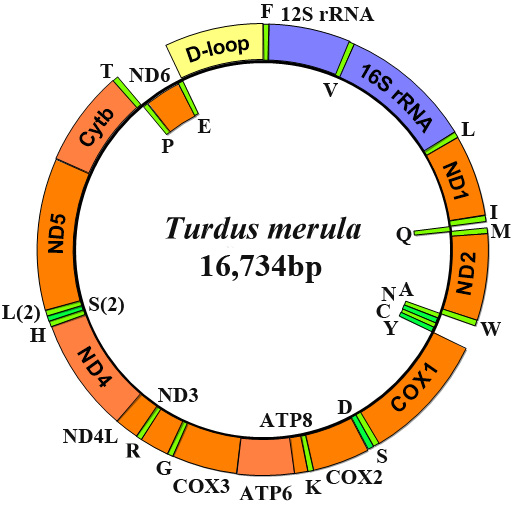
Gene organization of the T. merula mitochondrial genome. All 37 genes are encoded on both strands. Genes for proteins and rRNAs are shown with the standard abbreviation. Genes for tRNAs are designated by a single letter for the corresponding amino acid with two leucine tRNAs and two serine tRNAs differentiated by numerals.
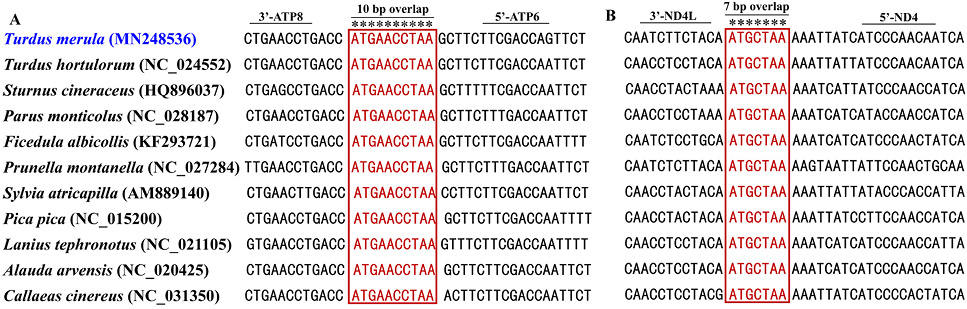
Sequence alignments of ATP8/ATP6 and ND4L/ND4 of passerine birds. The boxed nucleotides indicate the 10 bp (ATGAACCTAA) and 7 bp (ATGCTAA) highly conserved overlaps.
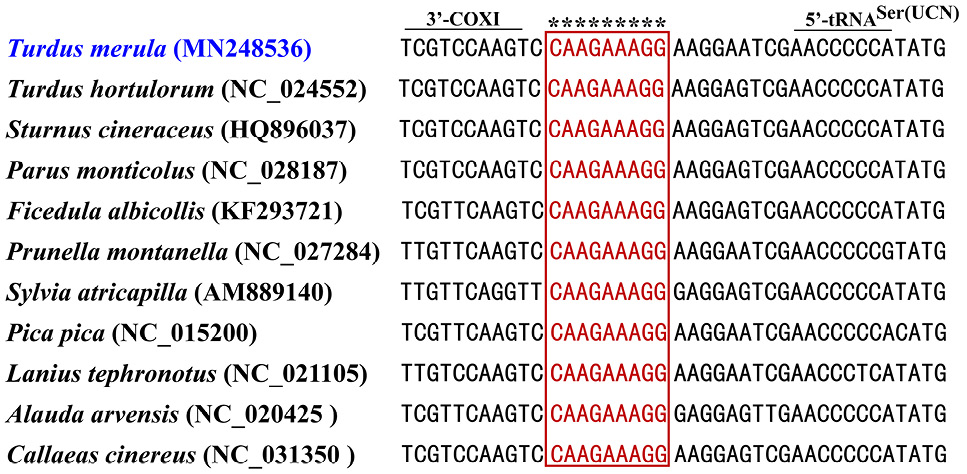
Sequence alignment of the space region between COXI and tRNASer (UCN) of passerine birds. The boxed nucleotides indicate the ‘CAAGAAAGG ‘ highly conserved motif. “ATGAACCTAA” between ATP8 and ATP6, and “ATGCTAA” between ND4L and ND4, and “CAAGAAAGG”.
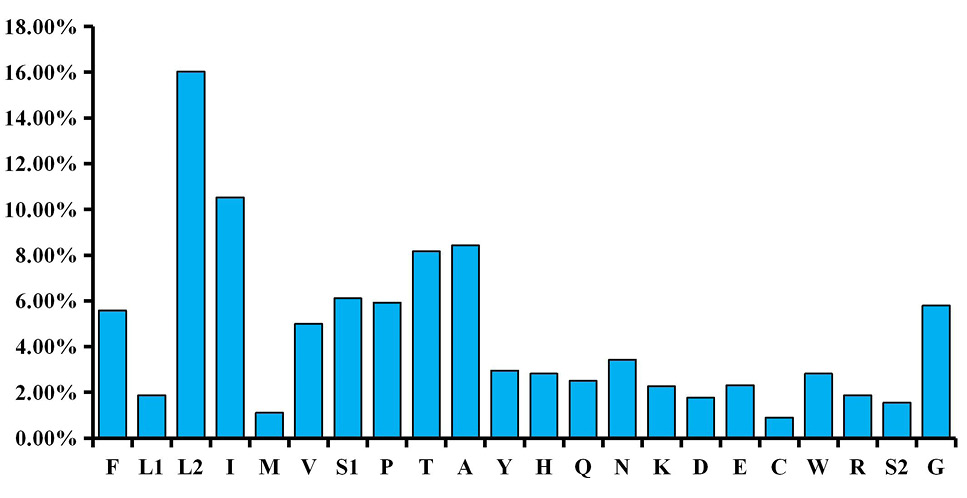
Percentages of amino acid usage in mitochondrial genomes of T. merula. A. Codon distribution in T. merula mitogenome. Codon families were provided on the X axis. Each amino acid is represented by the one-letter abbreviation. Note that leucine and serine are each coded by two different genetic codons, and listed separately.
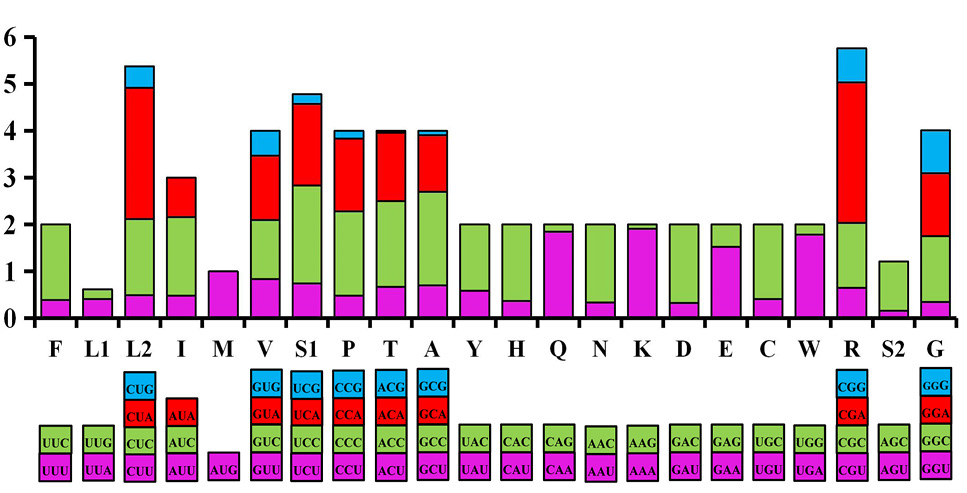
Relative Synonymous Codon Usage (RSCU) in T. merula mitogenome. Codon families were provided on the X axis and the RSCU values on the Y axis.
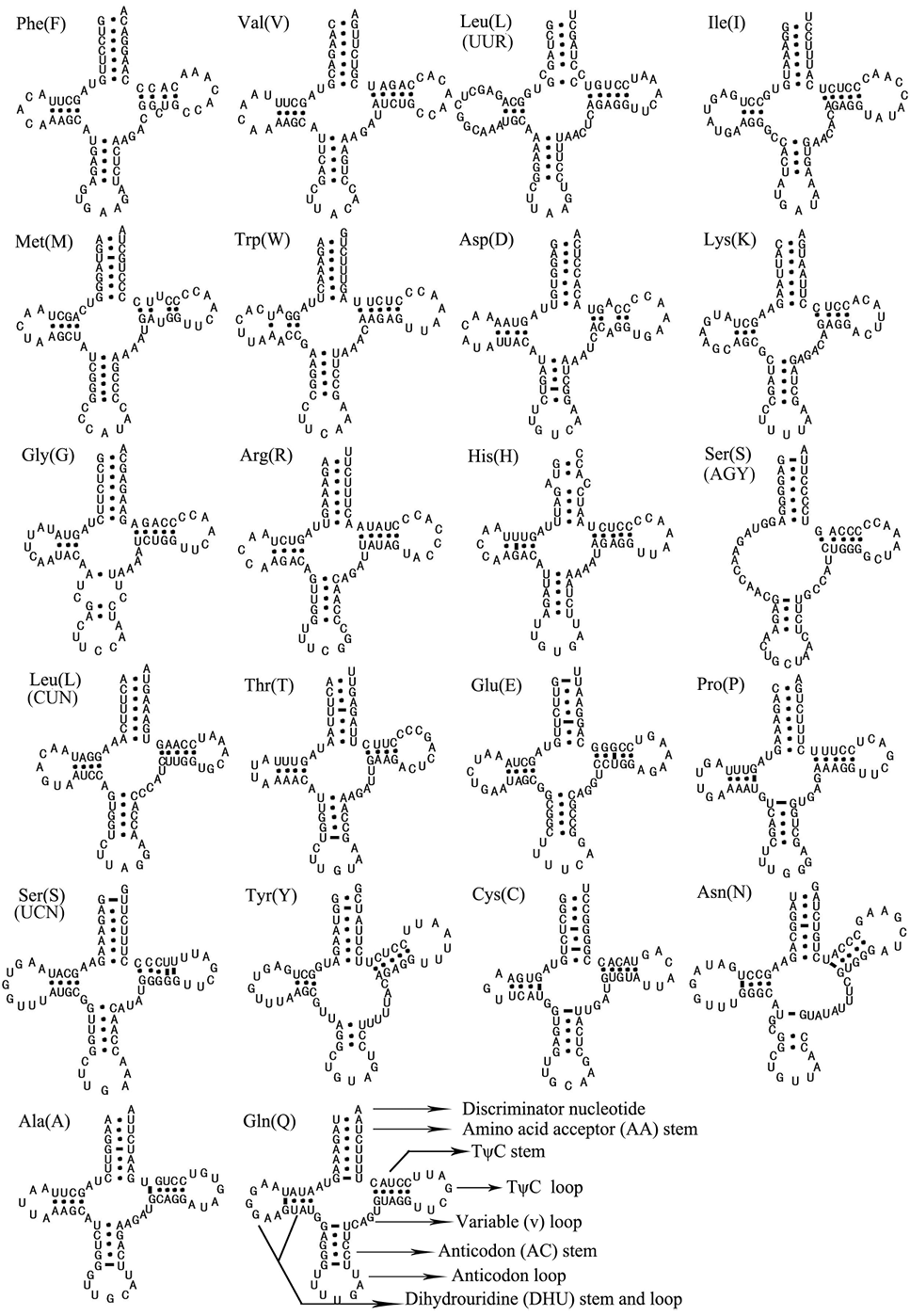
Predicted secondary structures for the 22 tRNA genes of T. merula.
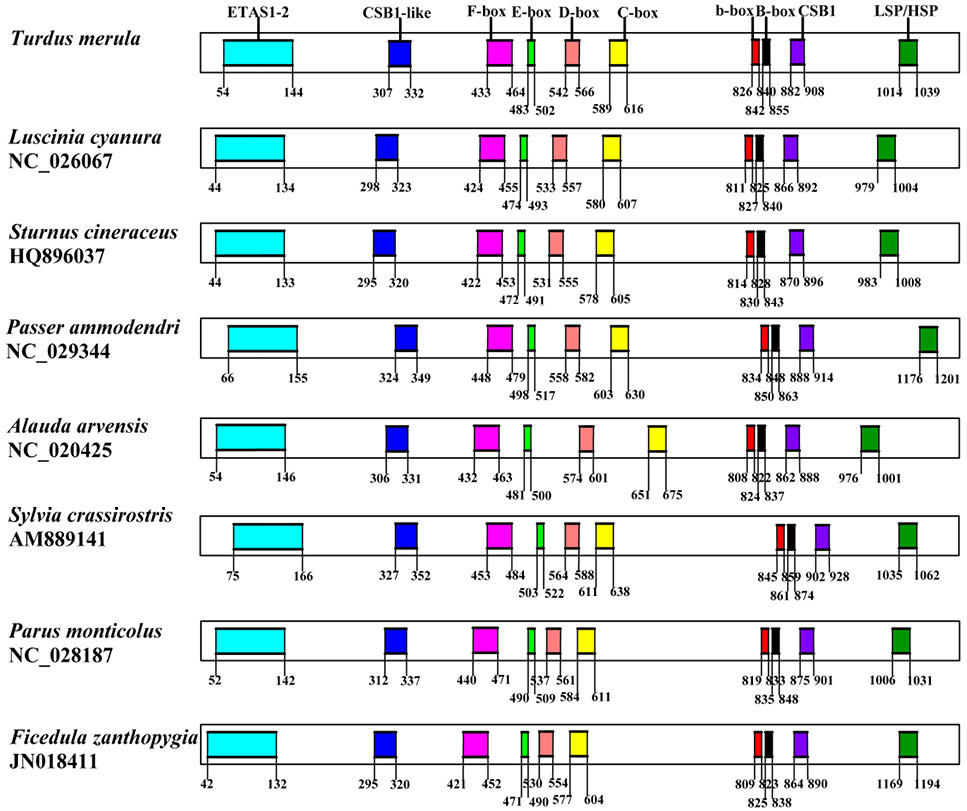
The structure of the control region of T. merula in this study. The number in rectangle frames denotes the numerical value of the boundary. Sequential features are indicated above the graph.
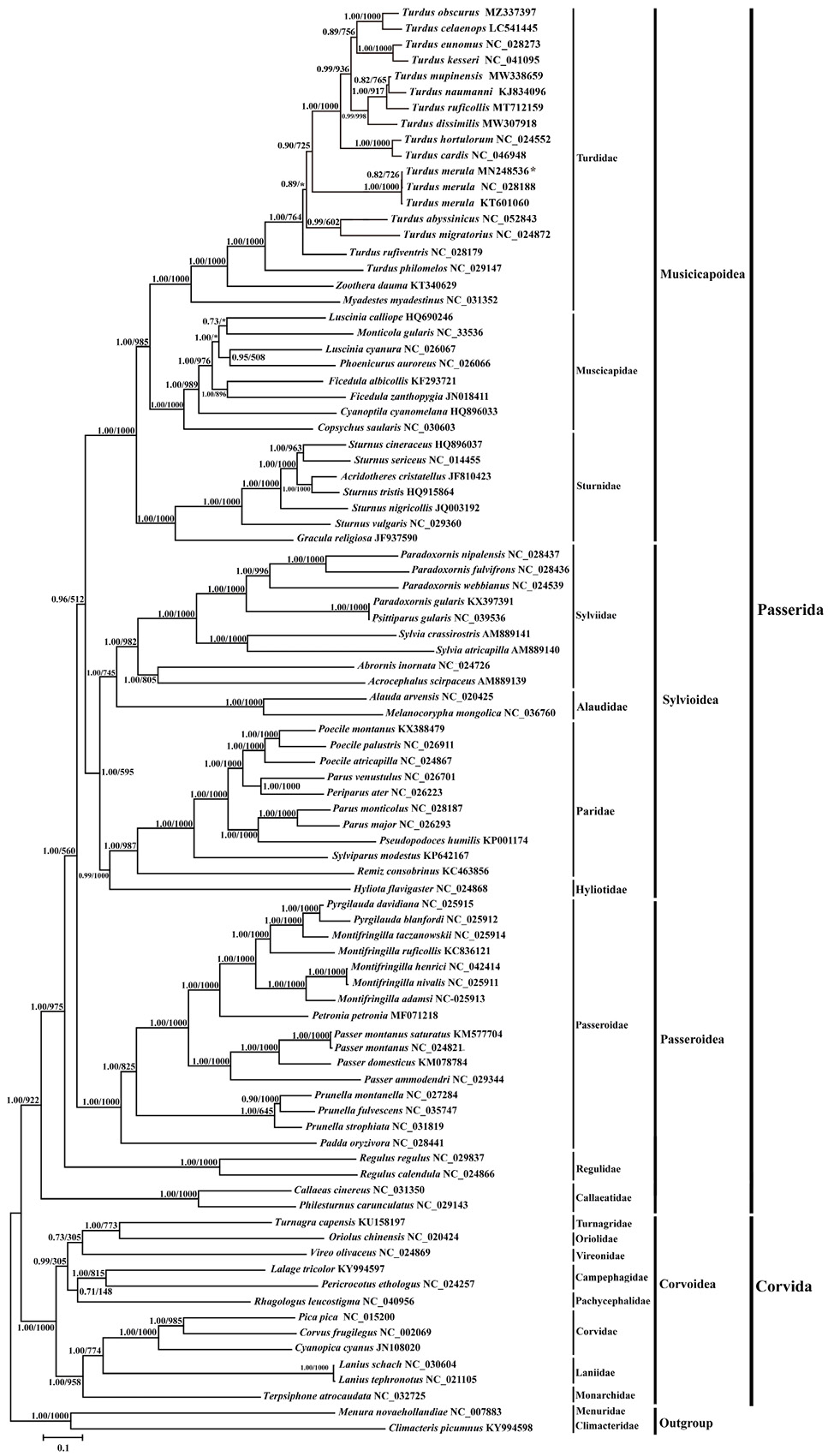
Inferred phylogenetic relationships based on 13 protein-coding genes with Bayesian inference (BI) and maximum likelihood (ML), respectively. Menura novaehollandiae (NC_007883) and Climacteris picumnus (KY994598) were used as outgroups. Bayesian posterior probability (BPP) and Bootstrap value (BP) of each node are shown in turn, such as BPP/BP 1.00/1000. The asterisk indicates that the BP value is less than 500. Sequences were analysed under the GTR+I+G model, based on the AIC criterion.
References
- Alam, M.T., Read, T.D. and Dove, A.D., 2014. The complete mitochondrial genome sequence of the world’s largest fish, the whale shark (Rhincodon typus), and its comparison with those of related shark species. Gene, 539: 44-49. https://doi.org/10.1016/j.gene.2014.01.064[CrossRef]
- Alström, P., Ericson, P.G., Olsson, U. and Sundberg, P., 2006. Phylogeny and classification of the avian superfamily Sylvioidea. Mol. Phylogenet. Evol., 38: 381-397. https://doi.org/10.1016/j.ympev.2005.05.015[CrossRef]
- Anderson, S., Bankier, A.T., Barrell, B.G., de Bruijn, M.H., Coulson, A.R., Drouin, J., Eperon, I.C., Nierlich, D.P., Roe, B.A., Sanger, F., Schreier, P.H., Smith, A.J., Staden, R. and Young, I.G., 1981. Sequence and organization of the mitochondrial human genome. Nature, 290: 457-465. https://doi.org/10.1038/290457a0[CrossRef]
- Anmarkrud, J.A. and Lifjeld, J.T., 2017. Complete mitochondrial genomes of eleven extinct or possibly extinct bird species. Mol. Ecol. Resour., 17: 334-341. https://doi.org/10.1111/1755-0998.12600[CrossRef]
- Barker, F.K., 2014. Mitogenomic data resolve basal relationships among passeriform and passeridan birds. Mol. Phylogenet. Evol., 79: 313-324. https://doi.org/10.1016/j.ympev.2014.06.011[CrossRef]
- Barker, F.K., Barrowclough, G.F. and Groth, J.G.A., 2002. phylogenetic hypothesis for passerine birds: Taxonomic and biogeographic implications of an analysis of nuclear DNA sequence data. Proc. R. Soc. B-Biol. Sci., 269: 295-308. https://doi.org/10.1098/rspb.2001.1883[CrossRef]
- Barker, F.K., Cibois, A., Schikler, P., Feinstein, J. and Cracraft, J., 2004. Phylogeny and diversification of the largest avian radiation. Proc. natl. Acad. Sci. USA, 101: 11040-11045. https://doi.org/10.1073/pnas.0401892101[CrossRef]
- Batista, R., Olsson, U. andermann, T., Aleixo, A., Ribas, C.C. and Antonelli, A., 2020. Phylogenomics and biogeography of the world’s thrushes (Aves, Turdus): New evidence for a more parsimonious evolutionary history. Proc. R. Soc. B., 287: 20192400. https://doi.org/10.1098/rspb.2019.2400[CrossRef]
- Benson, G., 1999. Tandem repeats finder: A program to analyze DNA sequences. Nucl. Acids Res., 27: 573-580. https://doi.org/10.1093/nar/27.2.573[CrossRef]
- Bernt, M., Braband, A., Schierwater, B. and Stadler, P.F., 2013. Genetic aspects of mitochondrial genome evolution. Mol. Phylogenet. Evol., 69: 328-338. https://doi.org/10.1016/j.ympev.2012.10.020[CrossRef]
- Boore, J.L., 1999. Animal mitochondrial genomes. Nucl. Acids Res., 27: 1767-1780. https://doi.org/10.1093/nar/27.8.1767[CrossRef]
- Boore, J.L. and Brown, W.M., 1998. Big trees from little genomes: Mitochondrial gene order as a phylogenetic tool. Curr. Opin. Genet. Dev., 8: 668-674. https://doi.org/10.1016/S0959-437X(98)80035-X[CrossRef]
- Brown, G.G., Gadaleta, G., Pepe, G., Saccone, C. and Sbisà, E., 1986. Structural conservation and variation in the D-loop-containing region of vertebrate mitochondrial DNA. J. mol. Biol., 192: 503-511. https://doi.org/10.1016/0022-2836(86)90272-X[CrossRef]
- Chen, W., Liu, W., Zhang, C., Liu, W., Li, K. and Hu, C., 2018. The complete mitochondrial genome of the red-necked stint Calidris ruficollis, (Charadriiformes, Scolopacidae). Conserv. Genet. Resour., a: 1-4. https://doi.org/10.1007/s12686-018-0996-1[CrossRef]
- Chen, W., Zhang, C. and Pan, T., 2018. The mitochondrial genome of the Kentish Plover Charadrius alexandrinus, (Charadriiformes: Charadriidae) and phylogenetic analysis of Charadrii. Genes Genom., b: 1-9. https://doi.org/10.1007/s13258-018-0703-3[CrossRef]
- Dang, J.P., Liu, N., Ye, W. and Huang, Y., 2008. Complete mitochondrial genome sequence of Gastrimargus marmoratus (Thunberg) (Orthoptera:Acridoidea). Acta entomol. Sin., 51: 671-680.
- Desjardins, P. and Morais, R., 1990. Sequence and gene organization of the chicken mitochondrial genome. A novel gene order in higher vertebrates. J. mol. Biol., 212: 599-634. https://doi.org/10.1016/0022-2836(90)90225-B[CrossRef]
- Dickinson, E.C., 2003. The Howard and Moore complete checklist of the birds of the world, 3rd ed. Christopher Helm, London.
- Doda, J.N., Wright, C.T. and Clayton, D.A., 1981. Elongation of displacement-loop strands in human and mouse mitochondrial DNA is arrested near specific template sequences. Proc. natl. Acad. Sci. USA, 78: 6116-6120. https://doi.org/10.1073/pnas.78.10.6116[CrossRef]
- Edwards, S.V., 1991. Mitochondrial resolution of a deep branch in the genealogical tree for birds. Proc. R. Soc. B Biol. Sci., 243: 99-107. https://doi.org/10.1098/rspb.1991.0017[CrossRef]
- Eoran, D.R., Hixson, J.E. and Brown, W.S., 1988. Comparison of ape and human sequences that regulate mitochondrial DNA transcription and D-loop DNA synthesis. Nucl. Acids Res., 166: 5841-5861. https://doi.org/10.1093/nar/16.13.5841[CrossRef]
- Ericson, P.G.P., Irestedt, M. and Johansson, U.S., 2003. Evolution, biogeography, and patterns of diversification in passerine birds. J. Avian. Biol., 34: 3-15. https://doi.org/10.1034/j.1600-048X.2003.03121.x[CrossRef]
- Ericson, P.G. and Johansson, U.S., 2003. Phylogeny of passerida (Aves: Passeriformes) based on nuclear and mitochondrial sequence data. Mol. Phylogenet. Evol., 29: 126-138. https://doi.org/10.1016/S1055-7903(03)00067-8[CrossRef]
- Feduccia, A., 1995. Explosive evolution in tertiary birds and mammals. Science, 267: 637-638. https://doi.org/10.1126/science.267.5198.637[CrossRef]
- Fuchs, J., Fjeldsa, J., Bowie, R.C.K., Voelker, G. and Pasquet, E., 2006. The African warbler genus Hyliota as a lost lineage in the Oscine songbird tree: Molecular support for an African origin of the Passerida. Mol. Phylogenet. Evol., 39: 186-197. https://doi.org/10.1016/j.ympev.2005.07.020[CrossRef]
- Gibb, G.C., England, R., Hartig, G., McLenachan, P.A., Taylor Smith, B.L., McComish, B.J., Cooper, A. and Penny, D., 2015. New Zealand passerines help clarify the diversification of major songbird lineages during the oligocene. Genome Biol. Evol., 7: 2983-2995. https://doi.org/10.1093/gbe/evv196[CrossRef]
- Guindon, S. and Gascuel, O., 2003. A simple, fast, and accurate algorithm to estimate large phylogenies by maximum likelihood. Syst. Biol., 52: 696-704. https://doi.org/10.1080/10635150390235520[CrossRef]
- Haring, E., Kruckenhauser, L., Gamauf, A., Riesing, M.J. and Pinsker, W., 2001. The complete sequence of the mitochondrial genome of Buteo buteo (Aves, Accipitridae) indicates an early split in the phylogeny of raptors. Mol. Biol. Evol., 18: 1892. https://doi.org/10.1093/oxfordjournals.molbev.a003730[CrossRef]
- Hope, S., 1989. Phylogeny of the avian family Corvidae. Dissertation, City University of New York, New York.
- Huelsenback, J.P. and Ronquist, F., 2001. Mrbayes: Bayesian inference of phylogenetic trees. Bioinformatics, 17: 754-755. https://doi.org/10.1093/bioinformatics/17.8.754[CrossRef]
- Ingman, M., Kaessmann, H., Paabo, S. and Gyllensten, U., 2000. Mitochondrial genome variation and the origin of modern humans. Nature, 408: 708-713. https://doi.org/10.1038/35047064[CrossRef]
- James, H.F., Ericson, P.G.P., Slikas, B., Lei, F.M., Gill, F.B. and Olson, S.L., 2003. Pseudopodoces humilis, a misclassified terrestrial tit (Paridae) of the Tibetan Plateau: Evolutionary consequences of shifting adaptive zones. IBIS, 145: 185-202. https://doi.org/10.1046/j.1474-919X.2003.00170.x[CrossRef]
- Jiang, L., Wang, G., Peng, R., Peng, Q. and Zou, F., 2014. Phylogenetic and molecular dating analysis of Taiwan blue pheasant (Lophura swinhoii). Gene, 539: 21-29. https://doi.org/10.1016/j.gene.2014.01.067[CrossRef]
- Johansson, U.S., Fjeldsa, J. and Bowie, R.C.K., 2008. Phylogenetic relationships within Passerida (Aves: Passeriformes): A review and a new molecular phylogeny based on three nuclear intron markers. Mol. Phylogenet. Evol., 48: 858-876. https://doi.org/10.1016/j.ympev.2008.05.029[CrossRef]
- Keith, B.F., 2014. Mitogenomic data resolve basal relationships among passeriform and passeridan birds. Mol. Phylogenet. Evol., 79: 313-324. https://doi.org/10.1016/j.ympev.2014.06.011[CrossRef]
- Lanfear, R., Frandsen, P.B., Wright, A.M., Senfeld, T. and Calcott, B., 2017. Partitionfinder 2: New methods for selecting partitioned models of evolution for molecular and morphological phylogenetic analyses. Mol. Biol. Evol., 34: 772–773. https://doi.org/10.1093/molbev/msw260[CrossRef]
- Li, B., Zhou, L., Liu, G. and Gu, C., 2016. Complete mitochondrial genome of Naumann’s thrush Turdus naumanni (Passeriformes: Turdidae). Mitochondrial DNA, 27: 1117-1118. https://doi.org/10.3109/19401736.2014.933327[CrossRef]
- Liu, L., Li, H., Song, F., Song, W., Dai, X., Chang, J. and Cai, W., 2012. The mitochondrial genome of Coridius chinensis (Hemiptera: Dinidoridae). Zootaxa, 3537: 29-40. https://doi.org/10.11646/zootaxa.3537.1.2[CrossRef]
- Liu, Q.N., Xin, Z.Z., Bian, D.D., Chai, X.Y., Zhou, C.L. and Tang, B.P., 2016. The first complete mitochondrial genome for the subfamily Limacodidae and implications for the higher phylogeny of Lepidoptera. Sci. Rep., 6: 35878. https://doi.org/10.1038/srep35878[CrossRef]
- Liu, Q.N., Zhang, H.B., Jiang, S.H., Xuan, F.J., Li, C.F., Zhang, D.Z., Zhou, C.L. and Tang, B.P., 2015. The complete mitochondrial genome of Eriocheir japonica sinensis (Decapoda: Varunidae) and its phylogenetic analysis. Biochem. Biochem. Syst. Ecol., 62: 241-248. https://doi.org/10.1016/j.bse.2015.09.008[CrossRef]
- Lobry, J.R., 1996. Asymmetric substitution patterns in the two DNA strands of bacteria. Mol. Biol. Evol., 13: 660-665. https://doi.org/10.1093/oxfordjournals.molbev.a025626[CrossRef]
- Long, J.L., 1981. Introduced birds of the world. Agricultural Protection Board of Western Australia. pp. 21-493.
- Lowe, T.M. and Eddy, S.R., 1997. tRNAscan-SE: A program for improved detection of transfer RNA genes in genomic sequence. Nucl. Acids Res., 25: 955-964. https://doi.org/10.1093/nar/25.5.955[CrossRef]
- Luo, J., Li, Y.H. and Hu, J., 2008. Nest site selection of Blackbird in Nanchong farmland area of Sichuan. Sichuan Anim., 27: 575-578.
- Marshall, H.D., Baker, A.J. and Grant, A.R., 2013. Complete mitochondrial genomes from four subspecies of common chaffinch (Fringilla coelebs): New inferences about mitochondrial rate heterogeneity, neutral theory, and phylogenetic relationships within the order Passeriformes. Gene, 517: 37-45. https://doi.org/10.1016/j.gene.2012.12.093[CrossRef]
- Mu, X., Liu, Y., Lai, M., Song, H., Wang, X., Hu, Y. and Luo, J., 2015. Characterization of the Macropodus opercularis complete mitochondrial genome and family Channidae taxonomy using Illuminabased de novo transcriptome sequencing. Gene, 559: 189-195. https://doi.org/10.1016/j.gene.2015.01.056[CrossRef]
- Nabholz, B., Jarvis, E.D. and Ellegren, H., 2010. Obtaining mtDNA genomes from next-generation transcriptome sequencing: A case study on the basal Passerida (Aves: Passeriformes) phylogeny. Mol. Phylogenet. Evol., 57: 466-470. https://doi.org/10.1016/j.ympev.2010.06.009[CrossRef]
- Nagy, J., Végvári, Z. and Varga, Z., 2019. Phylogeny, migration and life history: Filling the gaps in the origin and biogeography of the Turdus thrushes. J. Ornithol., 160: 529-543. https://doi.org/10.1007/s10336-019-01632-3[CrossRef]
- Ni, Y., 2014. Distribution and protection of Blackbird Xinjiang subspecies. Xinjiang Animal Husbandry, pp. 63-64.
- Nylander, J., Urban, O., Per, A. and Isabel, S., 2008. Accounting for phylogenetic uncertainty in biogeography: A bayesian approach to dispersal-vicariance analysis of the thrushes (Aves: Turdus). Syst. Biol., 57: 257-268. https://doi.org/10.1080/10635150802044003[CrossRef]
- Ohtsuki, T., Kawai, G. and Watanabe, K., 2002. The minimal tRNA: Unique structure of Ascaris suum mitochondrial tRNASer(UCU) having a short T arm and lacking the entire D arm. FEBS Lett., 514: 37-43. https://doi.org/10.1016/S0014-5793(02)02328-1[CrossRef]
- Payevsky, V. A., 2014. Phylogeny and classification of passerine birds, passeriformes. Mycologist, 4: 143-156. https://doi.org/10.1134/S2079086414020054[CrossRef]
- Peng, L.F., Yang, D.C. and Lu, C.H., 2016. Complete mitochondrial genome sequence of Eurasian blackbird, Turdus merula (Aves: Turdidae). Mitochondrial DNA A, 27: 4609-4610. https://doi.org/10.3109/19401736.2015.1101580[CrossRef]
- Perna, N.T. and Kocher, T.D., 1995. Patterns of nucleotide composition at fourfold degenerate sites of animal mitochondrial genomes. J. mol. Evol., 41: 353-358. https://doi.org/10.1007/BF01215182[CrossRef]
- Posada, D., 2008. Jmodeltest: Phylogenetic model averaging. Mol. Biol. Evol., 25: 1253-1256. https://doi.org/10.1093/molbev/msn083[CrossRef]
- Posada, D. and Buckley, T.R., 2004. Model selection and model averaging in phylogenetics: Advantages of akaike information criterion and bayesian approaches over likelihood ratio. Tests. Syst. Biol., 53: 793-808. https://doi.org/10.1080/10635150490522304[CrossRef]
- Powell, A.F., Barker, F.K. and Lanyon, S.M., 2013. Empirical evaluation of partitioning schemes for phylogenetic analyses of mitogenomic data: An avian case study. Mol. Phylogenet. Evol., 66: 69-79. https://doi.org/10.1016/j.ympev.2012.09.006[CrossRef]
- Raikow, R.J., 1986. Why are there so many kinds of passerine birds? Syst. Zool., 35: 255-259. https://doi.org/10.1093/sysbio/35.2.255[CrossRef]
- Randi, E. and Lucchini, V., 1998. Organization and evolution of the mitochondrial DNA control region in the avian genus Alectoris. J. mol. Evol., 47: 449-462. https://doi.org/10.1007/PL00006402[CrossRef]
- Ritchie, P. and Lambert, D., 2000. A repeat complex in the mitochondrial control region of Adélie penguins from Antarctica. Genome, 43: 613-618. https://doi.org/10.1139/g00-018[CrossRef]
- Rong, Y., Wu, X.B., Peng, Y., Su, X. and Yang, B., 2010. Complete mitochondrial genome of Otis tarda (Gruiformes: Otididae) and phylogeny of Gruiformes inferred from mitochondrial DNA sequences. Mol. Biol. Rep., 37: 3057. https://doi.org/10.1007/s11033-009-9878-7[CrossRef]
- Ryu, S.H. and Hwang, U.W., 2012. Complete mitochondrial genome of Saunders’s gull Chroicocephalus saundersi (Charadriiformes, Laridae). Mitochondrial DNA, 23: 134-136. https://doi.org/10.3109/19401736.2012.660927[CrossRef]
- Sambrock, J. and Russel, D., 2001. Molecular cloning: A laboratory manual, 3rd ed. Cold Spring Harbor Laboratory Press, U.S.
- Sangster, G., Alström, P., Forsmark, E. and Olsson, U., 2010. Multi-locus phylogenetic analysis of old world chats and flycatchers reveals extensive paraphyly at family, subfamily and genus level (Aves: Muscicapidae). Mol. Phylogenet. Evol., 57: 380-392. https://doi.org/10.1016/j.ympev.2010.07.008[CrossRef]
- Sbisa, E., Tanzariello, F., Reyes, A., Pesole, G. and Saccone, C., 1997. Mammalian mitochondrial D-loop region structural analysis: identification of new conserved sequences and their functional and evolutionary implications. Gene, 205: 125-140. https://doi.org/10.1016/S0378-1119(97)00404-6[CrossRef]
- Seutin, G. and Bermingham, E., 1997. Rhodinocichla rosea is an emberizid (Aves; Passeriformes) based on mitochondrial DNA analyses. Mol. Phylogenet. Evol., 8: 260-274. https://doi.org/10.1006/mpev.1997.0426[CrossRef]
- Sheldon, F.H. and Gill, F.B.A., 1996. Reconsideration of songbird phylogeny, with emphasis on the evolution of titmice and their sylvioid relatives. Syst. Biol., 45: 473-495. https://doi.org/10.1093/sysbio/45.4.473[CrossRef]
- Shepherd, L.D. and Lambert, D.M., 2007. The relationships and origins of the New Zealand wattlebirds (Passeriformes, Callaeatidae) from DNA sequence analyses. Mol. Phylogenet. Evol., 43: 480-492. https://doi.org/10.1016/j.ympev.2006.12.008[CrossRef]
- Sibley, C.G. and Ahlquist, J.E., 1992. Phylogeny and classification of birds: a study in molecular evolution. Q. Rev. Biol., 67: 62-63. https://doi.org/10.1086/417486[CrossRef]
- Simon, C. and Frati, F., 1994. Evolution, weighting, and phylogenetic utility of mitochondrial gene sequences and a compilation of conserved polymerase chain reaction primers. Annls entomol. Soc. Am., 87: 651-701. https://doi.org/10.1093/aesa/87.6.651[CrossRef]
- Song, S.N., Tang, P., Wei, S.J. and Chen, X., 2016. Comparative and phylogenetic analysis of the mitochondrial genomes in basal hymenopterans. Sci. Rep., 6: 20972. https://doi.org/10.1038/srep20972[CrossRef]
- Stewart, J.B. and Bckenbach, A.T., 2005. Insect mitochondrial genomics: The complete mitochondrial genome sequence of the meadow spittlebug Philaenus spumarius (Hemiptera: Auchenorrhyncha: Cercopoidae). Genome, 48: 46-54. https://doi.org/10.1139/g04-090[CrossRef]
- Tamura, K., Stecher, G., Peterson, D., Filipski, A. and Kumar, S., 2013. MEGA6: Molecular evolutionary genetics analysis version 6.0. Mol. Biol. Evol., 30: 2725-2729. https://doi.org/10.1093/molbev/mst197[CrossRef]
- Treplin, S., Siegert, R., Bleidorn, C., Thompson, H.S., Fotso, R. and Tiedemann, R., 2008. Molecular phylogeny of songbirds (Aves: Passeriformes) and the relative utility of common nuclear marker loci. Cladistic, 24: 328-349. https://doi.org/10.1111/j.1096-0031.2007.00178.x[CrossRef]
- Varani, G. and Mcclain, W.H., 2000. The G x U wobble base pair. A fundamental building block of RNA structure crucial to RNA function in diverse biological systems. EMBO Rep., 1: 18. https://doi.org/10.1093/embo-reports/kvd001[CrossRef]
- Velez-Zuazo, X. and Agnarsson, I., 2011. Shark tales: A molecular species-level phylogeny of 367 sharks (Selachimorpha, Chondrichthyes). Mol. Phylogenet. Evol., 58: 207-217. https://doi.org/10.1016/j.ympev.2010.11.018[CrossRef]
- Walberg, M.W. and Clayton, D.A., 1981. Sequence and properties of the human KB cell and mouse L cell D-loop regions of mitochondrial DNA. Nucl. Acids Res., 9: 5411-5421. https://doi.org/10.1093/nar/9.20.5411[CrossRef]
- Wang, L. and Yin, W., 2016. Distribution and characteristics of blackbird in urban green space of Guangzhou. Anhui agric. Sci., pp. 18-19.
- Wolstenholme, D.R., 1992. Animal mitochondrial DNA: Structure and evolution. Int. Rev. Cytol., 141: 173. https://doi.org/10.1016/S0074-7696(08)62066-5[CrossRef]
- Xu, H., Xiong, W., Yao, Y., Ni, Q. and Pan, Y., 2010. Phylogenetic evolution of birds in the subfamily of thrush based on mitochondrial CoI gene. J. Northeast For. Univ., 38: 75-78.
- Yan, L., Zhang, H.B., Yan, P. and Wu, X.B., 2016. The complete mitochondrial genome of Turdus hortulorum (Passeriformes, Turdidae). Mitochondrial DNA A, 27: 543-544. https://doi.org/10.3109/19401736.2014.905849[CrossRef]
- Yokobori, S. and Pääbo, S., 1995. Transfer RNA editing in land snail mitochondria. Proc. natl. Acad. Sci. USA., 92: 10432-10435. https://doi.org/10.1073/pnas.92.22.10432[CrossRef]
- Yong, H.S., Song, S.L., Lim, P.E., Chan, K.G., Chow, W.L. and Eamsobhana, P., 2015. Complete mitochondrial genome of Bactrocera arecae (Insecta: Tephritidae) by next-generation sequencing and molecular phylogeny of Dacini tribe. Sci. Rep., 5: 15155. https://doi.org/10.1038/srep15155[CrossRef]
- Yoon, K.B., Cho, C.U. and Park, Y.C., 2015. The mitochondrial genome of the Saunders’s gull Chroicocephalus saundersi (Charadriiformes: Laridae) and a higher phylogeny of shorebirds (Charadriiformes). Gene, 572: 227-236. https://doi.org/10.1016/j.gene.2015.07.022[CrossRef]
- Yoon, K.B., Kim, H.R., Kim, J.Y., Jeon, S.H. and Park, Y.C., 2013. The complete mitochondrial genome of the Ussurian tube-nosed bat Murina ussuriensis (Chiroptera: Vespertilionidae) in Korea. Mitochondrial DNA, 24: 397-399. https://doi.org/10.3109/19401736.2013.763243[CrossRef]
- Zhang, H., Bai, Y., Shi, X., Sun, L., Wang, Z. and Wu, X., 2018. The complete mitochondrial genomes of Tarsiger cyanurus and Phoenicurus auroreus: A phylogenetic analysis of Passeriformes. Genes Genom, 40: 1-15. https://doi.org/10.1007/s13258-017-0617-5[CrossRef]
- Zhao, S., Ma, Y., Wang, G., Li, H., Liu, X., Yu, J., Yue, B. and Zou, F., 2012. Molecular phylogeny of major lineages of the avian family Phasianidae inferred from complete mitochondrial genome sequences. J. nat. Hist., 46: 757-767. https://doi.org/10.1080/00222933.2011.653588[CrossRef]
- Zheng, G.M., 2018. A checklist on the classification and distribution of the birds of China (3rd editon). Science Press, Beijing.
- Zhou, L.Z., Song, Y. and Ma, Y., 2001. The breeding ecology of Blackbird. J. Ecol., 20: 32-34.
Services
Article usage statistics
Loading…