Research Article · Volume 10, Issue 5, 17 April 2022 · Open Access
Comparative Study of Curcumin and Garlic Extracts as Antioxidants in Growing Rabbit Diets on Productive Performance and Antioxidant Status
· · ·
Affiliations & Notes ⌄
1Department of Animal Production, National Research Centre, 12622, Giza, Egypt
2Animal Production Research Institute, Agricultural Research Center, Giza, Egypt. *Correspondence | A. Samy, Department of Animal Production, National Research Centre, 12622, Giza, Egypt
This study aimed to evaluate how adding curcumin and garlic extracts to the diet of growing rabbits affected productive performance, carcass characteristics and antioxidant status. Sixty growing rabbits (APRI) were divided into five groups of 12 rabbits each at the age of six weeks. Five diets containing the same proportions of all nutrients were made. The first control diet (without any additives); curcumin (CE) or garlic extract (GE) at concentrations of 200 or 400 ppm were added to the other diets. The results revealed that adding curcumin or garlic extract to growing rabbit diets boosted significantly meat crude protein (P<0.05) while, decreasing moisture and fat levels. Digestibility coefficients of CP, CF, and EE, as well as the nutritive values of TDN, DCP, and DE, were considerably improved (P<0.05), although DM, OM, and NFE digestibility was unaffected in all treatments. Considerably, Addition of curcumin or garlic extract boosted final weight, weight gain, and feed efficiency compared to the control group. Dietary treatments were significantly (P<0.05) raised carcass weight and carcass percent, while liver, heart, kidney, giblets, and spleen percentage were not affected. When curcumin or garlic extract were added at 200 or 400 ppm, Improved the antioxidants status by enhanced total antioxidant capacity also, significantly (P<0.05) enhanced hepatic antioxidants enzyme (superoxide dismutase, catalase, and glutathione peroxidase) compared with the control. Slightly (P>0.05) decreased in malondialdehyde of all treatments compared to the control. Also, there is no any negative effect on the thyroid hormones with any treatments compared to the control. These results suggested that rabbits fed diets enriched with curcumin or garlic extract could have better performance, carcass characteristics, and antioxidant status compared to the control.
Feed additives are an important component of poultry feeds that help them perform better and produce more ; ; ; ; . In terms of weight increase, feed efficiency, and reduced mortality in chicken, natural feed additives (phytogenic) have shown promising results . Phytogenic are supposed to boost poultry performance by encouraging the release of digestive enzymes, which leads to better digestion and absorption ; . Phytochemicals or their extracts have a positive impact on bird performance, immunity, and blood parameters. Phytogenic and their extracts are effective feed additions in poultry nutrition because of their favorable effects and safety ; . Many studies were conducted on natural feed additives such as garlic, ginger, fenugreek, curcumin, castor, propolis and other plant extracts as an alternative to antibiotic to enhance performance and gut function of broiler chicks ; ; . Alliin, allicin, ajoenesn, vinyldithiins, and flavonoids are among the sulfur-containing phyto constituents found in garlic. Allicin is the principal active component in garlic (Allium sativum L.) extract . Garlic extract could be beneficial in broiler feed as a natural feed additive. Garlic’s antibacterial properties are related to the presence of organosulfur compounds such allicin and diallyl sulphide. Organosulfur compounds may also be able to impact gut fermentation patterns by increasing propionate and butyrate and decreasing acetate levels . Supplementing garlic to the rabbit diet increased live body weight and improved feed efficiency . Garlic in the diet of rabbits enhanced body weight and feed efficiency . Also, Broilers with garlic extract supplemented diet had superior growth performance . Garlic promotes nutrient digestion by reducing peptic and stomach ulcers, boosting the growth of helpful microbes digesting fibrous feed, and therefore increasing the number of nutrients accessible for assimilation . Garlic contains Polyphenols and flavonoids, which protect cell membranes and DNA from oxidative damage ; . In addition to, Garlic includes various antioxidant actions, such as organosulfur, flavonoids like quercetin, which may contribute to a healthier animal and improved nutrient utilization and performance . Oluwafemi et al. (2021) found that adding 0.4% of ginger and garlic oil mixture to broiler feed significantly increased growth performance. Shiyou et al. (2011) reported that turmeric (Curcuma longa) is a rich source of phenolic chemicals, terpenoids, and curcuminoids. Curcumin is the primary bioactive component of turmeric, and it has antioxidant, antiviral, and antibacterial properties . Curcumin’s improved the excretion of lipase, trypsin, chymotrypsin, and amylase, which may be responsible for curcumin’s beneficial effects on broiler growth performance . Al-Sultan (2003) concluded that using turmeric at 5.0 g/kg in broiler diets improved the growth performance. Al-Jaleel (2012) observed that introducing 0.50% turmeric in broiler diets increased body weight compared to the control and other dietary treatments (0.25, 1, 1.5 % turmeric). Curcumin significantly reduced total cholesterol, probably by inhibiting the hepatic enzyme 3-hydroxyl-3-methyglutaryl Co-A reductase, that is responsible for the synthesis of cholesterol in the liver . Therefore, the goal of this study was to investigate the influence of the addition curcumin or garlic extract in rabbit diets on productive performance, digestibility, carcass characteristics, thyroid hormones, and antioxidant enzyme activities.
MATERIALS AND METHODS
This study was conducted at Egypt’s Kafr Elsheikh Governorate’s Ministry of Agriculture’s Sakha Research Station. The laboratory work was carried out at department of Animal Production, National Research Centre, Egypt and department of by Products Research, Animal Production Research Institute, Agricultural Research Center. The goal of this study was to investigate the influence of curcumin and garlic extracts in growing rabbit diets on performance and antioxidants status.
Curcumin and garlic were extracted using dried turmeric rhizomes and fresh garlic which acquired from a local Egyptian market. All of the chemicals and solvents were acquired from Merck and were of analytical grade.
Curcumin extract (CE) is obtained by extracting curcumin from dried turmeric rhizomes. To obtain a curcuminoid-rich extract, use Soxhlet extraction by Percolation (boiler and reflux) with acetone as solvent (Zieliska et al., 2020; .
Garlic extract (GE) was extracted using a heat reflux extraction process including 70% ethanol and continuous stirring for three hours, following by separation of the extract using a rotary evaporator at 40°C ; .
Finally, calcium carbonate was used as a carrier material to load the extracts separately so that they could be easily used and mixed with feed ingredients.
Experimental diets
According to Agriculture Ministry Decree (1996) instructions, the control diet was formulated to meet the nutritional requirements of growing rabbits. Five diets containing the same proportions of all nutrients were made. The first control diet (without any additives); curcumin (CE) or garlic extract (GE) at concentrations of 200 or 400 ppm were added to the other diets. The experiment period lasted from 6 - 14 week of age. Components and chemical analysis of a control diet are presented in Table 1.
Animals and management
Sixty growing rabbits (APRI strain) were randomly distributed into five groups, 12 rabbits of each, the average start body weight was closely to 635 g. The rabbits were housed in battery cages measuring 60 x 50 x 40 inches with separate feeders. Water and feed were freely available. The rabbits were housed in the same sanitary and management conditions. Weekly feed intake and live body weights data were used to calculate feed conversion ratio (FCR) and body weight gain (BWG).
Table 1: Components and chemical analysis of a control diet.
Ingredient %
%
Chemical analysis
Alfalfa hay
34.95
DM %
87.57
Barley grain
25.60
OM %
81.55
Soybean meal 44%
14.30
CP %
16.94
Wheat bran
20.60
CF %
12.98
Molasses
3.02
EE %
2.28
Soft Limestone
0.43
DE (kcal/kg)2
2505
Salt
0.30
AP %
0.545
Dicalcium phosphate
0.30
Ca%
0.795
Mineral-vitamin premix*
0.30
Methionine %
0.445
DL-Methionine
0.20
Lysine %
0.805
Total
100
* Each 3 kg of mineral and vitamin premix contains the following: Vit. A (12000000 IU), Vit. D3 (200000 g), Vit. E (10 g), Vit. K3 (2.5 g), Vit. B1 (1.0 g), Vit. B2 (5.0 g), Vit. B6 (1.5 g), Vit. B12 (10 g), Pantothenic acid (10 g), Niacin (30 g), Choline chloride (500 g), Folic acid (1.0 g), Biotin (50 mg), Fe (30 mg), Mn (40 mg), Zn (45 mg), Cu (3 g), Co (100 mg), I (300 mg), Se (100 mg). 2DE was estimated using values from the N R C (1977).
Digestibility trail
Five rabbits from each group were used in a digestibility trial at the end of the study. According to AOAC (2000) feces were daily collected and dried at 50-60 oC for 24-48 hours for constant weight before being finely powdered and were kept till chemical analysis. The digestibility coefficients of nutrients and nutritive values of the dietary treatments were determined using data from quantities and chemical analyses of feed and feces, according to Cheeke et al. (1982).
Blood samples and carcass parameters
At the end of the experiment, 5 rabbits per feeding treatment were starved for 24 hours and slaughtered for carcass and internal organs measures. Live weight, carcass weight (g), carcass percentage, gastrointestinal tract weight percent (GIT percent), organs represented as percentages of live weights, giblet (heart, liver, and kidney) percentage, and abdominal fat percentage were calculated. The meat composition of breast muscle was determined using the AOAC (2000). The blood samples were taken with the rabbits slaughtering.
Analyses of antioxidants status
Blood serum samples were separated by centrifugation at 4000 rpm for 10 minutes, and then stored at -20 oC until chemical analysis. Total antioxidant capacity (TAC) and malondialdehyde (MDA) concentrations were assessed in blood serum.
Furthermore, the livers were collected for the analysis of catalase (CAT), superoxide dismutase (SOD) and glutathione peroxidase (GSH) antioxidant enzymes using commercial kits (biodiagnostic, Cairo, Egypt) in an automatic calibration spectrophotometer with high-performance readings (FlexorEL200 Biochemical Analyzer).
Thyroid hormone concentration
Commercial ELISA kits were used to measure total T3 and T4 concentrations in the blood (MyBioSource, Inc., San Diego, CA). The T4/T3 ratio was obtained by dividing the value of T4 by the value of T3.
Statistical analysis
SAS’s (2001) General Linear Models technique was used to examine the data. The statistical data of 95 percent reliability was analyzed using one-way analyses of variance. The differences among means were compared using Duncan’s multiple rang test at significance level (P<0.05).
RESULTS AND DISCUSSION
The effects of curcumin or garlic extract on live body weight (LBW), daily weight gain (DWG), daily feed intake (DFI), and feed conversion ratio (FCR) of growing rabbits are shown in Table 2. The results showed that adding 200 ppm (CE1, GE1) or 400 ppm (CE2, GE2) of curcumin or garlic extract had a significant (P<0.05) favorable effect on LBW during the experimental period. The greatest significant (P<0.05) LBW values were obtained when curcumin or garlic extract were used at 400 ppm. At 14 weeks of age, the inclusion of CE2 and GE2 resulted in the greatest LBW and DWG values (2230 and 2249g) and (28.35 and 28.82g), respectively compared to the control group that had the lowest LBW (1899g) and DWG (22.83g) values. At all ages, the daily feed consumption of rabbits fed diets containing various doses of curcumin or garlic extract remained were no significantly affected. Curcumin and garlic extract supplementation had a significant (P<0.05) effect on the FCR of growing rabbits during the experimental period. In comparison to 200 ppm levels and the control group, inclusion of curcumin or garlic extract at 400 ppm resulted in considerably (P<0.05) enhanced FCR values during the experimental period. The results of the performance index (PI) and growth rate (GR) showed significant (P<0.05) differences in PI and GR among the dietary treatments at overall ages of the rabbits, with the best values of PI and GR for rabbits fed diets containing CE2 (81.88 and 110.54) and GE2 (82.61 and 111.93), respectively and the worst values recorded for rabbits fed control diet (56.93 and 101.51), respectively.
The improvement in body weight and feed conversion ratio could be attributed to optimum antioxidant activity of curcumin and garlic extracts, which stimulate protein synthesis via the enzymatic system, based on the findings of this and prior investigations. Furthermore, curcumin and garlic extracts can inhibit or limit the growth and colonization of a wide range of pathogenic and non-pathogenic bacteria in the gut, resulting in a more balanced microbial ecosystem and improved nutrient digestion and absorption, as well as improved growth performance and physiological status.
These findings are consistent with those of numerous researches, including Kafi et al. (2017), who found that adding 0.75 percent turmeric (Curcuma longa) to broiler diets were significantly enhanced growth rate. Hussein (2012) also found that using curcumin in the broiler diet significantly (P<0.05) improved growth performance. Growing rabbits fed a diet supplemented with Curcuma longa showed a slight increase in body weight at all ages . Al-Sultan (2003) found that adding 5 g/kg turmeric to the diet of broilers was boosted body weight. Similarly, Al-Jaleel (2012) investigated the effect of feeding broiler chicks dietary Curcuma longa at 0, 0.25, 0.50, 1, 1.5 percent on performance and found that including 0.50 percent curcumin enhanced body weight compared to the other groups. El-Rawi et al. (2020) found that adding 4 and 8 g/kg of turmeric powder (Curcuma longa) to rabbit diet had a significant impact on final weight, weight gain, feed intake, feed conversion ratio, and relative growth ratio when compared to the control group. Garlic supplementation to broiler chicks improved growth performance and feed conversion ratio by increasing villus height, digestive enzyme activity, and nutrient absorption in the intestine . Garlic supplementation significantly improved (P<0.05) rabbit weight gain, feed conversion ratio, and hematological parameters, according to Onu and Aja (2011). Garlic supplementation improved body weight gain and feed conversion ratio in broilers, according to ; ; . This could be due to the action of allicin, which has antibacterial, antiviral, antiprotozoal, antifungal, antioxidant, anticancer, and anti-inflammatory properties in garlic and its extract.
Coefficients of digestibility and nutritive values
Table 3 are showings the influence of curcumin and garlic extracts on digestibility coefficients and nutritive values. The addition of CE or GE had no significant effect on the digestibility coefficients of DM, OM, or NFE. While the digestibility coefficients of CP, CF, and EE were significantly (P<0.05) affected. The addition of CE or GE were substantially raised the digestibility coefficient of CP (P<0.05), with the inclusion of 200 ppm GE yielding the highest value (78.60%). The digestibility coefficients of CF and EE were significantly (P<0.05) different where, the best digestibility coefficient of CF value (38.13%) was achieved, with no significant differences with the addition of 200 ppm GE or CE. The addition of 400 ppm CE considerably (P<0.05) enhanced the digestibility coefficient of EE, with the addition of 400 ppm CE recording the highest value (76.33%). The addition of CE or GE were significantly (P<0.05) improved total digestible nutrients (TDN), digestible energy (DE), and digestible crude protein (DCP), where 400 ppm CE had the best DE (2876.06 Kcal/Kg) compared to control group. There were no significant differences in DE among 200 ppm CE, 200 ppm GE, and 400 ppm GE. The group supplemented with 400 ppm CE had the highest TDN value (64.92%) on record, while no significant differences in TDN percent with 200ppm CE, 200ppm GE, and 400ppm GE addition.
The beneficial effects of herbal plants and their extracts in animal nutrition include improving digestive enzyme secretion, stimulation of appetite, activation of the immune response, and antibacterial, antiviral, and antioxidant actions that may affect the digestive tract’s physiological and chemical function . Turmeric extract (curcumin) is an antioxidant that can help the gallbladder secrete bile and boost the secretion of pancreatic juice, which contains enzymes like amylase, lipase, and protease that help with carbohydrate, fat, and protein digestion . These findings are consistent with those of Astawa et al. (2016), who found that turmeric extract (curcumin) had the best CP and OM digestibility coefficients of body weight when compared to the control group. The bile synthesis and secretion into the small intestine may be linked to improve fat and protein digestion when CE was added by 0.04 ml/Kg to diets .
Carcass characteristics
Table 4 is showing the effects of dietary treatments on carcass characteristics. The effects of dietary treatments on carcass weight, carcass percent, gastrointestinal tract percent (GIT), and abdominal fat percent were significant (P<0.05) compared to the control group. The highest carcass weight and carcass precentage values were recorded with the groups supplemented with 400 ppm CE (1312g, 65.63) and 400 ppm GE (1304 g, 64.53), respectively. Different additions had no effect on the liver, heart, kidney, giblets, and spleen percentage. All dietary treatments significantly (P<0.05) decreased GIT percent compared to the control which had the largest GIT percent (20.08%), while dietary supplementation with CE or GE at 400 ppm having a lowest value 16.47% and 17.88%, respectively.
Table 2: Effect of curcumin and garlic extracts on growth performance of rabbits.
Item
Control
CE1 200 ppm
CE2 400 ppm
GE1 200 ppm
GE2 400 ppm
Se of mean
P value
LBW (g)
Initial W (6 wk)
620
636
643
645
635
±6.65
0.410
At 10 wk
1199b
1364a
1406a
1340a
1418a
±19.54
0.015
At 14 wk
1899c
2148b
2230a
2093b
2249a
±30.81
0.001
DWG) (g)
6-10 wk
20.68 c
25.95 ab
27.28 ab
24.82 b
27.96 a
±0.70
0.005
6-14 wk
22.84 c
26.96 b
28.35 a
25.85 b
28.82 a
±0.52
0.001
DFI (g)
6-10 wk
55.53
54.10
56.60
56.94
56.79
±0.32
0.170
6-14 wk
76.30
76.79
77.23
77.21
78.53
±0.48
0.320
FCR (g/g)
6-10 wk
2.69 a
2.09 b
2.08 b
2.29 b
2.03 b
±0.07
0.002
6-14 wk
3.34 a
2.85 bc
2.72 c
2.99 b
2.73 c
±0.06
0.001
PI%
56.93d
75.42b
81.88a
70.15c
82.61a
±2.21
0.001
GR
101.51c
108.52ab
110.54ab
105.83bc
111.93a
±1.09
0.005
a,b,c Means in the same row with different superscript are significantly different (P< 0.05). LBW: live body weight, DWG: daily weight gain, FI: feed intake, FCR: feed conversion ratio. Performance index % (PI)= final live body weight (Kg)/feed conversion ratio x 100. Growth rate% (GR)= (W2-W1)/(1/2(W2+W1))x100. Whereas: W1= initial bodyweight, W2= Final body weight (g)
Table 3: Effect of curcumin and garlic extracts on nutrients digestibility of rabbits
Item
Control
CE1 200 ppm
CE2 400 ppm
GE1 200 ppm
GE2 400 ppm
Se of mean
P value
Nutrients digestibility
DM
64.30
66.30
67.17
67.07
66.60
±0.41
0.123
OM
66.50
67.57
67.60
68.13
67.87
±0.32
0.330
CP
75.07b
77.97a
78.47a
78.60a
77.67a
±0.41
0.011
CF
36.47b
37.03b
37.31ab
37.20ab
38.13a
±0.26
0.360
EE
74.53ab
75.30ab
76.33a
73.50b
72.83b
±0.17
0.022
NFE
73.83
74.27
75.70
75.20
74.93
±0.33
0.402
Nutritive value%
DCP
13.03b
13.53a
13.62 a
13.65 a
13.48 a
±0.07
0.011
TDN
63.47c
64.11b
64.92a
64.61ab
64.21b
±0.13
0.001
*DE
2811.52c
2840.19b
2876.06a
2862.34ab
2844.50b
±5.90
0.001
a,b Means in the same row with different superscript are significantly different (P< 0.05). *DE = TDN X 44.3 .
Table 4: Effect of curcumin and garlic extracts on carcass characteristics of rabbits.
Item
Control
CE1 200 ppm
CE2 400 ppm
GE1 200 ppm
GE2 400 ppm
Se of Mean
P value
Live body weight (g)
1862 ab
1865ab
2000a
1795b
2022a
±30.40
0.046
Carcass weight (g)
1105b
1166b
1312a
1112b
1304a
±27.33
0.002
Carcass %
59.32c
62.50b
65.63a
61.97b
64.53a
±0.63
0.002
Liver %
3.17
3.38
3.56
3.27
3.44
±0.06
0.317
Heart %
0.35
0.35
0.37
0.37
0.36
±0.02
0.547
Kidney %
0.57
0.57
0.56
0.57
0.59
±0.02
0.615
Giblets %
4.10
4.29
4.49
4.22
4.39
±0.06
0.281
Spleen %
0.06
0.06
0.06
0.06
0.06
±0.01
0.691
GIT %
20.08a
18.66bc
16.47d
19.71ab
17.88c
±0.38
0.007
Abdominal fat %
0.43bc
0.49ab
0.56a
0.41bc
0.38c
±0.02
0.016
a,b,c Means in the same row with different superscript are significantly different (P< 0.05).
These findings were in line with those of Sarica et al. (2005), who discovered that thyme and garlic extracts had no influence on the weight of broiler chickens’ hearts, livers, gizzards, or spleens. In addition, Alçiçek et al. (2003) discovered that using herb extract improved carcass weight but had no effect on belly fat percentage. According to Raghdad and Al-Kassie (2012), adding turmeric powder to broiler chicken feeds dramatically enhanced the dressing percentage as the quantity of inclusion increased. According to Okanlawon et al. (2020), rabbits fed a diet supplemented with 10 g and 15 g turmeric/kg feed had the highest dressing percentage.
Meat composition
Table 5 is showing the impact of curcumin and garlic extracts on rabbit meat composition. The addition of CE or GE to the diet of growing rabbits had a significant (P<0.05) impact on the meat moisture, protein, and ether extract content. While the addition of curcumin or garlic extract had no effect on the meat content of ash, there was no significant effect on the meat content of ash. Curcumin or garlic extract were significantly (P<0.05) boosted crude protein while decreasing moisture and fat levels in meat. With the addition of 200 ppm GE, the highest value of crude protein (25.77%) was observed. While, control had the greatest moisture and ether extract values (70.88% and 2.31%), respectively.
Meat moisture content reduced in response to CE or GE, implying that CE and GE may impact meat’s water retaining ability. These findings are consistent with Rajput et al. (2013), who found that adding turmeric powder curcumin (150-200 mg/kg of feed) to the diet significantly reduced belly fat relative to the control group. This reduction in abdominal fat could be attributed to better fat digestion and metabolism . Dzinic et al. (2013), on the other hand, found that adding 2% garlic to the feed of broiler chicks had no influence on the protein level of the meat. Similarly, Kanani et al. (2017) found that adding 0.5 percent turmeric powder to broiler chicks had no influence on meat protein content.
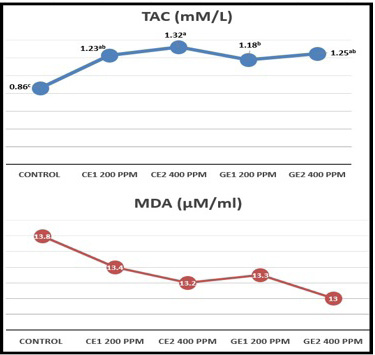
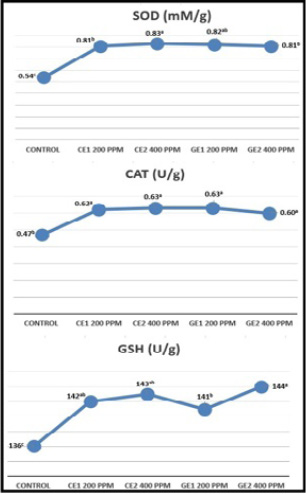
Figures 1 and 2 are showing the effects of different treatments on antioxidant enzymes in rabbits. The addition of 200 or 400 ppm CE or GE significantly (P<0.05) enhanced TAC, SOD, CAT, and GSH compared to the control group. The inclusion of curcumin and garlic extract, resulted in a slight (P>0.05) reduction in MDA. Total antioxidant capacity is an important metric that takes into account all antioxidants in the blood . Total antioxidant capacity, SOD, CAT, and GSH all increased in response to dietary CE or GE supplementation in this investigation, demonstrating that CE or GE treatment may improve the total antioxidant status of rabbits. Total antioxidant capacity changes in blood plasma after supplementation with antioxidant-rich feeds offer information on the absorption and bioavailability of ingested antioxidants . The present findings tie with prior research on the antioxidant properties of CE or GE, which were also demonstrated in this study. Allicin, alliin, allyl disulfide, and allyl cysteine are antioxidant chemicals found in garlic . These findings are in line with those of other research , which found that garlic extract lowered MDA levels in blood samples, indicating fewer oxidation reactions in the body.
Thyroid hormones
Table 6 is showing the effects of dietary treatments on thyroid hormones. The addition of 200 or 400 ppm CE or GE to the growing rabbit diets had no influence on T3, T4, or T4/T3 in any of the groups. Hassan et al. (2015) confirmed these findings and reported that phytogenic and their extracts are good feed additives and safe in poultry nutrition.
Table 5: Effect of curcumin and garlic extract on meat composition of rabbits
Item
Control
CE1 200 ppm
CE2 400 ppm
GE1 200 ppm
GE2 400 ppm
Se of Mean
P value
Moisture
70.88a
70.04b
69.91b
69.77b
70.31ab
±0.13
0.016
Crude protein
24.57c
25.28b
25.58ab
25.77a
25.44ab
±0.12
0.001
Ether extract
2.31a
2.15b
2.16b
2.06b
2.05b
±2.24
0.013
Ash
2.24
2.53
2.43
2.40
2.21
±0.06
0.381
a,b Means in the same row with different superscript are significantly different at (P< 0.05).
Table 6: Effect of curcumin and garlic extracts on thyroid hormones of rabbits
Item
Control
CE1 200 ppm
CE2 400 ppm
GE1 200 ppm
GE2 400 ppm
Se of mean
P value
T3
3.71
4.94
4.57
4.22
4.63
±0.19
0.311
T4
14.80
15.84
15.64
15.02
15.28
±0.28
0.421
T4/T3
4.05
3.21
3.59
3.61
3.35
±0.17
0.343
a,b Means in the same row with different superscript are significantly different at (P< 0.05). T3: Triiodothyronine, T4: Thyroxin.
CONCLUSIONS AND RECOMMENDATIONS
It could be stated that adding up to 400 ppm of curcumin and garlic extracts to growing rabbit diets can improve growth performance, carcass weight, and antioxidant status without any negative effect.
Novelty Statement
Using a simple method to extract both curcumin and garlic to obtain phenolic compounds and flavonoids, which considered as natural antioxidants that have been used as important alternatives to antibiotics in feeding rabbits, and the results led to an improvement in body weight gain, nutritional efficiency and the state of the antioxidants in the body without any harmful effect on the rabbits.
AUTHOR’S CONTRIBUTION
All authors contributed equally to the manuscript.
Conflict of interest
The authors have declared no conflict of interest.
Figures
Figure 1. Figure 1.
Effect of curcumin and garlic extract on TAC and MDA in plasma.
Figure 2.
Effect of curcumin and garlic extract on TAC and MDA in plasma.
References
Abd EL-Latif SA, Tosson AM, Elwan HAM, Helpawy ES (2019). Effect of dietary growth promoters on performance and carcass traits of growing rabbits. Acta Sci. Nutr. Health, 3(7): 124-130. https://doi.org/10.31080/ASNH.2019.03.0409[CrossRef]
Abd-Elsamee MO, El-Sherbiny AE, Hassan HMA, Samy A, Mohamed MA (2012). Adding phytase enzyme to low phosphorus broiler diets and its effect upon performance, bone parameters and phosphorus excretion. Asian J. Poult. Sci., 6(4): 129-137. https://doi.org/10.3923/ajpsaj.2012.129.137[CrossRef]
Agriculture Ministry Decree (1996). The standard properties for ingredients, feed additives and feed manufactured for animal and poultry. El-Wakaee El-Masria, No. 192 (1997), P 95 Amirria Press Cairo, Egypt.
Ahmed SA, Sedki AA, Mohamed IA (2002). Response of growing rabbits to diets containing black seed, garlic or onion as natural feed additives. Egypt. J. Rabbit Sci., 12: 69–83.
Alçiçek A, Bozkurt M, Çabuk M (2003). The effects of an essential oil combination derived from selected herbs growing wild in turkey on broiler performance. S. Afr. J. Anim. Sci., 33: 89-94. https://doi.org/10.4314/sajas.v33i2.3761[CrossRef]
Al-Jaleel RAA (2012). Use of turmeric (Cucuma longa) on the performance and some physiological traits on the broiler diet. Iraqi J. Vet. Med., 36(1): 51-57. https://doi.org/10.30539/iraqijvm.v36i1.548[CrossRef]
Al-Kassie GAM, Mohseen AM, Abd-Al-Jaleel RA (2011). Modification of productive performance and physiological aspects of broilers on the addition of a mixture of cumin and turmeric to the diet. Res. Opin. Anim. Vet. Sci., 1: 31-34.
Al-Sultan SI (2003). The effect of Curcuma longa (Tumeric) on overall performance of broiler chickens. Int. J. Poult. Sci., 2(5): 351-353. https://doi.org/10.3923/ijps.2003.351.353[CrossRef]
Al-Sultan SI, Gameel AA (2004). Histopathological changes in the livers of broiler chicken supplemented with turmeric (Curcuma longa). Int. J. Poult. Sci., 3: 333–336. https://doi.org/10.3923/ijps.2004.333.336[CrossRef]
AOAC (2000). Official methods of analysis 17th ed. Association of official analytical chemists. Washington, DC., USA.
Astawa PA, Budaarsa IK, Sumadi IK, Mahardik IG (2016). Additional turmeric powder (Curcuminoid) into traditional ration to improve the productivity of Bali Pig. Int. Res. J. Eng. IT Sci. Res., 2(7): 28-33. https://doi.org/10.21744/irjeis.v2i7.118[CrossRef]
Cheeke PR, Patton N, Tempelton GS (1982). Rabbit production 5th Ed. Int. Print and Publ. Danville.
Chen K, Xie K, Liu Z, Nakasone Y, Sakao K, Hossain A, Hou DX (2019). Preventive effects and mechanisms of garlic on dyslipidemia and gut microbiome dysbiosis. Nutrients, 11: 1225. https://doi.org/10.3390/nu11061225[CrossRef]
Chimbaka IM, Walubita K (2020). The effects of garlic (allium sativum) powder on growth performance of rabbits (oryctolaguscuniculus). Glob. Sci. J., 8(7): 2020, Online: ISSN 2320-9186.
Duncan DB (1955). Multiple range and multiple F tests. Biometric, 11: 1-42. https://doi.org/10.2307/3001478[CrossRef]
Durak I, Oztürk HS, Olcay E, Can B, Kavutcu M (2002). Effects of garlic extract on oxidant/antioxidant status and atherosclerotic plaque formation in rabbit aorta. Nutr. Metab. Cardiovasc. Dis., 12(3): 141-147.
Dzinic N, Okanovic D, Jokanovic M, Tomovic V, Palk D (2013). The influence of garlic powder in broiler feed on carcass and breast meat quality. Qual. Life, 4: 55-61. https://doi.org/10.7251/QOL1303055DZ[CrossRef]
Elkelawy H, Mansour M, El-Naggar R, Elkassas N (2017). Effect of garlic (Allium sativum) treatment on hematological, biochemical, hormonal and fertility parameters of male Bouscat rabbits. Egypt. J. Rabbit Sci., 27(2): 341-357. https://doi.org/10.21608/ejrs.2017.46587[CrossRef]
El-Rawi E, Jasim A, Ibrahim E (2020). Effect of adding turmeric powder to local buck rabbit’s rations on some production and blood traits. Proceedings of the 1st International Multi-Disciplinary Conference Theme: Sustainable Development and Smart Planning, IMDC-SDSP 2020, Cyperspace, 28-30 June 2020. https://doi.org/10.4108/eai.28-6-2020.2298232[CrossRef]
Elsherif HMR, Orabi A, Ali AS, Samy A (2021). Castor and propolis extracts as antibiotic alternatives to enhance broiler performance, intestinal microbiota and humoral immunity. Adv. Anim. Vet. Sci., 9(5): 734-742.
Gaber E-SB, Amany MB, Lamiaa G, Wasef, Yaser HAE, Ahmed AS, Mohamed EAH, Ayman ET, Yasmina MA-E, Hari PD (2020). Chemical constituents and pharmacological activities of garlic (Allium sativum L.) Nutrients, 12(3): 872. https://doi.org/10.3390/nu12030872[CrossRef]
Gebreyohannes G, Gebreyohannes M (2013). Medicinal values of garlic: A review. Int. J.,
Ghiselli A, Serafini M, Natella F, Scaccini C (2000). Total antioxidant capacity as a tool to assess redox status: Critical view and experimental data. Free Radic. Biol. Med., 29: 1106–1114. https://doi.org/10.1016/S0891-5849(00)00394-4[CrossRef]
Hassan H, Amani WY, Ali HM, Mohamed MA (2015). Adding phytogenic material and/or organic acids to broiler diets: Effect on performance, nutrient digestibility and net profit. Asian J. Poult. Sci., 9(2): 97-105. https://doi.org/10.3923/ajpsaj.2015.97.105[CrossRef]
Hassan HMA, Samy A, El-Sherbiny AE, Mohamed MA, Abd-Elsamee MO (2016). Application of nano-dicalcium phosphate in broiler nutrition: Performance and impact on environmental pollution. Asian J. Anim. Vet. Adv., 11(8): 477-483. https://doi.org/10.3923/ajava.2016.477.483[CrossRef]
Hussein SN (2012). Effect of turmeric (Curcuma longa) powder on growth performance, carcass traits, meat quality, and serum biochemical parameters in broilers. J. Adv. Biomed. Pathobiol. Res., 3: 25-32.
Jahan ZA, Ahsan UH, Muhammad Y, Tanveer A, Sarzamin K (2008). Evaluation of different medicinal plants as growth promoters for broiler chicks. Sarhad J. Agric., 24: 323-329.
Kafi A, Uddin MN, Uddin MJ, Khan M, Haque E (2017). Effect of dietary supplementation of turmeric (Curcuma longa), ginger (Zingiber officinale) and their combination as feed additives on feed intake, growth performance and economics of broiler. Int. J. Poult. Sci., 16(7): 257-265. https://doi.org/10.3923/ijps.2017.257.265[CrossRef]
Kanani PG, Daneshyar M, Aliakbarlu J, Hamian F (2017). Effect of dietary turmeric and cinnamon powders on meat quality and lipid peroxidation of broiler chicken under heat stress condition. Vet. Res. Forum, 8(2): 163-169.
Khan SH, Iqbal J (2016). Recent advances in the role of organic acids in poultry nutrition. J. Appl. Anim. Res., 44(1): 359-369. https://doi.org/10.1080/09712119.2015.1079527[CrossRef]
Khan MSI, Prodhan MS, Islam MS, Hasan MN, Islam MS (2017). Effect of garlic extract on growth performances and hematological parameters of broilers. Asian J. Med. Biol. Res., 3: 317-322. https://doi.org/10.3329/ajmbr.v3i3.34519[CrossRef]
Loghmanifar S, Roozbeh NL, Nouri H, Jafarian S (2020). Effects of different extraction methods on antioxidant properties and Allicin content of garlic. J. Food Sci. Hyg., 1(1); 16-25.
Makwana RB, Parikh SS, Savaliya BD, Chauhan HD, Patil SS, Patbandha TK (2018). Growth performance and carcass charactristics of broilers fed garlic (Allium sativum) supplemented diets. Int. J. Pure App. Biosci., 6(1): 927-932. https://doi.org/10.18782/2320-7051.5547[CrossRef]
Mbiriri DT, Cho S, Mamvura CI, Choi NJ (2016). Effects of a blend of garlic oil, nitrate and fumarate on in vitro ruminal fermentation and microbial population. J. Anim. Physiol. Anim. Nutr., 101(4): 713-722. https://doi.org/10.1111/jpn.12508[CrossRef]
Mehdipour BZ, Gharachorloo M (2020). Curcumin as a bioactive compound: biological properties and encapsulation methods. J. Food Bioproc. Eng., 3(1): 79-86.
Mohamed MA, Hassan HMA, Samy A, Abd-Elsamee MO, El-Sherbiny AE (2016). Carcass characteristics and bone measurements of broilers fed nanodicalcium phosphate containing diets. Asian J. Anim. Vet. Adv., 11(8): 484-490. https://doi.org/10.3923/ajava.2016.484.490[CrossRef]
Okanlawon EO, Bello KO, Akinola OS, Oluwatosin OO, Irekhore OT, Ademolue RO (2020). Carcass yield and intestinal morphology of male rabbits fed diets supplemented with turmeric (Curcuma longa) powder. Ghana J. Agric. Sci., 55(2): 97-106. https://doi.org/10.4314/gjas.v55i2.8[CrossRef]
Oleforuh-Okoleh VU, Chukwu GC, Adeolu AI (2014). Effect of ground ginger and garlic on the growth performance, carcass quality and economics of production of broiler chickens. Glob. J. Bio-Sci. Biotechnol., 3: 225- 229.
Olukosi OA, Dono ND (2014). Modification of digesta pH and intestinal morphology with the use of benzoic acid or phytobiotics and the effects on broiler chicken growth performance and energy and nutrient utilization. J. Anim. Sci., 92: 3945-3953. https://doi.org/10.2527/jas.2013-6368[CrossRef]
Oluwafemi RA, Halima A, Alagbe JO (2021). Effect of dietary inclusion of ginger (Zingiber officinale) and garlic (Allium sativum) oil mixture on the growth performance and caecal microbial population of broiler chickens. Int. J. Clin. Case Rep. Rev., 8(5): https://doi.org/10.31579/2690-4861/161[CrossRef]
Onu PN, Aja PM (2011). Growth performance and haematological indices of weaned rabbits fed garlic (Allium sativum) and ginger (Zingiber officinale) supplemented diets. Int. J. Food Agric. Vet. Sci., 1: 51–59.
Raghdad A, Al-Kassie A (2012). Use of turmeric (Curcuma longa) on the performance and some physiological traits on the broiler diets. Iraqi J. Vet. Med., 36(1): 51-57. https://doi.org/10.30539/iraqijvm.v36i1.548[CrossRef]
Rahimi R, Ardekani MRS (2013). Medicinal properties of Foeniculum vulgare Mill. in traditional Iranian medicine and modern phytotherapy. Chinese J. Integ. Med.,19(1): 73–79. https://doi.org/10.1007/s11655-013-1327-0[CrossRef]
Rajput N, Muhammad N, Yan R, Zhong X, Wang T (2013). Effect of dietary supplementation of curcumin on growth performance, intestinal morphology and nutrients utilization of broiler chicks. J. Poult. Sci., 50: 44-52. https://doi.org/10.2141/jpsa.0120065[CrossRef]
Recoquillay F (2006). Active plant extracts show promise in poultry production. Poult. Int., 2006: 28-30.
Rodrigues C, Percival SS (2019). Immunomodulatory effects of glutathione, garlic derivatives, and hydrogen sulfide. Nutrients, https://doi.org/10.3390/nu11020295[CrossRef]
Sarica S, Ciftci A, Demir E, Kilinc K, Yildirim Y (2005). Use of antibiotic growth promoter and two herbal natural feed additives with and without exogenous enzymes in wheat based broiler diets. S. Afr. Anim. Sci., 35: 61-72. https://doi.org/10.4314/sajas.v35i1.4050[CrossRef]
Schepetkin IA, Kirpotina LN, Khlebnikov AI, Balasubramanian N, Quinn MT (2019). Neutrophil immunomodulatory activity of natural organosulfur compounds. Molecules, https://doi.org/10.3390/molecules24091809[CrossRef]
Schneider BH, Flatt WP (1975). The evaluation of feed through digestibility experiments. University of Georgia Press Athens, Georgia, USA. pp. 423.
Shahidi F, Hossain A (2018). Bioactives in spices, and spice oleoresins: Phytochemicals and their beneficial effects in food preservation and health promotion. J. Food Bioact., https://doi.org/10.31665/JFB.2018.3149[CrossRef]
Shiyou L, Wei Y, Guangrui D, Ping W, Peiying Y, Bharat BA (2011). Chemical composition and product quality control of turmeric (Curcuma longa L.). Pharm. Crops, 2011(2): 28-54. https://doi.org/10.2174/2210290601102010028[CrossRef]
Statistical Analysis Systems Institute (2009). SAS user’s guide Statistics. Version 8, Edition SAS. Institute, Inc, Cary, North Carolina.
Sugiharto I, Widiastuti E, Prabowo NS (2011). Effect of turmeric extract on blood parameters, feed efficiency and abdominal fat content in broilers. J. Indones. Trop. Anim. Agric., 36: 21-26. https://doi.org/10.14710/jitaa.36.1.21-26[CrossRef]
Tollba AAH, Hassan MSH (2003). Using some natural additives to improve physiological and productive performance of broiler chicks under high temperature conditions. 2. Black cumin (Nigella sativa) or garlic (Allium sativum). Poult. Sci., 23: 327-340.
Utami MMD, Dwiani HP, Agus A (2020). Addition turmeric extract on ration to reduce fat deposit of broiler. J. Phys. Conf. Ser., 1569: 042090. https://doi.org/10.1088/1742-6596/1569/4/042090[CrossRef]
Yadav DK, Sharma K, Dutta A, Kundu A, Awasthi A, Goon A, Banerjee K, Saha S (2017). Purity evaluation of curcuminoids in the turmeric extract obtained by accelerated solvent extraction. J. AOAC Int., 100(3): 586-591. https://doi.org/10.5740/jaoacint.17-0057[CrossRef]
Zielińska A, Alves H, Marques V, Durazzo A, Lucarini M, Alves TF, Souto EB (2020). Properties, extraction methods, and delivery systems for curcumin as a natural source of beneficial health effects. Medicina, 56(7): 336. https://doi.org/10.3390/medicina56070336[CrossRef]