
Exploring the performance of tropical grasses under sub-tropical sub-humid conditions of Peshawar is a good initiative for sustainable fodder production for livestock. The present study was carried out at Range Research Garden, Pakistan Forest Institute, Peshawar to ascertain fresh forage production and air-dried yield of grasses namely: Panicum antidotale (Blue panic grass), Cenchrus ciliaris (Buffel grass), Pennisetum purpureum (Mott grass), Chloris gayana (Rhodes grass) and Setaria anceps (Setaria grass) at different growth stages. The grasses were clipped at three phenological stages: Pre-flowering, full- flowering and maturity. The cut forage was weighed freshly and then air dried to find out the yield. The compiled data were subjected to Analysis of Variance followed by LSD test. Results revealed that forage production of grasses changed from pre-flowering to maturity. In Buffel, Rhodes and Setaria grasses, significant increase in air dried yield was noticed in all growth stages until maturity stage. Significant increase in air dried yield was observed at full-flowering stage in blue-panic grass while in Mott grass, air dried yield increased significantly at full-flowering stage and it declined significantly at maturity stage. It is concluded that full- flowering stage is the most suitable stage for harvesting optimum forage yield. Mott, Rhodes, Buffel and Setaria grasses are recommended for planting by the farmers for better fodder production in sub-tropical sub-humid areas.
Research Article · Volume 75, Issue 1, 31 July 2025 · Open Access
Comparative Forage Productivity of Tropical Grasses at Different Growth Stages
·
Affiliations & Notes ⌄
- 1Forestry Student, Pakistan Forest Institute, Peshawar, Khyber Pakhtunkhwa, Pakistan
- 2Director Biodiversity Research, Pakistan Forest Institute, Peshawar, Khyber Pakhtunkhwa, Pakistan. *Correspondence | Ashar Farooq, Director Biodiversity Research, Pakistan Forest Institute, Peshawar, Khyber Pakhtunkhwa, Pakistan
- 3Email: asharfarooq1973@gmail.com
Article Info ⌄
- Journal:
- Pakistan Journal of Forestry
- Published:
- 31 July 2025
From the article
- Likewise, air-dried forage yield (Table 2, Figure 3) varied from 0.87 to 3.13 t/ha in the pre-flowering stage, 3.14 to 6.78 t/ha at full-flowering, and 4.48 to 7.0 t/ha at maturity.
- As regards fresh yield, all grasses showed significant difference between pre-flowering and full-flowering stage and non-significant difference between full-flowering stage and maturity stage except mott grass which showed significant difference among all growth stages.
- Based on the findings, it can be concluded that the full-flowering stage represents the optimal time for harvesting these grass species to maximize forage yield.
- Among the grasses evaluated, Mott grass emerged as the highest-yielding species in terms of fresh forage yield, while Setaria grass showed superior performance in terms of dry matter (DM) yield.
Selected from the article's own text.
Abstract
Introduction
Forage plays a vital role as the primary source of nutrition for ruminants such as cattle, sheep and goats in their health, growth, and milk or meat production. Forage growth is closely associated with the plant’s growth stage, regulating the balance between tissue production and senescence. This balance directly influences the chemical composition, regrowth capacity, and long-term persistence of pastures . Approximately 54% of the world’s land surface consists of pastures and rangelands that supports millions of pastoralists, ranchers and large populations of wildlife (UNEP, 2021). These resources are essential in supplying the various products and services that the human needs to survive . In Pakistan, livestock sector contributes 14.36% to the national Gross Domestic Product (Economic Survey of Pakistan, 2022-23). Pakistan faces a 53.71% forage deficiency, as only 165.76 million tons of green forage are available for livestock against the estimated requirement of 358.11 million tons . Cutting interval has a significant impact on grass production and is closely associated with the plant’s growth stage, regulating the balance between tissue production and senescence. This balance directly influences the chemical composition, regrowth capacity and long-term persistence of pastures . Assessing the yield and quality of cultivated grasses is essential for improving pasture-based livestock systems while promoting sustainability and productivity. This study aims to assess the fresh as well as air dried forage yield of some tropical grasses at different growth stages.
Materials and Methods
The study was conducted at Range Research Garden, Pakistan Forest Institute Peshawar (Figure 1). It is located at 33.43oN 73.04oE. Its elevation is 507 meters (1663 ft). Climate of the area is sub-tropical sub-humid.
Five grass species namely: Panicum antidotale (Blue panic grass), Cenchrus ciliaris (Buffel grass), Pennisetum purpureum (Mott grass), Chloris gayana (Rhodes grass) and Setaria anceps (Setaria grass) were selected for the research. Randomized Complete Block Design with three replications was used for data analysis. The grasses were clipped at three phenological stages: Pre-flowering, full- flowering and maturity. The cut forage was weighed freshly and then air dried to find out the yield. Data were statistically analyzed using Analysis of variance (ANOVA). Differences in means were evaluated by Least Significant Difference (LSD) test.
Results and Discussion
Grasses showed significant variation in both fresh and air-dried forage yield as presented in Tables 1, 2. Fresh forage yield (Table 1, Figure 2) ranged from 3.13 to 8.72 t/ha at the pre-flowering stage, 6.90 to 11.43 t/ha at full-flowering, and 6.51 to 13.27 t/ha at maturity. Likewise, air-dried forage yield (Table 2, Figure 3) varied from 0.87 to 3.13 t/ha in the pre-flowering stage, 3.14 to 6.78 t/ha at full-flowering, and 4.48 to 7.0 t/ha at maturity. As regards fresh yield, all grasses showed significant difference between pre-flowering and full-flowering stage and non-significant difference between full-flowering stage and maturity stage except mott grass which showed significant difference among all growth stages.
Table 1: Fresh forage yield of grasses (t/ha) at different growth stages.
| Name of grass | Pre- flowering stage | Full-flowering stage | Maturity stage |
| Blue panic | 5.18a | 9.18b | 10.09b |
| Buffel | 4.31a | 7.87b | 8.76b |
| Mott | 8.72a | 11.43b | 13.27c |
| Rhodes | 3.13a | 6.90b | 6.51b |
| Setaria | 5.30a | 9.20b | 10.88b |
abc means with same superscripts indicate no significant difference at the P = 0.05
The forage yield of various grass species was found to vary significantly depending on their stage of maturity. Specifically, in Buffel, Rhodes, and Setaria grasses, the air-dried forage yield showed marked differences as the plants progressed from the pre-flowering stage to full maturity. These grasses demonstrated a consistent increase in yield with advancing maturity, indicating that delaying harvest until later stages can result in higher biomass production.
Table 2: Air dried forage yield of grasses (t/ha) at different growth stages.
| Name of grass | Pre-flowering stage | Full-flowering stage | Maturity stage |
| Blue panic | 2.08a | 5.58b | 5.62b |
| Buffel | 2.12a | 3.79b | 5.24c |
| Mott | 3.13a | 6.78b | 7.00b |
| Rhodes | 0.87a | 3.92b | 4.48c |
| Setaria | 1.15a | 3.14b | 5.89c |
abc means with same superscripts indicate no significant difference at the P = 0.05
In contrast, Blue Panic and Mott grasses exhibited a different pattern. For these species, the most substantial increase in air-dried forage yield occurred by the full-flowering stage. Beyond this point, no significant increase in yield was observed as the plants matured further. This suggests that the optimal harvest time for maximizing yield in Blue Panic and Mott grasses may be at or around full flowering, rather than waiting until full maturity.
These observations align closely with earlier findings reported by Sarwar et al. (2006), Mushtaque et al. (2010), and Ahmad et al. (2012), who documented similar trends. According to their studies, dry matter (DM) yields tend to be lower during early growth stages, such as vegetative or pre-flowering phases, and increase as the plant matures. This is generally attributed to greater biomass accumulation and structural development over time, which contributes to higher forage yields in later stages.
This trend is attributed to the progressive rise in cell wall content, which leads to higher DM levels in mature grasses compared to early-stage growth, where cell wall content is relatively low. As grasses mature, their cell walls undergo significant structural changes, becoming increasingly complex and thicker. This maturation process involves the greater deposition of structural carbohydrates such as cellulose and hemicellulose, along with lignin, a complex polymer that provides rigidity but is highly resistant to microbial breakdown. As a result, the dry matter (DM) content of the grass increases due to the accumulation of these indigestible components. However, this rise in DM is accompanied by a decline in the grass’s nutritional value for animals. The higher proportion of cell wall material, particularly lignin, reduces the digestibility of the forage, making it harder for animals to extract energy and nutrients. Therefore, while mature grasses may offer more bulk, their feeding value is diminished compared to younger, more digestible growth stages.
Conclusions and Recommendations
- Based on the findings, it can be concluded that the full-flowering stage represents the optimal time for harvesting these grass species to maximize forage yield. At this stage, most grasses reach a balance between high biomass accumulation and acceptable forage quality, making it the most productive point in their growth cycle for fodder purposes.
- Among the grasses evaluated, Mott grass emerged as the highest-yielding species in terms of fresh forage yield, while Setaria grass showed superior performance in terms of dry matter (DM) yield. These characteristics make both species particularly valuable for farmers seeking to maximize forage availability either in its fresh form or for preservation as hay or silage.
- In addition, Mott, Rhodes, Buffel, and Setaria grasses are recommended for cultivation in sub-tropical sub-humid regions, where their growth characteristics align well with the prevailing environmental conditions. These species have demonstrated strong adaptability, good biomass production, and reliable yield performance under such climatic zones.
- Adopting these grasses in fodder production systems can help enhance forage availability, support livestock productivity, and contribute to more sustainable agricultural practices in regions where feed scarcity can be a limiting factor.
- Overall, these results underscore the importance of selecting appropriate harvest times based on species-specific growth and yield patterns. Such information is critical for optimizing forage production, ensuring efficient use of resources, and meeting livestock feed requirements more effectively.
Acknowledgements
The authors would like to thank field staff of Range Management Branch, Pakistan Forest Institute, Peshawar for their support during the entire study period.
Novelty Statement
This study makes a novel contribution by identifying palatable plant species and assessing their role in forage production, providing fresh insights into sustainable livestock feeding strategies. By emphasizing species selection and productivity, this research advances our understanding of optimizing rangeland resources to enhance forage yield and quality.
Author’s Contribution
Hassan Mustafa: Concept, design and writing the manuscript.
Ashar Farooq: Critical thinking and proof reading.
Conflict of interest
The authors have declared no conflict of interest.
Figures
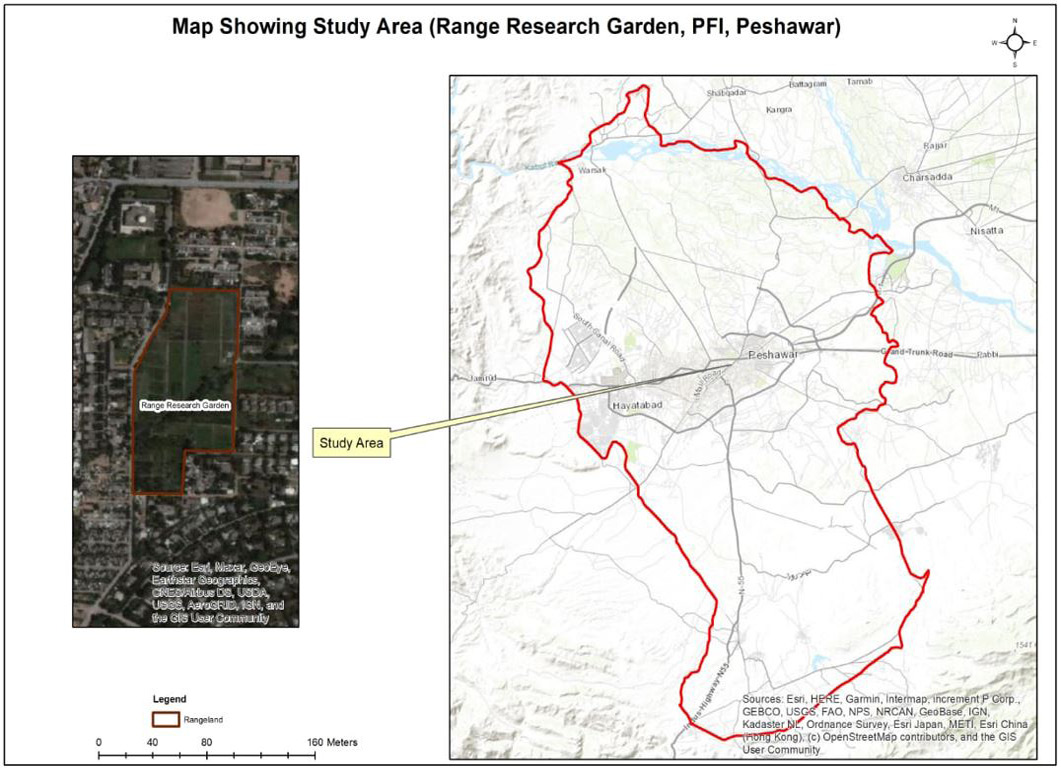
Map of study area.
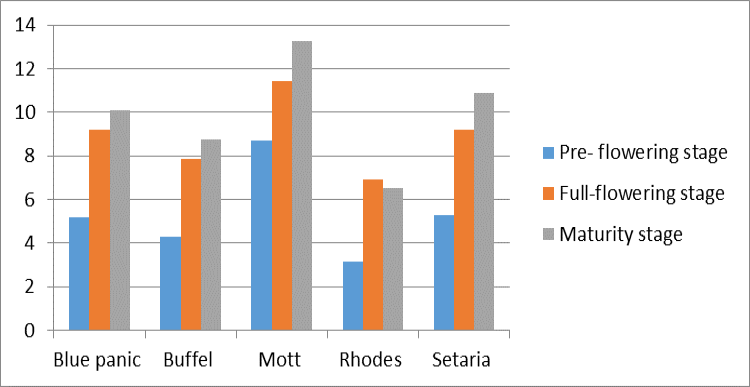
Fresh forage yield of grasses at different growth stages.
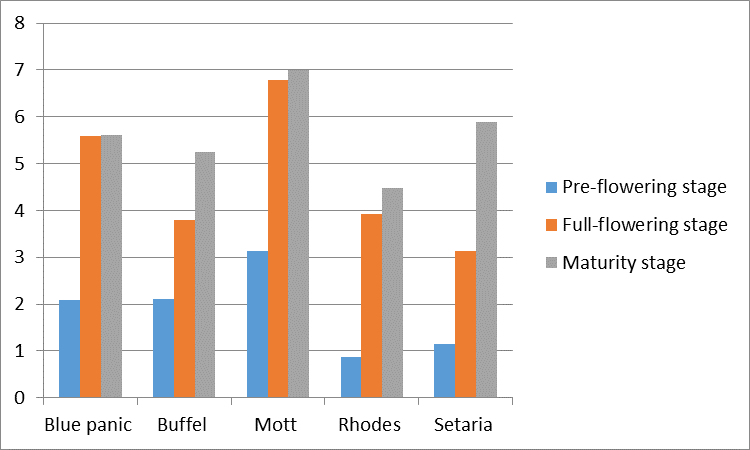
Air dried forage yield of grasses at different growth stages.
References
- Ahmed, S.A., Halim, R.A. and Ramlan, M.F., 2012. Evaluation of the use of farmyard manure on a guinea grass (Panicum maximum)-stylo (Stylosanthes guianensis) mixed pasture. Pertanika J. Trop. Agric. Sci., 35: 55-65.
- Costa, N.L., Gianluppi, V. and Moraes, A., 2011. Produtividade de forragem e morfogênese de Trachypogon vestitus em diferentes idades de rebrota nos cerrados de Roraima. Rev. Brasil. Saúde e Produção Anim., 12(4): 935-948.
- Economic Survey of Pakistan, 2022-23. Pakistan economic survey. Government of Pakistan, Finance Division, Economic Adviser’s Wing, Islamabad, Pakistan.
- Holechek, J.L., Pieper, R.D. and Herbel, C.H., 2011. Range management principles and practices. 6th ed., New Jersey: Prentice-Hall, Inc. Upper Saddle River.
- Lounglawan, P., Lounglawan, W. and Suksombat, W., 2014. Effect of cutting interval and cutting height on yield and chemical composition of king napier grass (Pennisetum purpureum x Pennisetum americanum). APCBEE Procedia, 8: 27-31. https://doi.org/10.1016/j.apcbee.2014.01.075[CrossRef]
- Mushtaque, M., Ishaque, M. and Bakhush, H.A., 2010. Studies on growth behavior and herbage yield of fountain grass. Pak. J. Sci., 62: 238-242.
- Sarwar, M., Mahr-un-Nisa, Khan, A. and Mushtaque, M., 2006. Chemical composition, herbage yield and nutritive value of Panicum antidotale and Pennisetum orientale for Nili buffaloes at different clipping intervals. Asian Austral. J. Anim. Sci., 19: 176-180. https://doi.org/10.5713/ajas.2006.176[CrossRef]
- United Nations Environment Programme, 2021. Press release. https://www.unep.org/news-and-stories/press-release/new-atlas
- Yaseen, G., Ahmad, M., Potter, D., Zafar, M., Sultana, S. and Mir, S., 2018. Ethnobotany of medicinal plants for livelihood and community health in deserts of Sindh-Pakistan. In: Plant and human health. Sprin. Cham., 1: 767-792. https://doi.org/10.1007/978-3-319-93997-1_24[CrossRef]
Services
Article usage statistics
Loading…