
Carotenoids are natural pigments, synthesized in photosynthetic organisms e.g., plants, bacteria, and algae, while carotenoids also be synthesized in some non-photosynthetic fungi or bacteria. The color gamut of carotenoids is from colorless to yellow, orange to red color, with variations reflected in many vegetables, fruits and flowers. They are categorized into two types: (1) xanthophylls and (2) carotenes. For instance, lycopene is found in tomatoes and watermelon, beta carotene in sweet carrots and potatoes, lutein in marigold flowers, and capsanthin and capsorubin in crimson pepper. Zeaxanthin is protective against scalp diseases, UV and skin redness. Lycopene is a bioactive component regarding the remedy of persistent sicknesses and lowering the chance of cardiovascular illnesses or cancer. The tremendous results of carotenoids in human food have prompted numerous efforts in plant genetic engineering to supply products with greater carotenoid accumulation, which isn’t always only beneficial for agriculture but also has consequences for scientific research in terms of organic, chemical, and molecular or genetic regulation. Carotenoid metabolism and its regulatory network is not only increasing plant “defense” but also enhance the quality of plants. In this overview article, we summarize the results of current research studies on carotenoid metabolism, knowledge about genetic information, and enzymes that are involved in carotenoid metabolism and regulation, underlying carotenoid accumulation, and factors that affect carotenoid regulation, and health benefits of carotenoids.
Review · Volume 38, Issue 5, 8 November 2022 · Open Access
Carotenoid Metabolism, Regulation in Tomato (Solanum lycopersicum) and Health Benefits: An Updated Review
· · · · · · · · · ·
Affiliations & Notes ⌄
- 1Department of Botany, University of Agriculture Faisalabad, Faisalabad, Pakistan
- 2Department of Horticulture, Faculty of Agricultural Sciences and Technology, Bahauddin Zakariya University, Multan, Pakistan
- 3Department of Plant Breeding and Genetics, Faculty of Agricultural Sciences and Technology, Bahauddin Zakariya University, Multan, Pakistan
- 4Institute of Food Science and Nutrition, Bahuddin Zakariya University, Multan, Pakistan
- 5Department of Entomology, Bahuddin Zakariya University, Multan, Pakistan
- 6Department of Food Science and Technology, Muhammad Nawaz Sharif University of Agriculture, Multan, Pakistan
- 7Department of Horticulture Sciences, University of Agriculture Faisalabad, Faisalabad, Pakistan
- 8College of Horticulture and Landscape Architecture, Southwest University, Chongqing, 400715, China
- 9School of Automotive Engineering, Wuhan University of Technology, Wuhan, 430070, China. *Correspondence | Wanpeng Xi and Mansoor Hameed, College of Horticulture and Landscape Architecture, Southwest University, Chongqing, 400715, China. Department of Botany, University of Agriculture Faisalabad, Faisalabad, Pakistan
- 10Emails: xwp1999@zju.edu.cn
- 11hameedmansoor@yahoo.com
Article Info ⌄
- Journal:
- Sarhad Journal of Agriculture
- Published:
- 8 November 2022

From the article
- There is a correlation between fruit volatiles and carotenoid degrees, the greater concentration of carotenoids in a fruit, the extra taste volatiles are formed, which makes tastier and nutritious tomato.
- Which brought about increased curiosity sightseeing regulatory metabolism of carotenoid.
- Carotenoids along with Lutein have also been beneficial for the eyes.
- This review article provides an overview of Carotenoid Metabolism, Regulation in tomato, and its health benefits, it comprises all of the existing literature about the metabolism of carotenoid and health benefits and may be helpful in the development of new pharmacologically active food in the future.
Selected from the article's own text.
Abstract
Introduction
Carotenoids are the second abundantly occurring natural pigments on the earth. They have more than 750 members in their family. They are synthesized in all the photosynthetic organisms e.g., bacteria, algae, and plants, carotenoids also be synthesized in a few non-photosynthetic fungi and bacteria. The color of Carotenoids varies from colorless to yellow, orange, and red color, with distinctions reflected in many vegetables, fruits, and flowers ; . Several eye-catching examples consist of lycopene found in tomatoes and watermelon, b-carotene in sweet potatoes and carrots, lutein found in marigold flowers and capsanthin is present in red pepper ; Ruiz and Rodrı, 2012; . Carotenoids have been categorized into two categories: (1) Xanthophylls (2) Carotenes Xanthophylls stand as well-known antioxidants and it has been proven that when they are exposed to excessive radiation, in photosystem II they Quench the excited repute of singlet chlorophyll . Zeaxanthin belongs to the family xanthophyll, it is a nutritional carotenoid . Zeaxanthin is extensively present as a pigment in fruits and vegetables and has radical scavenging activities , Which allows showing oblique antimalarial actions and serves as an excellent pointer for parasitism . A protecting effect on neurological problems has also been proven via Zeaxanthin by using various mechanisms i.e., anti-oxidant, anti-apoptotic, and anti-inflammatory ; .
It can perform a vital character in anti-allergenic reactions . Zeaxanthin can be protective against scalp sicknesses, UV, pores , and skin redness (Silv´an et al., 2016). Due to the shielding effects of zeaxanthin in contradiction of excessive light and oxidative pressure, it is ophthalmologically useful . Zeaxanthin can limit cancer cell invasion and migration it exhibits anticancer activity . It provokes tumor cells to have inverse multidrug reluctance, which leads to cell death . According to Sugiura et al. (2012), excessive consumption of antioxidants could shield antagonistically to osteoporosis, by keeping bone healthy.
Krinsky and Johnson (2005) in their experiment demonstrated that carotenoids are one of the most essential and crucial elements in human food because they provide catalysts for the biogenesis of vitamin A. Vitamin A is a very well carotenoid speculative with a wide range of organic characteristics. Ford and Erdman (2012) in their study demonstrated that, lycopene is the maximum profuse carotenoid in ripped tomatoes is regarded as a bioactive aspect apropos the remedy of continual illnesses and decreasing the chance of cardiovascular sicknesses and cancers . According to Vogel et al. (2010) in addition to, features of carotenoids as a nutritional pigment, they also serve as the precursors of numerous vital unstable flavor compounds in plant life, which confers the sensory traits which may be detected through consumers. Carotenes in plants produce a wide range of compounds, including apocarotenoids, which are produced through oxidative cleavage and provide volatile compounds that make up the aromatic components of leaves, flora, and fruits, as well as well-known phytohormones such as a bscisic acid and strigolactones, which are produced through abiotic stress . According to The Tomato Genome Consortium (2012), these beneficial effects of carotenes in the human diet have promoted numerous attempts in plant genetic engineering to create products with higher carotenoid content, which is useful for agriculture but also has implications for medical research in terms of organic, chemical, and molecular genetic law, carotenoid metabolism is influenced by a variety of factors, including gene expression regulation. A specific event, which could be an environmental or developmental cue, could activate and adjust a specific carotenoid pathway community via restricting enzymes. Plant protection and reliability will be improved by increasing carotenoid metabolic activity and its regulatory network . There may be a complicated aggregate of bioactive additives in Tomato which serves as a nutritional source of vitamins, an aggregate of carotenoids, consisting of b-carotene, lycopene, and lutein. During the fruit ripening, the mechanism which controls carotenoid metabolism is systematic and complicated. Tomato genomes have been sequenced, revealing approximately 35000 protein-coding genes, laying the groundwork for studying interactions among transcription elements, phytohormone signaling pathways, and other factors influencing carotenoid metabolic activity .
Klee and Giovannoni (2011) concluded that the mutant’s availability with the single genetic mutations as well as knockdown transgenesis has a great influence on the accumulation of carotenoid has which makes tomato an excellent system to study the metabolism of carotenoid. We analyze the findings of recent research on carotenoid metabolism, regulation, factors affecting regulation, and health benefits in this review article.
Carotenoid biosynthesis and metabolism in tomato (Solanum lycopersicum)
Noteworthy progress has been made to understand carotenoid metabolism and regulation. According to Chappell et al. (1995), biosynthesis of Carotenoid is reliant on the availability of the building blocks isopentenyl diphosphate (IPP) and its isomer dimethylallyl diphosphate (DMAPP). Isopentenyl diphosphate (IPP) and dimethylallyl diphosphate (DMP) has two wonderful routes in plants (DMAPP). There are two pathways for the biosynthesis of carotenoid, inside the cytosol, the mevalonic acid (MVA) pathways while in the plastids there are methylerythritol 4-phosphate (MEP) pathways . In plastid, according to Matusova et al. (2005), chain reactions take place for the biosynthesis of carotenoid biosynthesis. The methylerythritol 4-phosphate (MEP) pathway produces precursors for carotenogenesis. In addition, the methylerythritol 4-phosphate (MEP) pathway is linked to the production of isoprene and diterpenes. Facet chains of chlorophylls and other photosynthesis-related compounds, as well as phylloquinone, tocopherol, and plastoquinone, as well as various hormones such as gibberellins, strigolactones, monoterpenes, and abscisic acid. Davies (2009) in their study found that in tomatoes, the production of linear Carbon fourteen one of the most widely studied pathways is lycopene formation from geranylgeranyl diphosphate (GGPP). Fraser et al. (2007) demonstrated that all carotenoid biosynthetic enzymes are located on the plastid, and the genes are encoded via the nuclear genome, as shown in the figure. Gene transcripts that are encoding 1-deoxy-D-xylulose 5-phosphate synthase (SlDXS), geranylgeranyl pyrophosphate synthase (SlGGPPS), phytoene desaturase (SlPDS), phytoene synthase (SlPSY), carotenes isomerase (SlCrtISO), and z-carotene desaturase (SlZDS) are delimited. They perform a vital role in the formation of lycopene during the ripening of tomatoes. According to Walter et al. (2002), an ostensible preliminary regulatory phase of carotenoid synthesis is catalyzed via SlDXS at some stage in early fruit ripening. Recent studies showed that during fruit development, the accumulation of carotenoids has a strong correlation with the organ-specific and developmental regulation of tomato SlDXS gene expression. There are two anatomically diverse regulated SlDXS isogenes one is SlDXS1 while 2nd is SlDXS2 found in plants .
Paetzold et al. (2010) in their finding concluded that the formation of Strong lycopene during the ripening of Tomato fruit twisted out stringently interrelated with the gene SlDXS1 expression but not with that SlDXS2 gene. While, SlDXS2 gene transcripts are observed abundantly in immature petals of tomatoes then the mature petals and other vegetables of the same species, isolated trichomes, and leaves. It has been confirmed that the transcription factor MADS-box, ripening inhibitor (RINA) regulates the accumulation of carotenoids through interacting with SlPSY1 promoters in fruit tissues . Fantini et al. (2013), evaluated the interactions of z-carotene isomerase (ZISO), CrtISO-Like 1, and CrtISO-Like 2 with virus-induced gene regulation. In the tomato fruit, there are 3 metabolic units were recognized consisting of PSY1, ZDS/CrtISO, and PDS/ZISO which catalyzes the biosynthesis of 15-cis-phytoene, nine hundred and ninety-di-cis-z-carotene, and all-trans-lycopene. In CrtISO-Like1/-Like 2 silenced, the disappearance of all-trans-z-carotene and growth within the content material of lycopene, isomers had been found which demonstrate CrtISO Like 1 and CrtISOLike 2 plays a dynamic role in the formation of all-trans-z-carotene as shown in Figure 1. Lycopene is a key player in the cyclization of the carotenoid biosynthetic pathway . Route one results in b-carotene, violaxanthin, neoxanthin, and zeaxanthin which provide Precursors for the biosynthesis of Abscisic acid and strigolactones. The accompanying path ends in a-carotene and lutein formation. In tomatoes, SlLCY-B genes are present: SlLCY-B1which active in flowers and green-colored tissues while the other one SlLCY-B2 is precise to chromoplast. The up-regulation of SlLCYB2 triggered b-carotene to accumulate within the beta fruit .
Environmental factors affecting on metabolic regulation of carotenoids
There are many factors that have a great influence on the metabolic regulation of carotenoids in tomatoes.
Light intensity: Yuan et al. (2015) concluded that the intensity of light affects Phytochromes that are receptors of light. They involve rebuttal to red light and far-red light. To induce a physiological response, there is a red light that could trigger the protein. In tomato fruit, Phytochromes are Concerned with the regulation of the amount of lycopene accumulation .
Heat stress : According to Poiroux et al. (2010) and Hermanns et al. (2020) moderate stress is effective in carotenoid metabolism without the occurrence of senescence and necrosis. In tomato fruits, oxidative strain will increase with the maturation of fruit and grasp a height at the last levels, which enable metabolic modifications and demulcent of fruit. Higher concentrations of antioxidants liposoluble compounds, such as b-carotene and lycopene accumulation for the safety of fruit as well as photosystem (Dall et al., 2013).
Temperature: The temperature has a giant impact on the flourishing and development of tomatoes. Temperatures much less than 12°C and greater than 32°C could strongly inhibit and categorically obstruct the synthesis of lycopene .
Hormonal regulation of carotenoid metabolism in (Solanum lycopersicum) tomato
Role of ethylene: Phytohormones induced ethylene, auxin, and Abscisic acid. They all involve the ripening of tomato fruit and carotenoid accumulation. Ethylene performs a vital function inside the ripening of fruit, an impact of Ethylene in the regulation of carotenoid accumulation throughout the development of fruit in tomatoes was studied. Marty et al. (2005) in their study evaluated that the beginning of maturation is brought on through a dramatic increase in Ethylene manufacturing in tomatoes, correlated with the speedy accretion of lycopene and b-carotene, expressions of genes SlPSY1 and SlPDS is Ethylene dependent. During tomato fruit ripening, Various Transcription elements are concerned in regulating Ethylene dependent carotenoid accumulation, which has been identified as a primary regulator of ethylene in the regulation of tomato fruit maturation ; .
Role of indole-3-acetic acid: The concentration of free indole-3-acetic reduces at the beginning of ripening of fruit, where the concentration of IAA amino acid conjugate is enhanced by its synthetic genes, GH3, upregulated ; .
Role of Abscisic acid: During the ripening of tomato fruit, abscisic acid is implicated in the development of tomato fruit, but understanding about the role of Abscisic acid within the carotenoid accumulation is restrained ; . The Suppression of the important Abscisic acid synthetic gene, SlNCED1, consequences in an improved level of Ethylene formation, downward regulatory expressions of SlLCY-B, also the upward regulatory expressions of SlPSY1 thru extended concentrations of carotenes, b-carotene, or lycopene. Ethylene, Indole acetic acid, and Abscisic acid are considered to be vital modulators in tomato fruit development ; .
Brassinosteroids (BR) and Jasmonic acid (JA): The roles of new phytohormones, in the regulatory mechanism of tomato ripening, have been examined. Jasmonic acid as well as its volatiles MeJA and methyl esters are all plant growth modulators that are taking part in the regulation of pollen viability, ripening of fruit, plant resistance, and secondary metabolites metabolisms ; .
Health benefits of carotenoids
Much research has been accomplished on protective activities and health benefits of carotenoids.
Neuroprotective activity: Zeaxanthin is found to be protective against nervous disorders through the use of an experimental model that involves antioxidants, anti-apoptotic, and anti-inflammatory processes ; ; ; , b; . Thomson et al. (2002) in their study concluded that whilst supplementing Japanese quails with 35 mgkg-1 of zeaxanthin resulted in increased levels of this molecule inside the liver and fats and reduction in apoptosis and showed the safety of photoreceptor in oppose to cell death which was induced by light. Xu et al. (2013) during their research found that zeaxanthin is protective to oxidative stress-induced through hydrogen peroxide on human retinal cells. Davey et al. (2020), in their research, concluded that zeaxanthin in the retina is more suitable for retinal ganglion cell survival and enhances visual acuity. Ro zanowska et al. (2021) studied the effects of carotenoids, such as zeaxanthin, in vitro, through the usage of RPE cells on photosensitized oxidation. They observed that zeaxanthin partially protects cells from photodamage. It’s also helpful for brain protection against infection and oxidative stresses . Sun and colleagues in their study concluded that lutein can protect nerves damage by reducing oxidative stress in mice models .
Antimalarial activity: Parasitic disease Malaria caused by the genus Plasmodium (protozoa species). It is the oldest health trouble in the world, about 40% of the populace is suffering from it . It transmits to the human body through the bite by inflamed lady mosquito belongs to genus Anopheles some micronutrients along with carotenoids, consisting of lutein, zeaxanthin, and zinc resist various infections, in which malaria is also included . As super antioxidants Carotenoids play a vital role within the modeling of the immune system. Various studies demonstrated the position of antioxidants and oxidative stress inside the pathogenicity of this pathogenic disorder ; . There are small antioxidant molecules that have been determined at low concentrations but act as antioxidant protection expedient in victims affected with malaria as a result of the Plasmodium vivax. Those molecules were pro-vitamin, vitamin A, vitamin E, vitamin C, and β carotenes, lycopene, lutein, etc. . Murillo and colleagues demonstrated that the main antioxidant Carotenoid, i.e., zeaxanthin offers protection in opposition to oxidative pressure caused by malarial contamination .
Anticancer activates: Various researches on cancer have exposed that zeaxanthin shows several consequences towards cell differentiation and cell proliferation . Zeaxanthin was observed to induce cell death in gastric cancer cells of humans via targeting the apoptosis signal pathway of mitochondria . A foremost task for most cancers remedy is Cancer metastases, currently, various researchers have done to produce anti-metastatic medicines thru excessive efficiency and less harmfulness. It was found, zeaxanthin restricts attacks and relocation of numerous cells of the tumor , showing that in a dose-dependent manner, Zeaxanthin inhibits the attack of hepatoma cells . The treatment of metastatic melanoma is prolonged via zeaxanthin, which strongly indicates the capacity of zeaxanthin as an effective dietary antagonist to chemo-resistant cells of cancer .
Anti-AIDS activities: AIDS (Acquired Immune Deficiency Syndrome) is caused by contamination with HIV that is Human Immunodeficiency Virus. It is a life-killing disorder . There is a major issue in HIV is a deficiency of micronutrients, especially antioxidants. Carotenoids have been showing a major function in immunity, with the aid of decreasing the oxidative strain caused by means of an overproduction of ROS. High consumption of carotene and different vitamins in Immuno-stimulation revealed that they could use for immune-deficient human beings. If they have less consumption of these vitamins as happens in AIDS . Zeaxanthin is a kind of dietary carotenoid that belongs to the circle of relatives of xanthophyll pigments comprises 60% of zeaxanthin as well as 40% of lutein, it alters antioxidative and antiinflammatory consequences . Results from the literature demonstrated that carotenoids are an aptitude intranet to onset of particular HIV inhibitors .
Activity against helminthiasis: Parasitic infection Helminths, which include parasitic worms of the intestine, cause helminthiasis. (1) nematodes, also known as roundworms, and (2) platyhelminths, also known as tapeworms, are two important phyla of nematodes. These worms produced harmful results at the host, triggering blood loss with the aid of secreting toxic substances. That can cause extreme injury to tissues that live inside the gastrointestinal tract and expand thru the liver . Intestines are the supreme place for these worms. The enhancement of these worms inside the intestine causes severe health problems. Carotenoids play a vital role against these parasites. Various researches showed the effectiveness of Cucurbits as a natural remedy, widely recognized for their health advantages and medicinal value, specifically used as an antihelmintic drug. Studies revealed that Cucurbits are rich in vitamins, carotenoids, i.e., lycopene, zeaxanthin, lutein, and minerals so they can effectively be used against roundworms .
Antiosteoporosis activities: Systemic metabolic bone disease is called osteoporosis (Foger et al., 2020). The decline in bone power which influences bone to emerge as brittle or weak leads to osteoporosis, increasing the risk of bone fragility and bone fractures . The imbalance between osteoblastic bone formation and osteoclastic bone resorption causes this disease. This causes bone tissue to deteriorate structurally and bone mineral density reduced . Many factors can cause Osteoporosis such as physical activities, lifestyle, age, environmental factors . Some other causes, including excessive caffeine consumption, alcohol intake, deficiency of nutrients, smoking play a major role in enhancing the amount of bone loss that causes osteoporosis disease . Epidemiologic studies revealed that reactive oxygen species are also diagnosed as a major lifestyle risk factor that’s responsible for bone mass loss . Age is likewise an important component, the excessive manufacturing of unfastened radicals and ROS levels grow with age, persuading oxidative damage to lipids, DNA, and protein that result in osteoporosis , Epidemiological studies evaluated that excessive intake of antioxidants, carotenes may be beneficial in protecting the bone metabolism against oxidative stress and maintaining bone health . Xu and Fellows (2013), Validated that there may be an association between carotenoids, i.e., lycopene, lutein, and zeaxanthin, and the threat of hips fracture. Excessive dietary consumption of β-carotene reduced hip fracture risks.
Ophthalmological activities: Lutein has a high preventative potential in opposition to age-associated macular sickness, which ends up in blindness and vision impairment in modern ranges ; . Lesser consumption of berries and leafy veggies promote age-associated macular disorder . Carotene Lutein uses a potent potential to enhance the visible acuity and helps a clean vision ; ; ; ; ; . Sun et al. (2012) in their research on mice models evaluated lutein confers substantial neuroprotection regarding Brief cerebral ischemic harm. Lutein’s dose from 7.5 to thirty mg/kg prevents nerve damage thru the aid of decreasing the wide variety of apoptotic cells and reducing oxidative stress . Li and Lo (2010) demonstrated that carotene lutein acts as a potent neuroprotective agent and protects the nerve system .
Cardioprotective activities: Cardiac diseases such as renal failure and heart attacks, have become a major threat to life worldwide, a large number of the world’s populace is stricken by it ; . Various studies have been done to evaluate the ability of cardioprotective functions and antioxidant characteristics of carotenoids . Leermakers and fellows Concluded that lutein may serve as atherosclerosis and inflammatory. They determined varying associations among lutein and blood stress, resistance to insulin, blood lipids, and adiposity . Lutein presents an anti-inflammatory motion to coronary thrombosis artery patients, these assets of lutein can reduce coronary artery issues .
Shield UV radiations and skin diseases: Severe skin infections in human beings are because of different environmental stresses, such as excessive contact with ultraviolet rays. Which brought on photooxidation harms the surface of the skin. Injury is concerned in skin photoaging, development of erythema, immune suppression, photo dermatosis, sunburn, and skin cancer all caused by the formation of reactive oxygen species ; . Zeaxanthin is known to be a leading pigment confined within the molecule, the important carotene that is located in human skin. Studies showed that ultraviolet rays caused Deoxyribonucleic acid impairment in epithelial cells of rats, and neuroblastoma cells of humans can be protected by xanthophyll . Huang and his coworkers of their current studies concluded that zeaxanthin shields the human conjunctival cells in opposition to pro-inflammatory responses and UVB-precipitated cell death . Zeaxanthin additionally inhibits the initiation of UVB signaling pathway and lipid peroxidation in human epithelial cells . Palombo demonstrated that the mixed remedy of lutein and zeaxanthin enhanced skin elasticity its hydration and photoprotective impact, and reduce lipid peroxidation . Zmitek and coworkers in their studies revealed that lutein has capability advantages towards pores and skin swelling, edema, hyperplasia prompted by UV rays .
Antiallergic activity: Simon (2019), demonstrated that allergic diseases are caused by an imbalance in the immune systems, it is induced through a reactions system that shows a severe inflammatory reaction, inclusive of allergic pores and skin sicknesses, urticaria, eczema dermatitis, rhinitis, angioedema, and reactions of drugs hypersensitivity. Allergic diseases because by inoffensive materials, i.e., meals, mites, dust particles, pollen, chemical substances, insects, and animal dander . Carotenoids together with zeaxanthin, lycopene, and lutein have the ability to adjust the responses of allergy by distinguished biological indicators within the skin and immune systems. Nowadays, a nice effect on human skin is shown by the neighborhood administration of zeaxanthin and its supplement . According to new research, zeaxanthin has a high level of radical scavenging activity against skin allergic infections caused by reactive oxygen species , Skin damage and inflammation were triggered as a result of this .
Effects for oral and dental infection: Gum infections, cavities, tooth infections, oral cancers, and plaque, all are oral and dental diseases. Lutein has anti-inflammatory and antioxidant activities. Lutein decreases the threat of oral and dental infections because of its antioxidant property. It is found that carotene lutein and zeaxanthin significantly reduced the possibility of oral diseases. Applications of Lutein and zeaxanthin showed the giant antioxidant protecting actions against oral sickness .
Conclusions and Recommendations
Carotenoids are the utmost valuable traits of tomato, with fitness, nutritional and industrial qualities. There is a correlation between fruit volatiles and carotenoid degrees, the greater concentration of carotenoids in a fruit, the extra taste volatiles are formed, which makes tastier and nutritious tomato. A greater need for carotenoids to function like antioxidants for plant life to be green garages for the manufacture of economically vital excessive value-able carotenoids. Which brought about increased curiosity sightseeing regulatory metabolism of carotenoid. Carotenoid metabolism in tomatoes, measured at a couple of stages by means of growth plans, metabolic alerts, and environmental aspects. Environmental influences, which include CO2, light, and heat enhance the accumulation of carotenoids in culmination to reduce the awful behavior of customers to genetically engrained foods. Further studies and advanced techniques such as omic, phenomics, genomics, transcriptomics, proteomics, metabolomics is needed to study the carotenoid metabolism in tomatoes for satisfying scientific interests and agricultural needs. Many studies indicate that carotenoids can be protective against age-related diseases, oral and dental infections, coronary heart diseases, and has neuroprotective protection, antimalarial and anthelmintic activities, and antimicrobial interests. Carotenoids along with Lutein have also been beneficial for the eyes. Lutein and zeaxanthin play a vital role in skin protection because of their antioxidant characteristics. This review article provides an overview of Carotenoid Metabolism, Regulation in tomato, and its health benefits, it comprises all of the existing literature about the metabolism of carotenoid and health benefits and may be helpful in the development of new pharmacologically active food in the future.
Acknowledgments
The author wishes to Acknowledge Professor Dr. Mansoor Hameed, chairman Department of Botany, University of Agriculture Faisalabad, Pakistan to facilitate this work.
Novelty Statement
In this paper we summarize the results of current research studies on carotenoid metabolism, knowledge about genetic information, and factors that affect carotenoid regulation, and health benefits of carotenoids.
Author’s Contribution
Samina Kausar: Conceptualization, methodology, analysis, original draft writing, manuscript review, and editing.
Rana Badar Aziz: Gave the main idea and helped in the writing and reviewing the manuscript.
Muhammad Waseem: Helped in writing the metabolic regulation of carotenoids.
Muhammad Ahmad: Helped in abstract writing and proofreading.
Hamza Shafiq: Review of literature.
Muhammad Asim: Helped in manuscript editing and proofreading.
Usama Zia: Helped in the health benefits of carotenoids.
Sobia Afzal: Helped in the metabolic pathway of carotenoid regulation.
Wanpeng Xi: Assisted in the finalization of the research idea supported in the writing and editing of the manuscript.
Mansoor Hameed: Proofread and approved the final manuscript.
Muhammad Usman Shoukat: Software and help in the drafting of the manuscript.
Conflict of interest
The authors have declared no conflict of interest.
Figures
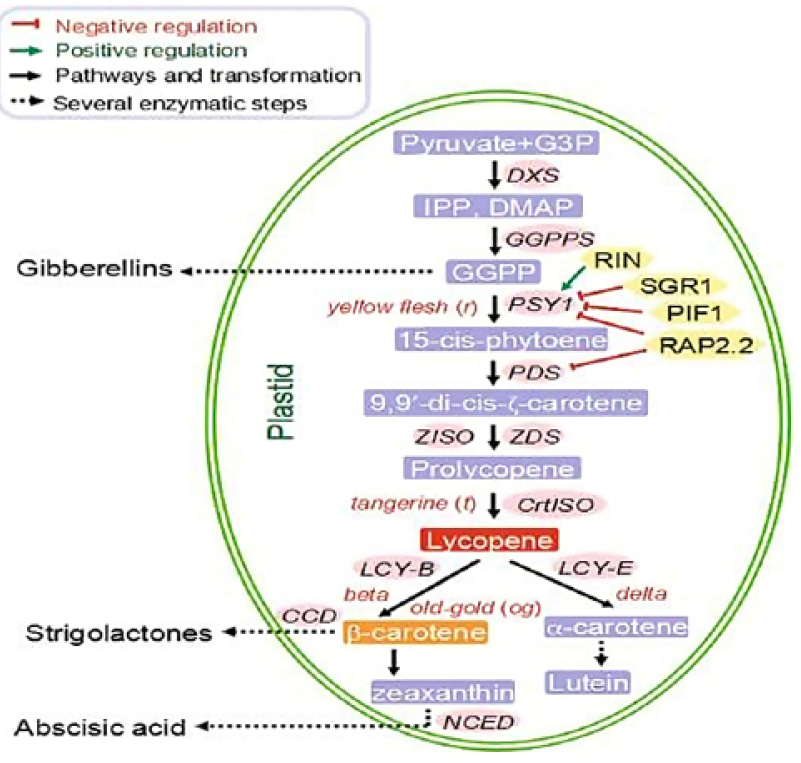
Metabolic pathway of carotenoid in tomato (Solanum lycopersicum).
References
- Abdel, E.S.M., H. Akhtar, K. Zaheer and R. Ali. 2013. Dietary sources of lutein and zeaxanthin carotenoids and their role in eye health. Nutrients, 5(4): 1169-1185. https://doi.org/10.3390/nu5041169[CrossRef]
- Alba, R., M.M. Cordonnier-Pratt, and L.H. Pratt. 2000. Fruit-localized phytochromes regulate lycopene accumulation independently of ethylene production in tomato. Plant Physiol., 123: 363-370. https://doi.org/10.1104/pp.123.1.363[CrossRef]
- Avinash, T., and V. Rai. 2017. An ethanobotanical investigation of cucurbitaceae from South India: A review. J. Med. Plants Stud., 5: 250-253.
- Aziz, E., R. Batool, W. Akhtar, S. Rahman, T. Shahzad, A. Malik, M.A. Shariati, A. Laishevtcev, S. Plygun, and M. Heydari. 2020. Xanthophyll: Health benefits and therapeutic insights. Life Sci., 240: 117104. https://doi.org/10.1016/j.lfs.2019.117104[CrossRef]
- Barker, F.M., D.M. Snodderly, E.J. Johnson, W. Schalch, W. Koepcke, J. Gerss, and M. Neuringer. 2011. Nutritional manipulation of primate retinas, V: Effects of lutein, zeaxanthin, and n –3 fatty acids on retinal sensitivity to blue-light–induced damage. Investig. Opthalmol. Vis. Sci., 52: 3934. https://doi.org/10.1167/iovs.10-5898[CrossRef]
- Bi, M.C., N. Hose, C.L. Xu, C. Zhang, J. Sassoon and E. Song. 2016. Nonlethal levels of zeaxanthin inhibit cell migration, invasion, and secretion of MMP-2 via NF-κB pathway in cultured human uveal melanoma cells. J. Ophthalmol., 2016. https://doi.org/10.1155/2016/8734309[CrossRef]
- Bi, M.C., R. Rosen, R.Y. Zha, S.A. McCormick, E. Song, and D.N. Hu. 2013. Zeaxanthin induces apoptosis in human uveal melanoma cells through Bcl-2 family proteins and intrinsic apoptosis pathway. Evid. Based Complement. Altern. Med., https://doi.org/10.1155/2013/205082[CrossRef]
- Bian, Q., S. Gao, J. Zhou, J. Qin, A. Taylor, E.J. Johnson, G. Tang, J.R. Sparrow, D. Gierhar, and F. Shang. 2012. Lutein and zeaxanthin supplementation reduces photooxidative damage and modulates the expression of inflammation-related genes in retinal pigment epithelial cells. Free Radic. Biol. Med., 53: 1298-1307. https://doi.org/10.1016/j.freeradbiomed.2012.06.024[CrossRef]
- Bottcher, C., R.A. Keyzers, P.K. Boss, and Davies. C. 2010. Sequestration of auxin by the indole-3-acetic acid-amido synthetase GH3-1 in grape berry (Vitis vinifera L.) and the proposed role of auxin conjugation during ripening. J. Exp. Bot., 61: 3615-3625. https://doi.org/10.1093/jxb/erq174[CrossRef]
- Buscemi, S., D. Corleo, F. Di Pace, M.L. Petroni, A. Satriano and G. Marchesini. 2018. The effect of lutein on eye and extra-eye health. Nutrients, 10(9). https://doi.org/10.3390/nu10091321[CrossRef]
- Cazzonelli, C.I., and B.J. Pogson. 2010. Source to sink: regulation of carotenoid biosynthesis in plants. Trends Plant Sci., 15: 266-274. https://doi.org/10.1016/j.tplants.2010.02.003[CrossRef]
- Chappell, J., F. Wolf, J. Proulx, R. Cuellar, and C. Saunders. 1995. Is the reaction catalyzed by 3-hydroxy-3-methylglutaryl coenzyme A reductase a rate-limiting step for isoprenoid biosynthesis in plants? Plant Physiol. 109: 1337-1343. https://doi.org/10.1104/pp.109.4.1337[CrossRef]
- Chen, H., A.D. Jones and G.A. Howe. 2006. Constitutive activation of the jasmonate signaling pathway enhances the production of secondary metabolites in tomato. FEBS Lett., 580: 2540-2546. https://doi.org/10.1016/j.febslet.2006.03.070[CrossRef]
- Chitchumroonchokchai, C., J.A. Bomser, J.E. Glamm, and M.L. Failla. 2004. Xanthophylls and α-tocopherol decrease UVB-induced lipid peroxidation and stress signaling in human lens epithelial cells. J. Nutr., 134: 3225-3232. https://doi.org/10.1093/jn/134.12.3225[CrossRef]
- Chung, R.W.S., P. Leanderson, A.K. Lundberg, and L. Jonasson. 2017. Lutein exerts anti-inflammatory effects in patients with coronary artery disease. Atherosclerosis, 262: 87-93. https://doi.org/10.1016/j.atherosclerosis.2017.05.008[CrossRef]
- Cutinho, P.F., J. Roy, A. Anand, R. Cheluvaraj, M. Murahari, and H.V. Chimatapu. 2020. Design of metronidazole derivatives and flavonoids as potential non-nucleoside reverse transcriptase inhibitors using combined ligand-and structure-based approaches. J. Biomol. Struct. Dynam., 38: 1626-1648. https://doi.org/10.1080/07391102.2019.1614094[CrossRef]
- Dall’Osto, L., M. Piques, M. Ronzani, B. Molesini, A. Alboresi, S. Cazzaniga, and R. Bassi. 2013. The Arabidopsis nox mutant lacking carotene hydroxylase activity reveals a critical role for xanthophylls in photosystem I biogenesis. Plant Cell, 25: 591-608. https://doi.org/10.1105/tpc.112.108621[CrossRef]
- Davey, P.G., Y. Wang, D.L. Gierhart, and M. Baudry. 2020. Neuroprotective effects of zeaxanthin in a mouse model of retinal ischemia/ reperfusion injury. Invest. Ophthalmol. Vis. Sci., 61: 655-655.
- Davies K.M., 2009. Plant pigments and their manipulation. Annu. Plant Rev., (Oxford: Blackwell Publishing), 14: 69.
- Eisenreich, W., F. Rohdich, and A. Bacher. 2001. Deoxyxylulose phosphate pathway to terpenoids. Trends Plant Sci., 6: 78-84. https://doi.org/10.1016/S1360-1385(00)01812-4[CrossRef]
- El-Akabawy, G., and N.M. El-Sherif. 2019. Zeaxanthin exerts protective effects on acetic acid-induced colitis in rats via modulati on of pro-inflammatory cytokines and oxidative stress. Biomed. Pharmacother., 111: 841-851. https://doi.org/10.1016/j.biopha.2019.01.001[CrossRef]
- Fantini, E., G. Falcone, S. Frusciante, L. Giliberto, and G. Giuliano. 2013. Dissection of tomato lycopene biosynthesis through virus induced gene silencing. Plant Physiol., 163: 986-998. https://doi.org/10.1104/pp.113.224733[CrossRef]
- Feng, L., K. Nie, H. Jiang, and W. Fan. 2019. Effects of lutein supplementation in agerelated macular degeneration. PLoS One, 14(12). https://doi.org/10.1371/journal.pone.0227048[CrossRef]
- Foger-Samwald, U., P. Dovjak, U. Azizi-Semrad, K. Kerschan-Schindl, and P. Pietschmann. 2020. Osteoporosis: Pathophysiology and therapeutic options. EXCLI J., 19: 1017.
- Ford, N.A., and J.W. Erdman. 2012. Are lycopene metabolites metabolically active? Acta Biochim. Pol., 59: 1-4. https://doi.org/10.18388/abp.2012_2159[CrossRef]
- Fraser, P.D., E.M. Enfissi, J.M. Halket, M.R. Truesdale, D. Yu, C. Gerrish, and P.M. Bramley. 2007. Manipulation of phytoene levels in tomato fruit: effects on isoprenoids, plastids, and intermediary metabolism. Plant Cell, 19: 3194-3211. https://doi.org/10.1105/tpc.106.049817[CrossRef]
- Fujisawa, M.Y. Shima, H. Nakagawa, M. Kitagawa, J. Kimbara, T. Nakano, T. Kasumi, and Y. Ito. 2014. Transcriptional regulation of fruit ripening by tomato Fruitful homologs and associated MADS box proteins. Plant Cell, 26: 89-101. https://doi.org/10.1105/tpc.113.119453[CrossRef]
- Gao, Y.Y., J. Ji, L. Jin, B.L Sun, L.H. Xu, C.K. Wang, and Y.Z. Bi. 2016. Xanthophyll supplementation regulates carotenoid and retinoid metabolism in hens and chicks. Poult. Sci., 95: 541-549. https://doi.org/10.3382/ps/pev335[CrossRef]
- Greenwood, B., and T. Mutabingwa. 2002. Malaria in 2002. Nature, 415: 670. https://doi.org/10.1038/415670a[CrossRef]
- Grudzinski, W., M. Piet, R. Luchowski, E. Reszczynska, R. Welc, R. Paduch and W.I. Gruszecki. 2018. Different molecular organization of two carotenoids, lutein and zeaxanthin, in human colon epithelial cells and colon adenocarcinoma cells. Spectrochim. Acta. A. Mol. Biomol. Spectrosc., 188: 57-63. https://doi.org/10.1016/j.saa.2017.06.041[CrossRef]
- Gunal, M.Y., A.A. Sakul, A.B. Caglayan, F. Erten, O.E.D. Kursun, E. Kilic, and K. Sahin. 2021. Protective effect of lutein/zeaxanthin isomers in traumatic brain injury in mice. Neurotox. Res., https://doi.org/10.1007/s12640-021-00385-3[CrossRef]
- Havaux, M., 2014. Carotenoid oxidation products as stress signals in plants. Plant J., 79: 597–606. https://doi.org/10.1111/tpj.12386[CrossRef]
- Hermanns, A.S., X. Zhou, Q. Xu, Y. Tadmor and L. Li. 2020. Carotenoid pigment accumulation in horticultural plants. Hortic. Plant J., 6(6): 343–360. https://doi.org/10.1016/j.hpj.2020.10.002[CrossRef]
- Huang, Y., C. Shi, and J. Li. 2019. The protective effect of zeaxanthin on human limbal and conjunctival epithelial cells against UV-induced cell death and oxidative stress. Int. J. Ophthalmol., 12: 369. https://doi.org/10.18240/ijo.2019.03.03[CrossRef]
- Jha, U.C., H. Nayyar, and K.H.M. Siddique. 2022. Role of phytohormones in regulating heat stress acclimation in agricultural crops. 2022. J. Plant Growth Regul., 41: 1041–1064. https://doi.org/10.1007/s00344-021-10362-x[CrossRef]
- Jiao, Y., L. Reuss, and Y. Wang. 2019. β-Cryptoxanthin: Chemistry, occurrence, and potential health benefits. Curr. Pharmacol. Rep., 5: 20-34. https://doi.org/10.1007/s40495-019-00168-7[CrossRef]
- Juin, C., R.G. de-Fleury, A.O. Junior, C. Oudinet, L. Pytowski, J.B. B´erard, E. Nicolau, V. Thi´ery, I. Lanneluc, and L. Beaugeard. 2018. Zeaxanthin from Porphyridium purpureum induces apoptosis in human melanoma cells expressing the oncogenic BRAF V600E mutation and sensitizes them to the BRAF inhibitor vemurafenib. Rev. Bras. Farmacogn., 28: 457-467. https://doi.org/10.1016/j.bjp.2018.05.009[CrossRef]
- Kelishadi, M.R., O. Asbaghi, B. Nazarian, F. Naeini, M. Kaviani, S. Moradi, G. Askari, M. Nourian and D. Ashtary-Larky. 2022. Lycopene supplementation and blood pressure: systematic review and meta-analyses of randomized trials. J. Herb. Med., 31: 100521. https://doi.org/10.1016/j.hermed.2021.100521[CrossRef]
- Khalighi, S.M., S. Saraf-Bank, Z.S. Clayton, and S. Soltani. 2021. A positive effect of egg consumption on macular pigment and healthy vision: A systematic review and meta-analysis of clinical trials. J. Sci. Food Agric., 101(10): 4003-4009.
- Klee, H.J., and J.J. Giovannoni. 2011. Genetics and control of tomato fruit ripening and quality attributes. Annu. Rev. Genet., 45: 41-59. https://doi.org/10.1146/annurev-genet-110410-132507[CrossRef]
- Krinsky, N.I., and E.J. Johnson. 2005. Carotenoid actions and their relation to health and disease. Mol. Aspects Med., 26: 459-516. https://doi.org/10.1016/j.mam.2005.10.001[CrossRef]
- Lee, C.S., 2014. Therapy of infections due to carbapenem-resistant gram-negative pathogens. Infect. Chemother., 46: 149-164. https://doi.org/10.3947/ic.2014.46.3.149[CrossRef]
- Leermakers, E.T.M., S.K.L. Darweesh, C.P. Baena, E.M. Moreira, D.M. Van Lent, M.J. Tielemans, T. Muka, A. Vitezova, R. Chowdhury, W. M. Bramer, J.C. Kiefte-de Jong, J.F. Felix and O.H. Franco. 2016. The effects of lutein on cardiometabolic health across the life course: a systematic review and meta-analysis. Am. J. Clin. Nutr., 103(2): 481-494. https://doi.org/10.3945/ajcn.115.120931[CrossRef]
- Leung, H.H., J.M. Galano, C. Crauste, T. Durand, and J.C.Y. Lee. 2020. Combination of lutein and zeaxanthin, and DHA regulated polyunsaturated fatty acid oxidation in H2O2-stressed retinal cells. Neurochem. Res., 45: 1007-1019. https://doi.org/10.1007/s11064-020-02994-4[CrossRef]
- Li, S.Y., and A.C.Y. Lo. 2010. Lutein protects RGC-5 cells against hypoxia and oxidative stress. Int. J. Mol. Sci., 11(5): 2109–2117. https://doi.org/10.3390/ijms11052109[CrossRef]
- Liu, R., T. Wang, B. Zhang, L. Qin, C. Wu, Q. Li, and L. Ma. 2015. Lutein and zeaxanthin supplementation and association with visual function in age-related macular degeneration. Investig. Ophthalmol. Vis. Sci., 56(1): 252-258. https://doi.org/10.1167/iovs.14-15553[CrossRef]
- Loya, S., Y. Kashman, and A. Hizi. 1992. The carotenoid halocynthiaxanthin: A novel inhibitor of the reverse transcriptases of human immunodeficiency viruses type 1 and type 2. Arch. Biochem. Biophys., 293: 208-212. https://doi.org/10.1016/0003-9861(92)90386-B[CrossRef]
- Maci, S., B. Fonseca and Y. Zhu. 2016. The role of lutein in brain health and function. Nutrafoods, 15: 179-188.
- Manios, Y., G. Moschonis, G. Trovas, and G.P. Lyritis. 2007. Changes in biochemical indexes of bone metabolism and bone mineral density after a 12-mo dietary intervention program: The postmenopausal health study. Am. J. Clin. Nutr., 86: 781-789. https://doi.org/10.1093/ajcn/86.3.781[CrossRef]
- Martel, C., J. Vrebalov, P. Tafelmeyer, and J.J. Giovannoni. 2011. The tomato MADS-box transcription factor ripening inhibitor interacts with promoters involved in numerous ripening processes in a colorless nonripening-dependent manner. Plant Physiol., 157: 1568-1579. https://doi.org/10.1104/pp.111.181107[CrossRef]
- Marty, I., S. Bureau, G. Sarkissian, B. Gouble, J.M. Audergon, and G. Albagnac. 2005. Ethylene regulation of carotenoid accumulation and carotenogenic gene expression in colour-contrasted apricot varieties (Prunus armeniaca). J. Exp. Bot., 56: 1877-1886. https://doi.org/10.1093/jxb/eri177[CrossRef]
- Matusova, R., K. Rani, F.W.A. Verstappen, M.C.R. Franssen, M.H. Beale, and H.J. Bouwmeester. 2005. The strigolactone germination stimulants of the plant-parasitic Striga and Orobanche spp. Are derived from the carotenoid pathway. Plant Physiol., 139: 920-934. https://doi.org/10.1104/pp.105.061382[CrossRef]
- MBiostat, W.L.W., X.S. Md, X.L. BSc, C.M.G. Cheung, R.K. Md, D.C.-Y.C. Md, P. T.Y.W. Mbbs. 2014. Global prevalence of age-related macular degeneration and disease burden projection for 2020 and 2040: A systematic review and meta-analysis. Lancet Glob. Health,
- Melendez-Martínez, A.J., C.M. Stinco, and P. Mapelli-Brahm. 2019. Skin carotenoids in public health and nutricosmetics: The emerging roles and applications of the UV radiation-absorbing colourless carotenoids phytoene and phytofluene. Nutrients, 11: 1093. https://doi.org/10.3390/nu11051093[CrossRef]
- Meléndez-Martínez, A.J., Böhm, V., Borge, G.I.A., Cano, M.P., Fikselová, M., Gruskiene, R., Lavelli, V., Loizzo, M.R., Mandi´c, A.I., and Brahm, P.M., 2021. Carotenoids: Considerations for their use in functional foods, nutraceuticals, nutricosmetics, supplements, botanicals, and novel foods in the context of sustainability, circular economy, and climate change. Annu. Rev. Food Sci. Technol., 12: 433–460. https://doi.org/10.1146/annurev-food-062220-013218[CrossRef]
- Metzger, A., G. Mukasa, A.H. Shankar, G. Ndeezi, G. Melikian, and R.D. Semba. 2001. Antioxidant status and acute malaria in children in Kampala, Uganda. Am. J. Trop. Med. Hyg., 65: 115-119. https://doi.org/10.4269/ajtmh.2001.65.115[CrossRef]
- Mitri, K., R. Shegokar, S. Gohla, C. Anselmi, and R.H. Müller. 2011c. Lutein nanocrystals as antioxidant formulation for oral and dermal delivery. Int. J. Pharm., 420(1): 141-146. https://doi.org/10.1016/j.ijpharm.2011.08.026[CrossRef]
- Murillo, A.G., S. Hu, and M.L. Fernandez. 2019. Zeaxanthin: Metabolism, properties, and antioxidant protection of eyes, heart, liver, and skin. Antioxidants, 8: 390. https://doi.org/10.3390/antiox8090390[CrossRef]
- Murray, I.J., M. Makridaki, R.L.P. van der Veen, D. Carden, N.R.A. Parry, and T.T.J.M. Berendschot. 2013. Lutein supplementation over a one-year period in early AMD might have a mild beneficial effect on visual acuity: The CLEAR study. Investig. Ophthalmol. Vis. Sci., 54(3): 1781-788. https://doi.org/10.1167/iovs.12-10715[CrossRef]
- Nakamura, S.T., Maoka, Y. Kuse, A. Muramatsu, Y. Yoshino, M. Shimazawa, and H. Hara. 2020. Distribution of carotenoids and protective effects of zeaxanthin on retina of ayu sweetfish (Plecoglossus altivelis). J. Oleo Sci., 69: 1095-1105. https://doi.org/10.5650/jos.ess20108[CrossRef]
- Nishino, A., H. Yasui, and T. Maoka. 2017. Reaction and scavenging mechanism of β-carotene and zeaxanthin with reactive oxygen species. J. Oleo Sci., Article ess16107. https://doi.org/10.5650/jos.ess16107[CrossRef]
- Manolagas, S.C., and A.M. Parfitt. 2010. What old means to bone. Trends Endocrinol. Metab., 21: 369-374. https://doi.org/10.1016/j.tem.2010.01.010[CrossRef]
- Paetzold, H., S. Garms, S. Bartram, J. Wieczorek, E.M. Uros-Gracia, M.R. Concepcion, W. Boland, D. Strack, B. Hause and M.H. Walter. 2010. The isogene 1-deoxy-D xylulose 5- phosphate synthase 2 controls isoprenoid profiles, precursor.
- Palombo, P., G. Fabrizi, V. Ruocco, E. Ruocco, J. Fluhr, R. Roberts and P. Morganti. 2007. Beneficial long-term effects of combined oral/topical antioxidant treatment with the carotenoids lutein and zeaxanthin on human skin: A double-blind, placebo-controlled study. Skin Pharmacol. Physiol., 20: 199-210. https://doi.org/10.1159/000101807[CrossRef]
- Park, S.Y., P. Fung, N. Nishimura, D.R. Jensen, H. Fujii, Y. Zhao, S. Lumba, J. Santiago, A. Rodrigues and T.F. Chow. 2009. Abscisic acid inhibits type 2C protein phosphatases via the PYR/PYL family of START proteins. Science, 324: 1068-1071. https://doi.org/10.1126/science.1173041[CrossRef]
- Parle, M., and Gurditta. 2011. Basketful benefits of papaya. Int. Res. J. Pharm., 2: 6-12.
- Pereira, H., L. Cust´odio, M.J. Rodrigues, C.B.D. Sousa, M. Oliveira, L. Barreira, N. Neng, R.da, J.M.F. Nogueira, S.A. Alrokayan and F. Mouffouk. 2015. Biological activities and chemical composition of methanolic extracts of selected autochthonous microalgae strains from the Red Sea. Mar. Drugs, 13: 3531-3549. the Red Sea. Mar. Drugs, 13: 3531-3549.https://doi.org/10.3390/md13063531[CrossRef]
- Poiroux-Gonord, F., L.P. Bidel, A.L. Fanciullino, H. Gautier, F.L. Lopez and L. Urban. 2010. Health benefits of vitamins and secondary metabolites of fruits and vegetables and prospects to increase their concentrations by agronomic approaches. J. Agric. Food Chem., 58: 12065-12082. https://doi.org/10.1021/jf1037745[CrossRef]
- Quail, P.H., 2002. Phytochrome photosensory signalling networks. Nat. Rev. Mol. Cell Biol., 3: 85-93. https://doi.org/10.1038/nrm728[CrossRef]
- Ramkumar, H.L., J. Tuo, D.F. Shen, J. Zhang, X. Cao, E.Y. Chew and C.C. Chan. 2013. Nutrient supplementation with n3 polyunsaturated fatty acids, lutein, and zeaxanthin decrease A2E accumulation and VEGF expression in the retinas of ccl2/ cx3cr1-deficient mice on Crb1rd8 background. J. Nutr., 143: 1129-1135. https://doi.org/10.3945/jn.112.169649[CrossRef]
- Rao, L.G., N.N. Kang, and A.V. Rao. 2014. Chapter 24-lycopene and other antioxidants in the prevention and treatment of osteoporosis in postmenopausal women. In V.R. Preedy (Ed.), https://doi.org/10.1016/B978-0-12-405933-7.00024-X[CrossRef]
- Ribeiro, D., M. Freitas, A.M.S. Silva, F. Carvalho and E. Fernandes. 2018. Antioxidant and pro-oxidant activities of carotenoids and their oxidation products. Food Chem. Toxicol., 120: 681-699. https://doi.org/10.1016/j.fct.2018.07.060[CrossRef]
- Ro zanowska, M.B., B. Czuba-Pelech, J.T. Landrum, and B.R´o zanowski. 2021. Comparison of antioxidant properties of dehydrolutein with lutein and zeaxanthin, and their effects on cultured retinal pigment epithelial cells. Antioxidants, 10: 753. https://doi.org/10.3390/antiox10050753[CrossRef]
- Robert, B., P. Horton, A.A. Pascal and A.V. Ruban. 2004. Insights into the molecular dynamics of plant light-harvesting proteins in vivo. Trends Plant Sci., 9: 385-390. https://doi.org/10.1016/j.tplants.2004.06.006[CrossRef]
- Rolland, N., G. Curien, G. Finazzi, M. Kuntz, E. Marechal, M. Matringe, S. Ravanel and D.S. Berny. 2012. The biosynthetic capacities of the plastids and integration between cytoplasmic and chloroplast processes. Annu. Rev. Genet., 46: 233-264. https://doi.org/10.1146/annurev-genet-110410-132544[CrossRef]
- Ronen, G., L.C. Goren, D. Zamir and J. Hirschberg. 2000. An alternative pathway to beta-carotene formation in plant chromoplasts discovered by map-based cloning of beta and old-gold color mutations in tomato. Proc. Natl. Acad. Sci. U. S. A., 97: 11102-11107. https://doi.org/10.1073/pnas.190177497[CrossRef]
- Ruiz-Sola, M.A., and M. Rodrı´guez-Concepcio´ na. 2012. Carotenoid biosynthesis in Arabidopsis: A colorful pathway. Arabidopsis Book, 10e0158. https://doi.org/10.1199/tab.0158[CrossRef]
- Sahin, K., F. Akdemir, C. Orhan, M. Tuzcu, H. Gencoglu, N. Sahin, I.H. Ozercan, S. Ali, I. Yilmaz, and V. Juturu. 2019. (3R, 3’R)-zeaxanthin protects the retina from photo-oxidative damage via modulating the inflammation and visual health molecular markers. Cutaneous Ocul. Toxicol., 38: 161-168. https://doi.org/10.1080/15569527.2018.1554667[CrossRef]
- Sakai, S., T. Sugawara, K. Matsubara and T. Hirata. 2009. Inhibitory effect of carotenoids on the degranulation of mast cells via suppression of antigen-induced aggregation of high affinity IgE receptors. J. Biol. Chem., 284: 28172-28179. https://doi.org/10.1074/jbc.M109.001099[CrossRef]
- Sandmann, G., S. Romer and P.D. Fraser. 2006. Understanding carotenoid metabolism as a necessity for genetic engineering of crop plants. Metab. Eng., 8: 291-302. https://doi.org/10.1016/j.ymben.2006.01.005[CrossRef]
- Santocono, M., M. Zurria, M. Berrettini, D. Fedeli and G. Falcioni. 2006. Influence of astaxanthin, zeaxanthin and lutein on DNA damage and repair in UVA-irradiated cells. J. Photochem. Photobiol. B, 85: 205-215. https://doi.org/10.1016/j.jphotobiol.2006.07.009[CrossRef]
- Schwartz, S., E. Frank, D. Gierhart, P. Simpson and R. Frumento. 2016. Zeaxanthin-based dietary supplement and topical serum improve hydration and reduce wrinkle count in female subjects. J. Cosmet. Dermatol., 15: e13-e20. https://doi.org/10.1111/jocd.12226[CrossRef]
- Sheng, Y.N., Y.H. Luo, S.B. Liu, W.T. Xu, Y. Zhang, T. Zhang, H. Xue, W.B. Zuo, Y.N. Li and C.Y. Wang. 2020. Zeaxanthin induces apoptosis via ROS-regulated MAPK and AKT signaling pathway in human gastric cancer cells. Oncol. Targets Ther., 13: 10995. https://doi.org/10.2147/OTT.S272514[CrossRef]
- Sheweita, S.A., K.I. Khoshhal and H.H. Baghdadi. 2014. Osteoporosis and oxidative stress role of antioxidants. In: I. Laher (Ed.), Systems Biology of free radicals and antioxidants. Berlin, Heidelberg: Springer. pp. 2973-2995. https://doi.org/10.1007/978-3-642-30018-9_128[CrossRef]
- Silvan, J.M., Reguero, M., and S.D.P. Teresa. 2016. A protective effect of anthocyanins and xanthophylls on UVB-induced damage in retinal pigment epithelial cells. Food Funct., 7: 1067-1076. https://doi.org/10.1039/C5FO01368B[CrossRef]
- Simon, D., 2019. Recent advances in clinical allergy and immunology 2019. Int. Arch. Allergy Immunol., 180: 291-305. https://doi.org/10.1159/000504364[CrossRef]
- Sugiura, M., M. Nakamura, K. Ogawa, Y. Ikoma, and M. Yano. 2012. High serum carotenoids associated with lower risk for bone loss and osteoporosis in post-menopausal Japanese female subjects: Prospective cohort study. PLoS One, 7. https://doi.org/10.1371/journal.pone.0052643[CrossRef]
- Sun, L., B. Yuan, M. Zhang, L. Wang, M. Cui, Q. Wang, and P. Leng. 2012. Fruit-specific RNAi-mediated suppression of SlNCED1 increases both lycopene and beta-carotene contents in tomato fruit. J. Exp. Bot., 63: 3097-3108. https://doi.org/10.1093/jxb/ers026[CrossRef]
- Sun, Y.X., T. Liu, X.L Dai, Q.S Zheng, Z.F. Hui, B. Di, Jiang. 2014. Treatment with lutein provides neuroprotection in mice subjected to transient cerebral ischemia. https://doi.org/10.1080/10286020.2014.939584[CrossRef]
- Thomson, L.R., Y. Toyoda, F.C. Delori, K.M. Garnett, Z.-Y, Wong, C.R. Nichols, K.M. Cheng, N.E. Craft, and C. Kathleen Dorey. 2002a. Long term dietary supplementation with zeaxanthin reduces photoreceptor death in light-damaged Japanese quail. Exp. Eye Res., 75: 529-542. https://doi.org/10.1006/exer.2002.2050[CrossRef]
- Tomato Genome, C., 2012. The tomato genome sequence provides insights into fleshy fruit evolution. Nature, 485: 635-641. https://doi.org/10.1038/nature11119[CrossRef]
- Vo, T.S., D.H. Ngo, and S.K. Kim. 2012. Potential targets for anti-inflammatory and anti-allergic activities of marine algae: An overview. Inflamm. Allergy Drug Targets Former. Curr. Drug Targets-Inflamm. Allergy Discontinued, 11: 90-101. https://doi.org/10.2174/187152812800392797[CrossRef]
- Vogel, J.T., D.M. Tieman, C.A. Sims, A.Z. Odabasi, D.G. Clark, and H.J. Klee. 2010. Carotenoid content impacts flavor acceptability in tomato (Solanum lycopersicum). J. Sci. Food Agric., 90: 2233-240. https://doi.org/10.1002/jsfa.4076[CrossRef]
- Walter, M.H., J. Hans, and D. Strack. 2002. Two distantly related genes encoding 1-deoxy-D-xylulose 5-phosphate synthases: differential regulation in shoots and apocarotenoid-accumulating mycorrhizal roots. Plant J., 31: 243-254. https://doi.org/10.1046/j.1365-313X.2002.01352.x[CrossRef]
- Wang, Y., C. Zhang, B. Xu, (et al. Please give all names). 2022. Temperature regulation of carotenoid accumulation in the petals of sweet osmanthus via modulating expression of carotenoid biosynthesis and degradation genes. BMC Genom., 23: 418. https://doi.org/10.1186/s12864-022-08643-0[CrossRef]
- Weigert, G., S. Kay, B. Pemp, S. Sacu, M. Lasta, R.M. Werkmeister, and L. Schmetterer. 2011. Effects of lutein supplementation on macular pigment optical density and visual acuity in patients with age-related macular degeneration. Investig. Ophthalmol. Vis. Sci., 52(11): 8174-8178. https://doi.org/10.1167/iovs.11-7522[CrossRef]
- Wu, N.L., Y.C. Chiang, C.C. Huang, J.Y. Fang, D.F. Chen, and C.F. Hung. 2010. Zeaxanthin inhibits PDGF-BB-induced migration in human dermal fibroblasts. Exp. Dermatol., 19: e173-e181. https://doi.org/10.1111/j.1600-0625.2009.01036.x[CrossRef]
- Xu, X., L. Hang, B. Huang, Y. Wei, S. Zheng, and W. Li. 2013. Efficacy of ethanol extract of Fructus lycii and its constituent’s lutein/zeaxanthin in protecting retinal pigment epithelium cells against oxidative stress: In vivo and in vitro models of age-related macular degeneration. J. Ophthalmol., https://doi.org/10.1155/2013/862806[CrossRef]
- Yu, M., W. Yan, and C. Beight. 2018. Lutein and zeaxanthin isomers reduce photoreceptor degeneration in the Pde6brd10 mouse model of retinitis pigmentosa. BioMed. Res. Int., pp. 1-8. https://doi.org/10.1155/2018/4374087[CrossRef]
- Yu, M., W. Yan, and C. Beight. 2018b. Lutein and zeaxanthin isomers protect against light-induced retinopathy via decreasing oxidative and endoplasmic reticulum stress in BALB/cJ mice. Nutrients, 10: 842. https://doi.org/10.3390/nu10070842[CrossRef]
- Yuan, H., J. Zhang, D. Nageswaran and L. Li. 2015. Carotenoid metabolism and regulation in horticultural crops. Hortic. Res., 2: 15036. https://doi.org/10.1038/hortres.2015.36[CrossRef]
- Zaccara, G., S. Lattanzi, M. Cincotta, and E. Russo. 2020. Drug treatments in patients with cardiac diseases and epilepsy. Acta Neurol. Scand., 142(1): 37-49. https://doi.org/10.1111/ane.13249[CrossRef]
- Zhang, Y.B., Z.M. Zhong, G. Hou, H. Jiang, and J.T. Chen. 2011. Involvement of oxidative stress in age-related bone loss. J. Surg. Res., 169: e37-e42. https://doi.org/10.1016/j.jss.2011.02.033[CrossRef]
- Zmitek, K., J. Zmitek, M. Rogl Butina, H. Hristov, T. Pogaˇcnik, and I. Pravst. 2020. Dietary lutein supplementation protects against ultraviolet-radiation-induced erythema: Results of a randomized double-blind placebo-controlled study. J. Funct. Foods, 75. https://doi.org/10.1016/j.jff.2020.104265[CrossRef]
Services
Article usage statistics
Loading…