
Birth processes and related behaviors are the crucial events in mammalian reproduction. However, detailed reports of birth processes and related behaviors in wild nonhuman primates in their natural habitats are rare. Here, we document our observations of birth processes and related behaviors via scan sampling and focal animal samples during the birth of two infant Yunnan snub-nosed monkeys (Rhinopithecus bieti) in 2017. One of the infants was born during diurnal to a multiparous female, while the other one was a nocturnal birth to a primiparous female. Actual parturition lasted only 7 min for diurnal birth. During the parturition process, the mother received what could be described as assistance in delivery from the other females and resident male within one male unit. During each of the two births, the one-male unit’s resident male patrolled the area to keeping it secure. After birth, other members of the unit showed intense interest in the neonate. Adult females are more skilled and efficient in handling infants than sub-adult females. Our results will serve to advance our understanding of this important life history event in nonhuman primates.
Research Article · Volume 54, Issue 5, 10 June 2022 · Open Access
Birth Processes and Related Behaviors of Yunnan Snub-nosed Monkeys in Baimaxueshan Nature Reserve
· · · · · · ·
Affiliations & Notes ⌄
- 1Key Laboratory of Southwest China Wildlife Resources Conservation (Ministry of Education), China West Normal University, Nanchong 637009, Sichuan Province, China 2Department of Basic Medical Biology, Medical College of North Sichuan Medical College, Nanchong 637007, Sichuan Province, China 3Key Laboratory for Ecology of Tropical Islands (Ministry of Education), Hainan Normal University, Haikou 571158, Hainan Province, China 4Key Laboratory of Tropical Animal and Plant Ecology of Hainan Province,
Article Info ⌄
- Journal:
- Pakistan Journal of Zoology
- Published:
- 10 June 2022

From the article
- Diurnal births allow the mother to start feeding as soon after giving birth as possible.
- The birth mother can get direct or indirect assistance from other members within unit.
- Adult females are more skillful and efficient in handling infants than sub-adult females.
- Our results will serve to advance our understanding of this important life history event in nonhuman primates.
Selected from the article's own text.
Abstract
INTRODUCTION
Birth processes and related behaviors are the crucial events in mammalian reproduction, and these behaviors including in parturition posture, duration time, assistant behavior and newborn infant care . Therefore, the behaviors surrounding the birthing process are expected to be under strong selective pressure. Understanding birth processes and related behaviors of primate parturition can help to illuminate the evolution in humans and non-human primates ; .
Detailed reports of birth in wild non-human primates in their natural habitats are rare, possibly because even most diurnal primates often give birth in seclusion at night ; . So far, two main evolutionary explanations have been advanced for nocturnal birth: females may reduce the chance of being left behind if their group moves on, and females may evade other group members’ excessive attention toward the newborn ; ; ; . In addition, overnight births could allow females more time to rest and take care of their infants immediately after parturition. As a result of widespread nocturnal birth, this critical life-history event has rarely been observed in anthropoid primates, and the temporal patterns of birth from the first signs of labor until maternal care begins are poorly documented.
Diurnal birth offers better observational conditions and allow the birth process and birth-related behaviors to be viewed clearly . Some viewpoints offer the explanation for diurnal birth: diurnal births allow the mother to start feeding as soon after giving birth as possible , but the presence of domesticated animals and human may have impact on the birth process. Detailed reports of parturition behaviors in wild colobine monkeys are currently restricted to a capped langur (Trachypithecus pileatus) , a white-headed langur (T. leucocephalus) , and a Sichuan snub-nosed monkey (R. roxellana) (Li et al., 2010a).
Yunnan snub-nosed monkeys (Rhinopithecus bieti) live in the eastern Himalayan highlands, bounded by the upper Yangtze River and Mekong Rivers (Xia et al., 2020a; . R. bieti is an endangered species of Asian colobine endemic to China, inhabiting high altitude mountain forests (Xia et al., 2020b), and the population of wild R. bieti has increased from more than 2,000 in 1994 to more than 3,000 in 2017 (Xia et al., 2020a). R. bieti social groups are characterized by a multilevel society, which are composed of many one-male units (OMUs) and at least one all-male unit (AMU) (Xia et al., 2020a). Previous studies have focused on the demography, ecology and sexual behavior of wild group (Li et al., 2010b; , 2020a, b). Here we report the parturition behaviors of two births of Yunnan snub-nosed monkeys and the reactions of other group members to the infant and the mother. We aim to (1) describe of the complete parturition process; (2) summarize the whole birth-related behaviors; and (3) understand birth for this endangered primate.
MATERIALS AND METHODS
Study site and species
A continuous study of the behavior and ecology of R. bieti is ongoing from 2010 to 2018 in Baimaxueshan Nature Reserve, Yunnan Province, China (Xia et al., 2020a, b). This study’s focal group lives at Xiangguqing (27°37′N, 99°22′E), which includes multiple habitat types: mixed coniferous and deciduous broadleaf forest, subalpine fir forest, montane sclerophyllous oak forest, subtropical evergreen broadleaf forest, and pine forest (Xia et al., 2020a). The focal group is a stable habituated group (ca 56-64 individuals in 2017), which was composed of nine one-male units (OMUs, average individual number was 5.7±3.3) and one all-male unit (AMU, individual number was 6) (Xia et al., 2020b). All group members were individually recognized using distinctive physical characteristics such as body size, hair pattern, scars, facial features, and pelage color and named by 2010 (Xia et al., 2020c).
During of this study, we observed two birth-related behavior. The first, a diurnal birth on February 24, 2017. The newborn male monkey, which was named QJ, was this group’s first birth in 2017. His mother, LX, had her first baby on May 7, 2016, who died the following day on May 8, 2016. The second, nocturnal birth occurred before 7:00 am on March 15, 2017. The diurnal birth occurred in the male HD’s OMU, and the nocturnal birth occurred in the male XS’s OMU (Table I).
The parturition site is located at 27°38′48.24″ N, 99°21′52.84″ E at 2783 m above sea level. The average temperature was 2.75℃, and rainfall was 5 mm on February 24, 2017. The tree of Tsuga dumosa in which diurnal birth occurred is beside a narrow ravine. Because of its location, we were able to observe the process of parturition from the opposite side (ca 20 m) of the ravine with few obstructions. There are main branches on the trunk of the tree with diameter approximately 30-40 cm, which can ensure safety for the monkeys. LX give birth on high branches, which are 40 m above the ground.
Table I. The composition of two focal one-male units during the 2017 birth season.
Data collection
Ihe entire delivery process occurred in three stages for diurnal birth. The first stage, prepartum, began when the female assumed a uterine contraction posture and ended when the vertex of the infant was visible at the vaginal orifice . The second stage, parturition, began when the head of the infant first appeared and ended when the newborn had completely emerged from the mother . The third stage, postpartum, began once the infant had emerged and included the whole process of severing the umbilical cord, licking the newborn and eating the placenta ; ; .
The birth processes and related behaviors data were recorded via scan sampling and focal animal samples. We recorded birth related behavior and the spatial distribution of the whole OMU individuals through scan sampling . Quantitative descriptive data on diurnal parturition were drawn from focal animal samples. Meanwhile, we used binoculars (OLYMPUS 10 × 42, EXWP I), a stopwatch (Tianfu, PC2810) and a digital camera (Canon, DS126271, 55-250 mm) to record the overall process.
RESULTS
Diurnal birth
Prepartum stage
Individuals of HD’s OMU remained on a tree near the feeding site. LX was anxious on the ground after reserve staff fed the monkeys lichens at 9:00. Other nearby individuals were feeding or playing together and paid no particular attention to her. LX’s amniotic sac ruptured at 9:45. LX appeared restless, moved away from her OMU and climbed up a tree. At the same time, HD sat with LX and groomed her. At 14:00, HD went to the birth tree alone and scanned the area (Table II). Thirty seconds later, LX and the rest of the unit followed in a tight pack. LX moved frequently at 14:35 and could not stop scratching herself. HD groomed LX for 242 seconds. LX was surrounded by XH and ML, two other females in the unit, and one infant at 14:55 (Fig. 1). HD remained vigilant. At 14:58 LX changed her body position constantly, twisting or raising her rump (Table II). All members of this unit were nervous and vocalized.
Parturition stage
It was difficult to observe this period clearly because LX was surrounded by the other females and infants. At 14:59, LX looked uncomfortable and was pushing the baby out. By 15:04, the infant’s head was entirely exposed, but still covered by a white viscous membrane. The birth was complete within 1 min.
Postpartum stage
The newborn, QJ, was immediately embraced by the other females of the OMU. It was too far away from us to recognize which females were involved. They licked QJ extensively, trying to examine and oral exploration the infant. The umbilical cord and placenta were still attached to the neonate’s body. HD approached QJ, and LX successfully retrieved the baby from the other group members at 15:10. She severed the umbilical cord quickly, but did not ingest the placenta. The whole process lasted 10 min.
Post-birth behavior
At 15:30, the female XH carried QJ tightly, went down to the ground, then ascended to a branch 5 m high. In total, XH carried QJ for 36 min. During this period, LX engaged in many familiar behaviors (approaching, following, contact sitting, proximity), parental behaviors (examination, oral exploration, kidnapping) and hostile behaviors (threat, escape, vigilance, warning, attack). Other females also approached her, followed her, stayed in proximity, and kidnapped the infant. At 16:08, LX held QJ in one arm while she ate. Four adult females and two infants showed intense interest in QJ. twenty min later, LX left the feeding site carrying QJ. Then, XH kidnapped, nursed and kissed QJ, and groomed him for 29 s. XH held QJ for 11 min. The mother, LX, approached XH, followed her, sat in contact with her, embraced her from behind, and smelled her infant while it was in XH’s arms. At 16:40 a primiparous female, ML, took QJ successfully and groomed him for 236 s (Table III). CF, XH and LX all stayed within 5 m of the infant. 3 min later, XH kidnapped QJ and left. Although we could identify the baby’s sex, we could only see the umbilical cord briefly. At 16:42, LX went to the feeding site and ate again. XH embraced the infant and groomed it for about 26 s. Then, CF groomed QJ for 75 s while two other individuals 1 m away showed intense interest in QJ. LX successfully reclaimed her baby at 17:10.
Nocturnal birth
This was a nocturnal birth in XS’s OMU.
Before giving birth, several changes were observed in LK of the mother. LK’s vulva got redder, the vaginal orifice became black, and her breasts became engorged with plump nipples (Fig. 2a-f). She moved on the ground more cautiously than usual. The unit’s resident male, XS, was aggressive and displayed frequently on March 14, 2017, more than sum total in the past five days. All members within unit except for one sub-adult female spent more time huddling the day before the birth.
We first observed the neonate with binoculars at 7:00 am. All females within unit showed intense interest in the infant. LK, the mother, remained alert all day. At 9:00 am, we were able to observe them closely. The neonate’s eyes were opening, and the umbilical cord was about 20 cm long. The infant was too weak to grasp LK well, so she held it with both hands (Fig. 2h). LK embraced the infant against her chest, then licked its hands, head, and body while kissing, smelling ceaselessly, and nursing the infant for 127 s.
Table II. Behavioral description of the birth events and phases.
Table III. The duration and number of times of birth-related behavior in XS’s OMU.
| Female | Embrace (sec) | Kidnap | Oral exploration | Smell | Sit in contact | Lick (sec) | Groom infant (sec) | Groom LK (sec) | Hold tail |
| LK | 29 | 4 | 29 | 22 | 31 | 723 | 0 | 0 | |
| EB | 0 | 62 | 3 | 5 | 4 | 0 | 544 | 126 | 1 |
| EY | 480 | 37 | 9 | 7 | 8 | 0 | 90 | 297 | 1 |
| BM | 133 | 13 | 1 | 3 | 5 | 0 | 0 | 0 | 0 |
During this day, the sub-adult female EB was threatened by LK nine times and tried to embrace the infant but was unsuccessful. A pregnant female, EY, successfully kidnapped the infant at 9:42 after trying 12 times. LK followed EY the entire time and tried to retrieve her infant 23 times while EY had it. About 8 min later, LK finally retrieved her infant, groomed it for 50 s and nursed it for 186 s. At 9:58, EB sit opposite to LK, gently held the infant’s head with her left hand. During this period, EB was oral exploring and smelling the infant and tried to take it 8 times. The multiparous female BM kidnapped the infant successfully 2 times while displaying less parental and familiar behavior. Compared with XH, who was multiparous, primiparous LK seemed inexperienced in holding her infant. Many times, we observed the infant sitting on the ground where it couldn’t nurse. Furthermore, LK did not immediately pick up her infant when she was sucking.
DISCUSSION
Parturition duration time
We recorded a total labor duration of 350 min, but actual parturition lasted only 7 min for LX’s diurnal birth. The parturition duration reported here is inconsistent with other primates. Such as, the parturition duration time of the Sichuan snub-nosed monkey (R. roxellana) was 4 min and 10 sec , the toque macaque (M. sinica) was 55 min , the capped langur (T. pileatus) was 43 min , the white-headed langur (T. leucocephalus) was 6 min and 53 sec , and the red howler (A. seniculus) was 2 min . We think that parturition duration time is closely related to the environment.
Parturition female’s behavior
Studying on parturition female’s behavior have an important significance on understanding birth-related behaviors ; . QJ was born at 15:05, and the mother resumed eating food within an hour. The second infant was born shortly before 7:00 on March 15, 2017, because blood was still evident on the infant’s head. We observed that the mother was sitting on the ground eating lichens with her baby in her arms at 9:57. Some researchers proposed that diurnal births allow the mother to start feeding as soon after giving birth as possible .
In this study, the placenta was left on the birth tree (Fig.1-1). Possible explanations for why the placenta was not consumed include: (1) Quality of life in this group has been improved by provisioning, reducing nutritional stress (Xia et al., 2020a). This is supported by the observation that in this same group, a female gave birth for two consecutive years, and both infants survived. In the wild, R. bieti typically only gives birth in two consecutive years when an infant die in its first year (Xia et al., 2020b). (2) The new mother was disturbed by other females after giving birth. Immediately after being born, QJ was embraced by other females and kidnapped for 10 min while the umbilical cord and placenta were still attached to the infant’s body. There might not have been time for LX to ingest the placenta. (3) The presence of domesticated animals and tourists might have been disruptive to the birth process. During the day of giving birth, February 24th, 2017, about 2 cows and 12 pigs fed near the monkey groups. Additionally, three tourists took pictures with a tripod and moved among the monkeys. The presence of tourists can have negative impacts on animals, especially when close contact occurs ; ; ; .
Parturition assistant behavior
Female assistance
The birth mother can get direct or indirect assistance from other unit members . This is especially important for primiparous females. When the pregnant female went into labor, she was surrounded by the other females from her OMU and received what could possibly be described as birth assistance. Females in labor receiving birth assistance from multiparous females has been reported (Starin,1988; ; ; ; ; . This has the potential to increase the newborn infant’s chances of survival, especially when the mother is primiparous. Although there are few cases of direct assistance from other individuals during birth, parturition in front of other social group members has been reported in some primates (Alouatta palliata; Macaca fuscata; Nasalis larvatus; Trachypithecus pileatus; T. leucocephalus;) ; ; ; ; .
The newborn was embraced by the other females in unit and licked extensively. In both birthing events reported here, there were many parental and familiar behaviors displayed towards the infant . The same phenomenon has been observed in the Sichuan snub-nosed monkey, R. roxellana ). Adult females, including the pregnant ones, showed more interest in the newborn than the unit’s sub-adult female. Adult females are more skilled and efficient in handling infants than sub-adult females. Females who are pregnant for the first time may take advantage of the opportunity to learn about infants from another birth.
Resident male assistance
Before the female gave birth, resident male became more aggressive. The resident male remained vigilant from beginning to end while she was in labor. The unit male’s role may be to provide support to the mother as well as to keep the area secure. Yunnan snub-nosed monkeys have a multi-level social structure, with several OMUs and AMUs coming together to form large groups of several hundred monkeys . Social bonds have many evolutionary benefits, but they may be particularly important during birth .
CONCLUSIONS
In summary, the parturition duration is inconsistent with primates. Diurnal births allow the mother to start feeding as soon after giving birth as possible. The birth mother can get direct or indirect assistance from other members within unit. Adult females are more skillful and efficient in handling infants than sub-adult females. Our results will serve to advance our understanding of this important life history event in nonhuman primates.
ACKNOWLEDGEMENTS
We are grateful to our field assistants Jianhua Yu, Jinming Yu and Lizhong Yu. We also thank Baimaxueshan Nature Reserve for our work permit.
Funding
Financial supports were provided by the National Natural Science Foundation of China (No. 32070454), the Biodiversity Survey and Assessment Project of the Ministry of Ecology and Environment, China (No. 2019HJ2096001006), the Second Tibetan Plateau Scientific Expedition and Research Program (No. 2019QZKK0501), the Sichuan Science and Technology Program (No. 2021JDRC0024).
Field study permissions
This field experiments were approved by State Forestry Administration of China (the Second National Survey on Terrestrial Wildlife Resources in China).
Statement of conflicts of interest
The authors have declared no conflict of interests.
Figures
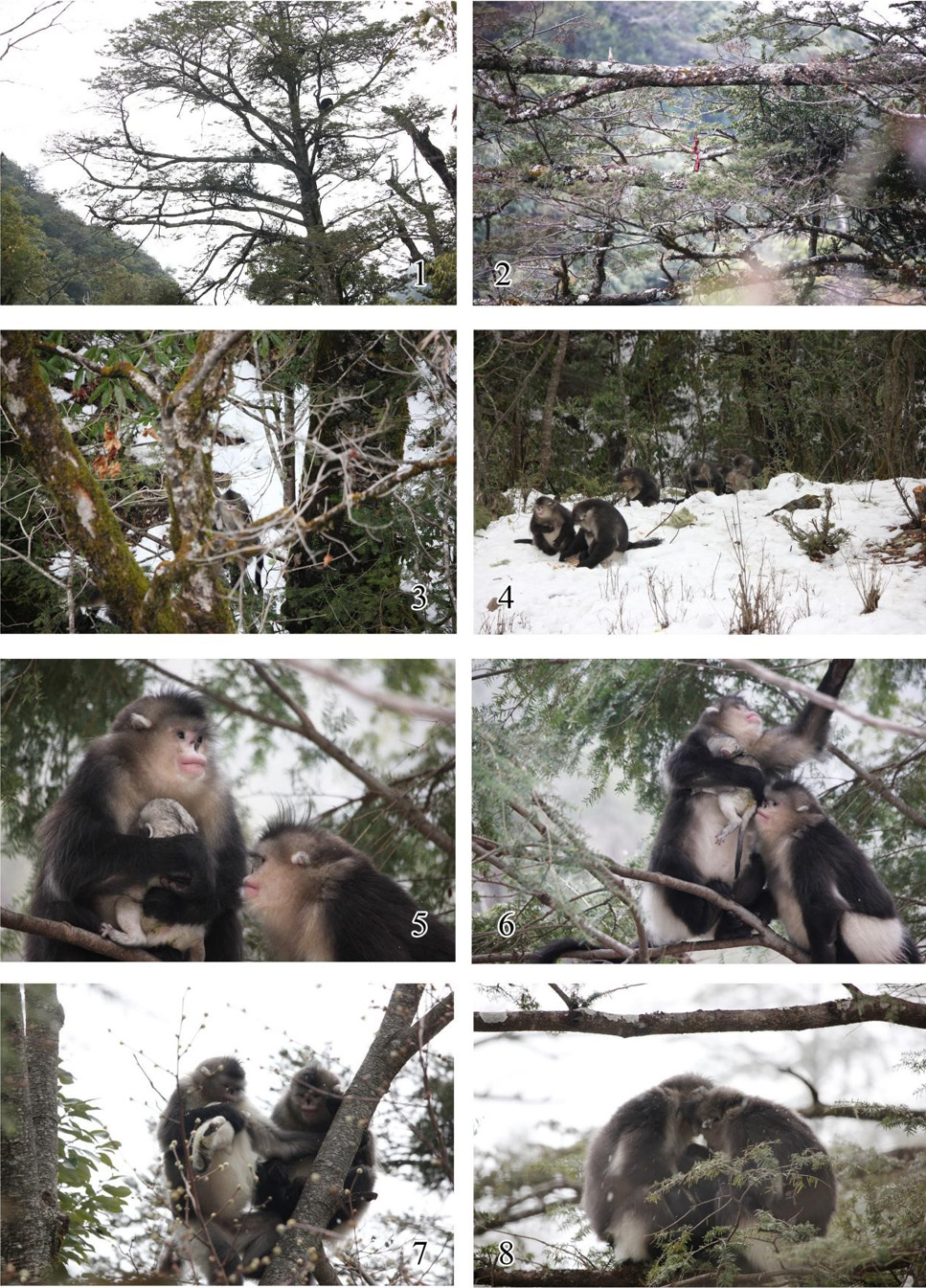
Postbirth behavior of Rhinopithecus bieti. (1) The birth tree. (2) The placenta, still on the branch where birth occurred. (3) XH embraced the infant and carried it to the ground. (4) LX eating for the first time after giving birth, one hour later. (5) XH nursing the infant. LX smelled her baby while it was in XH’s arms. (6) XH, still holding QJ, left LX. (7) XH kidnapped the infant from ML, who had been grooming it. The infant’s umbilical cord is barely visible. (8) CH grooming the infant.
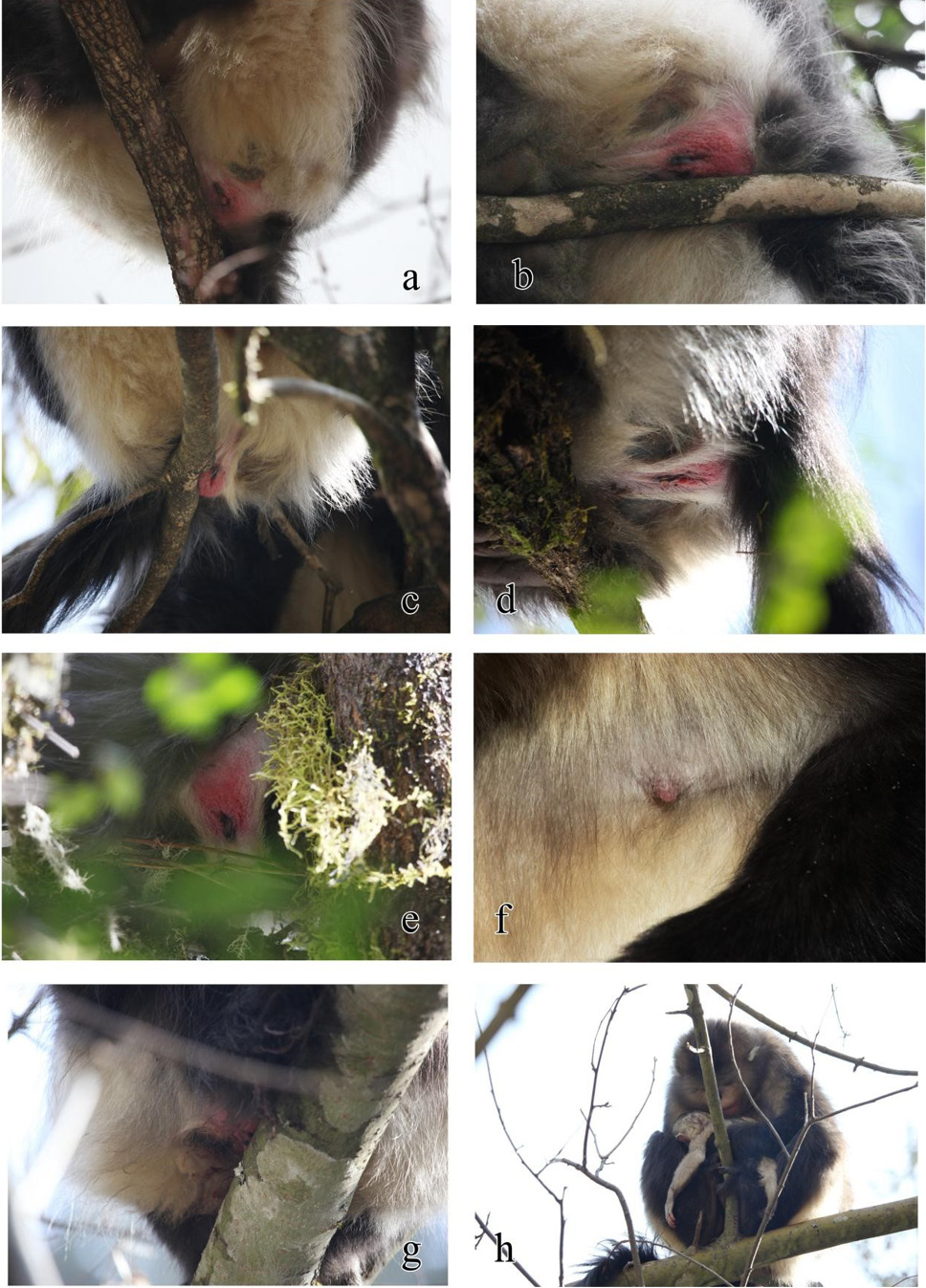
Changes in LK prior to giving birth on March 15, 2017. (a) The vulva started to become red on February 25, 2017. (b) The vulva was redder, with a raised pattern, on February 26, 2017. (c) The vulva was bright red and protruded when LK sat on branch on March 8, 2017. (d) Transparent fluid was visible dripping from the vulva at 15:02 on March 14, 2017. (e) The vaginal orifice was black and wet at 16:02 on March 14, 2017, but she had yet to show discomfort. As the OMU went to feed, LK moved on the ground cautiously. (f) The engorged breast, with protruding nipple. (g) The vulva, covered with blood after giving birth. (h) LK embracing the infant with both hands in the early morning.
References
- Altmann, J., 1974. Observational study of behavior: Sampling methods. Behaviour, 49: 227-265. https://doi.org/10.1163/156853974X00534[CrossRef]
- Chism, J., Olson, D.K. and Rowell, T.E., 1983. Diurnal birth and perinatal behavior among wild patas monkeys: evidence of an adaptive pattern. Int. J. Primatol., 4: 167-184. https://doi.org/10.1007/BF02743756[CrossRef]
- Deluycker, A., 2014. Observations of a daytime birthing event in wild titi monkeys (Callicebus oenanthe): implications of the male parental role. Primates, 55: 59-67. https://doi.org/10.1007/s10329-013-0368-0[CrossRef]
- Dias, P.A.D., 2005. Observation of parturition in the Mexican mantled howler monkeys (Alouatta palliata) on the Island of Agaltepec, Veracruz State, Mexico. Am. J. Primatol., 65: 93-98. https://doi.org/10.1002/ajp.20100[CrossRef]
- Ding, W., Yang, L. and Xiao, W., 2013. Daytime birth and parturition assistant behavior in wild black-and-white snub-nosed monkeys (Rhinopithecus bieti) Yunnan, China. Behav. Process., 94: 5-8. https://doi.org/10.1016/j.beproc.2013.01.006[CrossRef]
- Douglas, P.H., 2014. Female sociality during the daytime birth of a wild bonobo at Luikotale, Democratic Republic of the Congo. Primates, 55: 533-542. https://doi.org/10.1007/s10329-014-0436-0[CrossRef]
- Duboscq, J., Neumann, C., Perwitasari-Farajallah, D., and Engelhardt, A., 2008. Daytime birth of a baby crested black macaque (Macaca nigra) in the wild. Behav. Process., 79: 81-84. https://doi.org/10.1016/j.beproc.2008.04.010[CrossRef]
- Gorzitze, A.B., 1996. Birth-related behaviors in wild proboscis monkeys (Nasalis larvatus). Primates, 37: 75-78. https://doi.org/10.1007/BF02382922[CrossRef]
- Huang, K., Xia, W.C., Fu, Y., Wan, Y.Q., Feng, H., Krzton, A., Li, J.Q., and Li, D.Y., 2021. The dominance hierarchy of the female Yunan snub-nosed monkeys, Rhinopithecus bieti. Pakistan J. Zool., 53: 1881-1887. https://doi.org/10.17582/journal.pjz/20200621150639[Full text][CrossRef]
- Jolly, A., 1972. Hour of birth in primates and man. Folia Primatol., 18: 108-121. https://doi.org/10.1159/000155472[CrossRef]
- Kumar, A., Solanki, G.S., and Sharma, B.K., 2005. Observations on parturition and allomothering in wild capped langur (Trachypithecus pileatus). Primates, 46: 215-217. https://doi.org/10.1007/s10329-004-0121-9[CrossRef]
- Li, D.Y., Ren, B.P., Grueter, C.C., Li, B.G. and Li, M., 2010a. Nocturnal sleeping habits of the Yunnan snub-nosed monkey in Xiangguqing, China. Am. J. Primatol., 72: 1092-1099. https://doi.org/10.1002/ajp.20871[CrossRef]
- Li, D.Y., Ren, B.P., Li, B.G., and Li, M., 2010b. Range expansion as a response to increasing group size in the Yunnan snub-nosed monkey. Folia Primatol., 81: 315-329. https://doi.org/10.1159/000322515[CrossRef]
- Li, Y., Ren, B.P., Li, Y.H., Li, D.Y. and Hu, J., 2013. Behavior ethogram and PAE coding system of Rhinopithecus bieti. Sichuan J. Zool., 32: 641-650. [in Chinese].
- Li, Y.H., Li, D.Y., Ren, B.P., Hu, J., Li, B.G., Kraton, A. and Li, M., 2014. Differences in the activity budgets of Yunnan snub-nosed monkeys (Rhinopithecus bieti) by age-sex class at Xiangguqing in Baimaxueshan Nature Reserve, China. Folia Primatol., 85: 335-342. https://doi.org/10.1159/000368831[CrossRef]
- Lott, D.F., and McCoy, M., 1995. Asian rhinos (Phinoceros unicornis) on the run? The impact of tourist visits on one population. Biol. Conserv., 73: 23-26. https://doi.org/10.1016/0006-3207(95)90053-5[CrossRef]
- Mann, J., and Suts, B., 1999. Behavioral development in wild bottlenose dolphin newborns (Tursiops Sp.). Behaviour, 136: 529-566. https://doi.org/10.1163/156853999501469[CrossRef]
- Nguyen, N., Lee, L.M., Fashing, P.J., Nurmi, N.O., Stewart, K.M., Turner, T.J., Barry, T.S., Callingham, K.R., Barret Goodale, C.B., Kellogg, B.S., Burke R.J., Bechtold E.K., Claase, M.J., Eriksen, G.A., Jones, S.C.Z., Kerby, J.J.T., Kraus, J.B., Miller, C.M., Trew, T.H., Zhao Y., Beierschmitt E.C., Ramsay M.S., Reynolds J.D., and Venkataraman, V.V., 2017. Comparative primate obstetrics: Observations of 15 diurnal births in wild gelada monkeys (Theropithecus gelada) and their implications for understanding human and nonhuman primate birth evolution. Am. J. Phys. Anthropol., 163: 14-29. https://doi.org/10.1002/ajpa.23141[CrossRef]
- Peker, S., Kowalewski, M.M., Pavé, R.E., and Zunino, G.E., 2009. Births in wild black and gold howler monkeys (Alouatta caraya) in northern Argentina. Am. J. Primatol., 71: 261-265. https://doi.org/10.1002/ajp.20643[CrossRef]
- Ratnayeke, A.P., and Dittus, W.P., 1989. Observation of a birth among wild toque macaques (Macaca sinica). Int. J. Priamtol., 10: 235-242. https://doi.org/10.1007/BF02735202[CrossRef]
- Sekulic, R., 1982. Birth in free-ranging howler monkeys Alouatta seniculus. Primates, 23: 580-582. https://doi.org/10.1007/BF02373970[CrossRef]
- Starin, E.D., 1988. Gestation and birth-related behaviors in Temminck’s red colobus. Folia Primatol., 51: 161-164. https://doi.org/10.1159/000156368[CrossRef]
- Timmermans, P.J.A., and Vossen, J.M.H., 1996. The influence of repeated motherhood on peri parturitional behavior in cynomolgus macaques (Macaca fascicularis). Int. J. Primatol., 17: 277-296. https://doi.org/10.1007/BF02735453[CrossRef]
- Treves, A., and Brandon, K., 2005. Tourism impacts on the behavior of black howler monkeys (Alouatta pigra) at Lamanai, Belize, In: Commensalism and conflict: The human-primate interface (eds. J.D. Paterson and J. Wallis). Norman, OK. Am. Soc. Primatol. Publ., pp. 146-167.
- Turner, S.E., Fedigan, L.M., Nakamichi, M., Matthews, H.D., Mckenna, K., Nobuhara, H., Nobuhara, T., and Shimizu, K., 2010. Birth in free-ranging Macaca fuscata. Int. J. Primatol., 31: 15-37. https://doi.org/10.1007/s10764-009-9376-8[CrossRef]
- Xia, W.C., Ren, B.P., Li, Y.H., Hu, J., He, X.M., Krzton, A., Li, M. and Li, D.Y., 2016. Behavioural responses of Yunnan snub-nosed monkeys (Rhinopithecus bieti) to tourists in a provisioned monkey group in Baimaxueshan Nature Reserve. Folia Primatol., 87: 349-360. https://doi.org/10.1159/000454922[CrossRef]
- Xia, W.C., Zhang, C., Zhuang, H.F., Ren, B.P., Zhou, J., Shen, J., Krzton, A., Luan, X.F. and Li, D.Y., 2020a. The potential distribution and disappearing of Yunnan snub-nosed monkey: Influences of habitat fragmentation. Glob. Ecol. Conserv., 21: e00835. https://doi.org/10.1016/j.gecco.2019.e00835[CrossRef]
- Xia, W.C., Ren, B.P., Zhou, H., Feng, H., He, X.M., Krzton, A., Hu, J., Aouititon, M., Luan, X.F. and Li, D.Y., 2020b. Reproductive parameters of wild Rhinopithecus bieti. Folia Primatol., 91: 202-218. https://doi.org/10.1159/000503246[CrossRef]
- Xia, W.C., Ji, S.N., Ren, B.P., He, X.M., Zhong, T., Krzton, A., Tang, Y., Li, D.Y., 2020c. Proximate causes of dispersal for female Yunnan snub-nosed monkeys. Zool. Res., 41: 78-83. https://doi.org/10.24272/j.issn.2095-8137.2020.008[CrossRef]
- Yang, B., Zhang, P., Huang, K., Garber, P.A. and Li, B.G., 2016. Daytime birth and post birth behavior of wild Rhinopithecus roxellana in the Qinling Mountains of China. Primates, 57: 155-160. https://doi.org/10.1007/s10329-015-0506-y[CrossRef]
- Yao, M., Yin, L.J., Zhang, L., Liu, L.J., Qin, D.G. and Pan W.S., 2012. Parturitions in wild white-headed langurs (Trachypithecus leucocephalus) in the Nongguan Hills, China. Int. J. Primatol., 33: 888-904. https://doi.org/10.1007/s10764-012-9625-0[CrossRef]
Services
Article usage statistics
Loading…