
Aphidius smithi (Aphidiinae: Hymenoptera) is an important endoparasitoid of pea aphid (Acyrthosiphon pisum) which has been utilized to determine the effectiveness of this agent in reducing pest damage. Biology of the A. smithi reared on A. pisum in the laboratory at 23± 1°C has been studied. The development cycle of A. smithi from larvae to adult was completed in about 11 days. The pre-mating period of males (n=10) varied between 5 and 8 min (mean: 4 min). Copulation time (n = 10 pairs) was between 33 and 55 sec (mean: 45.2 sec). Oviposition time (n = 10 females) was between 1 and 2 sec (mean: 1.5 sec). Female parasitoids lived longer (5.75 days) than male parasitoids (4 days) when offered honey and water as a food diet. Lifespan of adult male and females was shorter i.e. 2.25 and 2.75 days respectively when fed upon dissected aphid. When adult parasitoids were released on pea plant provided with pea aphid, mean period of life for male and female was 4.75 and 6 days respectively. Sex ratios of field collected mummies were female biased (60%). Two species of hyperparasitoids viz. Asaphes suspensus (68%) and Pachyneuron aphidis (54%) were involved. Examination for phenotypic polymorphism showed that field population of A. smithi contained both dark and light pigmentation pattern of abdominal segments while laboratory reared samples were only dark pigmented in both sexes. The findings of this study can help in defining strategies for the rearing to release this parasitoid in biological control programs against A. pisum in Pakistan.
Research Article · Volume 55, Issue 5, 5 September 2023 · Open Access
Biological Parameters of Aphidius smithi Sharma and Subba Rao (Hymenoptera: Aphidiinae), A Parasite of the Pea Aphid, Acyrthosiphon pisum (Homoptera: Aphididae) Under Laboratory Conditions
· · ·
Affiliations & Notes ⌄
- 1Department of Plant Protection, Pest Warning and Quality Control of Pesticides Lahore, Pakistan 2Department of Entomology, Pir Mehr Ali Shah Arid Agriculure Universiy, Murree Road, Rawalpindi, Pakistan 3Fareed Biodiversity and Conservation Centre, Department of Agriculture Engineering, Khwaja Fareed University of Engineering and Information Technology, Rahim Yar Khan, Punjab, Pakistan * Corresponding author: taslstar@yahoo.com 0030-9923/2023/0005-2407 $ 9.00/0
Article Info ⌄
- Journal:
- Pakistan Journal of Zoology
- Published:
- 5 September 2023

From the article
- Our study constitutes the developmental time, adult longevity, coloration and position of emergence hole of mummified aphid, phenotypic differences, parasitism rate, and sex ratio of A. smithi.
- In the present investigation, maximum parasitism was observed in 3rd instars of A. pisum (83.44%) followed by 4th instars (65.22%) than 1st and 2nd instars (Fig. 2) As the 1st instars (1-day) showed higher mortality because they are more fragile than 3rd and 4th instars aphids.
- The adult parasitoid of A. smithi lived shorter when fed only on water and honey solution compared to those kept with pea aphid as a host to feed on honey dew, their longevity was relatively longer than other artificial food therefore mean life of male and female was 4.75 and 6 days, respectively.
- Male and female population of field collected mummified aphid were female biased.
Selected from the article's own text.
Abstract
INTRODUCTION
Aphids are important pests of cultivated crops in Pakistan. They not only reduce the yield of crops but also serve as vectors of disease. Irshad (2001) mentioned that about 92 species of aphids are in Pakistan. Naumann-Etienne and Remaudiére (1995) listed 300 different species of aphids in various ecological zones of Pakistan from different host plants. Additionally, many studies (Hassan et al., 2010; Bodlah et al., 2011, 2017; Amin et al., 2017a, b; Kanturski et al., 2017; Maryam et al., 2019) have added many new records from Pakistan but still no formal updated list of aphid fauna is available. Among different aphid’s species, Acyrthosiphon pisum, commonly known as the pea aphid, is a sap-sucking insect in the Aphididae family. It is considered as the model aphid species as its reproductive cycle, including the sexual phase and the overwintering of eggs can be easily completed on host plants under laboratory conditions (Aqueel et al., 2014). Considering their economic importance towards agricultural crops, it is necessary to adopt timely control measures in order to avoid losses caused by these tiny creatures. In Pakistan, aphids have mostly been controlled by insecticidal applications. However due to adverse effects of insecticides, total reliance on them cannot be made (Irshad, 2001). So, there is a need to design a complete integrated pest management (IPM) strategy to overcome the side effects of pesticides. In IPM programme, the role of parasitoids and predators are very important (Snyder and Ives, 2003). Predators and parasitoids both are playing an important role in successful control of aphids but aphid parasitoids have achieved more success than predator’s viz. 21.8% and 4.1%, respectively (Hirose, 2006) and commonly used in biological control programs in greenhouses and field situations (Boivin et al., 2012). In Pakistan, the importance of biological control has been discussed by Irshad (1987) and Mohyuddin (1981). Biological control work on aphids in Pakistan has also been reported (Alam et al., 1969; CIBC, 1977; Habib, 1973; Hamid, 1983; Hamid et al., 1974; Khalil et al., 1990; Mughal and Munshi, 1985; Mustafa et al., 1996; Suhail et al., 1999). A. smithi is native to Pakistan and India (Sharma and Subbarao, 1958) but still has not been reared for controlling pea aphid in Pakistan. Current studies would provide basis for its possible utilization as a bio-control agent for the management of pea aphid in Pakistan. In Pakistan, both pea aphid and its parasitoid have been reported (Starỳ et al., 1998; Naeem et al., 2005). Several studies have been done on mass rearing of A. smithi and utilizing of these natural enemies in the field in parts of the world but poor studies has been done in Pakistan.
To serve as a baseline of information in our efforts to determine the effectiveness of A. smithi as a biological control agent of A. pisum, we studied various developmental stages of A. smithi on its host, adult longevity, host age preference for parasitism, sex ratio, pre-oviposition time and oviposition behavior, pre mating time and mating time, sex ratio of field collected mummies at laboratory conditions, mummy coloration and position of emergence hole and phenotypic differences of its field population. The present study will help the future workers of Pakistan to utilize this parasitoid in integrated pest management programs as a source of effective biological control agents for pea aphid management under the field conditions as well as in green houses.
MATERIALS AND METHODS
Study site
Present investigations were carried out at biological control laboratory of Entomology Department, PMAS-Arid Agriculture University, Rawalpindi during 2012-13. Pea crop was sown with double rows spaced at least 12 to 18 inches apart over an area of 1 acre for collection of aphids, parasitoids and hyperparasitoid. All recommended agronomic practices were applied to the crop.
Rearing of Acyrthosiphon pisum
Adult females of A. pisum were collected from the field of pea. In laboratory, females aphids (n=50) were released on the leaves of pea plants (n=6) in order to maintain aphid culture. Aphids of the same age (1st instars to 4th instars) were maintained and used for further experiments.
Rearing of Aphidius smithi
Both male and female individuals of A . smithi were collected from field of pea plants and reared on A. pisum in biological control laboratory of Entomology Department, at 23±1˚C. Male and female individuals of A. smithi were released in separate glass jars and kept there for mating. Hundred aphids (3rd instars obtained from aphid culture) were placed in 4 glass jars, containing pea plant leaves, covered with muslin cloth. Three mated females were taken and released in glass jar with aphids for 48 h. They were provided with 10% honey solution soaked in cotton. Mummified aphid on the pea plant leaves were collected from glass jars after 4-5 days and put in small gelatinized capsules (2×0.5cm) until emergence. Emerged individuals were again used to maintain culture of A. smithi.
Life cycle of Aphidius smithi
In order to study the life cycle of A. smithi, 500 aphids (3rd instars of A. pisum from aphid culture) were nourished on pea plant leaves in four glass jars. Each jar was provided with fresh pea plant leaves after two days. Five mated females of A. smithi (from maintained culture) were released in jars for a period of 48 h. After removal of females from the jar, mummified aphids (at least 10 from each jar) were also removed after every 24 h for dissection. Ten mummified aphid from each jar were taken on daily basis and dissected daily under the microscope (Swift SM-80 with magnification 2xs and 4xs). Color photographs of each developmental stage were also taken. Morphological variations in each stage from larval instars to adult stage were noted and snapped under Nikon microscope. Time taken by each stage was noted in days.
Effect of different diets on parasitoids longevity
In the first treatment, four replications of five A. smithi individuals both males and females were released in Petri plates supplied with artificial diet (honey + water on cotton wool). Adults were allowed to feed on artificial diet until death. Numbers of days of insect life were counted from 1st day of release till death. In the 2nd treatment, five individuals of A. smithi were released for their whole life time (until death) on potted plants of pea with 3rd instars nymphs of A. pisum in laboratory. Potted plants were wrapped with polythene bags. Polythene bags were provided with a piece of muslin cloth for ventilation. Number of days of life was counted from 1st day of release of adult until death. In the 3rd treatment, five females and males were allowed to feed on dissected A. pisum in Petri plates with four replications. Number of days of life was counted from 1st day of release of adult until death.
Determination of pre-mating time, copulation time, pre-oviposition time
In order to observe pre-mating time and copulation time, ten observations were made by releasing 10 males and 10 females of A. smithi in Petri dishes plates. Pre-mating and mating time were noted using stop watch in seconds. Similarly, pre oviposition time was also noted for ten mated females when released in Petri dishes containing 3rd instars aphid (A. pisum) with three replicates.
Male and female population of field collected parasitoids and hyperparasitoid
For determination of male and female population of field collected mummies, about 200-500 aphid mummies were collected after every 5 days and reared under laboratory conditions till the emergence of parasitoids and hyperparasitoids. Emerged parasitoids and hyperparasitoids were separated into males and females to determine the effect of hyperparasitism on sex ratio.
Mummy coloration and position of emergence hole
Mummies were observed under binocular microscope for their colouration and position of emergence hole made by parasitoids and hyperparasitoids and coloured photographs were snapped.
Determination of phenotypic differences of field population of Aphidius smithi
Phenotypic differences of field collected population as well as laboratory collected population of A. smithi were observed under microscope and snapped.
RESULTS
Life stages of Aphidius smithi
Various life stages of A. smithi were studied on A. pisum in the laboratory at 23±1°C. During oviposition, mated female of A. smithi laid eggs singly in the adipose tissues of aphid. Parasitized aphid continued feeding and remains attached to the leaves of host plant after oviposition (Fig. 1A). Mummified aphid changed into golden yellow (Fig. 1B). After oviposition period, hatching started after 72±1h, blackish larva was observed on feeding of soft adipose tissue in the aphid’s metasoma (Fig. 1C). After 96±1h, dissections showed that blackish larva changed into yellow colour (Fig. 1D). On 5th day of development, larva was still yellowish in colour but it was entirely changed from the 4th day larva, head, mesosoma and metasoma were clearly differentiated (Fig. 1E). Other body parts like antennae, legs and wings started to develop but transparent in colour (Fig. 1F). There were four larval instars completed inside the mummified aphid. The metasoma was cleaned out then mesosoma and head. On 6th day, larva started segmentations. Head and mesosoma changed into dark colour; antennae and wings were not completely developed at that time (Fig. 1G). On 7th day, no considerable changes occurred in the larva. On 8th day of development, larva changes into pre pupae stage (Fig. 1H). On 9th day, larva turned into pupa (Fig. 1I). On the 11th day, pupa changed into mummy (Fig. 1J). At the same day, adult emerged out by making an opening in the metasoma of the host (Fig. 1K). Total life cycle of A. smithi inside the host (A. pisum) from oviposition to emergence was completed in 11th day (Table I).
Table I. Development duration of Aphidius smithi when reared on Acyrthosiphon pisum.
| Biological parameters | n | Mean ± SE |
| Hatching period (h) | 3 | 81±1.45 |
| Ovi-position to mummification time (h) | 3 | 80±8 |
| Pupal period (h) | 3 | 177±5.10 |
| Ovi-position to emergence time (h) | 3 | 245±18.17 |
Adult longevity
Data analysis showed that diet had a significant effect on adult parasitoids longevity. In first treatment when honey solution was used as food, the average life of male and female was 4 and 5.75 days, respectively. In second treatment, mean life of male and female was 2.25 and 2.75 days, respectively when fed upon dissected aphid. While in the 3rd treatment, when adult parasitoids were released on pea plants provided with pea aphid as a host to feed on honey dew, their longevity was relatively longer than other artificial food therefore mean life of male and female was 4.75 and 6 days, respectively (Fig. 3).
Pre-mating time, copulation time, pre-oviposition time and oviposition time
One or two males copulated with virgin females within few minutes of emergence while others showed no attraction towards the virgin females until 2 to 3 h after emergence. Mostly pre-mating time of males (n= 10) was between 5 and 8 min with average time of 4±0.53 min. however, it was longer in females. The majority of females rejected all copulatory attempts at least two h after emergence. When newly emerged females were confined with males for a period of 12 h, all were started to be mated i.e., they produced offspring of both sexes. Copulation time (n= 10 pairs) was between 33 and 55 sec with mean value of 45.2±2.63 sec. Pre-oviposition period was between 1 and 8 min with mean value of 2.8±0.65 min while its oviposition time was between 1 and 2 sec with mean value of 1.7±0.21 sec (Table II).
Table II. Various biological parameters of Aphidius smithi at 23 ̊C±1.
| Biological Parameter | n | Mean ± SE |
| Pre- mating time of male (Min) | 10 | 4±0.53 |
| Mating time of male (Sec) | 10 | 45.2±2.63 |
| Pre-oviposition time (Min) | 10 | 2.8±0.65 |
| Oviposition time (Sec) | 10 | 1.7±0.21 |
Male and female population of aphid parasitoids and hyperparasitoids in field conditions
A total of 1855 mummies were collected from the field throughout experiment. Out of them 744 were the males (40%) and 1111 were the females (60%) (Table III). A total of 417 aphid mummies were found to have hyperparasitism. Two species of hyperparasitoids viz. Asaphes suspensus and Pachyneuron aphidis were involved. Sex ratio of these two species was female biased. Out of 417 hyperparasitoids, 257 (62%) were females and 160 (38%) were males. A. suspensus was the most abundant hyperparasitoid (68%) which parasitized A. smithi while P. aphidis was the least numbers (54%) (Table IV).
Table III. Sex ratio of field collected parasitoids during 2012-13.
| Sex ratio | Collected parasitoid | Percentage | Average±S.E |
| Male | 744 | 40 | 37.2±4.30 |
| Female | 1111 | 60 | 55.55±7.13 |
Table IV. Species wise sex ratio of field collected aphid hyper parasitoids during 2012-13.
| Name of species | Female (%) | Male (%) | Total |
| Asaphes suspensus | 155 (68%) | 72 (32%) | 227 |
| Pachyneuron aphidis | 102 (54%) | 88 (46%) | 190 |
Mummy colouration and position of emergence hole of hyperparasitoids
Colour photographs of hyperparasitoids mummies with emerging hole were taken under Nikon microscope. From light yellowish mummy of A. suspensus, adult hyperparasitoid produced an apical irregular hole at the middle end (Fig. 4A, B) while from the whitish yellow mummy of P. aphidis, adult hyperparasitoid made an irregular hole on the left side above cornicle (Fig. 4C, D).
Phenotypic polymorphism
Field population of A. smithi contained both dark and light pigmentation pattern of abdominal segments while laboratory reared samples were only dark pigmented in both sexes. Field reared dark phenotype contained all abdominal segments pigmented with regular bands while light phenotype with bright orange pigmentation (Fig. 5A-D). Phenotypic polymorphism in laboratory reared population of A. smithi resulted in a single pigmentation pattern of both genders (Fig. 6A-B).
DISCUSSION
Biological control agents are often first tested under laboratory condition to evaluate their potential for success (Kalyebi et al., 2015). Parasitic natural enemies of aphids such as Aphidius spp., have been successfully used in the suppression of aphid populations (Van, 2012). Our study constitutes the developmental time, adult longevity, coloration and position of emergence hole of mummified aphid, phenotypic differences, parasitism rate, and sex ratio of A. smithi.
Successful introduction of a biological control agent such as parasitoids requires knowledge of its lifecycle and interactions with the host (Mutitu et al., 2013). In the present research, various life stages of A. smithi on A. pisum were studied in the laboratory at 23±1°C. Total life cycle of A. smithi inside the host (A. pisum) from oviposition to adult emergence was completed in 11 days (Table I) similarly to other Aphidius species at 20-22°C (Kalule and Wright, 2004; Dhiman, 2006; Colinet et al., 2005). The development behavior of A. smithi was also similar to the results given by Starý (1970) for Aphidius species. Adult female laid eggs singly in the host. The hatching larva lived inside the body cavity of host and used all material leaving just exoskeleton of aphids. Larva made a clean circular hole with one of its mandibles in the Venter of aphid body and fixed the later to the plant part with a silk-like secretion. The larva pupated within the aphid body and dead aphid changed into a mummy. The adult parasitoid cut with its mandibles a circular hole in abdominal part of aphid, usually between the siphunculi. The colour and form of the mummies and the form of the emergence hole may be used to some extent for identification of the most abundant species of Aphidiinae attacking known hosts on a certain crop (Powell, 1982). Aphidiinae parasitoids exhibit a well integrated symbiotic relation with their host during larval development of A. smithi in pea aphid feeding on holidic diets (Cloutier,1978, 1986; Cloutier and Mackauer, 1979).
In biological control, host instars selection by a parasitoid is among the most important factors that affect its potential to reduce an aphid population (Hågvar and Hofsvang, 1978). In the present investigation, maximum parasitism was observed in 3rd instars of A. pisum (83.44%) followed by 4th instars (65.22%) than 1st and 2nd instars (Fig. 2) As the 1st instars (1-day) showed higher mortality because they are more fragile than 3rd and 4th instars aphids. Reason interrelated with the mortality of 1st instars (1- day aphid) might be more susceptible to injuries during oviposition as an effect of venom or sting injection. As compare to the adult aphids that did not have such type of issues from parasitoids. A. smithi generally preferred older aphids which were larger in size and age than other Aphidiinae species which are usually prefer small or medium sized aphid nymphs (Perdikis et al., 2004). All our observations also agreed with the results of (He et al., 2005; Lin and Anthony, 2003). Therefore, the present study indicates that host preference could be an important factor for effectiveness of A. smithi against A. pisum.
Successful biological control is to some extent dependent on the longevity of beneficial insects. Availability of carbohydrates in adipose tissue of host can improve the nutrition of parasitic insects, and thereby increase their longevity. Evidence suggests that individual fitness benefits afforded by food sources are important for a time-limited parasitoid (Williams and Roane, 2007). Providing parasitoids with food will result in increased longevity and subsequent parasitism rates (Irvin et al., 2007). Longevity is generally influenced by searching activity, mating, oviposition, body size, temperature, humidity, photoperiod and diet (Jervis and Copland, 1996). In present study, food provision of female parasitoids affected their longevity significantly. The adult parasitoid of A. smithi lived shorter when fed only on water and honey solution compared to those kept with pea aphid as a host to feed on honey dew, their longevity was relatively longer than other artificial food therefore mean life of male and female was 4.75 and 6 days, respectively. Development time of females was greater than of males on all host diet. Present study revealed that nutritional needs of parasitoids on artificial diets are not always efficient because of low nutritional quality. On the contrary, the importance of host feeding and natural food supplied to parasitoids by host species that is related to the long lasting host parasitoid interactions still maintain its validity and reliability. These results are in conformity with the already recorded observations of Bodlah et al. (2012) on Diaeretiella rapae who stated that female lived longer (11.1±0.16 days) than males (9.4±0.18 days). Adult longevity of parasitoids was even shorter when they were kept with dissected aphid (Rakhshani, 2001). Female longevity of Aphidius gifuensis is also greater than male (Chi and Su, 2006).
In our study, average pre-mating time of males was 4 min; however, it was longer in females at least two h after emergence. Average copulation time was 45.2 sec. Mean pre-oviposition period was 2.8 min while its oviposition time was between 1 and 2 sec (Table II). All our observations agreed with the observations of Sheng and Carver (1985).
Male and female population of field collected mummified aphid were female biased. Females were more in number as compared to the males because they consisted of 59.89% of the total collected mummies from the field (Table III). It has been determined in many studies that hymenopterous females regulate their sex ratio in response to variety of ecological (availability of food, temperature etc.) and biological factors (parasitoid age, host size, host age, host density etc.) (Medeiros et al., 2006; Bogdanovic et al., 2009; Yu et al., 2003; Fuester et al., 2003; Garcia-Medel et al., 2007). Similar results were found by Starỷ (1988) who reported that population of parasitoids under field condition was female biased. It was also confirmed by King (1987) that the sex ratio of adult wasp under field conditions was female biased. Our results are also correlated with the study of Kos et al. (2008) who documented that population of several species of aphid parasitoid was female biased. Aphidius parasitoids frequently produce female biased sex ratios early in adult life (He and Wang, 2006). Two species of hyperparasitoids viz. Asaphes suspensus and Pachyneuron aphidis were identified. A. suspensus was the most abundant hyperparasitoid species (54%) which parasitized the A. smithi while P. aphidis was in least numbers (46%) (Table IV).
Phenotypic polymorphism involving coloration or pigmentation pattern was examined in field population of Aphidius smithi by Mackauer (1968). Our results are in line with Mackauer (1968) with reference to field population with both dark and light pigmentation pattern of abdominal segments. Phenotypic differences were more distinct in female gender. The difference of pigmentation in field population may be due to continuous fluctuation in temperature and humidity of the filed environment which were constant under laboratory condition and resulted in a single pigmentation pattern in laboratory reared samples of both genders.
As pea aphid is a serious pest in Pakistan and many other countries of the world. So our standardized parameters will not only helpful for only the mass rearing of A. smithi in Pakistan but other countries too. After mass rearing in bio-control laboratories, this parasitoid like other bio-control agents, would be the part of IPM programs under the field conditions as well as in green houses in Pakistan.
ACKNOWLEDGEMENT
We are grateful to Department of Entomology, PMAS Arid Agriculture University Rawalpindi for providing Biological control laboratory facility, research area and technical facilities.
Statement of conflict of interest
The authors have declared no conflict of interest.
Figures
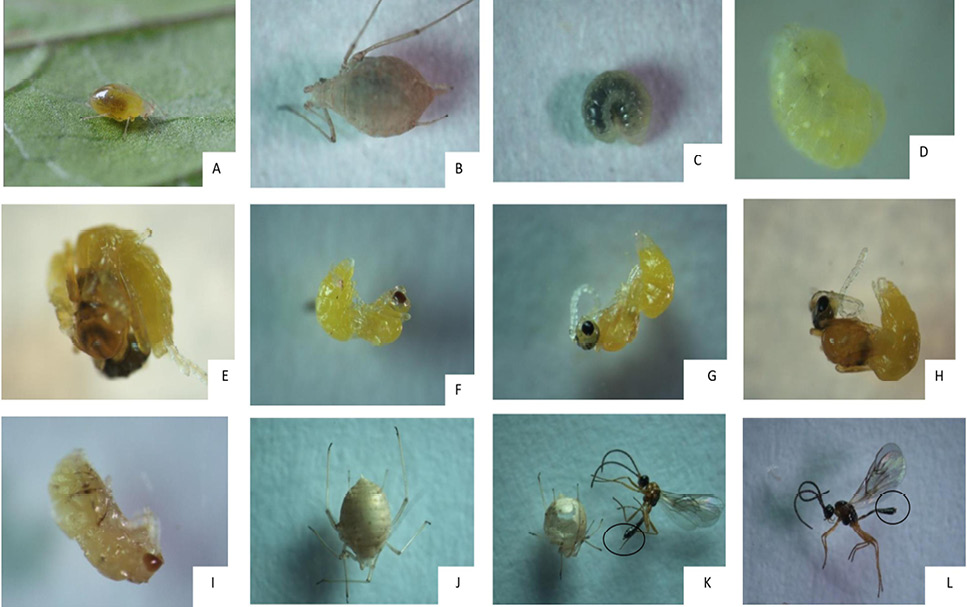
Life cycle of Aphidius smithi on Acyrthosiphon pisum; parasitized aphid (A), mummified aphid (B), newly hatched (C), later stage (D), 4th days old larvae (E), 5th days old larvae (F), 6th days old larvae (G), 8th day pre pupae stage (H) and on 9th changed into pupae (I). fully developed mummy (J), pupae changed into adult female at 11 days and emerged from host on the same day (K), male adult parasitoids (L).
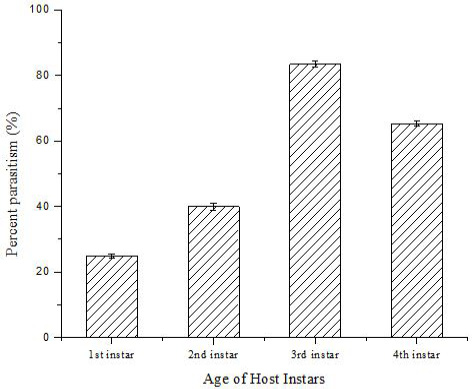
Comparison of different aphid parasitized by A. smithi female in relation to host age (mean values with SD, n=20).
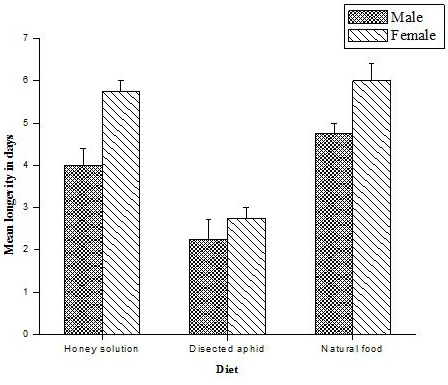
Effect of different diet sources on adult longevity of Aphidius smithi (mean values with SD, n= 5).
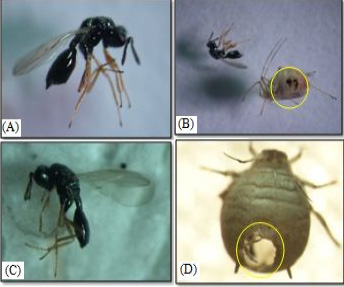
Mummy coloration and position of emergence hole of hyperparasitoids with its respective species. Pachyneuron aphidis (A, B) and Asaphes suspensus (C, D).
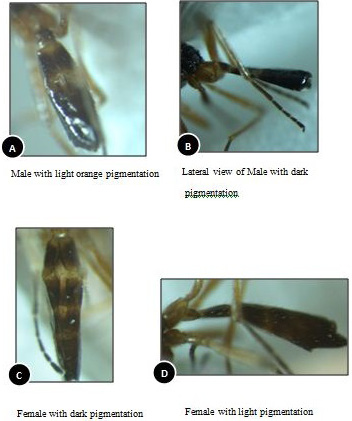
Phenotypic polymorphism in field population of Aphidius smithi.
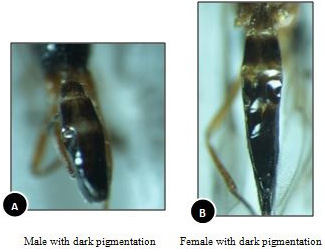
Phenotypic polymorphism in laboratory reared population of Aphidius smithi.
References
- To check the effect of parasitism on aphid age, 1-day old, 2 days old, 3 days old and 4 days old were secured from maintained culture of aphids. Each age group was replicated three times in Petri plates supplied with 20 aphids reared on pea plant leaves. Three mated females of A. smithi from maintained culture were released in each replicate and remained for their whole life. The parasitoid was given with honey and moistens cotton. The mummies were counted at each second day after ten days of release in Petri dishes and then removed from leaf.
Services
Article usage statistics
Loading…