
The current study was carried out on avian diversity and main ecological factors occurring at Gharo Creek, district Thatta, Sindh, Pakistan, from April 2020 to March 2021. Data were collected both early in the morning (7:00-10:00 am) and in the evening (3:00 to 6:00 pm) by using the point count method in three main selected habitat types. A total of 112 bird species belonging to 15 orders, 40 families, and 71 genera occurring in the study area. Among the three habitat types, the more diverse and abundant habitat of birds was Creek (51%) followed by scrubland (27%) and Bhambore fort (21%) with Shannon diversity index (3.701). The more diverse and abundant bird species were the winter visitors followed by resident species. The common birds with higher numbers were Indian black-winged stilt (375) followed by great egret (180), western reef egret (75), house sparrow (72), little egret (60), house crow (55), common myna (43), white eared bulbul (40) and greater sand plover (40). In the Gharo Creek area significantly (P<0.05) higher diversity was recorded as compared to the Scrubland forest area and Bhambor (Terrestrial) Fort area. However, threats responsible for the decline of biodiversity and density of avifauna include destruction of habitats, soil erosion, human interaction, drought, illegal killing, predation, water pollution, scarcity of food, and unfavorable environmental conditions. The study area is rich in bird diversity however, awareness campaigns and enforcement of legislation are required on a priority basis to conserve the avian diversity, distribution, and address the threats.
Research Article · Volume 56, Issue 2, 28 January 2024 · Open Access
Avian Diversity and its Associated Threats in Gharo Creek, District Thatta, Sindh, Pakistan
· · · · · · · ·
Affiliations & Notes ⌄
- 1Department of Zoology, University of Karachi, Karachi, 75270, Pakistan 2College of Life Sciences, Hainan Normal University, Haikou, 571158, China 3Department of Zoology, Shah Abdul Latif University Khairpur, Sindh, Pakistan 4Department of Zoology, Hazara University, Mansehra, Pakistan, 21300 5Department of Zoology, Bahawalnager Campus, The Islamia University, Bahawalpur, Pakistan * Corresponding author: rahmatullahkhanpk@gmail.com
Article Info ⌄
- Journal:
- Pakistan Journal of Zoology
- Published:
- 28 January 2024

From the article
- Most abundant bird species were Indian black-winged stilt (375), great egret (180), western reef egret (75), house sparrow (72), little egret (60), house crow (55), common myna (43), white-eared bulbul (40) and greater sand plover (40) (Table I).
- We were recorded more birds species in Gharo Creek (which consists of a water body) 51% followed by scrubland 27% and Bhambore fort 21%.
- He also reported bird’s species are more diverse and abundant in dense forests.
- The major threats to the avian fauna of gharo creek are habitat degradation, loss of habitat due to land reclamation, hunting, water pollution, and other anthropogenic activities.
Selected from the article's own text.
Abstract
INTRODUCTION
Birds are vertebrate animals having feathers on their body, bipedal, endothermic, and oviparous that inhabit water bodies, agricultural fields, urbanized areas, rural areas, and mountainous territories on various altitudes ; . Birds belong to class aves with various sizes and morphology, that are distributed worldwide but some bird species are endemic to particular regions of the world and habitats . They range in body size from 2 (inches) that is hummingbird (Mellisuga helenae) to the 118 (inches) ostrich (Struthio camelus). Aves is the major group or class of birds which comprises the subdivision Palaeognathae (group of flightless birds), the tiramisu (birds with weak flight), and the Neognathae (flight birds) . They are pollution-sensitive indicators. Birds devour large numbers of harmful insects, as well as their larvae and eggs, hence serve as biological control agents keeping insect pests populations in check thus being good friends of farmers . They are social, they communicate using visual signals and through calls and songs and participate in social behaviors including cooperative breeding, hunting, floating, and mobbing of predators. Many species are of economic importance, mostly a source of food acquired through hunting or farming. Some species particularly songbirds and parrots are popular as pets . As bird’s richness and diversity are the most prevalent lives, which lead beauty to the existing life on the earth. Apart from this, their essentially beautiful plumage, melodious songs, always have fascinated mankind . It is not too fanciful a metaphor to consider Pakistan as lying at the crosswords of Asia’s major Palearctic bird migration routes. Apart from resident birds, there are an influx of winter visitors from northern breeding grounds, or summer breeding visitors both from the northern mountainous regions and from the Indus plains to warmer southern latitudes. The explanation for the phenomenon appears to lie more in Pakistan’s strategic geographic location rather than in the natural endowment of transport facilities . Similarly, the north of the country is bounded by a continuous palisade of some of the highest mountain ranges in the world, stretching from the Pamirs and Hindukush in Afghanistan, eastward to the Himalayas which continue across the northern frontier of India . The heterogeneous uniqueness of the natural environment is one of the important factors that have increased avian diversity . The current study was aimed to know the avifauna and associated threats.
MATERIALS AND METHODS
Study areas
The current study was conducted in Gharo Creek, district Thatta, Sindh during the study period April 2020 to March 2021. It is situated about 65 km from Karachi Pakistan (Fig. 1).
Based on scientific purpose the study area was divided into three main habitat types.
Habitat I: Gharo Creek (24°44’45.642” N and 67°32’3.018” E).
Habitat II: Terrestrial section of Bhambore Fort area (24°44’58.5” N and 67°31’9.888” E).
Habitat III: Scrubland forest (24°44’51.318” N and 67°31’49.014” E).
Survey design
During the whole study period data were collected in the morning (7:00 am-11:00 am) throughout favorable environmental conditions by using two authentic and recognized methods i.e. (1) Line transect method (2) Point count method. For this purpose four-line transects and four-point counts were placed. For line transect, a straight line of about 1000 (m) in length and with 50 (m) radius on both sides of the line which is data collecting and observation range, while birds spotted outside this range were ignored. Each transect was traveled within 30 minutes covering the distance between two transects (about 1000m). Similarly, for point count, a circle of 50 (m) radius was placed. Inside this range, observations and data were recorded. At each point, observations were recorded for 10 min. The distance between the two points was about 1000 m. Survey and data were collected while following the rules and laws used by ; ; ; , 2022).
Identification of birds
Most birds were identified by direct observations in the field. However when facing some problems using equipment like binoculars (70 X 40mm) for observation and Digital cameras to take photographs to identify bird species . The two field guides were used for the identification of avian species: (1) Birds of Pakistan and (2) Waterbirds of Asia .
Statistical analysis
Collected data were arranged in an MS Excel sheet to analyze. One-way ANOVA and Shannon Diversity Index were applied each for comparison and diversity of bird species ; Khan et al., 2022; .
RESULTS
In this study, avian diversity and threats were explored systematically. A total of 112 species of birds relating to 40 families and 15 orders were noted. Most abundant bird species were Indian black-winged stilt (375), great egret (180), western reef egret (75), house sparrow (72), little egret (60), house crow (55), common myna (43), white-eared bulbul (40) and greater sand plover (40) (Table I). Of 112 species 44 were resident, 57 were winter visitors, five were passage migrants and 11 were summer and altitudinal visitors (Fig. 2).
Table I. List of bird species along with concerned information recorded in the study area.
| Orders/ Families | Common name (Scientific name) | Status | Observations |
| Pelecaniformes | |||
| Pelecanidae | Great white pelican (Pelecanus onocrotalus) | WV | 26 |
| Phalacrocoracidae | Little cormorant (Phalacrocorax niger) | R | 06 |
| Great cormorant (Phalacrocorax carbo) | WV | 04 | |
| Indian cormorant (Phalacrocorax fuscicolis) | R | 02 | |
| Ciconiiformes | |||
| Ardeidae | Great egret (Carmerodius alba) | WV | 180 |
| Little egret (Egretta garzetta) | R | 60 | |
| Western reef egret (Egretta gularis) | R | 75 | |
| Grey heron (Ardea cinerea) | WV | 26 | |
| Indian pond heron (Ardeola grayii) | R | 65 | |
| Little heron (Buturoides striatus) | R | 03 | |
| Ciconiidae | White stork (Ciconia ciconia) | WV | 3 |
| Threskiornithidae | Eurasian spoonbill (Platalea leucorodia) | WV | 1 |
| Falconiformes | |||
| Pandionidae | Osprey (Pandion haliaetus) | WV | 35 |
| Coraciformes | |||
| Alcedinidae | Common kingfisher (Alcedo atthis) | R | 25 |
| Kingfisher (Halcyon smyrensis) | R | 09 | |
| Pied kingfisher (Ceryle rudis) | R | 10 | |
| Meropidae | Green bee-eater (Merops orientalis) | R | 09 |
| Upupidae | Common hoopoe (Upupa epops) | WV | 7 |
| Coraciidae | Indian roller (Coracias benghalensis) | R | 7 |
| Charadriiformes | |||
| Charadriidae | Red-wattled lapwing (Vanellus indicus) | R | 18 |
| Kentish plover (Charadrius alexandrinus) | WV | 12 | |
| Lesser sand plover (Charadrius mongolus) | WV | 21 | |
| Greater sand plover (Charadrius leschenaultia) | WV | 40 | |
| Common ring plover (Charadrius hiaticula) | WV | 08 | |
| Little-ringed plover (Charadrius dubius) | WV | 05 | |
| Scolopacidae | Whimbrel (Numenius phaeopus) | WV | 08 |
| Eurasian curlew (Numenius arquata) | WV | 21 | |
| Black tailed godwit (Limosa limosa) | WV | 38 | |
| Bar tailed godwit (Limosa lapponica) | WV | 06 | |
| Common redshank (Tringa totanus) | WV | 04 | |
| Marsh sandpiper (Tringa stagnatilis) | WV | 25 | |
| Common greenshank (Tringa nebularia) | WV | 10 | |
| Terek sandpiper (Xenus cinereus) | WV | 05 | |
| Common sandpiper (Tringa hypoleucos) | WV | 05 | |
| Green sanpiper (Tringa ochropus) | WV | 03 | |
| Table continues on next page .............. | |||
| Orders/ Families | Common name (Scientific name) | Status | Observations |
| Great knot (Calidris tenuirostris) | WV | 04 | |
| Sanderling (Calidris albus) | WV | 06 | |
| Little stint (Calidris minutus) | WV | 18 | |
| Temminck’s stint (Calidris temminckii) | WV | 12 | |
| Dunlin (Calidris alpine) | WV | 10 | |
| Curlew sandpiper (Calidrius testaceus) | WV | 10 | |
| Spotted redshank (Tringa erythropus) | WV | 04 | |
| Recurvirostridae | Black winged stilt (Himantopus himantopus) | R | 375 |
| Pied avocet (Recurvirostra avocetta) | WV | 36 | |
| Dromadidae | Crab plover (Dromas ardeola) | M | 02 |
| Laridae | Common gull (Larus canus) | WV | 19 |
| Brown-headed gull (Larus brunnicephalus) | WV | 04 | |
| Black headed gull (Larus ridibundus) | WV | 16 | |
| Slender billed gull (Larus genei) | R | 10 | |
| Pallas gull (Larus ichthyaetus) | WV | 02 | |
| Heuglin’s gull (Larus heuglinii) | WV | 02 | |
| Caspian gull (Larus cachinnans) | WV | 02 | |
| Sternidae | Gull billed tern (Gelochelidon nilotica) | WV | 13 |
| Caspian tern (Hydroprogne caspia) | M | 07 | |
| Sandwhich tern (Sterna sandvicensis) | M | 01 | |
| Common tern (Sterna hirundo) | SV | 03 | |
| White checked tern (Sterna repressa) | SV | 03 | |
| Little tern (Sterna albifrons) | R | 10 | |
| Whiskered tern (Chlidonias hybrida) | 02 | ||
| Oyster catcher (Haematopus ostralegus) | WV | 02 | |
| Anseriformes | |||
| Anatidae | Common shelduck (Tadorna tadorna) | WV | 04 |
| Common teal (Anas crecca) | WV | 03 | |
| Northern shovler (Anas clypeata) | WV | 03 | |
| Common pochard (Aythya ferina) | WV | 02 | |
| Accipitriformes | |||
| Accipitridae | Black kite (Milvus migrans) | R | 18 |
| Brahminy kite (Haliastur indus) | R | 06 | |
| Marsh harrier (Circus aeruginosus) | WV | 02 | |
| Shikra (Accipiter badius) | R | 02 | |
| Greater spotted eagle (Aquila clanga) | WV | 02 | |
| Steppe eagle (Aquila nipalensis) | WV | 02 | |
| Gruiformes | |||
| Gruidae | Common crane (Grus grus) | PM | 08 |
| Phoenicopteriformes | |||
| Phoenicopteridae | Greater flamingo (Phoenicopteris ruber) | V | 12 |
| Lesser flamingo (Phoenicopterus minor) | VW | 20 | |
| Table continues on next page .............. | |||
| Orders/ Families | Common name (Scientific name) | Status | Observations |
| Passeriformes | |||
| Pyconotidae | White eared bulbul (Pycnonotus leucogenys) | R | 40 |
| Red vented bulbul (Pycnonotus cafer) | R | 16 | |
| Sylviidae | Lesser white throat (Sylvia curruca) | WV | 04 |
| Boated warbler (Hippolais caligata) | WV | 12 | |
| Plain leaf warbler (Phyllosscopus neglectus) | WV | 14 | |
| Common chiffchaff (Pylloscopus collybita) | WV | 16 | |
| Timalidae | Afghan babbler (Turdoides caudatus) | R | 22 |
| Jungle babbler (Turdoides striatus) | R | 08 | |
| Alaudidae | Indian bush lark (Mirafra erhythroptera) | R | 02 |
| Sparrow lark (Eremopterix grisea) | R | 02 | |
| Short toad lark (Calandrella brachydactyla) | WV | 02 | |
| Crested lark (Galerida cristata) | R | 24 | |
| Eurasian sky lark (Alauda arvensis) | WV | 08 | |
| Sand lark (CalaRndrella raytal) | R | 02 | |
| Passeridae | House sparrow (Passer domesticus) | R | 72 |
| Nectariniidae | Purple sunbird (Nectarinia asiatica) | R | 02 |
| Motaciliidae | White wagtail (Motacilla alba) | WV | 02 |
| Citrine wagtail (Motacilla citreola) | WV | 01 | |
| Yellow wagtail (Motacillla flava) | PM | 01 | |
| Tawny pipit (Anthus compestris) | WV | 04 | |
| Laniidae | Long tailed shrike (Lanius schach) | R | 02 |
| Corvidae | Rufous treepie (Dendrocitta vagabunda) | R | 02 |
| House crow (Corvus splendens) | R | 55 | |
| Sturnidae | Myna (Acridotheres tristis) | R | 43 |
| Dicruridae | Black drongo (Dicrurus macrocercus) | R | 16 |
| Hirundinidae | Barn swallow (Hirundo rustica) | WV | 08 |
| Turdidae | Indian robin (Saxicoloides fulicata) | R | 02 |
| desert wheatear (Oenanthe deserti) | WV | 02 | |
| Isabellin wheatear (Oenanthe isabellina) | WV | 02 | |
| Estrildidae | Indian silverbill (Lonchura malabarica) | R | 18 |
| Appodiformes | |||
| Apodidae | House swift (Apus affinis) | R | 03 |
| Psittacidae | Rose ringed parakeet (Psittacula krameri) | R | 02 |
| Strigiformes | |||
| Strigidae | Spotted owlet (Athene brama) | R | 01 |
| Eurasian eagle (Bubo bubo) | R | 01 | |
| Galliformes | |||
| Phasianidae | Common quail (Coturnix coturnix) | M/PM | 12 |
| Columbiformes | |||
| Columbidae | Blue rock pigeon (Columba livia) | R | 09 |
| Red turtle dove (Streptopelia tranquebarica) | R | 05 | |
| Collared dove (Streptopelia decaocto) | R | 03 | |
| Laughing dove (Streptopelia senegalensis) | R | 02 | |
Bird diversity and deviation
In all selected habitats bird diversity and distribution were varied to some extent. Bird species were recorded in all habitats however, one of the three habitats had more diversity of bird species while the other two had less density. The most diverse habitat was Gharo Creek which had about 51% of bird species followed by scrubland about 27% and Bhambore fort terrestrial land about 21%. The most abundant order was Charadriiformes which had about 41 species (36.60%) followed by Passeriformes 30 species (26.78%). The remaining 13 orders ranged from 1-8 birds species, percentages ranging from 0.89-7.14 (Table II).
Table II. Orders and number of birds species with their percentage.
| S. No. | Orders | No. of species percentage (%) |
| 1 | Pelecaniformes | 4 (3.57) |
| 2 | Ciconiformes | 8 (7.14) |
| 3 | Falconiformes | 1 (0.89) |
| 4 | Gruiformes | 1 (0.89) |
| 5 | Coraciformes | 6 (5.35) |
| 6 | Phoenicopteriformes | 2 (1.78) |
| 7 | Anseriformes | 4 (3.57) |
| 8 | Charadriiformes | 41 (36.60) |
| 9 | Accipitriformes | 6 (5.35) |
| 10 | Passeriformes | 30 (26.78) |
| 11 | Strigiformes | 2 (1.78) |
| 12 | Columbiformes | 4 (3.57) |
| 13 | Galliformes | 1 (0.89) |
| 14 | Apodiformes | 1 (0.89) |
| 15 | Psittasiformes | 1 (0.89) |
No, numbers.
The most diverse and abundant bird species were Indian black-winged stilt (375), great egret (180), western reef egret (75), house sparrow (72), and Indian pond heron (65) (Table III). Similarly, based on seasonal status most abundant species were winter visitors (57), summer visitors (2), and vagrants (1) (Table IV).
Threats
The main threats faced by the birds were habitat destruction in the form of vegetation cutting and pollution, construction, and destruction which greatly disturbed the bird species. Illegal hunting and killing were rampant for various purposes like meat, plumage, and hunting purposes. Human interruption and disturbance in the form of grazing, wood collection, and general visiting to bird habitats play a key role in bird decline. Furthermore, drought and scarcity of feeding and foraging materials greatly affect birds. Waterbirds are largely affected by liquid effluents from boats and domestic wastewater.
Table III. Resident birds’ species and their observation.
| Common name/ Scientific name | Numbers |
| Indian black-winged stilt (Himantopus himantopus) | 375 |
| Great egret (Carmerodius alba) | 180 |
| Western reef egret (Egretta gularis) | 75 |
| House sparrow (Passer domesticus) | 72 |
| Indian pond heron (Ardeola grayii) | 65 |
| Little egret (Egretta garzetta) | 60 |
| House crow (Corvus splendens) | 55 |
| Common myna (Acridotheres tristis) | 43 |
| White eared bulbul (Pycnonotus leucotis) | 40 |
| Greater sand plover (Charadrius leschenaultia) | 40 |
Table IV. Seasonal status of birds species in Gharoo Creek.
| Status of birds | Number of species |
| Resident | 44 |
| Winter visitors | 57 |
| Passage migrant | 05 |
| Migrant | 03 |
| Summer visitors | 02 |
| Vagrants | 01 |
DISCUSSION
The current research was conducted on the avian fauna of Gharo creek, district Thatta, Sindh, Pakistan during the period April 2020 to March 2021. All the possible habitats, distribution, diversity of avian fauna, and threats explored. The highest number of species were recorded from order Charadriiformes followed by order Passeriformes. The birds near the bank of Creek were about 700 in number. In some habitats, single species were abundant while some species were in very low frequency because of their low density. Our result is similar to that of Ghalib et al. (2008). Umar et al. (2018) reported 670 bird species in Pakistan. Khan and Gabol (2021) reported 133 bird species in Balochistan. They also worked in the main jungle of Western Brazil where all the possible habitats were greatly affected by human interruptions and illegal activities greatly affects avian fauna.
Our studied habitats have low agricultural lands, rapid urbanizations, and constructions. Secondly, the illegal hunting and fishing by locals greatly disturb the feeding and foraging activity of both local and migratory birds. Habitat degradation, hunting, disturbance, and drought-affected the avifauna of the area. Similarly, liquid effluents from boats, savage and other wastes are directly dumped in the water (Gharo Creek) and in surrounding which badly affect avifauna. Ghalib et al. (2008) reported that the overall numbers of water birds have fallen during recent years due to the degradation of wetlands, lack of management, disturbance, and environmental pollution including the effect of pesticides. Similarly, Ghalib et al. (2008) also reported the major threats to the shorebirds were habitat degradation, land reclamation, hunting, disturbance, and droughts.
In Gharo Creek deforestation of mangroves greatly affects avifauna. Mangroves prevent soil erosion, reduces the effects of flooding, etc. They also provide perching, foraging, and nesting sites to the avifauna especially the migratory birds belong to the orders Ciconiiformes, Charadriiformes, etc. Younas et al. (2017) reported that constructions of roads and factories decline the various flora as a source of habitat, feeding, and foraging activities for avian fauna. Similarly, Muzzafar (2000) reported that floral vegetation provides all the basic resources to various residential birds.
In the study area, dense forests and grasslands are present which provide nesting sites in trees as well on land. Except for mountainous habitats all the basic habitats were present which provide an aesthetic environment to avian fauna. Altaf et al. (2013) reported that bird species mostly depend on attractive habitats which fulfill all their basic life requirements. In the same way, Sadam et al. (2021) also reported the habitat and possible requirements of common birds of district Mardan. Sulieman et al. (2016) reported that urbanization and cutting of forests decline the attraction and habitats of common birds.
We were recorded more birds species in Gharo Creek (which consists of a water body) 51% followed by scrubland 27% and Bhambore fort 21%. Similarly, Luo et al. (2019) recorded most species 41% in habitat near a water body, and 14% species in habitats of scrubland. Sadam et al. (2021) also recorded more species in agricultural areas near urban areas. He also reported bird’s species are more diverse and abundant in dense forests. Begum et al. (2016) reported 133 birds’ species near the coastal and allied area of Balochistan.
CONCLUSION
The major threats to the avian fauna of gharo creek are habitat degradation, loss of habitat due to land reclamation, hunting, water pollution, and other anthropogenic activities.
ACKNOWLEDGMENT
The author of this paper greatly acknowledges the University of Karachi, Pakistan.
Statement of conflict of interest
The authors have declared no conflict of interest.
Figures
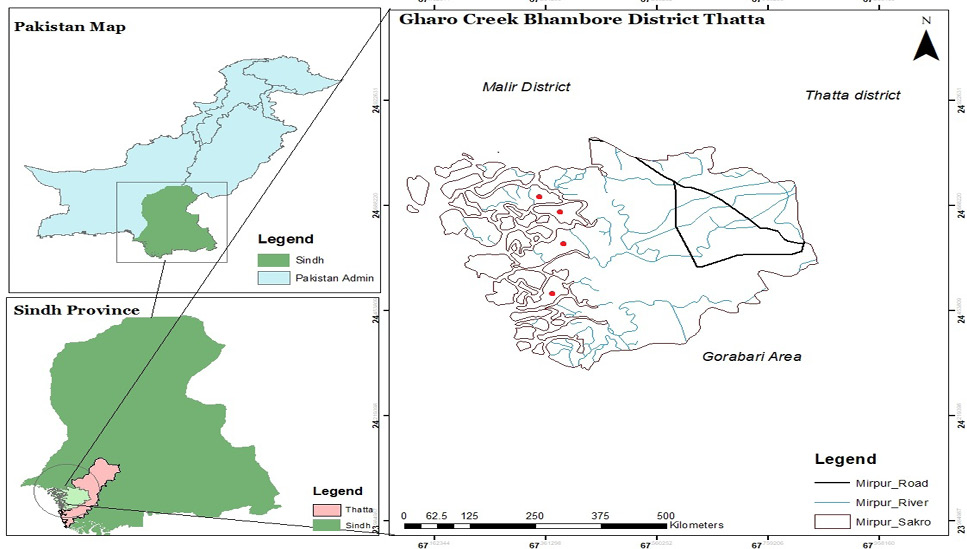
Map of the study area Gharo Greek, showing sampling sites.
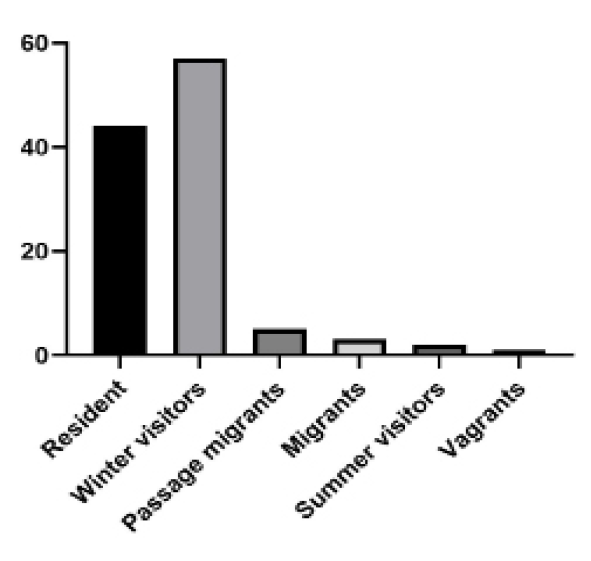
Seasonal Status of birds recorded in Gharo Creek.
References
- Altaf, M., Javid, A., Irfan, M.A., Munir, S.A., Iqbal, K.J., and Umair, M., 2013. Diversity, distribution and ecology of birds in summer season flathead Khanki, Punjab, Pakistan. Biologia (Pakistan), 59: 131-137.
- Begum, A., Khan, M.Z., Ghalib, S.A., Kanwal, R., Zehra, A., Yasmeen, G., and Safi, A., 2016. Distribution, status and current trends in the population of coastal birds of Balochistan. Can. J. Pure appl. Sci., 10: 3853-3864.
- Bibby, C.J., Burgess, N.D., Hillis, D.M., Hill, D.A., and Mustoe, S., 2000. Bird census techniques: Elsevier.
- Bibi, F., and Ali, Z., 2013. Measurement of diversity indices of avian communities at Taunsa Barrage Wildlife Sanctuary, Pakistan. J. Anim. Pl. Sci., 23: 469-474.
- D’Amen, M., Rahbek, C., Zimmermann, N.E., and Guisan, A., 2017. Spatial predictions at the community level from current approaches to future frameworks. Biol. Rev., 92: 169-187. https://doi.org/10.1111/brv.12222[CrossRef]
- Ghalib, S.A., Jabbar, A., Wind, J., Zehra, A., and Abbas, D., 2008. Avifauna of hingol national park, Balochistan. Pakistan J. Zool., 40: 317-330.
- Ghalib, S.A., Rais, M., Abbas, D., Tabassum, F., Begum, A., and Jabeen, T., 2009. An overview of the status of shorebirds and internationally important sites in Pakistan. Pakistan J. Zool., 41: 165-172.
- Govender, C.O., 2021. Regional representativeness hotspots for world’s tetrapod vertebrate genera.
- Khan, R.U., and Gabol, K., 2021. 34. Breeding biology of chakoor partridge (Alectoris chukar) in Bajaur, Khyber-Pakhtunkhwa, Pakistan: Critically affected by eggs collection and predation. Pure appl. Biol., 10: 913-921. https://doi.org/10.19045/bspab.2021.100094[CrossRef]
- Khan, R.U., Sadam, A., and Mahmood, S., 2021. Population ecology of chakor partridge (Alectoris chukar) in District Bajaur, Khyber Pakhtunkhwa, Pakistan. Pakistan J. Zool., 52: 801-1200 https://doi.org/10.17582/journal.pjz/20190806070800[Full text][CrossRef]
- Luo, K., Wu, Z., Bai, H., and Wang, Z., 2019. Bird diversity and waterbird habitat preferences in relation to wetland restoration at Dianchi Lake, south-west China. Avian Res., 10: 1-12. https://doi.org/10.1186/s40657-019-0162-9[CrossRef]
- Mahboob, S., 2009. Diversity of avifauna of Trimmu Barrage, District Jhang, Punjab, Pakistan. Pakistan J. Zool., 41: 43-49.
- Muzzafar, M., 2000. Some selected urban avian biodiversity of Lahore with special emphasis on species of concern. M.Sc. thesis. Deptt. of Envirn. Sci., Kinnaird College for Women, Pakistan.
- Platt, S.G., Win, M.M., Lin, N., Aung, S.H.N., John, A., and Rainwater, T., 2021. Avian species richness in traditional rice ecosystems: a case study from upper Myanmar. J. Threat. Taxa, 13: 18719-18737. https://doi.org/10.11609/jott.6992.13.7.18719-18737[CrossRef]
- Roberts, T.J., 1991. The birds of Pakistan: Passeriformes: Pittas to buntings (Vol. 2). Oxford University Press.
- Sadam, A., Khan, R.U., and Mahmood, S., 2021. Identifying bird traits that enable them to become urban exploiters in an urban area of Mardan, Pakistan. https://doi.org/10.17582/journal.pjz/20190805080803[Full text][CrossRef]
- Sadam, A., Gabol, K., Panhwar W.A., Mahmood. S., Kamal, M., Ullah, H., Abidullah, S., Tufail, M., Ahmad, B., Khan, G.B. and Hassan, U.H., 2022. Oriental Skylark (Alauda gulgula) nestling morphometry and feeding habits in Bajaur Khyber-Pakhtunkhwa Pakistan. Pakistan J. Zool., 54: 2519-2525. https://dx.doi.org/10.17582/journal.pjz/20210818110804[Full text][CrossRef]
- Shuaib, M., Hussain, F., Rauf, A., Jan, F., Romman, M., Parvez, R., and Bahadur, S., 2021. Traditional knowledge about medicinal plant in the remote areas of Wari Tehsil, Dir Upper, Pakistan. Braz. J. Biol., 83: e246803. https://doi.org/10.1590/1519-6984.246803[CrossRef]
- Steven, R., Rakotopare, N., and Newsome, D., 2021. Avitourism tribes: As diverse as the birds they watch consumer tribes in tourism. Springer. pp. 101-118. https://doi.org/10.1007/978-981-15-7150-3_8[CrossRef]
- Sulieman, Y., Pengsakul, T., and Afifi, A., 2016. Bird diversity in Shendi area, Sudan. Int. J. Res. Granthaalayah, 4: 55-63. https://doi.org/10.29121/granthaalayah.v4.i6.2016.2638[CrossRef]
- Umar, M., Hussain, M., Murtaza, G., Shaheen, F. A., and Zafar, F., 2018. Ecological concerns of migratory birds in Pakistan: A review. Punjab Univ. J. Zool., 33: 69-76. https://doi.org/10.17582/pujz/2018.33.1.69.76[CrossRef]
- Younas, S., Gul, S., Rehman, H.U., Junaid, F., Achakzai, W.M., Saddozai, S., and Ahmad, Z., 2017. Zoological fauna of Khurum Dam and Muhabbat Khel Dam of district Karak, Khyber Pakhtunkhwa, Pakistan.
Services
Article usage statistics
Loading…