
Crops routinely experience several different abiotic stress factors simultaneously. Thus, the purpose of this study was to find out how heat and water stress affected the physiology of Elaeis guineensis Jacq. seedlings with potassium (K) fertiliser application. Six regimes of oil palm seedlings with different amounts and types of potassium fertiliser (control amount of KCl, double rate of K2SO4 and double rate of KNO3) under different levels of water (well-watered, moderate water stress and severe water stress) and temperature stress (30°C and 32°C) were studied in this experiment. According to this study, heat stress decreased the plant’s bole diameter (3.04 cm2), leaf area (448.08 cm2), stem dry weight (1.54 g), total dry weight (6.29 g), frond numbers (5.5), leaf dry weight (2.95 g), leaf moisture content (195%), relative water content (70.5%) and increased leaf temperature by 5.36 °C. High temperatures had no appreciable impact on the biochemical characteristics of the palms or the gas exchange in the leaves. Only in the presence of extreme water stress, the level of proline, soluble sugar, phenolic content and lipid preoxidation significantly rises by 1.81 mg/g fresh weight, 51.72 mg sucrose/g dry, 1.1 mg g/gallic acid dry weight and 1.76 umol/g fresh weight. Leaf gas exchange and biochemical characteristics were not susceptible to the 2°C rise, only the development of oil palm seedlings was. Thus, it is advised to provide 75% of the soil field’s capacity for water and to apply twice as much K2SO4 to oil palm seedlings when there is a water shortage.
Research Article · Volume 41, Issue 3, 24 July 2025 · Open Access
Amelioration of Water Stress by Potassium Fertiliser under High Temperatures on Oil Palm Seedlings Growth, Carbon Assimilation and Biochemical Changes
· · · ·
Affiliations & Notes ⌄
- 1School of Agriculture Science and Biotechnology, Faculty of Bioresources and Food Industry, Universiti Sultan Zainal Abidin, Besut Campus, 22200 Besut, Terengganu, Malaysia
- 2Department of Biology, Faculty of Science, Universiti Putra Malaysia, 43400, Serdang, Selangor, Malaysia
- 3Institute of Biological Science, Faculty of Science, University of Malaya, 50603, Kuala Lumpur, Malaysia
- 4Department of Crop Science, Faculty of Agriculture, Universiti Putra Malaysia, 43400, Serdang, Selangor, Malaysia. *Correspondence | Mohd Hafiz Ibrahim, Department of Biology, Faculty of Science, Universiti Putra Malaysia, 43400, Serdang, Selangor, Malaysia
- 5Email: mhafiz_ibrahim@upm.edu.my
Article Info ⌄
- Journal:
- Sarhad Journal of Agriculture
- Published:
- 24 July 2025

From the article
- This work was conducted to characterised oil palm seedlings growth, leaf gas exchange, and biochemical changes under water stress and rising temperature with potassium supplementation in the future.
- The result showed that only the development of oil palm seedlings was shown to be susceptible to a 2°C rise, but the seedlings’ metabolic processes and leaf gas exchange were unaffected.
- This indicates that the oil palm seedlings can acclimatise to a 2 °C increase in future conditions.
- The current study also revealed that combined stress has a predominant effect over individual stress and potassium fertiliser (K2SO4) has the potential to reduce the effect of moderate water stress under ambient temperature.
Selected from the article's own text.
Abstract
Introduction
Elaeis guineensis Jacq. has emerged as the major oil crop in the world where 25.8% of its world production comes from Malaysia Malaysian Palm Oil Council (MPOC, 2023). Paterson et al. (2017) agreed that the high production of this crop is due to its adaptation to the tropical climate as the production of CPO is highly dependent on environmental factors. However, if the temperature increases by 2°C from the optimum and rainfall decreases by 10%, the yield of oil palm is anticipated to be reduced by 30% . The projection by Intergovernmental Panel on Climate Change (IPCC) expects that global warming of 1.5°C and 2°C will be exceeded by the end of this century . This prediction causes an alarming threat as high temperatures can reduce crop productivity and quality . The elevated temperature was reported to reduce net photosynthesis in assai palm , reduce the spikelet size and grain weight in rice plant , and decrease number of leaf, fresh weight and dry weight in chili plant . However, different crops respond differently to elevated temperature throughout their life cycle , and plant response to heat stress depends on the and its type, degree of temperature, and stress duration ; . Although the effects of heat stress have been widely reported for several plant species, it remains unexplored for E. guineensis seedlings.
According to Zandalinas et al. (2018), the simultaneous stress between heat and drought is common in an open environment, and in Malaysia, this combination of stresses is mostly carried by the event of El-Nino. El-Nino often resulted in less rainfall and higher temperatures, which might cause palm trees to experience water stress . Suresh (2013) states that with every rise of 1°C, oil palm requires 10% of water. A study by Jaredi et al. (2024) showed that water stress caused leaf drying and necrosis as well as reduced it root mass and volume. Water stress also causes a stomata closure which results in the reduction of transpiration and photosynthesis rates, consequently reducing the production of photoassimilates and growth in oil palm seedlings . Even worse, the situation may further be aggravated under high temperature conditions as the combined effect of these stresses is higher compared to the individual stress .
According to Hasanuzzaman et al. (2018), potassium (K) fertiliser is one of the best options for coping with environmental stresses. Numerous crops, including tomato , sesame , and sunflower have been researched for their ability to use K fertiliser to reduce water stress. In these field experiments, they agreed that under water stress, this fertiliser could increase the relative water content of leaves, reduce the production of reactive oxygen species (ROS) and regulate the stomata opening. Besides, other researchers have conducted experiments using K to alleviate heat stress . In Malaysia, a few K fertilisers are available, including potassium nitrate (KNO3), potassium chloride (KCl), and potassium sulphate (K2SO4) that sold at different prices and KCL is the is the most cheapest and commonly used in oil palm plantation . Eventhough the price of K2SO4 is more pricey than KCl, this fertiliser is used when the soil lacks of sulphate anion . The other study state that KCl may give high salinity and chloride toxicity to the crop ; ; . Thus, K2SO4 and KNO3 were suggested as an alternative to the chloride-free K source in this study.
Since drought and heat stress are most likely to occur simultaneously under field conditions, it is important to focus on research that mimics the field environment. The alleviation of the combination of water and heat stress by K fertiliser was limited and the study on the effect of elevated temperature and water stress conditions with potassium fertiliser supplementation on the oil palm seedlings has never been reported. In this study, agronomic approaches such as water and nutrient management might be a cheaper and faster option to improve this naturally occurring environmental condition. This experiment is in line with the 13th Sustainable Development Goals (SDG) which is to take urgent action to combat climate change and its impacts; thus, the result from this study is crucial if growers are to adapt to climate change. The experiment’s water level, fertilizer sources, and dosages were chosen based on past investigations , 2020, 2022).
Materials and Methods
Experimental design and plant materials
The experiment was conducted in the rain-proofed glasshouse and unit chamber at the Rimba Ilmu Botanical Gardens in Universiti Malaya, 50603 Kuala Lumpur, Malaysia from January to June 2020. Two-month-old oil palm seedlings (Tenera) were acclimated to growth chambers for a month. The seedlings were moved into 10 x 12 cm polybags filled with soil from the Muchong series prior to acclimatisation. In a randomized complete block design (RCBD) with six replications, a total of 36 polybags were arranged (Figure 7). The three levels of water treatment used in the study were: severe water stress (25% ER), moderate water stress (75% ER) and well-watered (100% ER) (Klapwijk and Lint, 1974). Three different sources of K fertilisers, i.e., potassium chloride (KCl) with a controlled rate, double rate of potassium sulphate (K2SO4), and double rate of potassium nitrate (KNO3) were applied once in two weeks based on MPOB (2013). Additionally, plants were fertilised at normal rates using the sources of N (ammonia) and P (CIRP). Plants were exposed under two levels of temperature which are 30°C (ambient) and 32°C (heat stress) for two months. Once every week, the water was calibrated, and the data were collected a month after the treatment.
Vegetative measurements
The vegetative measurements of oil palm seedlings were measured following MPOB (2017). The leaves were measured by using a Leaf Area Meter (model Li-3100 area meter), then the samples were dried in an oven for 48 hours at 75 °C, or until the weights were consistent for plants dry weights measurement. After that, samples were weighed with digital balances. The leaf chlorophyll content was measured by using SPAD meter (502, Minolta Inc, USA) .
Chlorophyll fluorescence
The fv/fm ratio of chlorophyll fluorescence was measured in following Jamaludin et al. (2020) on fully grown young leaf number two, measurements were made between the hours of 8:00 and 10:00 using a portable chlorophyll fluorescence meter (Handy PEA, Hansatech Instruments Ltd., Kings Lynn, UK). Dark-acclimation clips were attached to the middle of the leaf surface, darkening the leaves for 15 minutes prior to measurements.
Leaf temperature
Plant leaves temperature was taken using an infrared (IR) thermometer on a few spots of fully expanded young leaves number two .
Leaf gas exchange
The leaf gas exchange for photosynthetic rate (Pn), transpiration rate (E), stomatal conductance (gs), and plant respiration (Rd) of the young palms were measured by using LICOR 6400XT Portable Photosynthesis System (LICOR–6400, LI–COR Inc., Lincoln, NE, USA). These measurements were taken between 9:00 and 11:00 when all plant components were fully functional .
Biochemical properties
The proline content was assessed by the technique described by Bates et al. (1973). The oil palm seedlings leave that have been collected are immediately frozen in liquid nitrogen and grounded with mortar. Then, a filter paper (Whatman #1, England) was used to remove the homogenate powder after it had been combined with 1 mL of aqueous sulfosalicylic acid (3% w/v). This mixture was then given an additional 1 mL of glacial acetic acid and ninhydrin reagent and incubated for an additional hour at 95°C before being submerged in an ice bath to stop the reaction. A B UV-visible spectrophotometer, calibrated with L-proline, was used to quantify the chromophore after the reaction was rapidly mixed with 2 mL of toluene and warmed to 25°C.
The protocol of Ibrahim et al. (2012) was used to estimate the phenolics content. An amount of ground dried oil palm tissue samples (0.1 g) was extracted with 80% ethanol (10 mL) on an orbital shaker for 120 min at 50 °C. The mixture was then filtered (WhatmanTM No. 1) and the filtrate was used for the quantification of total phenolics. Then, the sample extract (200 μL) was mixed with Folin-Ciocalteu reagent (1.5 mL) for 5 min at 22°. After that, the mixture was added with 60 g (1.5 mL) L−1 NaNO3 solution and the absorbance was measured at 725 nm after two hours.
The total soluble sugar was determined by mixing samples (0.5 g) with distilled water (10 mL), then incubated and vortexed in a conical tube (15 mL) for 10 minutes. Then, anthrone (0.1 g) was dissolved in sulphuric acid (50 mL and 95%) for the anthrone reagent preparation. The dried material was then combined with distilled water, centrifuged for 10 minutes at 3,400 rpm, and then filtered. A 100 °C water bath was used for five minutes with 8 mL of anthrone reagent added in 4 mL aliquots. A UV160U spectrophotometer (Shimadzu, Japan) was used to test the sample’s absorbance at 620 nm, and the results were represented as mg sucrose/g dry .
The leaf tissue of oil palm was assessed for lipid peroxidation using the methods of Jaafar et al. (2012). About 1 g of fresh oil palm leaves were mixed in 1 mL of 0.5% trichloroacetic acid (TCA) using a mortar and pestle, and the mixture was centrifuged at 9,000 rpm for 20 min. The supernatant (0.5 mL) and 20% TCA (2.5 mL) containing 0.5% TBA were combined, and the mixture was then heated in a water bath for 30 minutes at 100 °C. Following a 10-minute centrifugation process at 9000 rpm, the supernatant was utilised to determine the MDA level using a specified absorbance of 532 nm.
Statistical analysis
One-way analysis of variance (ANOVA) was performed with at p ≤ 0.05 to measure differences in variables between the different treatments followed by DMRT test to compare with treatments means using SPSS statistical software (ver. 25.0 SPSS, Chicago, USA).
Results and Discussion
Plant vegetative growth
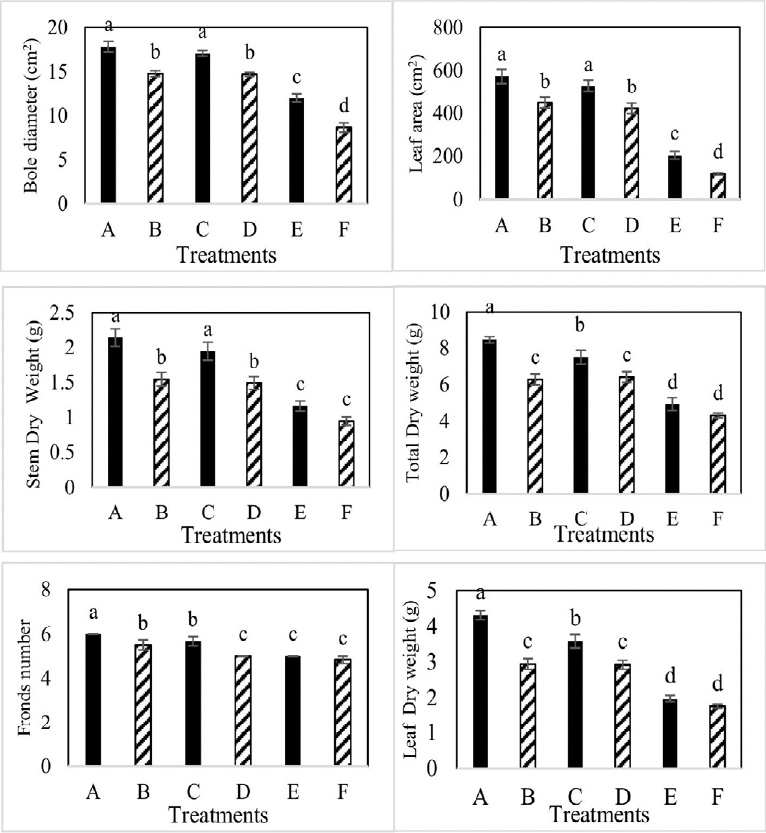
The results showed that the tested management practices influenced all the growth components (Figure 1; P ≤ 0.05). It was observed that high temperature stress deteriorated the growth of E. guineensis compared to ambient temperature with treatment A (control) was the best treatment and F was the worst treatment. However, in most parameters, there were no significant difference between treatment A and C, B and D as well as E and F. The largest bole diameter was discovered under the control treatment (17.83 cm) and it decreased to 14.79 cm (Treatment B) when treated with high temperature while the lowest was in the F treatment when plants were under the combination of water and heat stress with high KNO3 application, which only registered 8.61 cm. However, there were no significant differences between treatment A (17.83 cm) and C (17.09 cm) as well as B (14.79 cm) and D (14.72 cm) even though the latter received only 75% ER of water but with a double rate of K2SO4.The same trend was found in most of the seedling’s growth attributes. The exposure of seedlings to 32 °C and 25% ER with high KNO3 (treatment F) triggered marked decreases in bole diameter (52%), leaf area (80%), stem dry weight (56%), total dry weight (49%), shoot dry weight (59%) and the number of fronds (20%) as compared to control counterparts.
The present results indicate that heat stress reduced the vegetative plant growth of the young palms significantly and the combination with water stress exacerbated the effect. According to Hasanuzzaman et al. (2013), the retardation of plant growth under elevated temperature is common and this is believed to occur due to the alteration in cell division and elongation caused by loss of cell water content, thus affecting leaf size and weight. A significant positive relationship was established between total dry weight (TDW) and relative water content (RWC) in this study (R2 = 0.707; P ≤ 0.01), indicating the weight of oil palm seedlings reduced when plant water status reduced. Heat stress also decreases plant growth by reducing its shoot dry weight, relative growth rate (RGR), and net assimilation rates (NAR) which in the end reduces the total dry weight ; . The results obtained are in agreement with previous work carried out by Khan et al. (2017) in their experiment on wheat and Naz et al. (2018) on potatoes where leaf relative water content, and fresh and dry weight were significantly reduced under heat stress in both plants. The combination effect between drought and heat stress creates more severe damage than individual stresses and this has also been studied in other C3 plants such as tomato , rice, and wheat . The reduction of photosynthesis and the accumulation of reactive oxygen species (ROS) might be the reason for this damage . From the correlations in Table 1, photosynthetic rate (Pn) had a significant positive correlation with TDW (R2= 0.742; P ≤ 0.01), suggesting that low A might trigger the reduction of TDW under stress conditions and proline have a negative correlation with TDW (R2= -0.706; P ≤ 0.01), signifying the reduction of TDW is due to the accumulation of ROS.
However, the application of high K2SO4 under moderate water stress and high temperature (treatment D) had no significant difference as with the control amount of KCl under well-watered and high temperature (treatment B) which signifies the ability of K fertiliser in alleviating water stress under elevated temperature. Potassium fertiliser’s effect in reducing abiotic stress has been extensively investigated by Hasanuzzaman et al. (2018). It is mentioned that under water stress, this fertiliser helps to regulate the stomata which control plant water loss via transpiration, and under heat stress, it prevents leaf damage and increases the photosynthetic ability of the plants.
Plant water status
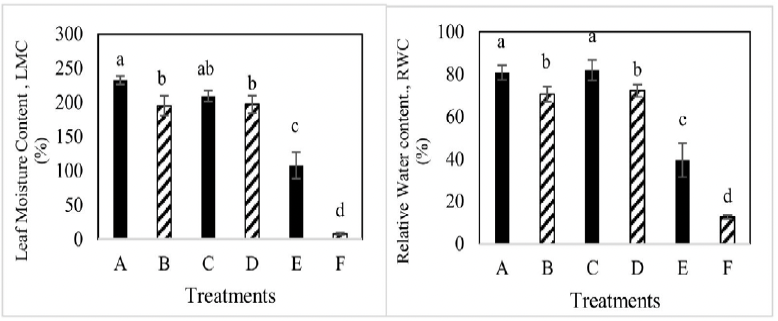
Figure 2 indicates the effect of elevated temperature under different water treatment levels, rates, and type of potassium fertilisers on the oil palm leaf moisture content (LMC) and relative water content (RWC). The increase in temperature from 30°C to 32°C resulted in a lower plant water status under both well-watered and water deficit conditions (P ≤ 0.05). However, plants under moderate water stress (75% ER) and well-watered (100% ER) had no significant difference as the former has been treated with high K fertiliser even though both were under elevated temperatures. Treatment F was the most affected as it was a combination of severe water stress and a high level of fertiliser where LMC was approximately thirteenfold decreased while RWC reduced threefold respectively compared to the severe water stress alone (treatment E).
Table 1: Pearson correlation coefficients (R2) between parameters in the experiment.
| Parameters | 1 | 2 | 3 | 4 | 5 | 6 | 7 | 8 |
| gs | 1 | |||||||
| E | 0.911** | 1 | ||||||
| A | 0.887** | 0.967** | 1 | |||||
| TDW | 0.784** | 0.753** | 0.742** | 1 | ||||
| proline | -0.810** | -0.881** | -0.931** | -0.706** | 1 | |||
| RWC | 0.804** | 0.857** | 0.899** | 0.707** | -0.883** | 1 | ||
| LP | -0.530** | -0.417* | -0.408* | -0.640** | 0.328 | -0.482** | 1 | |
| fv/fm | 0.751** | 0.842** | 0.852** | 0.653** | -0.862** | 0.938** | -0.432** | 1 |
Note: gs = stomatal conductance; E= transpiration rate; A = net photosynthesis; TDW= total dry weight; RWC= relative water content; LP= leaf temperature. * and ** significant at P ≤ 0.05 and P ≤ 0.01, respectively.
LMC and RWC are common methods used to evaluate the plant water status. In this experiment, high temperature and water scarcity had the greatest influence on water status in oil palm seedlings (Figure 2; P ≤ 0.05). Heat stress depleted water in the soil by affecting soil temperatures and transpiration by increasing vapor pressure deficit . It is agreed that elevated temperature increases the evapotranspiration rate, makes drought more intense, and increases soil salinization . These results also support the findings presented by Khan et al. (2017) when they reported that relative water content in plants was expressively reduced by severe drought and heat stresses; thus, drought and heat stresses are said to have a key role in the water deficit of plants.
Leaf temperature
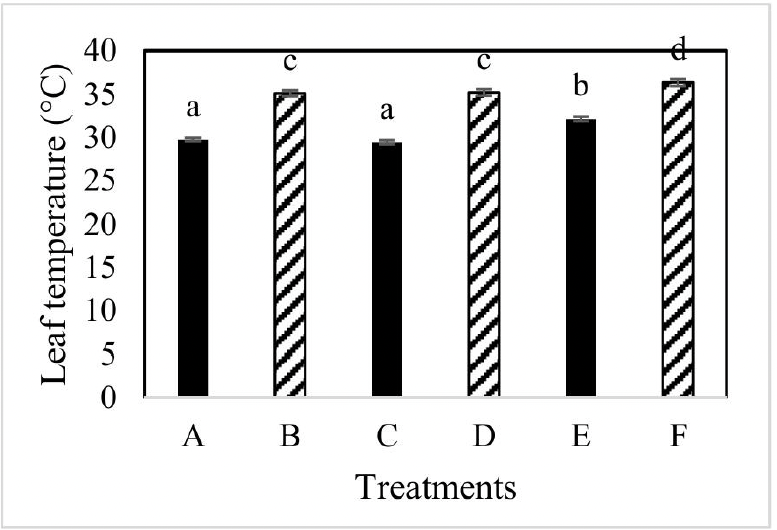
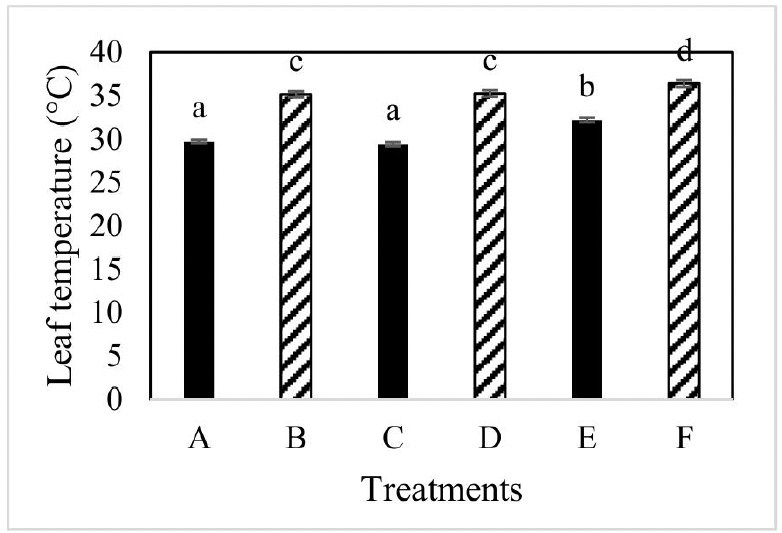
Figure 3 represented that leaf temperature is significantly increased at a higher level of heat as compared to ambient (P ≤ 0.05). However, treatment B and D were not significant as well as A and C. The temperature rose about 4°C when the plants were put under combination stress (treatment F) compared to the severe water stress alone with high fertilisation (treatment E).
Higher leaf temperature is an indicator of plant stress due to the stomata closure that reduces plant transpiration. The correlations in Table 1 revealed that gs (R2 = -0.530; P ≤ 0.01) and E (R2 = -0.417; P ≤ 0.05) had a significant negative correlation with leaf temperature. The result showed that the combined effect of heat and drought stresses caused a more dramatic increase in leaf temperature than either heat or drought alone. The high level of fertiliser in this combination stresses in treatment F gave no reduction to the leaf temperature might be due to the soil salinization which exaggerated the effect . However, in moderate water stress with high K treatment, the leaf temperature showed no significant difference with well-watered plants with a lower K under ambient temperature indicating the function of K in regulating stomata opening to increase the transpiration rate, thus reducing the temperature . Those findings are in line with Kataria and Singh (2013) in their research with Cicer arietinum L. under water stressed conditions.
Leaf gas exchange
The effects of leaf gas exchange were attributed to the abiotic stresses on all weeks of measurement (Figure 4; P ≤ 0.05).). Severe water stress significantly reduced stomatal conductance, transpiration rate and photosynthetic rate, but increased dark respiration in E. guineensis. However, there was no significant difference between treatments A, B, and C in the photosynthesis of oil palm seedlings. When the amount of water was reduced from 100% ER to 25% ER, the transpiration rate of the seedlings was found to be lower than the control treatment (100% ER). Moderate water stress combined with high temperature (treatment D) had reduced the photosynthesis to about 0.884, transpiration rate to about 0.352, and stomatal conduction to about 0.099 compared to well-watered plants under the same temperature (treatment B).
In this experiment, water availability had the greatest influence on the leaf gas exchange of oil palm seedlings while the reduction of photosynthesis was more apparent in plants subjected to water deficit with a combination of heat stress. It is agreed that photosynthesis is among the most sensitive physiological processes towards temperature stress which could affect plant growth and yield ; ; . Yet, the current result revealed that there was no significant difference between treatments A and B which indicates the increase of 2°C had no significant effect on photosynthesis when plants were well-watered. The reason behind this might be that the temperature is still within the optimum range and moderately suitable for oil palm cultivation . It is in line with the study from another species of palm seedlings (Euterpe oleracea Mart.) when they were exposed under 36°C for 14 days, it shows that there was no significant difference of A, gs, and E with control plants, yet the leaf gas exchange was reduced significantly under 40°C, indicating this species is tolerant for few degrees rise from optimum temperature and very sensitive to extreme temperature .
When the palms were exposed to moderate water stress with a double rate of K2SO4 under ambient temperature (treatment C), the photosynthesis was also not significant as a control which proved the ability of K in alleviating water stress by increasing the rate of ATP production, consequently increased the net photosynthesis . K+ ions were also responsible for closing the stomata to prevent water loss which it can be translated by a highly significant difference between A and gs (R2 = 0.887; P ≤ 0.01). Besides, it is believed that the accompanied ion in the treatment C (SO4-2) played an important role in increasing photosynthesis by its involvement in chlorophyll synthesis . The function of K in alleviating water stress has been observed in many other crops such as cotton , wheat , peanut , and tomato . The combination stress drastically reduces A due to an increase in photoinhibition which leads to PSII reaction center damage . As observed in this study, there was a strong positive relationship between A and maximum efficiency of PSII where the combined stress treatment showed a significant decrease in A when fv/fm was reduced (R2 = 0.852; P ≤ 0.01). However, Zandalinas et al. (2018) agreed that the stomatal response under this combination of stress is challenging as plants must find a balance between inhibiting water loss due to water scarcity and protecting from over-heating by increasing E to cool down leaves due to high temperature. It is also stated that under these abiotic stresses’ plants such as Nicotiana tabacum and Populus yunnanensis have high leaf temperature, respiration, and accumulation of ROS which is in agreement with the current study.
Maximum efficiency of Photosystem II (fv/fm) and chlorophyll content
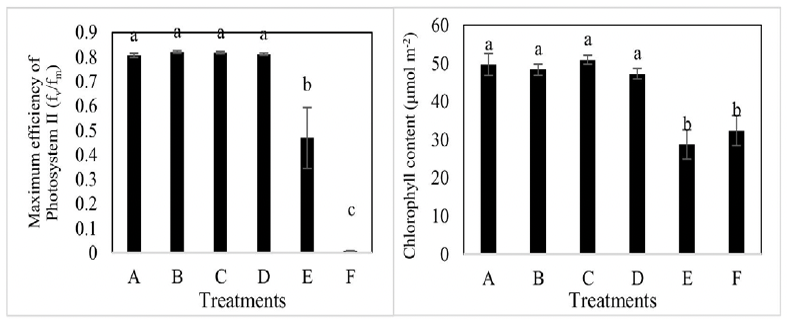
Apart from leaf gas exchange, the maximum efficiency of Photosystem II (fv/fm) and chlorophyll content in oil palm seedlings were also affected by the treatment given. From the graph in Figure 5, it can be seen that there was no significant difference between treatments A, B, C, and D, but when the seedlings were exposed to 25% ER, the fv/fm reduced significantly for almost twice and drastically reduced under the combined stress for about 120 times from the control (P ≤ 0.05). The same trend was applied to the chlorophyll content, but there was no significant difference between ambient and high temperature under severe water stress treatment.
It is agreed that abiotic stress can significantly affect the activity of photosynthesis in oil palm species ; . For a healthy plant, the approximate optimal ratio of fv/fm is supposed to be in the range of 0.79–0.83 , and in the current study, the fv/fm of treatment A, B, C, and D were higher than 0.8 indicated that the palms were not under stress condition. As mentioned before, the temperature rise in this study is still within the optimum range of this species, thus the photosynthesis activity of these seedlings was unaffected by the increase of 2°C. Such responses were relatively similar to those observed in heat temperature stressed assai palm . However, plants treated with severe water stress showed a significant decrease in fv/fm which indicates there was the inactivity of PSII reaction centres and this also has been observed by Suresh et al. (2010) in their study with E.guineensis under water stress. The damaging effects of both stresses were obvious on the functioning of photosystem II (fv/fm) which is a reliable sign of more damage in the PSII electron transport cycle due to the photoinhibition as in agreement with previous reports on rice plants . The reduction of chlorophyll content under severe water stress is believed due to this damage in photosynthetic membrane structure as observed by Song et al. (2019) in Zea mays L.
Biochemical properties
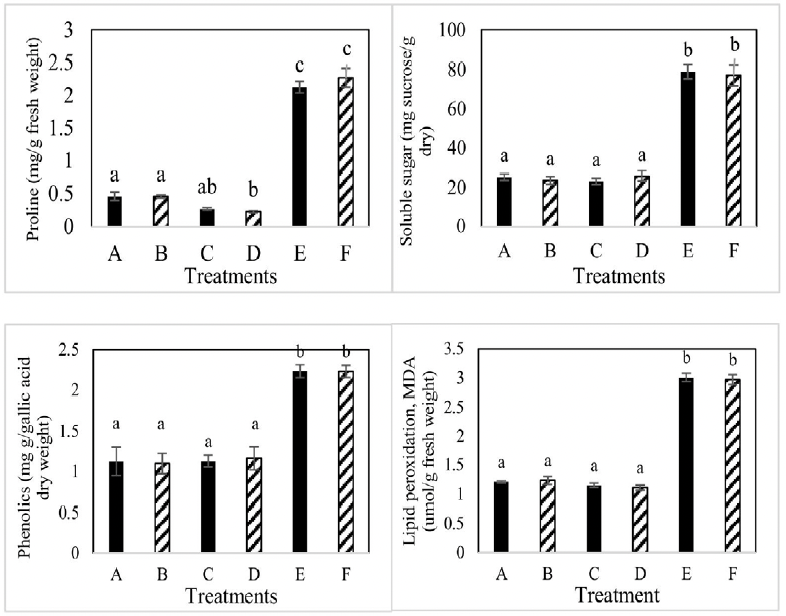
Biochemical properties were influenced by temperature and water stress with potassium fertiliser applied to the seedlings (Figure 6; P ≤ 0.05). It was found that severe water stress significantly increased all the biochemical attributes in both ambient and elevated temperatures of the seedlings. However, under well-watered and mild water stress, the level of soluble sugar, total phenolics, and lipid peroxidation were not significance with each other regardless of the temperature and rate or type of K. The combination of heat stress and severe water stress with high fertilisation (treatment E) had risen the level of proline, soluble sugar, total phenolics and lipid peroxidation from control treatment for about approximately 394%, 205%, 98%, and 146%, respectively.
Proline, soluble sugar, total phenolics, and lipid peroxidation are frequently used as biochemical indicators to evaluate oxidative damage in plants under abiotic stress ; . In this experiment showed that palms under well-watered (treatments A and B) and moderate water stress with a double rate of potassium (treatments C and D) can tolerate the high temperature which suggests the increase of 2°C gave no negative effect on the oil palm seedlings. However, the biochemical properties were found to be enhanced under severe water stress and elevated temperature suggesting there is the accumulation of ROS which can cause oxidative damage and cell death. In this study, the seedlings under severe stress produce these antioxidant components for detoxification of ROS to protect plant cells from oxidative damage ; . The spike of biochemical properties under a combination of water and heat stress also has been studied in the legumes family , bread wheat , and assai palm .
Conclusions and Recommendations
This work was conducted to characterised oil palm seedlings growth, leaf gas exchange, and biochemical changes under water stress and rising temperature with potassium supplementation in the future. The result showed that only the development of oil palm seedlings was shown to be susceptible to a 2°C rise, but the seedlings’ metabolic processes and leaf gas exchange were unaffected. This indicates that the oil palm seedlings can acclimatise to a 2 °C increase in future conditions. The current study also revealed that combined stress has a predominant effect over individual stress and potassium fertiliser (K2SO4) has the potential to reduce the effect of moderate water stress under ambient temperature. Future research on the development of oil palm crops ability to withstand stress will be aided by these findings.
Acknowledgements
The authors wish to thank the Ministry of Higher Education Malaysia for its financial support through FRGS (grant numbers FRGS/1/2016/STG03/UPM/02/6/5524945), and the Southeast Asian Regional Center for Graduate Study and Research in Agriculture (SEARCA).
Novelty Statement
The combined effect of heat and drought stress and their impact on the physiological and morphological parameters simultaneously on Elaeis guineensis seedlings has not been explored yet. This provides valuable insight for future studies and crop management of this species.
Author’s Contribution
Tuan Syaripah Najihah: Experiment conduction, data collection and analysis, manuscript writing.
Mohd Hafiz Ibrahim: Supervising, project planning and manuscript editing.
Rosimah Nulit: Manuscript editing.
Nurul Amalina Mohd Zain: Supervising and project planning.
Puteri Edaroyati Megat Wahab: Reviewing of the manuscript.
Conflict of interest
The authors have declared no conflict of interest.
Figures
Effect of temperatures under fertilization with potassium at various water stress levels on the leaf gas exchange of the seedlings for four weeks. Error bars depict standard error of the mean (SEM) (n=6). Same letters were not significantly different at p < 0.05.
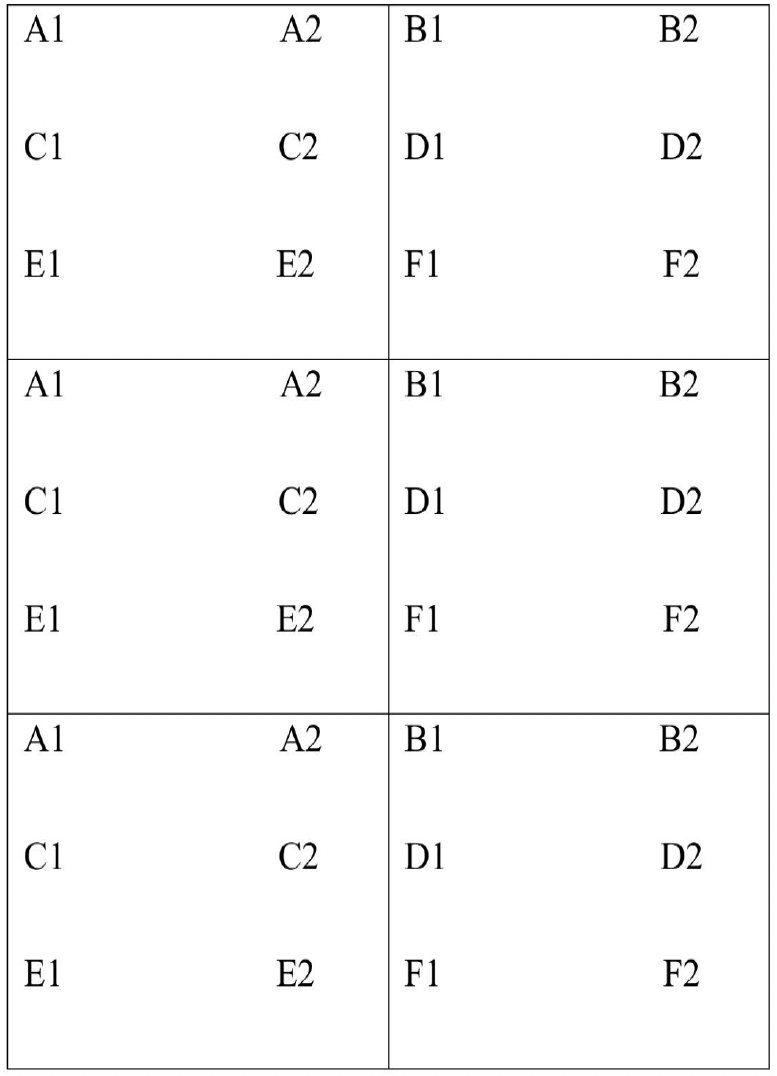
Field layout of various treatments and replications in RCBD. Notes: A 100% ER + KCl + 1X rate + 30°C; B = 100% ER+ KCl + 1X rate + 32°C; C = 75% ER + K2SO4 + 2X rate +30°C; D =75% ER + K2SO4 + 2X rate +32°C; E = 25% ER + KNO3 + 2X rate +30°C; F = 25% ER + KNO3 + 2X rate +32°C.
References
- Aboelill, A.A., H.M. Mehanna., O.M. Kassab and E.F. Abdallah. 2012. The response of peanut crops to foliar spraying with potassium under water stress conditions. J. Basic Appl. Sci., 6(8): 626–634.
- Akram, S., C.M. Ayyub, M. Shahzad and A. Shahzad. 2021. Role of proline in mitigating the deleterious effects of heat stress in chillies. Contemp. Agric., 70(1-2): 28-35. https://doi.org/10.2478/contagri-2021-0006[CrossRef]
- Akter, N. and M. Islam. 2017. Heat stress effects and management in wheat. A review. Agron Sustain. Dev., 37(5): 1-17. https://doi.org/10.1007/s13593-017-0443-9[CrossRef]
- Amiro, B.D., G.W. Thurtell and T.J. Gillespie. 1983. A small infrared thermometer for measuring leaf temperature in leaf chambers. J. Exp. Bot., 34(11): 1569–1576. https://doi.org/10.1093/jxb/34.11.1569[CrossRef]
- Amjikarai Radhakrishna, N.K., V. Chenniappan and V. Dhashnamurthi. 2018. Combined effects of drought and moderately high temperature on the photosynthesis, PS II photochemistry and yield traits in rice (Oryza sativa L.). Indian J. Plant Physiol., 23(3): 408–415. https://doi.org/10.1007/s40502-018-0386-4[CrossRef]
- Baque, M.A., M.A. Karim, A. Hamid and H. Tetsushi. 2006. Effects of fertilizer potassium on growth, yield and nutrient uptake of wheat (Triticum aestivum) under water stress conditions. S. Pac., 27(1): 25–35.
- Bates, L.S., R.P. Waldren and I.D Teare. 1973. Rapid determination of free proline for water-stress studies. Plant Soil, 39(1): 205–207. https://doi.org/10.1007/BF00018060[CrossRef]
- Bita, C. and T. Gerats. 2013. Plant tolerance to high temperature in a changing environment: scientific fundamentals and production of heat stress-tolerant crops. Front. Plant Sci., 4(2013): 273. https://doi.org/10.3389/fpls.2013.00273[CrossRef]
- Chaturvedi, P., A.J. Wiese, A. Ghatak, L. Zaveska Drabkova, W. Weckwerth and D. Honys. 2021. Heat stress response mechanisms in pollen development. New Phytol., 231(2): 571-585. https://doi.org/10.1111/nph.17380[CrossRef]
- Corley, R. and P.B.H. Tinker. 2015. The climate of the oil palm-growing regions. In R. Corly (Ed.), The oil palm. Wiley Blackwell. pp. 53–67. https://doi.org/10.1002/9781118953297.ch3[CrossRef]
- da Rocha, I.T.M., F.J. Freire, E.C.A. de Oliveira, E.R. de Souza, M.BG.S. Freire, D.E.S. Neto and A.V. da Silva. 2019. Salt effect of potassium fertilizer on productivity and technological quality of sugarcane. Aust. J. Crop Sci., 13(9): 1552–1560. https://doi.org/10.21475/ajcs.19.13.09.p1919[CrossRef]
- Dar, J. S., M.A. Cheema, M.I.A. Rehmani,S. Khuhro, S. Rajput, A.L. Virk, S. Hussain, M.A. Bashir, S.M. Allghanem, F.M. A-Zuaibr and M.J. Ansari. 2021. Potassium fertilization improves growth, yield and seed quality of sunflower (Helianthus annuus L.) under drought stress at different growth stages. PLoS One, 16(9): e0256075. https://doi.org/10.1371/journal.pone.0256075[CrossRef]
- Fang, S., H.Yang, L. Duan, J. Shi and L. Guo. 2023. Potassium fertilizer improves drought stress alleviation potential in sesame by enhancing photosynthesis and hormonal regulation. Plant Physiol. Biochem., 200: 107744. https://doi.org/10.1016/j.plaphy.2023.107744[CrossRef]
- Firmansyah and N. Argosubekti. 2020. A review of heat stress signaling in plants. Proc. Conf. Ser. Earth Environ. Sci. Sweeden, 484(1): 1-11. https://doi.org/10.1088/1755-1315/484/1/012041[CrossRef]
- Gunadi, N. 2009. Kalium sulfat dan kalium klorida sebagai sumber pupuk kalium pada tanaman bawang merah. J. Horticul., 19(2).
- Gunawan, S., M.T.S. Budiastuti, J. Sutrisno and H. Wirianata. 2020. Effects of organic materials and rainfall intensity on the productivity of oil palm grown under sandy soil condition. Int. J. Adv. Sci. Eng. Inf. Technol., 10(1): 356-361. https://doi.org/10.18517/ijaseit.10.1.11001[CrossRef]
- Hasanuzzaman, M., K. Nahar and M. Fujita. 2013. Extreme temperature responses, oxidative stress and antioxidant defense in plants. Abiot. Stress Plant Resp. Appl. Agric., 13(2013): 169-205. https://doi.org/10.5772/54833[CrossRef]
- Hasanuzzaman, M., K. Nahar, M.M. Alam, R. Roychowdhury and M. Fujita. 2013. Physiological, biochemical, and molecular mechanisms of heat stress tolerance in plants. Int. J. Mol. Sci., 14(5): 9643–9684. https://doi.org/10.3390/ijms14059643[CrossRef]
- Hasanuzzaman, M., M.B. Bhuyan, K. Nahar, M.S. Hossain, J.A. Mahmud, M.S. Hossen, A.A.C. Masud, Moumita and M. Fujita. 2018. Potassium: A vital regulator of plant responses and tolerance to abiotic stresses. Agronomy, 8(3): 31. https://doi.org/10.3390/agronomy8030031[CrossRef]
- Húrsula, N.L., R.I.N. Santos, G.I.S. Teixeira, D.G. Araujo, W.V.D. Silvestre and H.A. Pinheiro. 2019. Leaf gas exchange, photochemical responses and oxidative damages in assai (Euterpe oleracea Mart.) seedlings subjected to high temperature stress. Sci. Hortic., 257(2019): 108733. https://doi.org/10.1016/j.scienta.2019.108733[CrossRef]
- Hussain, A., M. Arshad, H. Ahmad, Q. Nazir, A. Mustafa, A. Afzal and H. Zeb. 2015. Comparative effectiveness of SOP and MOP for crop productivity in Pakistani soils. A review. I Int. J. Agron. Agric., 6: 256–267.
- Ibrahim, H.M., Z.E.H. Jaafar, E. Karimi and A. Ghasemzadeh. 2012. Primary, secondary metabolites, photosynthetic capacity and antioxidant activity of the malaysian herb Kacip Fatimah (Labisia pumila Benth) exposed to potassium fertilization under greenhouse conditions. Int. J. Mol. Sci., 13(11): 15321-15342. https://doi.org/10.3390/ijms131115321[CrossRef]
- Ibrahim, M.H., H.Z.E. Jaafar, A. Rahmat and Z.A. Rahman, Z.A. 2012. Involvement of nitrogen on flavonoids, glutathione, anthocyanin, ascorbic acid and antioxidant activities of malaysian medicinal plant Labisia pumila Blume (Kacip Fatimah). Int. J. Mol. Sci., 13(1): 393-408. https://doi.org/10.3390/ijms13010393[CrossRef]
- Ibrahim, M.H., H.Z.E. Jaafar, A. Rahmat and Z.A. Rahman. 2011. The relationship between phenolics and flavonoids production with total non-structural carbohydrate and photosynthetic rate in Labisia pumila Benth. under high CO2 and nitrogen fertilization. Molecules, 16(1): 162–174. https://doi.org/10.3390/molecules16010162[CrossRef]
- Jaafar, H.Z.E., M.H. Ibrahim and N.F.M. Fakri. 2012. Impact of soil field water capacity on secondary metabolites, phenylalanine ammonia-lyase (PAL), maliondialdehyde (MDA) and photosynthetic responses of Malaysian Kacip Fatimah (Labisia pumila Benth). Molecules, 17(6): 7305–7322. https://doi.org/10.3390/molecules17067305[CrossRef]
- Jakovljević, D. and M. Stanković. 2020. Adaptive strategies of plants under adverse environment: mitigating effects of antioxidant system. In: (ed. M. Hasanuzzaman) Plant Ecophysiology and Adaptation under Climate Change: Mechanisms and Perspectives II. Springer, Singapore. https://doi.org/10.1007/978-981-15-2172-0_8[CrossRef]
- Jamaludin, R., N. Mat, K.S. Mohd, N.A. Badaluddin, K. Mahmud, M.H. Sajili and M.M. Khandaker. 2020. Influence of exogenous hydrogen peroxide on plant physiology, leaf anatomy and rubisco gene expression of the Ficus deltoidea Jack var. Deltoidea. Agronomy, 10(4): 497. https://doi.org/10.3390/agronomy10040497[CrossRef]
- Jaredi, Z.S., N.A. Shaharuddin, S.N.A. Abdallah and A.M. Azzeme. 2024. Effect of cultivar variability on physiological response of oil palm to drought stress. https://doi.org/10.21203/rs.3.rs-4294476/v1[CrossRef]
- Ju, Y., X. Yue, X. Zhao, H. Zhao and Y. Fang. 2018. Physiological, micro-morphological and metabolomic analysis of grapevine (Vitis vinifera L.) leaf of plants under water stress. Plant Physiol. Biochem., 130(2018): 501–510. https://doi.org/10.1016/j.plaphy.2018.07.036[CrossRef]
- Kataria, N. and N. Singh. 2013. Amelioration of water stress by potassium fertilizer in chickpea (Cicer arietinum L.). J. Trop. Plant Physiol., 5(2013): 22–32.
- Khan, N.A., S. Khan, N. Naz, M. Shah, A.S. Irfanullah, H. Sher and A. Khan. 2017. Effect of heat stress on growth, physiological and biochemical activities of wheat (Tri-ticum aestivum L.). Int. J. Biosci., 11(4): 173–183. https://doi.org/10.12692/ijb/11.4.173-183[CrossRef]
- Khandaker, M.M., H.M. Azam, J. Rosnah, D. Tahir and M. Nashriyah. 2018. The effects of application of exogenous IAA and GA3 on the physiological activities and quality of Abelmoschus esculentus (Okra) var. Singa 979. Pertan. J. Trop. Agric. Sci., 41(1).
- Klapwijk, D. and P.J.A.L. Lint. 1974. Fresh weight and flowering of tomato plants as influecend by container type and watering conditions. Acta Hortic., 23(1972): 237–248. https://doi.org/10.17660/ActaHortic.1974.39.23[CrossRef]
- Kumar, A.R. and N. Kumar. 2008. Studies on the efficacy of sulphate of potash (SOP) on the physiological, yield and quality parameters of banana cv. Robusta (Cavendish-AAA). Eur. Asian J. Biosci., 2(12): 102-109.
- Lamaoui, M., M. Jemo, R. Datla and F. Bekkaoui. 2018. Heat and drought stresses in crops and approaches for their mitigation. Front. Chem., 6(2018): 26. https://doi.org/10.3389/fchem.2018.00026[CrossRef]
- Li, J., Z. Li, X. Li, X. Tang, H. Liu, J. Li and Y. Song. 2023. Effects of spraying KH2PO4 on flag leaf physiological characteristics and grain yield and quality under heat stress during the filling period in winter wheat. Plants, 12(9): 1801. https://doi.org/10.3390/plants12091801[CrossRef]
- Lopes-Filho, W.R.L., F.H.S. Rodrigues, I.V.L. Ferreira, L.O. Correa, R.L. Cunha, R. and H.A. Pinheiro. 2021. Physiological responses of young oil palm (Elaeis guineensis Jacq.) plants to repetitive water deficit events. Ind. Crop. Prod., 172: 114052. https://doi.org/10.1016/j.indcrop.2021.114052[CrossRef]
- Mahalingam, R., 2015. Consideration of combined stress: A crucial paradigm for improving multiple stress tolerance in plants. In Mahalingam, R. (Ed.), Combined Stresses in Plants. Springer, Cham., pp. 1-25. https://doi.org/10.1007/978-3-319-07899-1_1[CrossRef]
- Malaysian Palm Oil Board, 2013. Oil palm biology: Facts and figures. MPOB.
- Malaysian Palm Oil Board, 2017. Oil palm vegetative measurements manual. MPOB.
- Malaysian Palm Oil Board, 2020. Malaysian palm oil industry (http://bepi.mpob.gov.my/index.ph p/en/production/production -2019/production-of-crude-oil-palm-2019.html). Retrieved on February 10, 2023.
- Malaysian Palm Oil Council, 2023. About palm oil (http://mpoc.org.my/about-palm-oil). Retrieved on February 10, 2023.
- Mancuso, M.A.C., R.P. Soratto, C.A.C. Crusciol and G.S.A. Castro. 2014. Effect of potassium sources and rates on arabica coffee yield, nutrition, and macronutrient export. Rev. Bras. Cienc. Solo., 38(5): 1448-1456. https://doi.org/10.1590/S0100-06832014000500010[CrossRef]
- Masson-Delmotte, V., P. Zhai, A. Pirani, S.L. Connors, C. Péan, S. Berger and B. Zhou. 2021. Climate change 2021: the physical science basis. Contribution of working group I to the sixth assessment report of the intergovernmental panel on climate change, 2(1), 2391. T.F., Dahe, Q., (Eds.), Special Report of the Intergovernmental Panel on Climate Change. Cambridge, UK. pp. 582.
- Naidoo, G. and K.K. Naidoo. 2018. Drought stress effects on gas exchange and water relations of the invasive weed Chromolaena odorata. Flora, 248(2018): 1–9. https://doi.org/10.1016/j.flora.2018.08.008[CrossRef]
- Najihah, T.S., M.H. Ibrahim, A.A. Razak, R. Nulit and P.E.M. Wahab. 2019. Effects of water stress on the growth, physiology and biochemical properties of oil palm seedlings. AIMS Agric. Food, 4(4): 854–868. https://doi.org/10.3934/agrfood.2019.4.854[CrossRef]
- Najihah, T.S., M.H. Ibrahim, N.A.M. Zain, R. Nulit and P.E.M. 2020. Activity of the oil palm seedlings exposed to a different rate of potassium fertilizer under water stress condition. AIMS Environ. Sci., 7(1): 46. https://doi.org/10.3934/environsci.2020004[CrossRef]
- Najihah, T.S., M.H. Ibrahim, R. Nulit and P.E.M. Wahab. 2022. Growth analysis, leaf gas exchange and biochemical response of Elaeis guineensis as affected by irrigation regimes and different sources of potassium fertilisers. Biosci. Res., 19(SI-1): 01-16.
- Naz, N., F. Durrani, Z. Shah, N.A. Khan and I. Ullah. 2018. Influence of heat stress on growth and physiological activities of potato (Solanum tuberosum L.). Phyton, 87(2018): 225. https://doi.org/10.32604/phyton.2018.87.225[CrossRef]
- Oettli, P., S.K. Behera and T. Yamagata. 2018. Climate based predictability of oil palm tree yield in Malaysia. Sci. Rep., 8(1): 1–13. https://doi.org/10.1038/s41598-018-20298-0[CrossRef]
- Paterson, R., M. Russell, L. Kumar, S. Taylor and N. Lima. 2015. Future climate effects on suitability for growth of oil palms in Malaysia and Indonesia. Sci. Rep., 5(1): 14457. https://doi.org/10.1038/srep14457[CrossRef]
- Paterson, R.R.M. and N. Lima. 2018. Climate change affecting oil palm agronomy, and oil palm cultivation increasing climate change, require amelioration. Ecol. Evol., 8(1): 452–461. https://doi.org/10.1002/ece3.3610[CrossRef]
- Paterson, R.R.M., L. Kumar, F. Shabani amd N. Lima. 2017. World climate suitability projections to 2050 and 2100 for growing oil palm. J. Agric. Sci., 155(5): 659–702. https://doi.org/10.1017/S0021859616000605[CrossRef]
- Perdomo, J.A., M.A. Conesa, H. Medrano, M. Ribas-Carbó and J. Galmés. 2015. Effects of long-term individual and combined water and temperature stress on the growth of rice, wheat and maize: relationship with morphological and physiological acclimation. Physiol. Plant, 155(2): 149–165. https://doi.org/10.1111/ppl.12303[CrossRef]
- Pessarakli, M., M. Haghighi and A. Sheibanirad. 2015. Plant responses under environmental stress conditions. Adv. Plants Agric. Res., 2(6): 73. https://doi.org/10.15406/apar.2015.02.00073[CrossRef]
- Prasad, P.V.V., S.A. Staggenborg and Z. Ristic. 2008. Impacts of drought and/or heat stress on physiological, developmental, growth, and yield processes of crop plants. In: (ed. L. Ahuja), Advances in agricultural systems modeling. Wiley. pp. 301-355. https://doi.org/10.2134/advagricsystmodel1.c11[CrossRef]
- Rivera-Mendes, Y.D., J.C. Cuenca and H.M. Romero. 2016. Physiological responses of oil palm (Elaeis guineensis Jacq.) seedlings under different water soil conditions. Agron. Colomb., 34(2): 163. https://doi.org/10.15446/agron.colomb.v34n2.55568[CrossRef]
- Saleem, M.H., M. Rehman, S. Fahad, S.A. Tung, N. Iqbal, A. Hassan, A. Ayub, M.A. Wahid, S. Shaukat, L. Liu and G. Deng. 2020. Leaf gas exchange, oxidative stress, and physiological attributes of rapeseed (Brassica napus L.) grown under different light-emitting diodes. Photosynthetica, 58(3): https://doi.org/10.32615/ps.2020.010[CrossRef]
- Sarkar, M.S.K., R.A. Begum and J.J. Pereira. 2020. Impacts of climate change on oil palm production in Malaysia. Environ. Sci. Pollut. Res., 27(9): 9760–9770. https://doi.org/10.1007/s11356-020-07601-1[CrossRef]
- Sattar, A., A. Sher, M. Ijaz, S. Ul-Allah, Rizwan, M.S., M. Hussain, K. Jabran and M.A. Cheema. 2020. Terminal drought and heat stress alter physiological and biochemical attributes in flag leaf of bread wheat. PLoS One, 15(5): e0232974. https://doi.org/10.1371/journal.pone.0232974[CrossRef]
- Signorelli, S., E. Casaretto, J. Monza and O. Borsani. 2015. Combined abiotic stress in legumes BT-Combined stresses. In: (ed. R. Mahalingam), plants: Physiological, molecular, and biochemical aspects. Springer International Publishing. pp. 123–145. https://doi.org/10.1007/978-3-319-07899-1_6[CrossRef]
- Siwar, C., F. Ahmed and R.A. Begum. 2013. Climate change, agriculture and food security issues: Malaysian perspective. J. Food. Agric. Environ., 11(2): 1118–1123.
- Song, L., J. Jin and J. He. 2019. Effects of severe water stress on maize growth processes in the field. Sustainability (Switzerland), 11(18): 5086. https://doi.org/10.3390/su11185086[CrossRef]
- Suresh, K., 2013. Adaptation and mitigation strategies for climate-resilient oil palm. In: (eds. H. Singh, N. Rao and K. Shivashankar), climate-resilient horticulture: Adaptation and mitigation strategies. Springer, India. pp. 1-12. https://doi.org/10.1007/978-81-322-0974-4_1[CrossRef]
- Suresh, K., C. Nagamani, K. Ramachandrudu and R.K. Mathur. 2010. Gas-exchange characteristics, leaf water potential and chlorophyll a fluorescence in oil palm (Elaeis guineensis Jacq.) seedlings under water stress and recovery. Photosynthetica, 48(3): 430–436. https://doi.org/10.1007/s11099-010-0056-x[CrossRef]
- Teixeira, L.A.J., J.A. Quaggio, H. Cantarella and E.V. Mellis. 2011. Potassium fertilization for pineapple: Effects on plant growth and fruit yield. Rev. Bras., 33(2): 618-626. https://doi.org/10.1590/S0100-29452011000200035[CrossRef]
- Temur, B., Y. Akhoundnejad, Y. Nas and L. Ersoy. 2023. Effect of different potassium fertilizers on yield and quality of tomato (Solanum lycopersicum L.) under drought stress conditions. Int. J. Agric. Environ. Food Sci., 7(4): 761-769. https://doi.org/10.31015/jaefs.2023.4.5[CrossRef]
- Wang, M., Q. Zheng, Q. Shen and S. Guo. 2013. The critical role of potassium in plant stress response. Int. J. Mol. Sci., 14(4): 7370–7390. https://doi.org/10.3390/ijms14047370[CrossRef]
- Xu, Y., C. Chu and S. Yao. 2021. The impact of high-temperature stress on rice: Challenges and solutions. Crop J., 9(5): 963-976. https://doi.org/10.1016/j.cj.2021.02.011[CrossRef]
- Zafar, S.A., A. Hameed, M.A. Nawaz, M.A. Wei, M.A. Noor, M. Hussain and Mehboob-ur-Rahman. 2018. Mechanisms and molecular approaches for heat tolerance in rice (Oryza sativa L.) under climate change scenario. J. Integr. Agric., 17(4): 726–738. https://doi.org/10.1016/S2095-3119(17)61718-0[CrossRef]
- Zahoor, R., H. Dong, M. Abid, W. Zhao, Y. Wang and Z. Zhou. 2017. Potassium fertilizer improves drought stress alleviation potential in cotton by enhancing photosynthesis and carbohydrate metabolism. Environ. Exp. Bot., 137(2017): 73–83. https://doi.org/10.1016/j.envexpbot.2017.02.002[CrossRef]
- Zandalinas, S.I., R. Mittler, D. Balfagón, V. Arbona and A. Gómez-Cadenas. 2018. Plant adaptations to the combination of drought and high temperatures. Physiol. Plant, 162(1): 2–12. https://doi.org/10.1111/ppl.12540.[CrossRef]
- Zhou, R., X. Yu, C.O. Ottosen, E. Rosenqvist, L. Zhao, Y. Wang, W. Yu, T. Zhao and Z. Wu. 2017. Drought stress had a predominant effect over heat stress on three tomato cultivars subjected to combined stress. BMC Plant Biol., 17(1): 1-13. https://doi.org/10.1186/s12870-017-0974-x[CrossRef]
- Zhu, T., C.F. Fonseca De Lima and I. De Smet. 2021. The heat is on: how crop growth, development, and yield respond to high temperature. J. Exp. Bot., 72(21): 7359-7373.
Services
Article usage statistics
Loading…