Introduction
Alfalfa (Medicago sativa L.) also called Lucerne and is a perennial forage crop grown in many countries including Pakistan. Alfalfa is famous as ‘Queen of Forages’. The alfalfa feeding value is the highest among the clovers with relatively longer green forage supply duration. Additionally, the alfalfa plant fixes maximum biological-N (300 kg ha-1) and hence enriches the soil ; . Its biomass is relatively higher in protein . The perennial nature of the crop with biological N-fixation ability makes alfalfa superior with economic production cost over other forages . However, the optimum soil P and K ensures alfalfa biomass production and quality . It has bene reported that alfalfa removes P 15 kg and K 60 kg for one ton of biomass production per ha with fixing sufficient N . Being a legume family member, alfalfa used phosphorus effectively for energy transfer, roots motivation and development, good nodulation and effective N-fixation during its growth and development . Deficiency of P has decreased growth potential with minimizing leaf expansion and surface area as well as by limiting leaf number . Reduce carbohydrates utilization has also been observed in plants with P limited in soils. Potassium is also equally important for the re-growth potential of the crop, N-fixing, photosynthesis, and effective water uses. Optimum P and K have improved forage protein, total digestible nutrient, fiber content, and quality herbage . Optimum P and K in the soil are important for good alfalfa productivity and to sustain good soil health for the maximum production of other crops in rotation .
Being a legume crop, alfalfa N fixation efficiency relates to the availability of optimum P and K in the soil. Growers are using the highest N, followed P and occasionally the K for the crops growing in rotations. This study aimed to investigate the alfalfa forage production efficiency in 1st establishment year of the crop growth with increasing P and K rate to the crop grown on soil remains longer under cereal based (i.e. wheat-maize) cropping system for a successful herbage productivity in the following years.
Materials and Methods
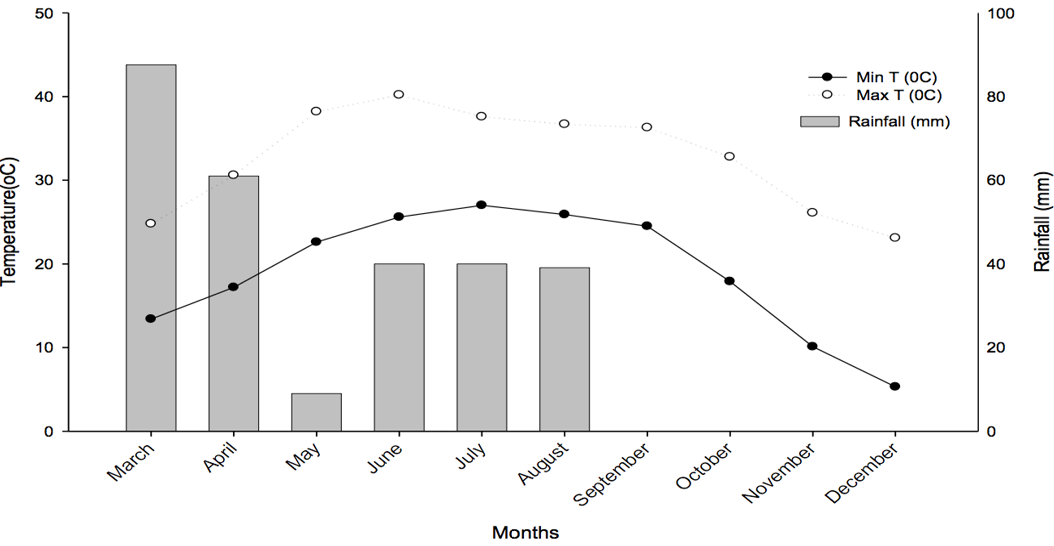
To study the effect of different Phosphorus (P) and Potassium (K) rates on first establishment year of the alfalfa crop, a field experiment was conducted at Agronomy Research Farm of the University of Agriculture Peshawar during 2015-16. Experiment was in three factors complete randomized block design, in three replications. The factor includes different P (i.e. 40, 80 and 120 kg ha-1) and K-rate (i.e. 25, 50 and 75 kg ha-1) and two alfalfa varieties (i.e. Sardi-7 and NRC-2015) to compare yearly biomass production. Field was prepared after harvesting maize in October 2015 by using tractor with cultivator and a rotavator. Sowing was made on November 02, 2015 using the desired seed rate (20 kg ha-1) for both alfalfa varieties. Each experimental unit was 2.4 x 4.0 m with accommodating 6 rows at 0.40 m distances. Both P and K were applied as per proposed rates at the time of seedbed preparation. Nitrogen was also applied 25 kg ha-1 uniform as basal application to all experimental units once at seedbed preparation. All other agronomic practices (i.e. irrigation, weeding, management etc.) were kept uniform during the crop growth season. Weather status i.e. rainfall and temperatures are shown in Figure 1. For the establishment phase of sampling excited.
Measurements
About three months after sowing the alfalfa, fresh herbage was cut as green forage. The first sampling was excited in a meter square area at two representative locations in an experimental unit and averaged for the fresh biomass weight. A handsome sample was oven dried at 70OC for two days (i.e. 34 h) in a hot air circulating oven and dry matter determined accordingly. From March onwards, periodic fresh and dry matters were excised on about monthly basis from April till December, 2016. Conversions of the fresh to dry matters was made into kg ha-1 as per standard procedure i.e. the ratio of biomasses of dry matter from fresh matters from area harvested and multiplied with the hectare area. Likewise, fresh matter was converted as ratio of fresh matter over the dry matter sample and multiplied with total fresh matter of an experimental unit and/or hectare. Leaf to stem ratio is an important parameter for forages, which also sampled for all samplings made in the year. To measure leaf to stem ratio (LSR), 10g fresh sample was taken from an experimental unit, sun dried for a week and bifurcated to leaf and stem weighed. The LSR was derived by further drying it in forced air circulating oven for a day at constant temperature (70OC) and weighted for stem and leaf fraction. Leaf weight was divided on stem for the LSR for each periodic sampling.
Periodic biomass samplings of the year-round duration are expressed for months in thermal units (TU OC) for better understanding the crop growth behavior. Each month of the year differs in photoperiod and temperature from March to December. The TU provide better understanding of the crop growth behavior, TU was calculated as mean cumulative temperature of the period for each individual day passed from crop emergence to the subsequent cut less base temperature (i.e. 6 OC) for alfalfa.
Data were statistically analyzed using analysis of variance techniques appropriate for the randomized complete block design. Means for the treatments, where found significant, were compared using LSD test (p<0.05).
Results and Discussion
Alfalfa herbage
Fresh matter (FM) of alfalfa in first establishment year was affected (p<0.05) by treatment varieties (V), K and P rates (Table 1). A significant effect noticed for V, K and P rate in the 1st sampling excited in March (TU 762OC) by accumulation of mean averaged temperatures of the growth period OC. Potassium showed a significant effect on FM in the 1st sampling with the highest FM at K 75 kg ha-1, followed by 50 and 25 kg ha-1, which were non-significant to each other. Phosphorus rate also showed significant effects on FM with the highest for 120 kg P ha-1, followed by 80 and the lowest for the 40 kg P ha-1. The 2nd sampling excited in April (TU 409OC) showed significant effects for V, K and P rates. Higher FM was recorded for NRC-15 over Sardi-7. Whereas, during the 2nd sampling, FM was non-significant (p>0.05) for K 50 and 75 kg ha-1 but with lower values for 25 kg K ha-1. Nonetheless, increased P from 40 to 80, and thereafter to 120 kg ha-1 significantly increased alfalfa FM. during 3rd sampling excited in May (TU 554OC) a significant effect observed for V, K and P rates with higher FM for NRC-15. The FM was highest for K 75 kg ha-1, followed by 50 and 25 kg ha-1. Increasing P from 40, to 80 kg ha-1 and subsequently to 120 kg ha-1 significantly increased FM in the 3rd sampling. During the 4th sampling in June (TU 816OC) FM was significant for V, K and P rates with higher for NRC-15. Similarly, the highest FM was recorded in K 75 kg ha-1, followed by K 50 and 25 kg ha-1, respectively. Increase P-rate from 40 to 120 kg ha-1 showed a significant increase in FM of alfalfa. During 5th sampling excited in July (TU 867OC), the alfalfa FM was non-significant for V, but were significant for K and P rates. The highest FM was reported for K 75 kg ha-1, followed by K 50 and 25 kg ha-1, respectively. Increasing P-rate from 40 to 120 kg ha-1 has shown a significant increase in the FM. During 6th sampling excited in August (TU 1086OC), the FM was significantly higher for variety Sardi-7 over the NRC-15. Likewise, highest FM was noted for K 75 kg ha-1, followed by 50 and 25 kg ha-1. Increasing P-rates from 40 to 120 kg ha-1 has significantly increased alfalfa FM. During 7th sampling i.e. September (TU 744OC), the FM was significant for V, K and P rates with higher for the Sardi-7. Similarly, the highest FM was noticed with K 75 kg ha-1, followed by K 50 and 25 kg ha-1. Increase in P-rates from 40 to 120 kg ha-1 exhibited a significant increment in alfalfa FM. During the 8th sampling in October (TU 679OC), the crop FM was significant for V, K and P rates with higher for the Sardi-7. The highest FM was also observed with K 75 kg ha-1, followed by K 50 with a non-significant change with K 25 kg ha-1. Increase P-rate from 40 to 120 kg ha-1 has significant increased FM. For the 9th sampling in November (TU 470OC), the crop FM was significant for V, K and P with higher for the Sardi-7. The highest FM was noted for K 25 kg ha-1, followed by K 50 with no change with K 75 kg ha-1. The application of P 120 kg ha-1 also resulted in higher FM than rest of the two rates. For the 10th sampling excited in December (TU 299OC), the crop FM was significant for V, K and P rates with higher for Sardi-7. The highest FM was noted for K 75 kg ha-1, followed by K 50 with no change with K 25 kg ha-1. The application of P 120 kg ha-1 showed higher FM than rest of the two P rates.
Dry Matter (DM)
Dry matter (DM) of alfalfa in the first establishment phase was affected (p<0.05) by V, K and P rates (Table 2). A significant effect was noted for V and P rates during March sampling (TU 762OC). Phosphorus also showed significant effects on DM with higher for P 120 kg ha-1, followed by P 80 and 40 kg ha-1. Sampling two excited in April (TU 409OC) showed higher DM for NRC-15 over the Sardi-7. Crop DM was non-significant (p>0.05) for K-rates. Nonetheless, increase in P from 40 to 120 kg ha-1 has significantly increased DM. During 3rd sampling excited in May (TU 554OC) showed higher DM for NRC-15. The highest DM was reported for K 75 kg ha-1, followed by K 50 and 25 kg ha-1, respectively. Increase P from
Table 1: Periodic fresh matter (t ha-1) observed in different months during establishment year of alfalfa as also expressed in Thermal Units (TU oC) during the first-year growth and development.
| Samplings | March | April | May | June | July | August | September | October | November | December |
| (TU OC) | 762 | 409 | 554 | 816 | 867 | 1086 | 744 | 679 | 470 | 299 |
| Varieties | ||||||||||
| Sardi-7 | 2.63 | 4.60 | 10.69 | 12.30 | 14.20 | 14.30 | 12.96 | 8.20 | 9.20 | 8.00 |
| NRC-15 | 3.05 | 5.60 | 11.68 | 13.40 | 14.00 | 14.00 | 9.84 | 4.50 | 5.10 | 4.40 |
| Significance level | *** | *** | *** | *** | ns | *** | *** | *** | *** | *** |
| Potassium (kg/ha) | ||||||||||
| 25 | 2.79 | 4.92 | 10.57 | 12.15 | 13.56 | 13.21 | 10.55 | 6.09 | 7.22 | 5.92 |
| 50 | 2.75 | 5.34 | 10.68 | 12.28 | 13.77 | 13.91 | 11.49 | 5.93 | 7.13 | 6.08 |
| 75 | 2.98 | 5.04 | 12.32 | 14.17 | 14.87 | 15.31 | 12.15 | 7.08 | 7.01 | 6.60 |
| Significance level | * | * | *** | *** | *** | *** | *** | *** | ** | *** |
| Phosphorous (kg/ha) | ||||||||||
| 40 | 2.44 | 4.37 | 9.97 | 11.46 | 12.09 | 12.17 | 9.48 | 5.28 | 6.63 | 5.80 |
| 80 | 2.91 | 4.90 | 11.29 | 12.98 | 13.70 | 13.62 | 11.42 | 6.22 | 6.79 | 5.94 |
| 120 | 3.17 | 6.03 | 12.31 | 14.15 | 16.41 | 16.64 | 13.30 | 7.61 | 7.94 | 6.85 |
| Significance level | *** | *** | *** | *** | ** | *** | *** | ** | ns | * |
| Interaction (K x P) | Ns | Ns | Ns | Ns | ns | ns | ** | ns | ns | ** |
| Interaction (Vx P) | Ns | Ns | Ns | Ns | ns | ns | ns | ns | ns | *** |
| Interaction (V x K) | Ns | Ns | Ns | Ns | ns | ns | ns | ns | ns | Ns |
| Interaction (V x K x P) | Ns | Ns | Ns | Ns | ns | ns | ns | ns | ns | Ns |
| LSD (p>0.05) using least significant test | ||||||||||
| Varieties | 0.15 | 0.23 | 0.53 | 0.61 | 0.65 | 0.81 | 0.52 | 0.64 | 0.68 | 0.40 |
| Potassium | 0.19 | 0.29 | 0.65 | 0.75 | 0.79 | 0.99 | 0.64 | 0.78 | 0.84 | 0.49 |
| Phosphorous | 0.19 | 0.29 | 0.65 | 0.75 | 0.79 | 0.99 | 0.64 | 0.78 | 0.84 | 0.49 |
40 to 120 kg ha-1, has also significantly increased DM. During 4th sampling excited in June (TU 816OC), crop DM was significantly higher for NRC-15. The highest DM was also associated to K 75 kg ha-1, followed by K 50 and 25 kg ha-1. Increasing P from 40 to 120 kg ha-1 has also increased (p>0.05) DM of alfalfa. During the 5th sampling excited in July (TU 867OC), DM did not vary for V, but did significantly vary for K and P rates. The highest DM was reported at K 75 kg ha-1, followed by K 50 with no change from K 25 kg ha-1. Increasing P from 40 to 120 kg ha-1 has enhanced DM of the crop. During the 6th sampling in August (TU 1086OC), DM was non-significant for both varieties. However, the highest DM was recorded for K 75 kg ha-1, followed by K 50 and 25 kg ha-1. Increasing P-rate from 40, to 120 kg ha-1 significantly increased DM. For 7th sampling in September (TU 744OC), crop DM was significant for V with higher for Sardi-7. Similarly, the highest DM was noted for K 75 kg ha-1, followed by K 50 and K 25 kg ha-1. Increase P-rates from 40 to 120 kg ha-1 significantly increased DM of the crop. During the 8th sampling excited in October (TU 679OC), crop DM was significant for V and P rates, with higher for Sardi-7. Increasing P-rate from 40 to 80 kg ha-1 has shown a significant increase in DM. Potassium did not show any change at this stage of the crop. During the 9th sampling in November (TU 470OC), crop DM was significant for V and P rates with higher for Sardi-7. The highest DM was also observed for P 120 kg ha-1, followed by P 80 and 40 kg ha-1. During the 10th sampling excited in December (TU 299OC), crop DM was significant for V, K and P rates with higher DM for Sardi-7. The highest DM was also observed for K 75 kg ha-1, followed by K 50 with no changes with K 25 kg ha-1. The application of P 120 kg ha-1 showed higher DM then rest of the two given rates.
Cumulative DM
Alfalfa being a perennial nature crop stays longer in the field after successfully establishment of the first-year growth. It is important to study the establishment growth, which returns in following years herbage production. We, therefore, studied periodic biomass (FM
Table 2: Periodic dry matter (t ha-1) observed in different months during establishment year of alfalfa as also expressed in Thermal Units (TU oC) during first-year growth and development.
| Sampling s | March | April | May | June | July | August | September | October | November | December |
| (TU OC) | 762 | 409 | 554 | 816 | 867 | 1086 | 744 | 679 | 470 | 299 |
| Varieties | ||||||||||
| Sardi-7 | 0.82 | 1.01 | 1.94 | 2.20 | 2.80 | 2.80 | 2.54 | 1.70 | 1.90 | 1.54 |
| NRC-15 | 1.00 | 1.13 | 2.03 | 2.30 | 2.70 | 2.80 | 1.82 | 0.90 | 0.90 | 0.85 |
| Significance level | *** | ** | ** | ** | ns | Ns | *** | *** | *** | *** |
| Potassium (kg/ha) | ||||||||||
| 25 | 0.91 | 1.07 | 1.91 | 2.19 | 2.69 | 2.56 | 2.04 | 1.30 | 1.41 | 1.13 |
| 50 | 0.89 | 1.09 | 1.92 | 2.20 | 2.70 | 2.80 | 2.13 | 1.35 | 1.35 | 1.18 |
| 75 | 0.94 | 1.05 | 2.13 | 2.44 | 2.91 | 3.05 | 2.37 | 1.35 | 1.38 | 1.28 |
| Significance level | ns | ns | *** | *** | * | *** | * | ns | ns | * |
| Phosphorous (kg/ha) | ||||||||||
| 40 | 0.76 | 0.96 | 1.81 | 2.09 | 2.24 | 2.22 | 1.56 | 1.10 | 1.21 | 1.06 |
| 80 | 0.95 | 1.03 | 2.03 | 2.33 | 2.72 | 2.68 | 2.18 | 1.32 | 1.34 | 1.18 |
| 120 | 1.03 | 1.21 | 2.11 | 2.42 | 3.33 | 3.52 | 2.80 | 1.58 | 1.59 | 1.35 |
| Significance level | *** | *** | *** | *** | *** | *** | *** | *** | *** | *** |
| Interaction (K x P) | ns | ns | * | * | ns | ns | ns | ns | ns | * |
| Interaction (Vx P) | ns | ns | ns | ns | ns | ns | ns | ns | ns | ns |
| Interaction (V x K) | ns | ns | *** | *** | ns | ns | ns | ns | ns | ns |
| Interaction (V x K x P) | ns | ns | ns | ns | ns | ns | ns | ns | ns | ns |
| LSD (p>0.05) using least significant test | ||||||||||
| Varieties | 0.08 | 0.08 | 0.06 | 0.07 | 0.15 | 0.19 | 0.18 | 0.13 | 0.15 | 0.09 |
| Potassium | 0.09 | 0.09 | 0.08 | 0.09 | 0.18 | 0.23 | 0.22 | 0.16 | 0.18 | 0.11 |
| Phosphorous | 0.09 | 0.09 | 0.08 | 0.09 | 0.18 | 0.23 | 0.22 | 0.16 | 0.18 | 0.11 |
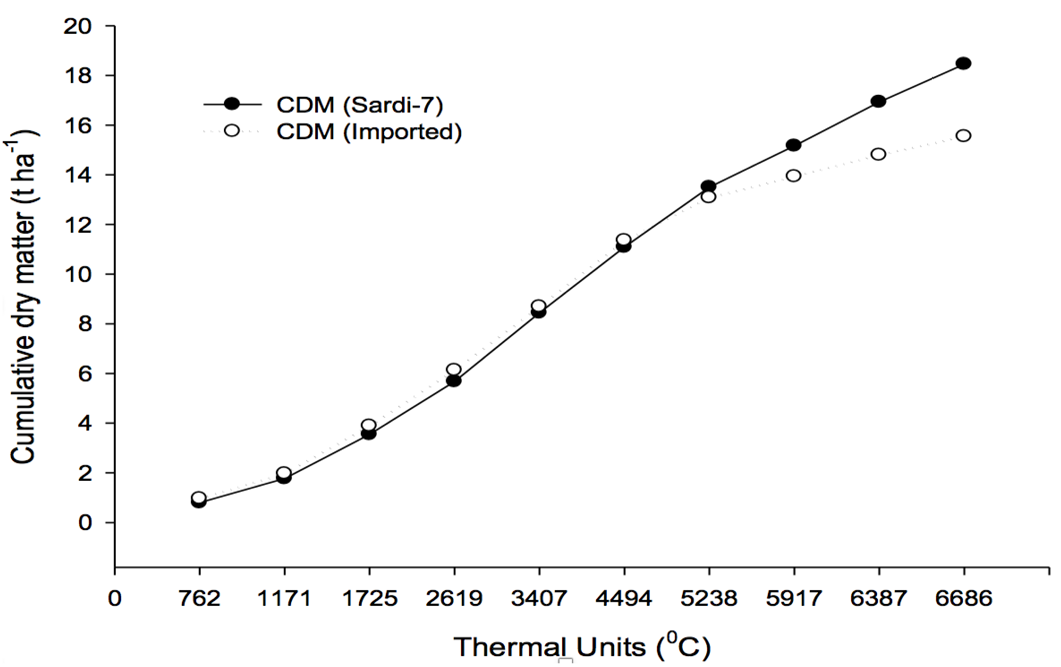
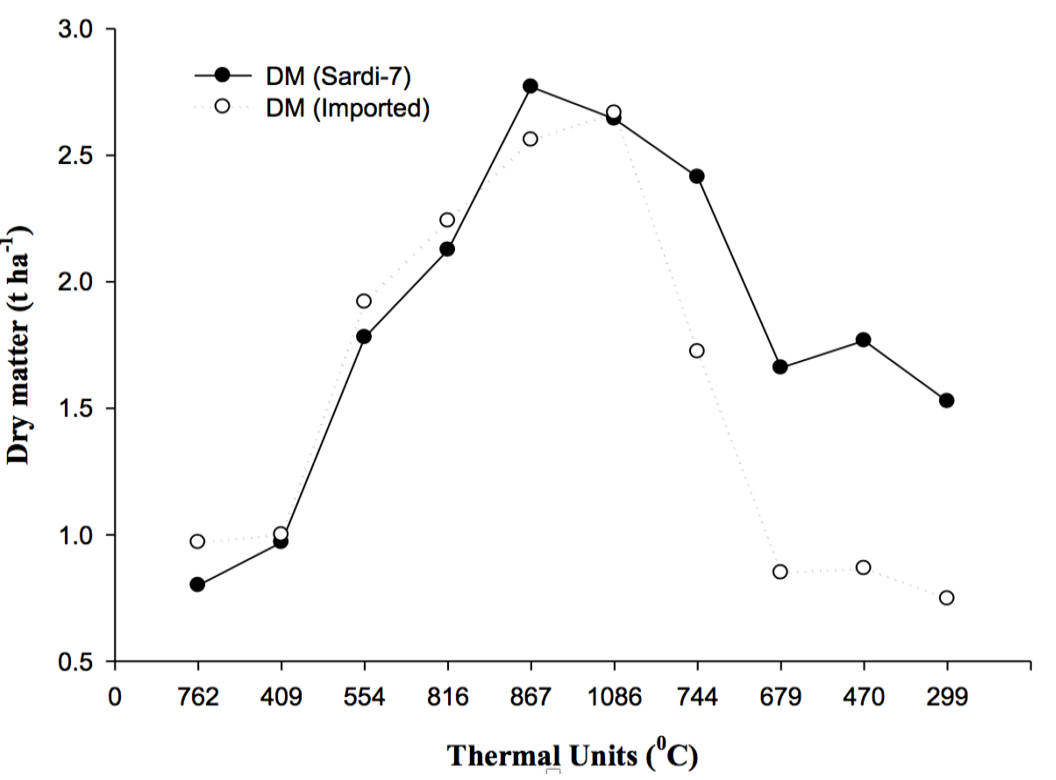
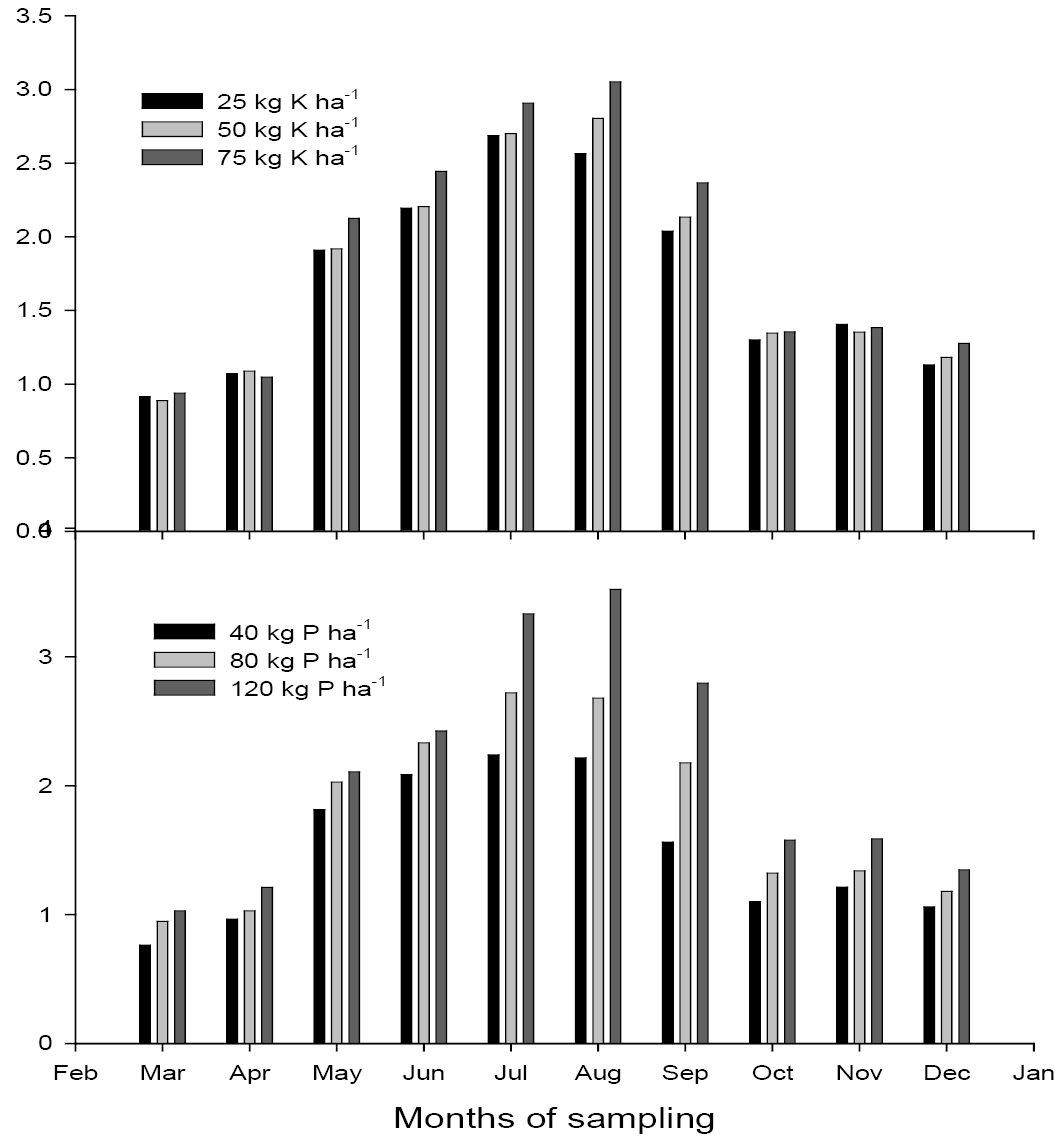
and DM) at monthly intervals starting from March (762OC) to December (6686OC) of proper canopy establishment of alfalfa varieties under the given treatments i.e. P and K-rates. Total biomass is expressed against accumulated TU OC of the growth season for two alfalfa varieties (Figure 2). While averaged across P and K, cumulative DM productions over the year for alfalfa varieties are shown in Figure 3. The Figure 2 shows that DM production of varieties was in similar fashion. Alfalfa exhibited almost similar growth in first two samplings (TU 762 and 1171°C), thereafter, each subsequent sampling contributed positively in DM of each variety in season. Nonetheless, DM of variety NRC-2015 remained static at TU 5238°C while Sardi-7 showed a positive growth till TU 6686°C. The figures expressed that variety NRC-2015 was fall dormant. Fresh matter of both alfalfa varieties over the 1st year samplings is also expressed in Figure 3. Seasonal FM of two varieties for about a monthly interval is shown against TU (°C). Data revealed that NRC-2015 DM production was slightly higher than Sardi-7 in first fourth samplings excised at TU 762°C, 409°C, 554°C and 816°C, but thereafter, both varieties showed an almost similar DM for the next two samplings i.e. TU 867°C and 1086°C. As thermal units (°C) accumulated with time of the season during months of the year, alfalfa DM production also increased. The maximum DM was recorded at TU 867°C and 1086°C during sampling of July and August, which was the longest photoperiod of the days of the year. Thereafter, a subsequently decrease in TU has decreased DM with minimum for the sampling made in December i.e. TU 299°C. Data in Figure 3 also showed that variety NRC-2015 decreased DM from 1086°C i.e. 6th sampling excited in the August. Variety NRC-2015 was fall dormant as compared to the other variety Sardi-7. Overall trends of the variety performance showed both varieties were almost similar in DM production with higher seasonal changes observed in the vegetation biomass productivity in Peshawar’s climate. While averaged across V, the DM of alfalfa with P and K rates are shown in Figure 4. Both the given P and K rates expressed their effects on DM in samplings harvested in the 1st establishment year. Fresh matter production increased with increasing TU in season. Alfalfa herbage yield was increased almost in similar fashions for the peak growth production at sampling with the maximum for higher P- and K-rates, i.e. 120 and 75 kg ha-1, respectively.
Leaf stem ratio (LSR)
Leaf to stem ratio (LSR) of alfalfa in establishment phase of growth did not vary in first sampling made in March i.e. 762 TU (Table 3). However, varieties differ in 2nd 3rd and 8th sampling excited in April (409 TU), May (554 TU) and October (679 TU) with higher for sardi-7 over NARC-15. A non-significant (p>0.05) effect in LSR was noted for V, K and P-rates for sampling excited in months March (762 TU), June (816 TU), July (8667 TU), September (470 TU) and December (299 TU). At 6th sampling i.e. August (1086OC TU), LSR was non-significant for V and P but significant for P only. The highest LSR was recorded for P 80 kg ha-1, followed by P 120 kg ha-1. In 7th sampling i.e. September (744OC TU), LSR was non-significant for varieties, K and P-rate. In 8th sampling excited in October (679OC TU), LSR was significant for varieties with higher for Sardi-7. For 9th sampling excited in November (470OC TU), LSR was significant for varieties i.e. higher for Sardi-7. The highest LSR was also noted for 75 kg K ha-1, followed by 50 with no change with 25 kg ha-1. P-rate of 120 was higher, followed by 80 and 40 kg ha-1. At 10th sampling excited in December (299OC TU), LSR did not vary for varieties, K and P rates.
Interactive effects of treatment (i.e. P x K, V x K, V x P and V x P x K) were non-significant for biomass production of alfalfa in the 1st sampling. Variety NRC-15 gave the highest biomass. Herbage (FM and DM) increased with increasing P-rate with highest for P 120 kg ha-1. Significant variation also recorded for V and P-levels on DM in 2nd sampling. Variety NRC-15 gave the maximum matter. Our results are in conformity with results of those reported by Mullen et al. (2001). They explained alfalfa response with P and K in the 1st year has increased
Table 3: Leaf to stem (LSR) of alfalfa observed in different months during the establishment year as also expressed in Thermal Units (TU oC) during first-year growth and development.
| Samplings | March | April | May | June | July | August | September | October | November | December |
| (TU OC) | 762 | 409 | 554 | 816 | 867 | 1086 | 744 | 679 | 470 | 299 |
| Varieties | ||||||||||
| Sardi-7 | 0.7 | 1.19 | 0.74 | 0.77 | 0.74 | 0.78 | 0.67 | 0.88 | 0.88 | 0.73 |
| NRC-15 | 0.74 | 1.1 | 0.66 | 0.73 | 0.68 | 0.75 | 0.7 | 0.74 | 0.85 | 0.77 |
| Significance level | ns | * | ** | Ns | ns | ns | ns | * | ns | ns |
| Potassium (kg/ha) | ||||||||||
| 25 | 0.72 | 1.14 | 0.69 | 0.74 | 0.70 | 0.77 | 0.68 | 0.91 | 0.83 | 0.76 |
| 50 | 0.72 | 1.14 | 0.71 | 0.76 | 0.65 | 0.75 | 0.67 | 0.82 | 0.78 | 0.75 |
| 75 | 0.73 | 1.15 | 0.69 | 0.74 | 0.77 | 0.77 | 0.71 | 0.70 | 0.99 | 0.75 |
| Significance level | ns | ns | ns | Ns | ns | ns | ns | ns | ** | ns |
| Phosphorous (kg/ha) | ||||||||||
| 40 | 0.74 | 1.13 | 0.71 | 0.77 | 0.68 | 0.67 | 0.64 | 0.72 | 0.75 | 0.76 |
| 80 | 0.72 | 1.19 | 0.70 | 0.74 | 0.73 | 0.88 | 0.70 | 0.88 | 0.87 | 0.78 |
| 120 | 0.70 | 1.11 | 0.69 | 0.74 | 0.71 | 0.73 | 0.71 | 0.82 | 0.98 | 0.71 |
| Significance level | ns | ns | ns | Ns | ns | ** | ns | ns | ** | ns |
| Interaction (K x P) | ns | ns | ns | Ns | ns | ** | ns | ** | ns | ns |
| Interaction (Vx P) | ns | ns | * | Ns | ns | ns | ns | ** | ns | ns |
| Interaction (V x K) | ns | ns | ns | Ns | ns | ns | ns | ** | ** | ns |
| Interaction (V x K x P) | ns | ns | ns | Ns | ns | ns | ns | ns | ns | ns |
| LSD (p>0.05) using least significant test | ||||||||||
| Varieties | 0.06 | 0.10 | 0.05 | 0.06 | 0.12 | 0.10 | 0.09 | 0.14 | 0.11 | 0.14 |
| Potassium | 0.07 | 0.13 | 0.06 | 0.08 | 0.14 | 0.12 | 0.11 | 0.18 | 0.14 | 0.17 |
| Phosphorous | 0.07 | 0.13 | 0.06 | 0.08 | 0.14 | 0.12 | 0.11 | 0.18 | 0.14 | 0.17 |
linearly for yield and biomass. Biomass in 2nd sampling also showed an increase with increasing P-rate to the crop. The maximum matter was observed for P 120 kg ha-1. Potassium rates did not show any change in herbage in the 2nd sampling. All interactions were also found non-significant in the 2nd sampling. Potassium with P resulted denser sprouting stand of alfalfa as compared to the P-rates alone . Optimum P has shown vigorous seedling growth . Biomass of alfalfa in the 3rd and 4th samplings was significantly affected by V, P- and K. Interactions of P x K and V x K were also significant. Variety NRC-15 gave higher FM. Phosphorus 120 kg ha-1 gave the maximum herbage. While averaged across V and P, K 75 kg ha-1 gave the maximum biomass. Results of Berg et al. (2003) reported an increase in P and K, which has dramatically increase alfalfa yield due to root extension and more nutrients uptake by plants ; . Biomass of the 4th sampling was affected by V, P- and K-level. All interactions were non-significant but P x K and V x K. Biomass was higher for NRC-15. Averaged across V and K, maximum herbage was observed in 4th sampling with P 120 kg ha-1. Potassium 75 kg ha-1 gave the maximum biomass in the 4th sampling. Application of P and K developed better shoot per plant that augmented higher yield . Results of Koenig (2002) has also reported higher biomass with increasing P and K. The FM in the 5th and 6th samplings were significant for P and K only.
All interactions were non-significant in the 5th sampling. The maximum biomass was recorded for P 120 kg ha-1. On averaged across P, the maximum biomass was observed with K 75 kg ha-1, which was significant from K 50 and 25 kg ha-1. Report of Berg et al. (2007) concluded that alfalfa plant survived in optimum P to develop the desired stand. It is known that P fertilizer required in greater amount to achieve the desired stand of alfalfa . Biomass in the 6th sampling was significant for P and K-rates. Interactive effects of P x K, V x P, V x K and V x P x K were non-significant (p>0.05). Herbage of the 6th sampling increased with increasing P to crop with highest for P 120 and minimum for P 40 kg ha-1. Similarly, the maximum biomass observed for K 75 kg ha-1 and minimum for K 25 kg ha-1 in 6th sampling. Epstein and Bloom (2005) reported that P shall be applied at sowing to contribute in growth and stand establishment processes, which include energy gaining, storage and utilization. Alfalfa variety Sardi-7 gave the maximum matter which increased with increasing P-rate with highest for P 120 kg ha-1. While averaged across V and P, maximum FM corresponds to K 75 kg ha-1, which was significantly vary from K 50 and 25 kg ha-1. Our results are in lines with findings of Lissbrant et al. (2009), who observed positive effects of K on alfalfa stand establishment. Balance nutrition of P and K are essential for alfalfa herbage yield. Biomass in the 8th sampling was significant for V, K and P. Interactive effect of P x K, V x P, V x K and V x P x K were non-significant. Sardi-7 gave higher biomass. It is understood that addition of K fertilizer encouraged advances in plant perseverance . Biomass regarding alfalfa in the 9th and 10th sampling was significantly for V and P. Sardi-7 gave the higher matter due to no fall dormancy character. Fresh matter in 9th sampling increased with increasing P with highest at P 120 kg ha-1 and lowest at P 40 kg ha-1. Similarly, K did not show any changes in biomass at the 9th sampling. All possible interactions of treatments were non-significant. Terry and Raymond (1992) observed that fast growing crop needs higher nutrients for good returns. Optimum availability of P and K are responsible for good production efficiency due to its utilization from soil in cuts . Biomass in the 10th sampling also significantly affected by V, P and K. All interactions were non-significant except P x K. Sardi-7 gave the maximum herbage. Averaged across V and K, the P 120 kg ha-1 gave maximum biomass. For K-rates, the maximum FM was recorded for K 75 kg ha-1 and minimum for K 25 kg ha-1. Alfalfa forage has responded to P fertilizers with increase in FM, carrying ability, and weight gain per ha-1 . Yield of alfalfa forages increased significantly with increasing K for better water regulation by plants .
Leaf to stem ratio (LSR)
Analysis of variance of LSR was non-significant in 1st sampling excited in March for V, P and K. All interactions i.e. P x K, V x P, V x K, V x P x K were non-significant. Statistically, LSR of 2nd sampling was affected by V only, with higher for the Sardi-7. The LSR in 3rd sampling was significantly affected by V, whereas, P and K did not change alfalfa LSR. Sardi-7 gave the maximum LSR. The LSR in 4th sampling was non-significant (p>0.05) for V, P and K. All interactions were also non-significant for the LSR. Afsharmanesh (2009) observed LSR contributed more than 95% in alfalfa yield for difference in varieties due to assimilate partitioning. Lamb et al. (2003) argued that genetic diversity is main reason of LSR in alfalfa ecotypes than the nutrient rates. Statistical analysis of the 5th sampling showed non-significant (P>0.05) effects of P, K and V including interactions. Mean data showed LSR of 6th sampling was significantly affected by P and for interaction P x K only. Maximum LSR observed for P 80 kg ha-1 followed by P 120 and P 40 kg ha-1. The LSR in 7th sampling was non-significant for V, P and K. All interactions were also non-significant (p>0.05). The LSR in 8th sampling was significantly affected by V only. Sardi-7 gave the maximum LSR. Dinesh Kumar (2007) observed that alfalfa LSR improve with optimum K with time of cuttings. Otherwise, fertilizer did not necessarily affect LSR. The higher LSR obtained in ecotypes have multi-foliolate character (Lemb at al., 2003). Literature of Raza and Mustafvi (2012) reported both P and K positively affects growth, and hence the LSR subject to favorable temperature in the season. The LSR of 9th sampling was significantly affected by P and K, varieties did not show any changes in LSR. LSR was the highest for P 120 kg and 80 kg ha-1 with non-significant changes. Potassium 75 kg ha-1 gave the maximum LSR, followed by K 50 kg ha-1. Mean of LSR in the 10th sampling was non-significant. Effect of P and K has enhanced leaf photosynthesis, growth and development . It is observed that alfalfa ecotypes with higher leaflet number and larger leaflet area resulted better biomass production .
Conclusions and Recommendations
Alfalfa biomass (t ha-1) increases with time for each sampling in the 1st establishment phase of growth. Biomass production showed increase with increase in TU (°C) of the season starting from March to August and then decline in a year. Both higher P (120 kg ha-1) and K (75 kg ha-1) ensured better plant stand and early growth for every next sampling excited for re-growth of alfalfa productivity. Between varieties, NRC-15 is fall dormant as compare to Sardi-7. Variety Sardi-7 is better in biomass to yield fresh matter for longer duration. Variety NRC-15 also gave the same herbage in the season with limited growth period for double crop system.
Acknowledgement
The authors highly acknowledge with thanks the financial support of the Higher Education Commission (HEC), Islamabad in the form of project grants Ref. No. 20-4475. Equal thanks are also extended to Prof. Nazir Ahmad, Dean Faculty of AHVS to extend cooperation using their Lab for forage quality analysis of the project work.
Author’s Contribution
Mr. M. Sohaib conducted the research and data compilation. Ms. Rabia Gohar did data analysis and data validation, tabulation and M. Akmal designed the experiment and edited draft paper for the publication.