
In this paper, a new species Megalurothrips longus sp.n. from Hainan Island of China is described and illustrated. This new species is unique in this genus by the combinations of having 5 pairs of long setae on pronotum, the ultrashort chapped craspedum on posterior margin of abdominal tergites, and the shape and relative locations of setae on tergite IX.
Short Communication · Volume 51, Issue 1, 21 January 2019 · Open Access
A New Species of Genus Meglurothrips Bagnall, 1915 (Thysanoptera: Thripidae) from Hainan Island of China
·
Affiliations & Notes ⌄
- 1College of Chemistry and Environment, Weinan Normal University, Weinan, Shaanxi 714099, China 2Key Laboratory for Ecology and Environment of River Wetlands in Shaanxi Province, Weinan, Shaanxi 714099, China 3Key Laboratory of Plant Protection Resources and Pest Management of the Ministry of Education, Entomological Museum, Northwest A&F University, Yangling, Shaanxi 712100, China , * Corresponding author: qlhu@nwsuaf.edu.cn
Article Info ⌄
- Journal:
- Pakistan Journal of Zoology
- Published:
- 21 January 2019

From the article
- Median setae on tergites anteromedial to campaniform sensilla (Fig. 1I).
- Abdominal sternites without discal setae, sternite with exceptional long posterior marginal setae (Fig. 1H), sternite II with 2 pairs while sternites III-VII with 3 pairs.
- Tergite IX with S1 (median setae) and S3 thorn-like (Fig. 1L).
- This new species is unique in this genus by having 5 pairs of long setae on pronotum and the ultrashort chapped craspedum on posterior margin of abdominal tergites.
Selected from the article's own text.
Abstract
Materials and methods
Thrips specimens examined in this study were mounted onto slides followed Zhang et al. (2006). All measurements described in this paper are in micrometers (μm). Specimens were observed with an EVOS digital inverted microscope. Photographs were made using a Nikon Y-IDT microscope with a Q-image CCD. Images were produced using the software Synoptic Automontage.
Megalurothrips longus, new species
(Fig. 1)
Male macroptera
Head
Head wider than long, with transverse striations posteriorly. 3 pairs of ocellar setae present, pair III is the longest, just inside of the ocellar triangle (Fig. 1B). Antennae 8-segmented, segments III and IV with two margins parallel to each other, sense cones forked (Fig. 1F). Maxillary palpi 3-segmented.
Thorax
Pronotum wider than long, nearly smooth, with 5 pairs of long setae other than the anteroanglular setae. 4 pairs of posteriormarginal setae present (the median long setae included) (Fig. 1E). Mesonotum sculptured with transverse striae, median pair of setae situated on the posterior margin; metanotum sculptured with longitudinal line laterally, median part with inversus U shaped striae. Median pair of metanotal setae nearly on the anterior margin, one pair of campaniform sensilla at the postmedian part (Fig. 1D); mesofurcal spinula present, metafurca without spinula (Fig. 1C). Fore vein with a short subapical gap followed by 2 distal setae, hind vein complete row of setae (Fig. 1G). Ferna undivided in the middle, prospinasternum complete (Fig. 1C).
Abdomen
Abdominal tergites with ultrashort chapped craspedum on the posterior margin. Tergites sculptured with transverse striae except the area between median setae on tergies II (Fig. 1K). Median setae on tergites anteromedial to campaniform sensilla (Fig. 1I). Tergite II with 3 setae arrayed in a longitudinal row laterally (Fig. 1J). Abdominal sternites without discal setae, sternite with exceptional long posterior marginal setae (Fig. 1H), sternite II with 2 pairs while sternites III-VII with 3 pairs. Median setae of sternite VII on posterior margin (Fig. 1H). Tergite IX with S1 (median setae) and S3 thorn-like (Fig. 1L).
Female
Unknown.
Measurements
Holotype in micros: Total body length 1348.03; head length 100.63, width 123.39. Length (width) of antennal segment: I 27.98 (29.16), II 39.88 (24.90), III 56.44 (14.45), IV 59.96 (14.35), V 36.29 (15.21), VI 66.87 (18.01), VII 8.77 (6.75), VIII 13.92 (5.37). Pronotum length 142.17, median width 186.52; posteromarginals, inner 40.52; posteroangulars, inner 60.32, outer 56.88; Median setae on metanotum length 49.19. Fore wing length 710.97, width 36.62 at middle, hind wing length 612.64, width 24.52 at middle.
Etymology
The specific epithet derived from the Latin term ‘longus’ which means ‘long’, which refers to the long setae on pronotum other than the posteroangular setae.
Type specimens
Holotype male macroptera, China: Jianfeng Town, Hainan Province, 170m, 18.vii.2009, Qingling Hu sweeping from grass; paratypes: 10 males, same data as holotype.
Remarks
This new species is unique in this genus by having 5 pairs of long setae on pronotum and the ultrashort chapped craspedum on posterior margin of abdominal tergites. It can be easily distinguished from other male known species (M. usitatus, M. mucunae, M. distalis, and M. peculiaris) by the presence of 2 pairs of thorn-like setae (S1 and S3) on tergite IX (Fig. 1L) (vs. only 2 pairs of long setae and 1 pair of thorn-like setae (S3) on tergite IX). This species can be distinguished from male known species M. typicus by the combinations of the unique long setae on pronotum, ultrashort chapped craspedum on Losterior margin of abdominal tergites and the relative locations of the setae on tergite IX.
Acknowledgements
The project was supported by the National Science Foundation of China (30570205), the Young Talent Support Program from the Association for Science and Technology of Colleges in Shaanxi Province (20160235), the Special Foundation for Young Scientists of Weinan Normal University in 2018 (18ZRRC11), and the Research Project of the Shaanxi Education Department (17JS040).
Statement of conflict of interest
The authors declare no conflict of interest.
Figures
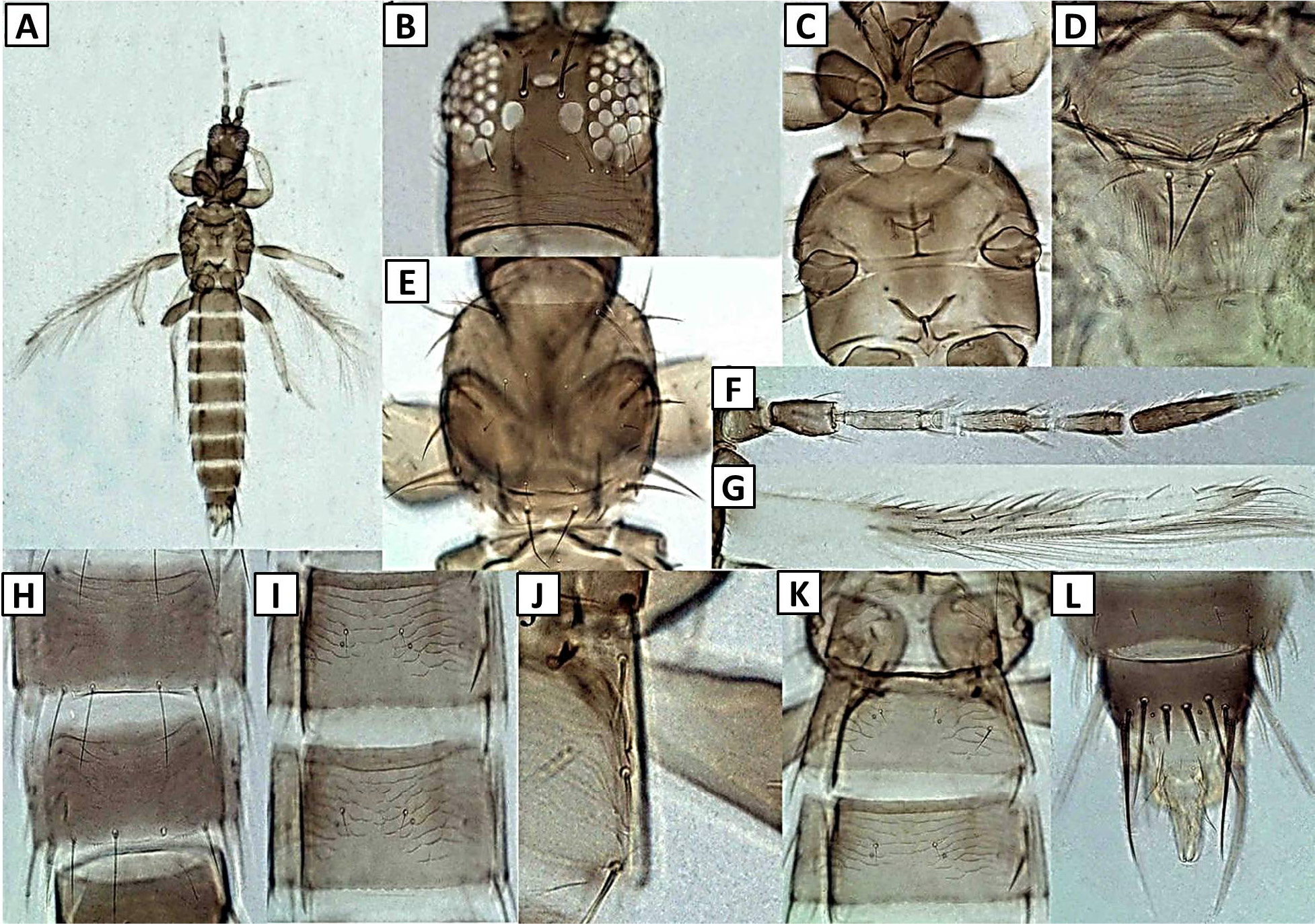
Megalurothrips longus new species (sp. n.). A, male; B, head; C, ventral view of thorax; D, meso- and metanota; E, pronotum; F, antenna; G, fore wing; H, abdominal sternites VI-VII; I, abdominal tergites IV-V; J, lateral longitudinal setae on abdominal tergite II; K, abdominal tergites I-III; L, male abdominal tergites VIII-X.
References
- Bagnall, R.S., 1915. Annu. Mag. Nat. Hist., 15: 588-597. https://doi.org/10.1080/00222931508693676[CrossRef]
- Han, Y.F., 1997. Economic insect fauna of China. Fasc. 55. Thysanoptera. Science Press, Beijing, pp. 513.
- Masumoto, M., 2010. Bull. Pl. Prot. Res., 46: 25-59.
- Mirab-Balou, M., Tong, X.L., Feng, J.N. and Chen X.X. 2011. Chec. Lis., 7: 720-744. https://doi.org/10.15560/11009[CrossRef]
- Mirab-Balou, M., Yang, S.L. and Tong, X.L., 2014. Ent. News, 123: 380-386. https://doi.org/10.3157/021.123.0509[CrossRef]
- Mound, L.A. and Palmer, J.M., 1981. Ent. Scan., 15: 153-217.
- Nazir T., Gogi D., Hassan W.U. and Hanan A., 2017. Pakistan J. Zool., 49: 1789-1796. http://dx.doi.org/10.17582/journal.pjz/2017.49.5.1789.1796[CrossRef]
- Palmer, J.M., 1987. In: Population structure, genetics and taxonomy of aphids and Thysanoptera (eds. J. Holman, J. Pelikan, A.F.G. Dixon and L. Weismann). SPB Academic Publishing, The Hague, pp. 480-495.
- Thrips Wiki, 2018. ThripsWiki - providing information on the World’s thrips. Available from: http://thrips.info/wiki/Megalurothrips (Accessed 14 June 2018).
- Zhang, H.R, Okajima, S. and Mound, L.A., 2006. Chin. Bull. Ent., 43: 725-728.
Services
Article usage statistics
Loading…