
In Bangladesh, goats are a commercially important animal that is raised both in urban and rural areas. Although goat farming is profitable, reproductive issues have been identified as a significant factor in the declining profitability of goat farming. The study aimed to investigate the prevalence of reproductive problems in does and how they are currently treated. Relevant data on different gynecological cases in does were collected from the record sheets of a teaching veterinary hospital in Chattogram district from August 2021 to July 2022. Cases were diagnosed through evaluating symptoms, physical examination, and ultrasonography. Descriptive and multivariate statistical analysis was done to study the prevalence and associated risks of different reproductive disorders. Results show that 12.41% (382/3079) reproductive disorders in does were recorded during the study period. The major reproductive disorders were anestrous (72.25%, 276/382), followed by retained placenta (6.8%, 26/382), and repeat breeding syndrome (4.19%, 16/382). Significant variation in prevalence estimates was observed considering the season (P=0.02) but not the age (P=0.59), BCS (P=0.65) or breed (P=0.97) of the animal. Different types of therapeutics were used for the treatment of reproductive disorders in goats, including nutritional supplements (62.68%, 173/276) that were commonly prescribed for treating anestrous. A combination of antibiotics and uterine lavage was predominantly prescribed for treating retained placenta (30.77%, 8/26) while hormonal therapy was predominately prescribed for the treatment of repeat breeding syndrome (56.25%, 9/16). The findings of this study will be useful in understanding the epidemiology, diagnosis, and clinical management of reproductive disorders in goats.
Research Article · Volume 9, Issue 2, 14 October 2023 · Open Access
A Clinical Survey on the Prevalence and Therapeutics of Reproductive Disorders in Goats in Chattogram, Bangladesh
· ·
Affiliations & Notes ⌄
- 1Department of Medicine and Surgery, Chattogram Veterinary and Animal Sciences University, Khulshi-4225, Chattogram, Bangladesh. *Correspondence | Md Ahaduzzaman, Department of Medicine and Surgery, Chattogram Veterinary and Animal Sciences University, Khulshi-4225, Chattogram, Bangladesh
- 2Email: zaman.cvasu@gmail.com
Article Info ⌄
- Journal:
- Veterinary Sciences: Research and Reviews
- Published:
- 14 October 2023
From the article
- The prevalence of different types of reproductive disorders is shown in Table 1 and Figure 1.
- Results of the study show that there was a significant effect of season on the occurrence of reproductive disorders in does but not on the age or BCS of the animals.
- The study presented the prevalence of reproductive disorders in female goats and the therapeutics used to treat them.
- The seasons influenced the occurrence of reproductive disorders in goats, with significantly higher prevalence in both the summer and winter seasons.
Selected from the article's own text.
Abstract
Introduction
Goats are a viable animal resource that contributes significantly to developing nations, particularly in Asia and Africa . The goat is popularly known as the “poor man’s cow” due to its utility and is the second-most important livestock in Bangladesh. It contributes significantly to the rural economy and generates significant amounts of foreign exchange via the export of skin and other byproducts. Goats are also important for their contribution to the local market by providing quality meat, milk, and industrial raw materials, including fiber and manure . However, goat production in developing countries, including Bangladesh, experienced several impediments to the growth of this sector, such as relatively low birth weight, sluggish development, insufficient milk production by does, and higher kid mortality .
The primary cause of decreased farm animal productivity has been determined to be reproductive problems. It has a negative impact on total productivity since reproduction requires regular pregnancy and parturition . The economics of goat husbandry are also impacted by reproductive problems, which decrease milk output and increase the likelihood of culling. A previous study reported that reproductive disorders are one of the major problems in goat rearing, following infectious diseases that hinder successful goat farming . In goat farming, several gyneco-obstetrical problems, such as dystocia, abortion, placenta retention, and other irregularities like metritis, pyometra, and vaginitis, can occur ; . However, the proportionate prevalence of these conditions can vary based on husbandry practice, the physical parameters of animals, and the epidemiology of a geographical area.
The reproductive problems of does can be managed through a proper diagnostic approach and effective therapeutic protocols. In Bangladesh, the most popular method used to handle gynecological issues in goats is symptomatic diagnosis followed by medicinal treatment. However, symptomatic diagnoses can lead to false diagnoses and result in therapeutic failure. Several authors from various countries have discussed the pattern of medication usage against reproductive problems ; ; Lopez‐Sebastián et al., 2014), which is underreported in Bangladesh or limited to field veterinary hospitals where there is a lack of facilities for confirmatory diagnosis ; ; . Therefore, the current study is carried out to determine the prevalence of various gynecological problems in goats in the Chattogram district of Bangladesh and outline the confirmatory diagnosis and therapeutics to treat them.
Materials and Methods
Data collection
A hospital-based longitudinal study was carried out to investigate the prevalence, associated risk factors, and therapeutics of reproductive disorders in goats in the Chattogram district. Data were collected between August 2021 and July 2022 at the Shahedul Alam Quadary Teaching Veterinary Hospital (SAQTVH) of Chattogram Veterinary and Animal Sciences University (CVASU), Bangladesh. We investigated animals that were brought to the hospital for routine checkups and therapeutic purposes.
Information on reproductive illnesses, including animal species, breed, age, body weight, BCS, aberrant condition, clinical history, clinical symptoms, etc., was acquired from the hospital’s stock of manually recorded registration sheets. Based on the history, clinical symptoms, and clinical examination of the animal, a practicing veterinarian used well-established diagnostic procedures like ultrasonography and/or X-rays to confirm a diagnosis of illness. Certain diseases were treated after a comprehensive identification of the disorders.
Data analysis
Data were analyzed using JMP Pro-13 (SAS Institute, Cary, NC, USA). To investigate the influence of age, animals were categorized into five age groups (Group-1 up to 1 year, Group-2 above 1 to 2 years, Group-3 above 2 to 3 years, Group-4 above 3 to 4 years, and Group-5 above 4 years), and seasonal patterns were categorized into summer (March-June), rainy (July-October), and winter (November-February). Body condition score was defined according to the criteria set by Villaquiran et al. (2004) for goats, where BCS-1, 2, 3, 4, and 5 were expressed as cachectic, poor, fair, good, and excellent categories, respectively. The frequency (n, %) of occurrence of reproductive problems and their association with independent categorical variables were estimated using the contingency table analysis. The association between categorical variables in the contingency table was tested using correspondence analysis . Different reproductive problems, together with other variables and medicine prescription patterns, were subjected to a descriptive study. The findings were reported as percentages.
Results and Discussion
A total of 3079 goats were registered at the hospital, of which 596 were gynecological cases (19.4%). Of the 596 cases, 382 had reproductive problems (64.3%); the rest were pregnant (35.6%). The prevalence of different types of reproductive disorders is shown in Table 1 and Figure 1. The major reproductive disorders in female goats were recorded as anestrous (276/382, 72.25%), and the lowest prevalence was vaginal prolapse (3/382, 0.79%).
Table 1: Prevalence of reproductive disorders in female goats (does) in a teaching veterinary hospital based study in Chattogram, Bangladesh.
| Name of reproductive disorders | Number of cases | Proportionate prevalence (%) | Population level prevalence |
| Abortion | 7 | 1.83 | 0.23 |
| Anestrous | 276 | 72.25 | 8.96 |
| Cystic ovarian disease | 5 | 1.31 | 0.16 |
| Dystocia | 19 | 4.97 | 0.62 |
| Hydrometra | 12 | 3.14 | 0.39 |
| Metritis | 10 | 2.62 | 0.32 |
| Mucometra | 4 | 1.05 | 0.13 |
| Repeat breeding syndrome | 16 | 4.19 | 0.52 |
| Retained placenta | 26 | 6.81 | 0.84 |
| Vaginal prolapse | 3 | 0.79 | 0.10 |
| Vaginitis | 4 | 1.05 | 0.13 |
| Sub total | 382 | 100 | |
| Normal pregnancy | 214 | 6.95 | |
| Other cases | 2483 | 80.64 | |
| Total | 3079 | 100 |
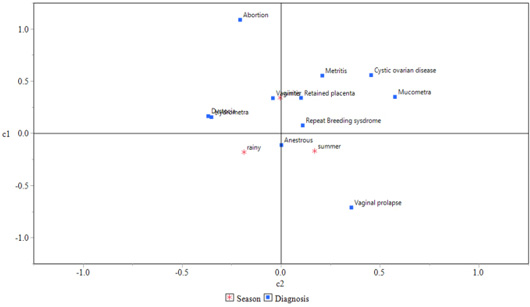
Considering the season, reproductive disorders of goats were observed more frequently (P= 0.02) during the summer (34.82%, 133/382) and winter (34.03%, 130/382) than the rainy season (31.15%, 119/382). Results of correspondence analysis show that anestrous and vaginal prolapse are more likely to occur during the summer, while cystic ovarian disease, metritis, mucometra, repeat breeding syndrome, retaining placenta, and vaginitis are more likely to occur in the winter season (Figure 2). No statistically significant variation was observed in prevalence estimates considering the age (P = 0.59), BCS (P = 0.65) and breed (P = 0.97) of animals.
Reproductive cases of doe were treated using single or combined drug therapy, where antibiotics, hormonal therapy, and nutritional therapy were predominately used (Table 2). Animals with a history of abortion were treated with Ab + S (71.43%), particularly when there was evidence of leftover foetus materials in the uterus in ultrasonography, while patients with left-over foetus materials were treated with Oxy + Ca + Lavage (28.57%). Anoestrus patients were mostly treated with Vita + Tra (89.13%) when animals were apparently healthy but in poor body conditions and no abnormalities were found in ultrasonography, while animals with persistent corpus luteum were treated with PGF alone (0.36) or in combination with Ca (0.72) or PGF followed by GnRH (9.78). The cystic ovarian disease was mostly treated with either GnRH + PGF (60%) or PGF (40%). Dystocia patients were mostly treated with PGF and calcium (57.89). Animals with hydrometra were treated with either PGF (83.33%) or in combination with calcium (16.67%). Metritis, retained placenta and vaginitis was treated mostly using Ab + S (90%, 61.54%, and 100%, respectively). Animals with repeat breeding syndrome
Table 2: Frequency distribution of therapeutics used for the management of reproductive disorders in female goats (does) in a teaching veterinary hospital in Chattogram, Bangladesh.
| Condition | Therapeutics | |||||||
| Ab+S | GnRH+ PGF | PGF | Vita+tra | Oxy+Ca+ lavage | PGF+ca | PGF+Dexa+ Ca | Prog+ Ca | |
| Abortion | 5(71.43) | 2(28.57) | 0(0) | 0(0) | 0(0) | |||
| Anestrous | 0(0) | 27(9.78) | 1(0.36) | 246(89.13) | 0(0) | 2(0.72) | 0(0) | 0(0) |
| Cystic ovarian disease | 0(0) | 3(60) | 2(40) | 0(0) | 0(0) | 0(0) | 0(0) | 0(0) |
| Dystocia | 0(0) | 0(0) | 1(5.26) | 0(0) | 1(5.26) | 11(57.89) | 6(31.58) | 0(0) |
| Hydrometra | 0(0) | 0(0) | 10(83.33) | 0(0) | 0(0) | 2(16.67) | 0(0) | 0(0) |
| Metritis | 9(90) | 0(0) | 0(0) | 1(10) | 0 | 0(0) | 0(0) | |
| Mucometra | 0(0) | 0(0) | 2(50) | 0(0) | 0(0) | 2(50) | 0(0) | 0(0) |
| Repeat breeding syndrome | 0(0) | 9(56.25) | 0(0) | 7(43.75) | 0(0) | 0 | 0(0) | 0(0) |
| Retained placenta | 16(61.54) | 0(0) | 0(0) | 2(7.69) | 7(26.92) | 1(3.85) | 0(0) | 0(0) |
| Vaginal prolapse | 0(0) | 0(0) | 0(0) | 0(0) | 0(0) | 0(0) | 0(0) | 3(100) |
| Vaginitis | 4(100) | 0(0) | 0(0) | 0(0) | 0(0) | 0(0) | 0(0) | 0(0) |
Ab + S: Antibiotic + supportive (lavage, herbal uterine stimulant and ecbolic); GnRH + PGF: Gonadotropin releasing hormone + prostaglandin; PGF: Prostaglandin; Vita + tra: Vitamin ADE + trace minerals; Oxy + Ca + lavage: Oxytocin + calcium + lavage; PGF + Ca: Prostaglandin + calcium; PGF + Dexa + Ca: Prostaglandin + dexamethasone + calcium; Prog + Ca: Progesterone + calcium.
and good BCS were treated with GnRH + PGF (56.25%), while those with poor BCS were treated with Vita + Tra (43.75%). Animals with vaginal prolapse are treated with progesterone and calcium (100%).
This study presented the prevalence and associated factors of reproductive disorders in adult female goats (does) and the therapeutics used to treat them in a hospital-based study. The study objectives were met by investigating a robust number of cases through the analysis of specific symptoms and ultrasonography.
In the present study, anestrous was the most prevalent reproductive disorder in does in Chattogram, Bangladesh. The proportionate prevalence of anestrus in the study was double (72.25%) the prevalence of anestrus in another teaching veterinary hospital (30.00-33.33%) in Sylhet district of Bangladesh or in a government upazila veterinary hospital (20.2%) in Chuadanga district . The higher prevalence of anestrus in does in Chattogram is probably due to the rearing of locally crossed exotic goat breeds in backyard systems where there is a lack of monitoring of heat and a poor nutritional plan. The prevalence of retained placenta (6.81%) in the present study is similar to the findings of Lucky et al. (2016), who stated 6.25% in goats, but lower (16.9%) than the findings of Sayeed et al. (2020). The prevalence of repeat breeding was recorded in 4.19% of goats in the present study, which is closer (6.7%) to the findings of Sayeed et al. (2020) and lower (9.3%) than the findings of Kulsum et al. (2020), who conducted a study in an upazila veterinary hospital in Dinajpur district. The prevalence of abortion was 1.83% in goats in the present study, which is lower than the findings (12.5%) of Lucky et al. (2016) or the findings (22.22%) of Boishakhi et al. (2018) in another teaching veterinary hospital in Mymensingh district. The prevalence rate of dystocia was 4.97% in goats in the present study, which is almost similar (3.20%) to Srivastava et al. (1985) in India. The prevalence of metritis was 2.62% in the present study, which is almost similar (4.5%) to Sayeed et al. (2020) and much lower (23.4%) than that of Kulsum et al. (2020). The discrepancies between the study findings and the previously estimated prevalence are due to different breed differences in the different study areas.
Results of the study show that there was a significant effect of season on the occurrence of reproductive disorders in does but not on the age or BCS of the animals. Overall prevalence of reproductive disorders was relatively higher in the summer (34.82%) and winter (34.03%) seasons, which is similar to the findings of Kulsum et al. (2020), who found higher prevalence (34.5%) in the winter season. It may be due to the high environmental temperature in the summer season, which creates stressful conditions for animals that subsequently cause anestrus and poor fertility . The results of the correspondence analysis are also suggesting that anestrus is linked to both the summer and rainy seasons when there is high temperature and humidity in Bangladesh. Other reproductive disorders were found to be associated with the winter seasons when there is less opportunity to provide grass to the animals, and animals suffer from metabolic and reproductive disorders. Our findings are similar to those of several studies ; ; ; . It is unclear why there was no significant effect of age and BCS on the occurrence of reproductive disorders in does. However, a relatively higher pooled prevalence (54.71%) of reproductive disorders was recorded in 1-2-year-old group animals, which are the 1st or 2nd parity, and animals with average body condition (63.87%), which is similar to earlier reports ; ; .
A combination of antibiotic and supportive treatment (Ab+S) was predominately prescribed to treat abortion, metritis, retained placenta, and vaginitis, which is rational as the causal agents are infectious pathogens ; ; . For the management of anestrous and repeat breeding syndromes, either vitamin and trace minerals or hormones were prescribed depending on history and animal body condition, as trace elements improved reproductive efficiency and hormones regulated ovulation or fertility ; . Calcium was used in combination with hormones in patients with conditions requiring muscular stability and contraction, such as dystocia, hydrometra, mucometra, and retained placenta . Dexamethasone was used in combination with hormones in cases of dystocia to induce quick parturition and relieve patient discomfort ; . The cautious use of lavage is suggested to be useful to reduce microbial burden and inflammation in the reproductive tract, but excessive use may enhance inflammation . Therefore, lavage was used in this study in a small number of patients with a history of abortion and retained placenta.
Conclusions and Recommendations
The study presented the prevalence of reproductive disorders in female goats and the therapeutics used to treat them. Anestrous is the most common reproductive problem in cross-bred goats. The seasons influenced the occurrence of reproductive disorders in goats, with significantly higher prevalence in both the summer and winter seasons. However, there was no significant influence of age or BCS on the animals. The diagnostic images captured and therapeutics prescribed can be used as a guide to diagnose and treat reproductive disorders in goats.
Acknowledgements
The authors would like to thanks the director, SAQTVH and animal owners for providing information.
Novelty Statement
Currently, there is a lack of information regarding the epidemiology, diagnosis, and treatment of reproductive cases in goats that can aid veterinarians in the successful management of these conditions in resource-poor settings. This work distinguishes itself through: (a) use of clinical laboratory facilities (x-ray, USG, etc.) together with anamnesis/symptoms for the diagnosis of different reproductive disorders in Bangladesh; (b) presented the best possible practices for clinical management of problems; and (c) use of multivariate techniques to assess risk analysis
Author’s Contribution
KB compiled clinical data and drafted the manuscript. MA design the study, analyzed the data and revised the manuscript. A, and KB diagnosed the cases and provided treatment.
Conflict of interest
The authors have declared no conflict of interest.
Figures
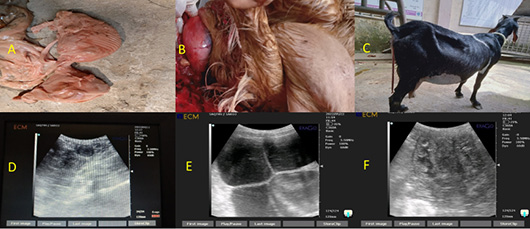
(A) An aborted foetus of 3.5 months gestational age; (B) A ball-like, round structure protruding from the vulva indicates prolapse of the vagina; (C) Hanging the placenta from the vulva of the doe after parturition indicates the retention of the placenta; (D) A round hypoechoic image within the ovary on ultrasonography indicates a luteal cyst of the ovary; (E) An echoic sac within the uterus on ultrasonography indicates a fluid-filled condition in the uterus, known as hydrometra; (F) A hypoechoic sac in the uterus indicates mucous present within the uterus, known as mucometra.
References
- Abecia, J.A., Forcada, F. and González-Bulnes, A., 2011. Pharmaceutical control of reproduction in sheep and goats. Vet. Clin. Food Anim. Pract., 27: 67-79. https://doi.org/10.1016/j.cvfa.2010.10.001[CrossRef]
- Ali, M., Bhuiyan, M. and Alam, M., 2011. Retrospective epidemiologic study of diseases in ruminants in Khagrachari hill tract district of Bangladesh. Bangladesh J. Vet. Med., 9: 145-153. https://doi.org/10.3329/bjvm.v9i2.13457[CrossRef]
- Ali, S., Zhao, Z., Zhen, G., Kang, J.Z. and Yi, P.Z., 2019. Reproductive problems in small ruminants (Sheep and goats): A substantial economic loss in the world. Large Anim. Rev., 25: 215-223.
- Bhowmik, P., Ahaduzzaman, M. and Hasan, R., 2017. A cross sectional anthropo-clinical study on antimicrobials prescription pattern in goat patients at Chittagong, Bangladesh. Bangladesh J. Vet. Med., 15: 119-126. https://doi.org/10.3329/bjvm.v15i2.35521[CrossRef]
- Boishakhi, A., Barson, R., Juyena, N. and Bhattacharjee, J. 2018. Assessing the treatment outcome of various reproductive diseases of animals by follow-up monitoring in VTH, BAU. Bangladesh J. Vet. Med., 16: 223-231. https://doi.org/10.33109/bjvmjd1812[CrossRef]
- Boyazoglu, J., Hatziminaoglou, I. and Morand-Fehr, P., 2005. The role of the goat in society: Past, present and perspectives for the future. Small Rumin. Res., 60: 13-23. https://doi.org/10.1016/j.smallrumres.2005.06.003[CrossRef]
- Deka, R.P., Magnusson, U., Grace, D., Randolph, T.F., Shome, R. and Lindahl, J.F., 2021. Estimates of the economic cost caused by five major reproductive problems in dairy animals in Assam and Bihar, India. Animals, 11: 3116. https://doi.org/10.3390/ani11113116[CrossRef]
- Dwyer, C., Conington, J., Corbiere, F., Holmøy, I., Muri, K., Nowak, R., Rooke, J., Vipond, J. and Gautier, J.M., 2016. Invited review: Improving neonatal survival in small ruminants: Science into practice. Animal, 10: 449-459. https://doi.org/10.1017/S1751731115001974[CrossRef]
- Härdle, W. and Hlávka, Z., 2007. Correspondence analysis. Multivariate statistics: Exercises and solutions, pp. 241-262.
- Hurley, W. and Doane, R., 1989. Recent developments in the roles of vitamins and minerals in reproduction. J. Dairy Sci., 72: 784-804. https://doi.org/10.3168/jds.S0022-0302(89)79170-0[CrossRef]
- Islam, M.H., Sarder, M.J.U., Rahman, M.S., Haque, M.A., Islam, M.A., Jahan, S.S. and Khaton, R., 2015. Retrospective study of reproductive diseases of small ruminants in northern barind tract in Bangladesh. Sciences, 3: 136-140. https://doi.org/10.11648/j.avs.20150305.13[CrossRef]
- Kashem, M., Hossain, M., Ahmed, S.U. and Halim, M., 2011. Prevalence of diseases, morbidity and mortality of Black Bengal Goats under different management systems in Bangladesh. Univ. J. Zool. Rajshahi Univ., 30: 01-04. https://doi.org/10.3329/ujzru.v30i0.10702[CrossRef]
- Kulsum, U., Juli, M.S.B., Zohara, B.F., Islam, M.N. and Akther, M., 2020. Incidence of reproductive disorders of goat in Dinajpur district of Bangladesh. Asian J. Med. Biol. Res., 6: 212-221. https://doi.org/10.3329/ajmbr.v6i2.48052[CrossRef]
- Lopez-Sebastián, A., Coloma, M., Toledano, A. and Santiago-Moreno, J., 2014. Hormone-free protocols for the control of reproduction and artificial insemination in goats. Reprod. Domest. Anim., 49: 22-29. https://doi.org/10.1111/rda.12394[CrossRef]
- Lucky, N.S., Hossain, M.K., Roy, A.C., Haque, M.M., Uddin, A.M., Islam, M.M. and Howlader, M.M.R., 2016. A longitudinal study on clinical diseases and disorders of cattle and goats in Sylhet, Bangladesh. J. Adv. Vet. Anim. Res., 3: 24-37. https://doi.org/10.5455/javar.2016.c128[CrossRef]
- Luo, J., Wang, W. and Sun, S., 2019. Research advances in reproduction for dairy goats. Asian-Aust. J. Anim. Sci., 32: 1284. https://doi.org/10.5713/ajas.19.0486[CrossRef]
- Margatho, G., Rodríguez-Estévez, V., Quintas, H. and Simões, J., 2019. The effects of reproductive disorders, parity, and litter size on milk yield of Serrana goats. Animals, 9: 968. https://doi.org/10.3390/ani9110968[CrossRef]
- Mazzuchini, M.P., Segabinazzi, L.G.T.M., Tongu, E.A., Okada, C.T.C., Joaquim, J.G.F. and Alvarenga, M.A., 2022. Safety of uterine lavage with ozonated saline in mares. Arch. Vet. Sci., 27: 88-104. http://dx.doi.org/10.5380/avs.v1i1.81197[CrossRef]
- Mellado, M., Valdez, R., Lara, L. and Garcıa, J., 2004. Risk factors involved in conception, abortion, and kidding rates of goats under extensive conditions. Small Rumin. Res., 55: 191-198. https://doi.org/10.1016/j.smallrumres.2003.10.016[CrossRef]
- Peters, A. and Poole, D., 1992. Induction of parturition in dairy cows with dexamethasone. Vet. Rec., 131: 576-578. https://doi.org/10.1136/vr.131.6.128[CrossRef]
- Purohit, G., Gupta, A., Gaur, M., Sharma, A. and Bihani, D., 2006. Periparturient disorders in goats. A retrospective analysis of 324 cases. Dairy Goat J., 84: 24-33.
- Pyörälä, S., Taponen, J. and Katila, T., 2014. Use of antimicrobials in the treatment of reproductive diseases in cattle and horses. Reprod. Domestic Anim., 49: 16-26. https://doi.org/10.1111/rda.12324[CrossRef]
- Rakib, M.R.H., Ahmed, S., Desha, N.H., Akther, S., Rahman, M.H., Pasha, M.M.H., Dhakal, A., Sultana, N. and Hemayet, M.A., 2022. Morphometric features and performances of Black Bengal goat in Bangladesh. Trop. Anim. Health Prod., 54: 341. https://doi.org/10.1007/s11250-022-03334-0[CrossRef]
- Sayeed, A., Khatun, M.S., Bari, S., Dash, A.K., Haldar, P.K. and Sarker, B.K., 2020. Prevalence of gynecological disorders of goat and pattern of drug used at Chuadanga, Bangladesh. Agric. Sci. Digest-A Res. J., 40: 424-429. https://doi.org/10.18805/ag.D-274[CrossRef]
- Srivastava, A., Patil, V. and Moore, B., 1985. Incidence of various disorders in local, Angora and crossbred goats. Indian Vet. J. (India), 6(2): 212-221.
- Sultan, A., Islam, M.R., Yadav, R.K., Akhter, R. and Ahmed, J.U., 2015. Prevalence of different reproductive disorders of small ruminants in five upazillas of Mymensingh district. Asian J. Med. Biol. Res., 1: 74-79. https://doi.org/10.3329/ajmbr.v1i1.25501[CrossRef]
- Swartz, T., Bryant, D., Schramm, H., Duncan, A., White, R., Wood, C. and Petersson-Wolfe, C., 2023. The effects of dexamethasone administration on physiological, behavioral, and production parameters in dairy cows after a difficult calving. J. Dairy Sci., 106: 653-663. https://doi.org/10.3168/jds.2022-22029[CrossRef]
- Villaquiran, M., Gipson, T., Merkel, R., Goetsch, A. and Sahlu, T., 2004. Body condition scores in goats. Am. Inst. Goat Res., Langston Univ., pp. 1-8.
- Wolfenson, D. and Roth, Z., 2019. Impact of heat stress on cow reproduction and fertility. Anim. Front., 9: 32-38. https://doi.org/10.1093/af/vfy027[CrossRef]
Services
Article usage statistics
Loading…